

How Does the Depamu Plunger Pump Work? An Analysis of Mechanism, Engineering, and Application
The Depamu plunger pump, a hallmark of precision fluid handling, is a positive displacement pump that operates on a principle both simple and profoundly effective: the cyclic change of a sealed chamber's volume through the reciprocating motion of a plunger. While the fundamental concept is universal to plunger pumps, Depamu's engineering distinguishes itself through advanced materials, sophisticated transmission mechanisms, and design innovations that address critical industrial challenges like pulsation, high pressure, and metering accuracy. This article delves into the detailed working principles of the Depamu plunger pump, exploring its core components, operational phases, and the technological advancements that make it a leader in the field.
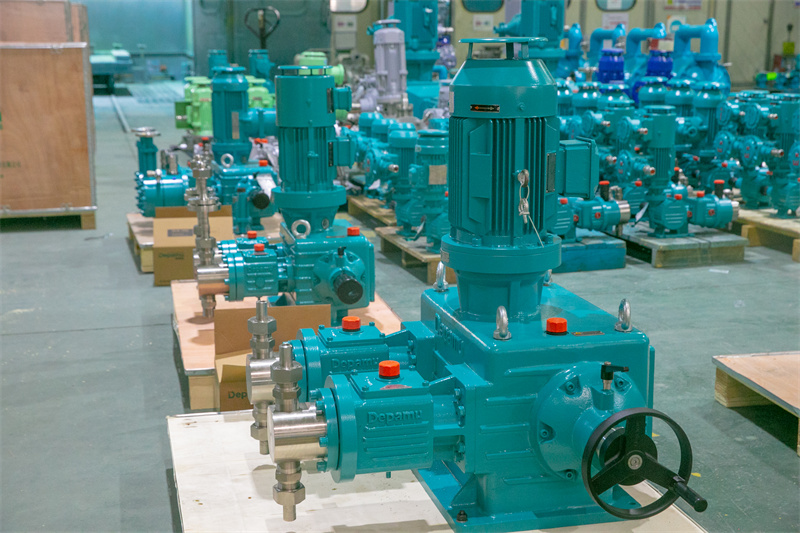
The Core Working Principle: Volumetric Displacement
At its heart, the Depamu plunger pump is a volumetric machine. Its operation is governed by a simple, reliable hydraulic principle: "the plunger contacts the fluid directly, the volume of the working chamber changes cyclically with the reciprocations of the plunger, so that the inlet and outlet check valve can suck and discharge the fluid". This direct contact means the plunger itself is a wetted part, displacing the process fluid with each stroke.
The pump's cycle consists of two primary phases: the suction stroke and the discharge stroke. These are controlled by the precise, alternating action of the inlet and outlet check valves, often described as high-precision "one-way valves" .
-
The Suction Stroke: The cycle begins with the plunger retracting from the working chamber. As the plunger moves backward, the volume of the chamber increases, creating a negative pressure differential (a partial vacuum) relative to the inlet pressure. This pressure difference forces the inlet check valve to open, allowing the process fluid to be drawn into the chamber from the supply line. Simultaneously, the outlet check valve remains firmly closed due to the downstream pressure and the valve's spring mechanism, preventing any backflow from the discharge line . The chamber is now primed and filled with a specific volume of fluid, determined by the plunger's cross-sectional area and stroke length.
-
The Discharge Stroke: The power end of the pump then drives the plunger forward into the working chamber. This action reduces the chamber's volume, compressing the fluid and rapidly increasing its pressure. Once the internal pressure exceeds the pressure in the discharge line, the outlet check valve is forced open. The high-pressure fluid is then pushed out of the chamber and into the process pipeline . At the same moment, the inlet check valve is forced shut by the rising pressure, ensuring that the fluid is directed only toward the discharge line. This sequence of reciprocating motion and valve action results in a pulsating flow, a characteristic that Depamu has addressed through innovative multi-plunger configurations.
The Power End: Converting Rotary Motion into Reciprocating Action
The mechanical energy required to drive the plunger comes from the "power end" of the pump. Depamu utilizes a variety of robust mechanisms to convert the rotary motion of an electric motor into the linear reciprocating motion of the plunger. A common and highly effective method is the "integrated sleeve adjustable eccentric transmission mechanism". This system, often in conjunction with a worm gear pair, allows for smooth and reliable motion conversion. The worm gear acts as a primary speed reducer, taking the high-speed rotation of the motor and reducing it to a lower, more powerful rotation suitable for driving the eccentric mechanism .
For high-pressure applications, Depamu has developed even more robust solutions. One notable example is the three-plunger reciprocating pump (triplex pump) equipped with a "double helical gear reduction mechanism". In this design, the motor directly drives a gear shaft via a coupling. This gear shaft meshes with a gear mounted directly on the crankshaft. This compact double-helical gear setup not only reduces the overall pump volume and manufacturing costs but also significantly improves transmission efficiency and accuracy, leading to smoother pump operation. The crankshaft, in turn, uses connecting rods to translate its rotational motion into the reciprocating motion of the three plungers. A critical feature of this system is its "forced lubrication circuit," where a gear pump driven by the gear shaft supplies oil through an "oil passage and an oil passage opening" within the crankshaft to lubricate the connecting rod bearings and other critical wear parts, ensuring a long service life .
Advanced Design Innovations: Pulsation Damping and Performance
Depamu distinguishes itself through engineering solutions that mitigate the inherent limitations of single-plunger pumps, primarily flow pulsation. One such innovation is the "flat flow Metering Pump," as described in patent CN111441924A. This design ingeniously combines a "full-stroke plunger" and a "half-stroke plunger" within the same pump body. The two plungers are driven by separate crank throws on the crankshaft, with the half-stroke plunger's crank throw having exactly half the eccentricity of the full-stroke plunger. Critically, the two throws are positioned "180 degrees out of phase". This phase offset means that as the full-stroke plunger is in its peak discharge phase, the half-stroke plunger is in its suction phase. By hydraulically connecting the two chambers with a system of check valves, the flow peaks and troughs of the two plungers are superimposed. Because they are perfectly out of phase, the pulsations cancel each other out, resulting in a dramatically "reduced pulsation and stable flow". This innovation is particularly valuable in processes requiring a consistent, uninterrupted flow, such as in chemical dosing or precise fuel injection.
Another area of innovation is Depamu's approach to the rotary plunger pump. While the standard plunger pump uses a linear, reciprocating motion, Depamu has also developed rotary variants. In one such design, the plungers are housed in a rotating cylinder block. As the block rotates, the plunger ends follow a stationary, angled "swash plate" . The plungers are forced to follow the swash plate's angled surface, causing them to reciprocate in and out of the cylinder block with each rotation. This rotary design is particularly suited for applications requiring compact size and smooth, high-speed operation, such as in hydraulic systems. To further enhance durability in these high-cycle applications, Depamu incorporates features like a "spherical head" on the plunger that rides in a "spherical surface" groove on the swash plate, reducing impact forces and wear.
Hydraulic End, Materials, and Control
The "hydraulic end" of the pump is the part that comes into contact with the process fluid. Depamu offers extreme flexibility in this area, constructing the pump head and internal components from a wide range of materials, including standard stainless steels (304, 316, 316L), high-performance alloys like Hastelloy C, and even specialty polymers for corrosive applications . The plungers themselves are designed with "high performance" and use "special design stuffing and sealing components" to ensure a "long service life and excellent sealing performance," a critical factor when pumping hazardous or expensive fluids .
The precision of Depamu pumps, particularly in the metering application, is world-class. The stroke length of the plunger can be adjusted across a "0-100%" range, allowing for a "stepless adjustment of flow rate" . This adjustment can be achieved manually, electrically, pneumatically, or via frequency control on the motor, offering enormous operational flexibility for both manual processes and fully automated, "remote automatic control" via electric actuators . This leads to a "metering accuracy" of ±0.5% in the 10%-100% adjustment range, making the Depamu plunger pump a genuine "metering" pump capable of precise chemical injection.
Conclusion
The Depamu plunger pump works by employing the time-tested principle of positive displacement through a reciprocating plunger, a process of suction and discharge governed by check valves. However, the company's true expertise lies in the sophisticated engineering of its power end—using eccentric drives, worm gears, and double-helical reduction systems—and its relentless pursuit of performance enhancements. Through innovations like the flat-flow design that cancels pulsation and advanced materials that resist extreme pressures of up to 228MPa, Depamu transforms a simple mechanical concept into a high-precision, reliable, and versatile industrial tool. Its ability to offer such a wide range of materials, configurations, and control options has cemented its position as a critical equipment supplier for the most demanding applications across the chemical, petrochemical, and energy industries.