

Depamu Hydraulic Diaphragm Metering Pumps: Precision Chemical Dosing for Municipal Water and Wastewater Treatment
Modern municipal water and wastewater treatment is defined by a paradox of scale and precision. Plants must process millions of liters of water daily, yet the chemicals that make that water safe—disinfectants, coagulants, pH adjusters, and nutrients removal agents—must be delivered in doses measured to the fraction of a milliliter. A deviation of even a few percentage points in chemical feed can compromise public health, trigger regulatory violations, or drive operational costs upward through wasted reagents and re-treatment. It is within this narrow margin that the Hydraulic Diaphragm Metering Pump has become an indispensable instrument of municipal infrastructure. Among the manufacturers serving this demanding sector, Depamu (Hangzhou) Pumps Technology Co., Ltd. has established a distinctive position, combining German-engineered hydraulic diaphragm technology with a broad product range designed specifically for the rigors of water and wastewater treatment. This article examines the technical foundations, product architecture, and municipal applications of Depamu hydraulic diaphragm metering pumps, demonstrating why they have become a trusted solution for precision chemical dosing in water treatment facilities worldwide.
Company Background and Technological Heritage
Depamu was established in 2003 and is headquartered in the Hangzhou Economic and Technological Development Zone, occupying a facility of approximately 35,000 square meters with registered capital of 54 million yuan. The company’s technological trajectory, however, extends further back. Its foundational direction was shaped in the early 1990s through the introduction of advanced hydraulic diaphragm metering pump technology and scientific management practices from Germany, a strategic technology transfer that positioned Depamu to compete at international levels of precision and reliability. Over more than two decades, this foundation has matured into a portfolio exceeding 100 patents, with the company serving not only as a manufacturer of metering pumps but as a comprehensive fluid-handling service provider.
Depamu’s credentials within the municipal sector are reinforced by its compliance with internationally recognized standards. The company holds certifications including CE, ISO 9001, ISO 14001, and ISO 45001, and its products conform to API 675 standards for metering pumps and API 674 for reciprocating positive displacement pumps. These certifications are not merely formalities; they signal that the pumps are engineered to withstand the continuous-duty, safety-critical demands of public water infrastructure, where equipment failure carries consequences far beyond operational downtime. Depamu’s products are currently deployed across more than fifty countries and are utilized in environmental water treatment alongside oil and gas, chemical, and power generation applications, a cross-sectoral exposure that has informed the robustness of its municipal product lines.
The Hydraulic Diaphragm Principle: Precision Through Hydraulic Transmission
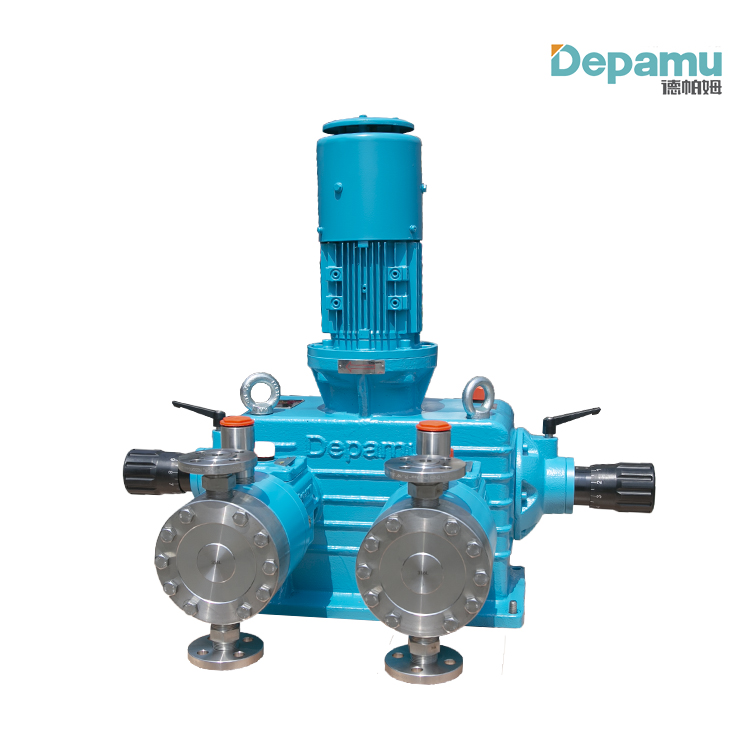
To appreciate the suitability of Depamu pumps for municipal dosing, it is necessary to understand the hydraulic diaphragm operating principle that distinguishes them from mechanically actuated alternatives. In a hydraulic diaphragm metering pump, the rotary motion of the motor is converted, through a reduction mechanism and crank connecting rod assembly, into the reciprocating motion of a piston. This piston displaces hydraulic oil within a sealed chamber, and the oil, in turn, transmits force and volumetric change to a process diaphragm. The diaphragm undergoes controlled cyclical deformation, drawing process fluid through an inlet check valve and discharging it through an outlet check valve.
This interposition of hydraulic fluid between the mechanical drive and the process diaphragm yields several advantages that are particularly consequential in municipal water treatment. The hydraulic fluid acts as a cushion, absorbing shock loads and producing smooth, uniform diaphragm movement that reduces mechanical stress on the diaphragm and extends service life. Because the diaphragm is hydraulically balanced, the pump can generate high discharge pressures without imposing excessive tensile stress on the diaphragm material. Furthermore, the hydraulic system can be designed with internal safety and compensation valves that automatically discharge air and replenish oil, preserving metering accuracy even after system upsets. This hydraulic management architecture is central to the reliability that municipal operators require from equipment expected to run continuously for thousands of hours between maintenance intervals.
Technical Architecture and Performance Characteristics
Depamu’s hydraulic diaphragm metering pump portfolio encompasses multiple series tailored to different flow and pressure envelopes within water and wastewater treatment. The DP(M)XAA series represents a flagship platform for general chemical dosing duties, offering a flow rate adjustment range of 10% to 100% with a metering accuracy of ±0.5%. This level of precision is significant: in disinfection applications, for example, a ±0.5% accuracy ensures that chlorine residual targets are maintained within regulatory limits without the over-dosing that wastes chemicals and generates disinfection byproducts. The DP(M)XAA pump head can be configured as a hydraulic diaphragm type, plunger type, or piston type, providing flexibility across the diverse fluid properties encountered in municipal plants, from corrosive disinfectants to viscous polymers.
The DP(M)TA series extends Depamu’s hydraulic diaphragm capability into applications requiring enhanced safety and durability. Its limit valve achieves an accuracy of ±0.002 mm, with surface hardness of 60–70 HRC and roughness of 0.4 μm, and the pump is designed for 80 million cycles across a temperature range of −80°C to 160°C. The PTFE composite diaphragm undergoes multi-directional rolling and surface quenching, achieving 99.92% evenness that reduces cold flow and enhances compressive strength during operation. For municipal plants handling hazardous or toxic treatment chemicals, the availability of double or multiple diaphragms, combined with a diaphragm rupture alarm that prevents process fluid from contacting hydraulic oil, provides a critical layer of containment assurance.
Depamu hydraulic Diaphragm Pumps also offer a range of flow adjustment modalities—manual, electrical, pneumatic, and frequency conversion—enabling integration into automated plant control systems. The stroke can be steplessly adjusted across the full 0%–100% range, both in static and dynamic states, allowing operators to modulate chemical feed in response to changing flow rates, turbidity levels, or residual chlorine measurements without interrupting pump operation. Multiple pump heads, up to twelve, can be connected in parallel, either to reduce pulsation when transporting a single fluid or to function as a proportioning pump for multiple chemicals. This modularity allows a single pump platform to serve multiple dosing points within a treatment train, simplifying maintenance and spare parts inventory.
Municipal Water Treatment Applications: From Source to Tap
Within drinking water treatment, Depamu hydraulic diaphragm metering pumps are deployed across the sequence of unit processes that transform raw water into potable supply. Coagulant and flocculant dosing represents a primary application. The accurate injection of aluminum sulfate, ferric chloride, or organic polymers is essential for destabilizing suspended particles and enabling their removal through sedimentation and filtration. The ±0.5% metering accuracy of the DP(M)XAA series ensures that coagulant dose tracks changes in raw water quality, preventing under-dosing that would allow turbidity to pass through the filters and over-dosing that would increase chemical costs and residual metals in finished water.
Disinfection is perhaps the most safety-critical dosing application in municipal water treatment. Whether the plant uses chlorine gas, sodium hypochlorite, or chloramines, the pump must deliver a precise and continuous feed of disinfectant to maintain a residual throughout the distribution system while minimizing the formation of regulated disinfection byproducts. Depamu hydraulic diaphragm pumps are specifically configured for disinfection chemical metering, with wetted parts available in materials such as PVC, PVDF, PTFE, and 316L stainless steel to resist the aggressive corrosion of chlorine-based solutions. The hydraulically actuated diaphragm ensures a hermetically sealed pumping system, a critical safety feature when handling toxic or volatile disinfectants.
pH adjustment and corrosion control constitute another major application domain. Municipal water must be stabilized to prevent corrosion of distribution pipes and leaching of metals into drinking water. Depamu pumps meter acids or bases—such as sulfuric acid, sodium hydroxide, or lime slurry—to adjust pH to the target corrosion index, while also dosing corrosion inhibitors such as orthophosphate or silicate. The hydraulic diaphragm design accommodates the abrasive and scaling tendencies of lime slurries more effectively than mechanical diaphragm alternatives, because the hydraulic cushion reduces the mechanical shock transmitted to the diaphragm and the internal compensation valve helps maintain consistent output despite changes in fluid viscosity or minor valve wear.
In advanced treatment scenarios, such as membrane filtration and groundwater remediation, Depamu pumps are employed for the precise dosing of scale inhibitors, antiscalants, and reducing agents. These chemicals protect reverse osmosis membranes from calcium carbonate and sulfate scaling and neutralize residual oxidants that would degrade polyamide membrane elements. The ability to adjust flow rate dynamically in response to permeate flow or oxidation-reduction potential signals makes the Depamu pump a compatible component of automated membrane protection systems.
Municipal Wastewater Treatment: Nutrient Removal and Solids Management
The wastewater treatment plant presents a different set of dosing challenges, characterized by variable influent loads, stringent nutrient discharge limits, and the need to manage large volumes of sludge. Depamu hydraulic diaphragm metering pumps address these challenges across multiple treatment stages. In biological nutrient removal, precise dosing of chemicals is essential for achieving compliance with total phosphorus and total nitrogen limits. Metal salts such as ferric chloride or aluminum sulfate are dosed to precipitate soluble phosphorus, while carbon sources such as methanol or acetate may be added to drive denitrification in anoxic zones. Depamu pumps provide the repeatable, adjustable output required to match chemical dose to fluctuating influent phosphorus concentrations and flow rates, avoiding the eutrophication risks associated with under-dosing and the chemical cost penalties of over-dosing.
Polymer dosing for sludge conditioning represents a particularly demanding application. Polymers used in sludge dewatering and thickening are viscous, shear-sensitive, and expensive; inaccurate dosing can result in poor cake solids, high polymer consumption, or both. The hydraulic diaphragm pump’s smooth, uniform diaphragm movement and the absence of mechanical linkages in the hydraulic end reduce shear degradation of the polymer chains, while the stepless stroke adjustment allows operators to fine-tune polymer feed as sludge characteristics change. Depamu pumps are deployed in both belt filter press and centrifuge dewatering systems for this purpose.
Disinfection of wastewater effluent, whether by chlorine, ultraviolet irradiation, or peracetic acid, also relies on metering pump precision. For chlorination and dechlorination, Depamu hydraulic diaphragm pumps meter sodium hypochlorite and sodium bisulfite solutions with the corrosion resistance and containment integrity required by the wastewater environment. The diaphragm rupture alarm and double-diaphragm options are particularly relevant in wastewater applications where process fluids may contain pathogens or high concentrations of reduced sulfur compounds that could compromise a single diaphragm barrier. Additionally, in plants employing ammonia removal through breakpoint chlorination or in facilities that add ammonia to chlorinated effluent to form chloramines, Depamu’s dosing systems for municipal water/wastewater ammonia adding are directly applicable.
Odor control constitutes a further wastewater application. Hydrogen sulfide generation in collection systems and at treatment headworks can be controlled through the dosing of oxidizing agents such as hydrogen peroxide, sodium nitrate, or ferrous chloride. These chemicals require metering pumps that can handle aggressive fluids and deliver consistent doses over long unattended periods—a duty profile well matched to the hydraulic diaphragm pump’s oil-immersion lubrication and extended maintenance intervals.
Operational Advantages for Municipal Infrastructure
The suitability of Depamu hydraulic diaphragm metering pumps for municipal service extends beyond their technical specifications to the operational realities of public water utilities. Municipal plants are staffed by operators with broad responsibilities, not necessarily by dedicated pump technicians. Pumps must therefore be robust, easily maintained, and capable of reliable performance with minimal intervention. The hydraulic diaphragm design addresses these needs through oil-immersion lubrication of the transmission mechanism, which ensures long-term reliable use of gears and bearings with infrequent oil changes. The absence of dynamic seals in the hydraulic end—the diaphragm serves as the barrier—eliminates the packing maintenance and leak paths associated with plunger pumps, reducing both maintenance labor and the risk of chemical releases.
The internal safety valve and compensation valve represent a further operational advantage. These components automatically discharge accumulated air from the hydraulic system and replenish lost hydraulic oil, maintaining metering accuracy without operator intervention. In municipal plants where pumps may run for weeks without attention, this self-regulating hydraulic management is a meaningful reliability differentiator. The pumps’ compatibility with automated control systems—through electrical, pneumatic, or frequency conversion stroke adjustment—also aligns with the trend toward supervisory control and data acquisition integration in modern water utilities.
Safety and environmental compliance are likewise embedded in the design. The vertical motor installation ensures safety without leakage, while the availability of diaphragm rupture detection and double diaphragm configurations provides defense in depth for hazardous chemical service. For utilities subject to increasingly stringent environmental regulations, the ability to document precise chemical dosing and to demonstrate containment integrity is not optional; it is a condition of operating permits and public trust.
Conclusion
The municipal water and wastewater sector demands dosing equipment that reconciles two seemingly opposing requirements: the hydraulic capability to move chemicals at plant scale and the metering precision to deliver those chemicals in exact, repeatable quantities. Depamu hydraulic diaphragm metering pumps resolve this tension through a design philosophy rooted in hydraulic transmission, precision manufacturing, and operational robustness. From the ±0.5% accuracy of the DP(M)XAA series to the advanced diaphragm integrity and safety architecture of the DP(M)TA platform, these pumps are engineered for the continuous-duty, safety-critical environment of public water infrastructure. Their applications span the full treatment train—coagulation, disinfection, pH adjustment, nutrient removal, polymer conditioning, and odor control—demonstrating a versatility that few dosing technologies can match in municipal service. As water utilities worldwide confront aging infrastructure, tightening regulations, and the imperative to optimize chemical consumption, the hydraulic diaphragm metering pump remains a foundational technology for protecting public health and environmental quality. Depamu’s contribution to this field, built on decades of German-influenced engineering and validated by certifications and deployments across more than fifty countries, positions the company as a credible and capable partner for municipal water and wastewater treatment operations seeking precision, reliability, and long-term value in their chemical dosing systems.