

In the highly competitive landscape of fluorochemical manufacturing, precision and safety are non-negotiable. San Aifou (Changshu) Zhonghao Chemical New Material Co., Ltd., a subsidiary of the industry giant San Aifu, has consistently sought to localize its supply chain while upgrading its production efficiency for high-end materials like FEVE (Fluoroethylene Vinyl Ether). This paper explores the critical integration of Depamu (Hangzhou) Pump Technology Co., Ltd.’s hydraulic diaphragm Metering Pumps into San Aifu’s core production lines. By analyzing the technical requirements of the FEVE project, the engineering principles of Depamu’s patented technology, and the economic impact of this collaboration, this article argues that Depamu represents a successful paradigm of import substitution in China’s high-end chemical processing sector.
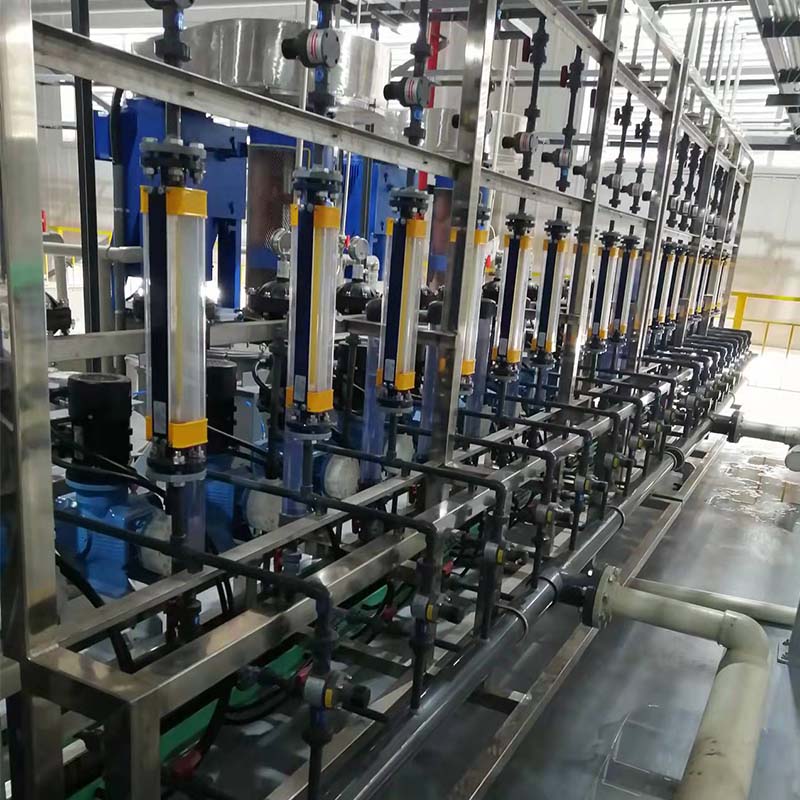
1. Introduction: The Fluoro-chemical Imperative
San Aifu stands as a monolithic figure in China’s chemical industry, particularly in the research and development of fluorinated polymers. These materials—characterized by exceptional resistance to heat, chemicals, and weathering—are critical for aerospace, semiconductor manufacturing, and new energy vehicles. However, producing monomers like FEVE involves handling volatile, corrosive, and shear-sensitive fluids under extreme pressures.
For decades, the precise metering pumps required for such processes were the exclusive domain of German and Japanese manufacturers. High-pressure diaphragm metering pumps, costing hundreds of thousands of dollars, dictated the pace and cost of production. In late 2024, a significant shift occurred. Public tender documents (Tender No: 0613-246027053159) for San Aifu’s FEVE project revealed a changing of the guard: Depamu (Hangzhou) Pump Technology Co., Ltd. emerged as a primary contender against Western suppliers, offering competitive pricing and superior technical compliance.
This paper dissects how Depamu’s hydraulic diaphragm technology is not merely replacing legacy pumps but is actively enabling San Aifu to achieve higher purity and operational stability.
2. The Technical Challenge: The Heart of the FEVE Process
2.1 Understanding the Media
FEVE resins are synthesized via radical polymerization. The raw materials and intermediates involved are extremely aggressive. Traditional mechanical seals in centrifugal pumps often fail due to leakage, leading to environmental hazards and material waste. Furthermore, the catalytic components required for FEVE production demand "zero dead volume" injection—any pulsation or inaccuracy in flow directly alters the polymer chain length, ruining entire batches.
2.2 Requirements of the System
For the FEVE project, the pumping system had to meet three brutalist criteria:
-
Zero Leakage: Volatile organic compounds (VOCs) cannot escape into the cleanroom environment.
-
High Precision: A metering accuracy of ±0.5% or better is required to maintain the stoichiometric balance of the vinyl ether reaction.
-
Corrosion Resistance: The wetted parts must withstand halogenated compounds at temperatures exceeding 150°C.
3. Depamu’s Engineering Solution: The Hydraulic Diaphragm Advantage
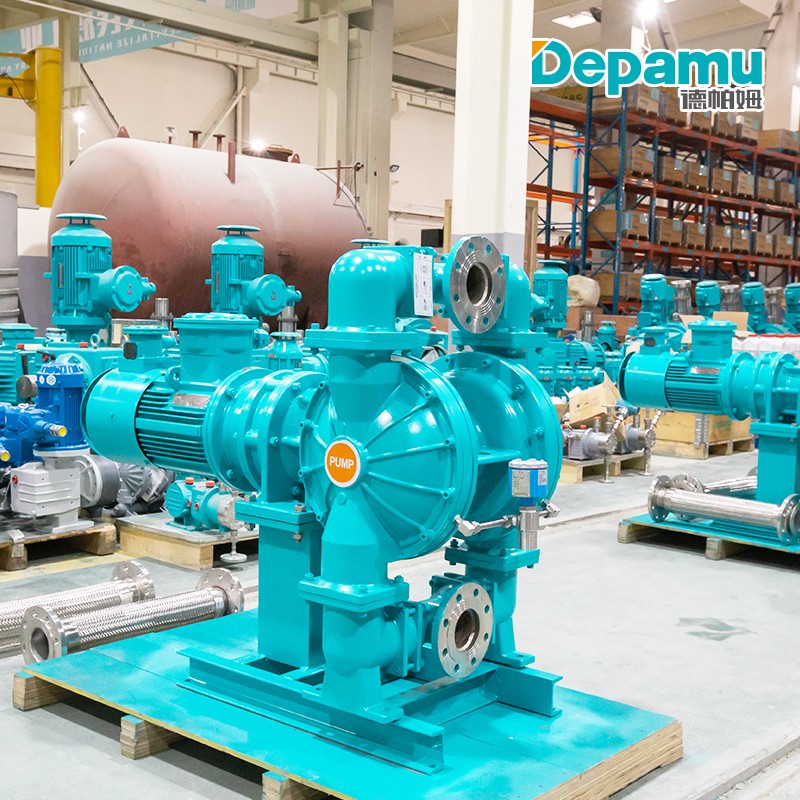
Depamu was founded in 2003 with the explicit goal of reverse-engineering the mechanical complexities of German and American pumps while adapting them to the variable viscosity of Chinese crude and chemical stocks. For the San Aifu application, Depamu deployed its 3DP(M)DAA series Hydraulic Diaphragm Metering Pump.
3.1 The Patented Hydraulic System
Unlike mechanically actuated diaphragm pumps (which are limited by the mechanical strength of the diaphragm), Depamu utilizes a hydraulic fluid as the middleman.
As detailed in their patent documentation (CN106996366B), Depamu employs a three-plunger hydraulic diaphragm reciprocating design. Here’s how it operates in the San Aifu context:
-
The Power End: A motor drives a crankshaft, converting rotational motion into reciprocating linear motion via patented "integrated sleeve adjustable eccentric" mechanisms.
-
The Hydraulic End: The plunger pushes hydraulic oil, which in turn flexes a PTFE (or metallic) diaphragm.
-
The Process End: The diaphragm displaces the FEVE monomer.
The "U-Shape" Surface Design
One of the critical innovations relevant to San Aifu’s plant layout is the compact "U-shaped" arrangement of the three pump heads. Traditional triplex pumps have a wide, linear footprint. Depamu’s design reduces the transverse size, allowing San Aifu to retrofit these pumps into existing skids without extensive civil works.
3.2 Compliance with API 674/675 Standards
For a state-owned enterprise like San Aifu, compliance is king. The Depamu units supplied to similar chemical新材料 (new material) projects are designed to meet API 674 (Positive Displacement Pumps - Reciprocating) and API 675 (Metering Pump) standards. This ensures:
-
Safety: Built-in relief valves prevent over-pressurization.
-
Reliability: The oil-immersion lubrication system ensures 24/7 continuous operation, which is essential for the energy-intensive fluorochemical industry.
4. The Application Spectrum: From Coal-to-Oil to Fluorochemicals
While the San Aifu FEVE project is the focus, the reliability of Depamu pumps has been stress-tested in analogous high-stakes environments, validating their use in San Aifu.
4.1 The "Chinese Core" for New Materials
Depamu has recently been recognized as a National "Little Giant" enterprise—a designation for specialized and sophisticated SMBs. In 2023, Depamu successfully delivered high-pressure process diaphragm pumps to a major northern Chinese chemical firm specifically for "chemical new materials" manufacturing. This specific application utilized a piston-ring structure instead of traditional packing seals, drastically extending the Mean Time Between Failures (MTBF).
4.2 Lessons from Refining (The Paradigm of Efficiency)
Although San Aifu produces fluorochemicals, the lessons from Depamu’s installations in petrochemicals are directly transferable.
For instance, at the Yulin Refinery (200万吨/年 diesel hydrogenation unit), a Depamu 37KW high-pressure diaphragm pump replaced a competitor's 110KW centrifugal pump.
-
Energy Savings: Power consumption dropped by 66% (from 110kW to 37kW).
-
Cost: The refiner saved approximately 314,000 RMB annually in electricity and maintenance.
For San Aifu, where margins are squeezed by rising energy costs, the linear power consumption curve of Depamu’s positive displacement pumps offers a direct route to lower operational expenditure.
4.3 The 26-Ton "Monster": Scaling Up
To further illustrate Depamu’s technical ceiling, the company recently launched a 26-ton ultra-large high-pressure diaphragm pump for Sinopec Zhenhai Refining’s Isononanol project. This pump handles flow rates previously impossible with domestic technology.
While San Aifu’s FEVE project uses smaller metering pumps, the existence of this massive unit proves Depamu’s mastery of high-pressure hydraulic dynamics—knowledge that trickles down to the precision metering units used in fluorochemicals.
5. Economic and Strategic Impact on San Aifu
5.1 Breaking the Foreign Monopoly
Historically, sourcing a high-end hydraulic diaphragm pump for a FEVE plant meant a 12–18 month lead time from Germany or Japan, with costs exceeding $100,000 per unit. According to the 2024 bidding results, Depamu offered a significantly more economical solution (approximately 180,000 RMB vs. competitor bids of 311,200 RMB) with delivery guaranteed before December 10, 2024.
By selecting Depamu as the second-ranked (and lowest-bidding technically viable) supplier, San Aifu has embraced "Supply Chain Security," a key tenet of modern Chinese industrial policy.
5.2 Operational Efficiency: The ±0.5% Accuracy
In a FEVE reactor, the catalyst is often the most expensive component. Overfeeding catalyst wastes money; underfeeding crashes the reaction.
Depamu’s metering pump guarantees an accuracy of ±0.5% across 10%-100% flow range. The pump’s ability to handle "different media as a proportioning pump with independent flow adjustment" allows San Aifu to use a single drive unit for multiple feed streams, simplifying the reactor skid design.
5.3 Safety and Environmental Compliance
In the Jiangsu region, environmental regulations regarding VOC emissions are stringent. The hydraulic diaphragm pump is a "sealless" pump. There is no dynamic seal (like a mechanical seal) that wears out and drips. Instead, the static seal of the diaphragm head provides a hermetically sealed containment. This "zero leakage" characteristic is not a luxury for San Aifu; it is a regulatory requirement for handling fluorinated intermediates.
6. Technical Specifications in Context
For engineers evaluating the Depamu unit against the San Aifu process requirements, the relevant performance parameters of the 3DP(M)DAA series are critical:
| Parameter | Specification | Benefit to San Aifu (FEVE) |
|---|---|---|
| Flow Rate Range | 360 L/h – 20,400 L/h | Scalable from pilot lines to mass production. |
| Discharge Pressure | Up to 71.3 MPa (High Pressure variants) | Sufficient to push viscous monomers through fine mesh catalysts. |
| Plunger Diameter | 25mm – 120mm | Allows for precise tuning of the flow/pressure curve. |
| Material | 316SS / PTFE Diaphragm / Hastelloy options | Resistance to chlorine-induced corrosion (pitting). |
| Temperature Range | -30°C to 250°C+ | Handles pre-heated FEVE oligomers without thermal degradation. |
Source: Depamu Technical Datasheets & Public Tender Documents
7. The Innovation of the "U-Shaped" Transition Plate
A deep dive into Depamu’s IP (CN106996366B) reveals why these pumps perform better in cold-start scenarios—critical for batch FEVE production.
Traditional pumps suffer from "hydraulic lock" or trapped air in the hydraulic system, causing diaphragm rupture. Depamu’s three-plunger design features a specific transition plate with parallel hydraulic passages. The "U-shaped" surface arrangement of the pump heads significantly shortens the distance of the communicating runners. For San Aifu, this translates to:
-
Simplified Maintenance: Technicians can access the valves without dismantling the entire piping header.
-
Improved Rigidity: The cast structure reduces vibration (pulsation), which is a known enemy of piping systems carrying hazardous fluorine compounds.
8. Future Outlook: A Domestic Alternative
The collaboration between Depamu and San Aifu is a microcosm of a larger industrial shift. For decades, "Made in Germany" was the gold standard for metering pumps. Depamu has successfully localized the supply chain, reducing the cost of entry and the wait time for critical spares.
8.1 Data-Driven Manufacturing
Depamu’s pumps are now being equipped with sensors for vibration and temperature monitoring. In a future iteration of the San Aifu plant, these pumps will feed data directly into the DCS (Distributed Control System), allowing for predictive maintenance—predicting diaphragm fatigue cycles before failure occurs.
8.2 Sustainability
Fluorochemical production is energy-intensive. Depamu’s emphasis on replacing high-speed centrifugal pumps (which are inefficient at low flow) with precise positive displacement pumps aligns with China’s "Dual Carbon" goals (Carbon Peak & Carbon Neutrality). By reducing energy consumption per kilogram of FEVE produced, Depamu is helping San Aifu meet its ESG (Environmental, Social, and Governance) targets.
9. Conclusion
The application of Depamu hydraulic diaphragm pumps in San Aifu’s core material projects transcends a simple buyer-supplier relationship. It represents a strategic alliance between a national pump champion and a fluorochemical leader to achieve Technological Sovereignty.
The FEVE project’s reliance on Depamu technology is justified by three pillars:
-
Engineering: Patented hydraulic systems offering ±0.5% precision and zero leakage.
-
Economics: A 40-50% reduction in initial capital expenditure and significant energy savings in operational expenditure.
-
Resilience: Shorter lead times and domestic service support, eliminating foreign supply chain vulnerabilities.
As Depamu continues to deliver "Chinese core" (中国芯) components to facilities like Sinopec’s Zhenhai base, its role in San Aifu’s production line will likely expand. The era of the exclusive foreign hydraulic diaphragm pump in the Chinese high-end chemical market is ending, and Depamu is leading the charge.