

Abstract
In the demanding environments of power generation, marine propulsion, and industrial turbomachinery, the reliable transfer of turbine oil is not merely a matter of routine maintenance—it is the lifeline of operational integrity. Turbine oil, typically a high-performance mineral or synthetic oil (such as ISO VG 32, 46, or 68), serves as both a hydraulic control medium and a lubricant for high-speed journal bearings. Depamu (Hangzhou) Pumps Technology Co., Ltd. has emerged as a leading manufacturer in this niche, offering triple Screw Pumps specifically engineered to handle the unique shear-sensitive, high-temperature, and continuous-operation requirements of turbine oil circulation . This article explores the technical architecture, operational advantages, and industrial applications of Depamu triple screw pumps within turbine oil systems.
1. The Critical Role of Turbine Oil Pumps
Before delving into the specifics of Depamu hardware, it is essential to understand the application context. Turbine oil circuits serve two primary functions: bearing lubrication and control systems.
In large steam turbines or gas turbines, the rotor spins at speeds ranging from 3,000 to 15,000 RPM. At these velocities, the oil wedge that forms in the journal bearings is literally floating the rotor on a film of fluid. Any interruption or contamination of this oil supply results in catastrophic bearing failure. Furthermore, modern turbines use hydraulic fluid (often the same turbine oil) to actuate control valves, governing the speed and load of the turbine.
Consequently, the pump driving this fluid must provide:
-
Continuous, pulse-free flow: Pulsation can cause vibration in control systems, leading to unstable turbine operation.
-
High reliability: Minimum 24/7/365 duty cycles, often for decades without major overhaul.
-
Viscosity tolerance: The ability to handle high viscosity during cold starts and low viscosity at operating temperatures (typically 40°C to 80°C).
2. The Depamu Triple Screw Pump: Design and Architecture
Depamu has positioned itself as a high-tech enterprise integrating R&D, production, and sales of fluid transfer equipment. While the company produces a wide range of pumps—including Metering Pumps, centrifugal pumps, and high-pressure Reciprocating Pumps—their triple screw pump technology is particularly well-suited for oil transfer .
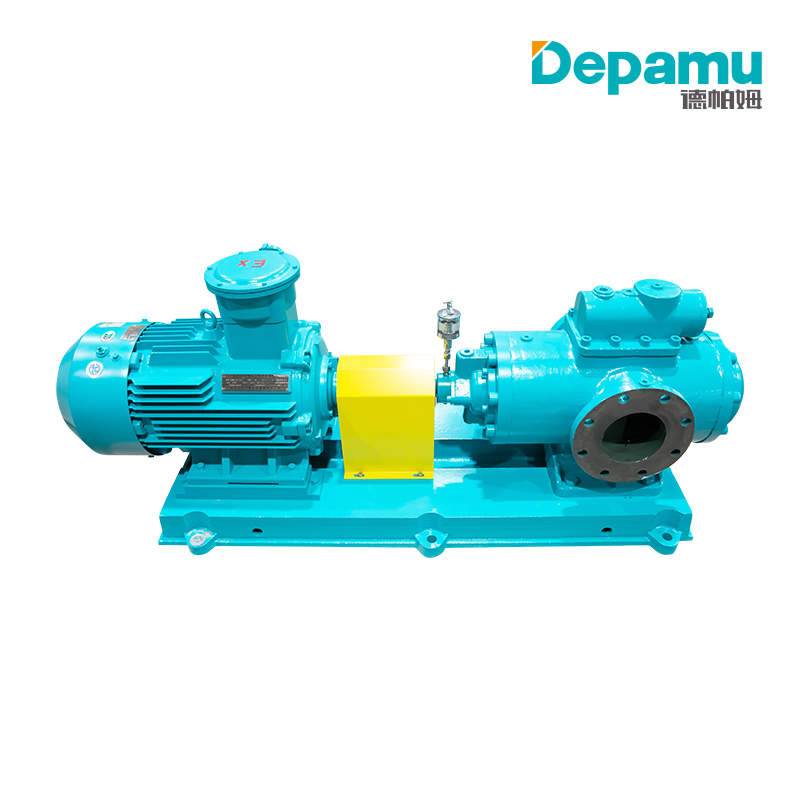
The "triple screw" configuration consists of one power rotor (drive screw) and two idler rotors (sealing screws). Unlike gear pumps that trap fluid between teeth, or centrifugal pumps that rely on high-speed impellers, the screw pump operates on the positive displacement principle via meshing threads.
Operating Principle
As the power rotor turns (driven by an electric motor through a flexible coupling), the two idler rotors rotate in the opposite direction. The intermeshing threads form a series of sealed cavities between the rotor and the pump liner. Fluid enters the suction port and fills these cavities. As the rotors turn, the cavities move axially toward the discharge port, progressively decreasing in volume—or maintaining a constant volume—to push the fluid out without pulsation.
Depamu constructs these pumps following rigorous international standards, including API 676 for rotary positive displacement pumps, ensuring they meet the stringent requirements of the petrochemical and power generation industries .
3. Technical Advantages for Turbine Oil Applications
When transferring turbine oil, Depamu triple screw pumps offer several distinct advantages over vane pumps, gear pumps, or centrifugal pumps.
3.1. Pulseless Flow (Non-Pulsating)
Turbine control systems are exquisitely sensitive to pressure fluctuations. A gear pump typically produces a flow ripple corresponding to the number of teeth passing the discharge port. In contrast, the helical geometry of the triple screw pump creates a continuous, non-pulsating flow. For turbine governors, this means stable pressure signals and reduced mechanical dithering.
3.2. Low Shear and Non-Emulsification
Turbine oil degrades via oxidation and aeration. High-shear pumps (like gear pumps) can churn the oil, causing micro-dieseling (tiny air bubbles exploding under pressure) and breaking down the viscosity index improvers. Depamu triple screw pumps generate low internal turbulence. The fluid moves axially with minimal agitation, preserving the oil's chemical properties and preventing the formation of foam and emulsions, which is critical for oil longevity .
3.3. High Suction Capability (Self-Priming)
Turbine lube oil reservoirs are often located in the basement or below the turbine deck. Depamu triple screw pumps exhibit strong self-priming characteristics, capable of drawing oil from depths (suction lift) of up to 8 meters . This eliminates the need for complex priming systems or flooded suction requirements.
3.4. Handling Variable Viscosities
Turbine oil experiences massive viscosity swings. On a cold start in a winter environment, ISO VG 46 oil might behave like molasses (up to 800+ cSt), while at operating temperature, it drops to ~46 cSt. The clearances within Depamu Screw Pumps are designed to handle these extremes. While gear pumps might seize or break under high cold viscosity, the screw pump design allows the rotors to float on the fluid film, accommodating the high drag without mechanical failure.
3.5. Acoustic Performance
Noise pollution is a significant concern in modern power plants and engine rooms. Depamu highlights that their screw pumps operate with low noise and vibration because the flow is uniform and the rotors are dynamically balanced . This contributes to a safer, more comfortable working environment and reduces piping vibration that can lead to fatigue fractures.
4. Material Science and Construction
Depamu leverages its R&D capabilities (holding over 100 technical patents) to produce pumps that resist the corrosive and thermal stresses of turbine environments . While the internal rotors are typically case-hardened alloy steel (to resist wear from particulates in the oil), the pump casing is often made of high-strength cast iron or carbon steel.
For turbine oil circuits, the seals are critical. Depamu typically offers mechanical seals designed for high-speed continuous rotation, often with a quench facility to prevent leakage. Given that turbine oil is expensive and environmentally hazardous (if leaked into bilges or drains), Depamu’s seal-less magnetic drive options (where available) or high-grade mechanical seals ensure zero fugitive emissions.
5. The Depamu Manufacturing Edge: "German Technology, Chinese Efficiency"
A recurring theme in Depamu’s literature is the integration of "German technology" . Historically, triple screw pump technology was perfected in Germany (e.g., Leistritz, Allweiler). Depamu has licensed or reverse-engineered these principles but adapted them for modern manufacturing techniques.
In 2021 and 2022, Depamu announced significant upgrades to their screw pump series, focusing on "high viscosity fluids, wear resistance, and high pressure" . They emphasize modularity. For the end-user, this means that the power frame (bearing housing) remains identical, while the hydraulic end (the screw set and liner) can be swapped to change flow rates or pressure capabilities. This modularity reduces spare parts inventory costs for turbine operators.
6. Application Case Studies: Where the Pumps Are Used
The suitability of Depamu triple screw pumps for turbine oil is validated by their deployment in high-stakes environments. According to industry procurement records and company literature, Depamu has been a qualified supplier for massive state-owned enterprises, including Sinopec (China Petroleum & Chemical Corporation) and CNPC .
6.1. Steam Turbine Lube Oil Skids
In thermal power plants, the turbine hall requires a continuous oil supply. Depamu pumps are integrated into "lube oil skids" that filter, cool, and pressurize the oil before distribution to the bearings. A specific procurement note from Sinopec Hainan Refining lists a requirement for: "Screw pump 5~10m³/h Lubricating oil -20~80°C / 0.5~1MPa" . This precisely matches the output of a small to medium Depamu triple screw unit used for bearing lubrication.
6.2. Governing and Control Systems (EHC)
Electro-Hydraulic Control (EHC) systems require ultra-clean, high-pressure oil. While some applications use high-pressure piston pumps, triple screw pumps are often used as the boost pump or the main pump in medium-pressure hydraulic systems, providing the steady state flow required for steam valve positioning.
6.3. Marine Turbines
Naval vessels and LNG carriers using steam turbines (or dual-fuel turbines) rely on Depamu-rated pumps for their engine room auxiliaries. The compact footprint of the triple screw pump—high flow rates in a relatively small package—is advantageous in the constrained space of a marine engineering room .
7. Performance Specifications and Sizing
To properly size a Depamu triple screw pump for turbine oil, engineers must consider three primary variables: Flow Rate (Q) , Pressure (P) , and Viscosity (v) .
Depamu produces models generally covering the following ranges (based on comparable API 676 models):
-
Flow Rates: From 0.5 m³/h up to 500 m³/h.
-
Discharge Pressure: Typically 1.0 MPa (10 bar) for standard lube oil, up to 4.0 MPa (40 bar) for hydraulic control applications.
-
Temperature: Standard seals handle -20°C to 150°C, covering the full operating spectrum of mineral oils.
Sizing Example:
*A 50 MW steam turbine requires 800 L/min of ISO VG 46 oil at 2.5 MPa.*
A Depamu triple screw pump would be selected with a motor size calculated by the formula:
Assuming 85% volumetric efficiency (standard for screw pumps due to internal slip), the motor size would be approximately 45–55 kW. Notably, the pump must be fitted with a safety relief valve on the discharge side, as positive displacement pumps will continue building pressure until the casing bursts or the motor stalls if the discharge line is blocked .
8. Maintenance and Reliability
One of the selling points of the Depamu triple screw pump is its maintenance-friendly design.
8.1. Long Service Life
Because the rotors do not physically touch each other (they are separated by a thin film of the pumped fluid), wear is minimal. The primary wear components are the outer liner and the mechanical seal. Depamu's use of high-precision double helical gears (in the timing gearbox for double screw, but in triple screw, the rotors themselves are the timing) ensures that the drive is balanced .
8.2. Interchangeability
The 2021 upgrade series emphasized that "the same drive part can be matched with four different designs of rotors/stators" . For the turbine operator, this means if they upgrade their turbine or change their flow requirements, they can change the hydraulic components of the pump without buying a new baseplate or motor—a significant capital savings.
8.3. Monitoring
Modern Depamu pumps often come with threaded ports for vibration sensors and temperature transmitters. In critical turbine applications, these pumps are connected to the plant DCS (Distributed Control System). A rise in case temperature might indicate internal wear (increased slip), prompting maintenance before a catastrophic failure occurs.
9. Comparison with Competitors
| Feature | Depamu Triple Screw | External Gear Pump | Centrifugal Pump |
|---|---|---|---|
| Flow Characteristic | Pulsation-free | Moderate pulsation | High pulsation (at low flow) |
| Viscosity Tolerance | Excellent (1 to 100,000 cSt) | Good (up to 10,000 cSt) | Poor (requires low viscosity) |
| Pressure Capability | High (up to 40 bar typical) | Medium-High | Low-Medium |
| Suction Lift | Excellent (Self-priming) | Good | Poor (Needs flooded suction) |
| Noise Level | Low (Smooth flow) | Medium (Gear clicking/meshing) | High (Cavitation risk) |
| Cost | Medium-High | Low-Medium | Low |
For turbine oil specifically, the centrifugal pump's primary flaw is the need for flooded suction; if the pump loses prime, it overheats and destroys the shaft seals. The Depamu screw pump maintains prime even with air entrainment.