

Depamu Demulsifier Injection Package in the Petroleum Industry and Oilfield Extraction
Introduction
In the modern petroleum industry, the extraction and processing of crude oil present numerous technical challenges, among which the formation of stable emulsions is one of the most persistent and costly. When crude oil is produced alongside water—a near-universal occurrence in oilfield extraction—the natural surfactants present in crude oil stabilize water-in-oil emulsions that severely impede downstream processing. These emulsions must be broken efficiently to meet pipeline and refinery specifications for basic sediment and water (BS&W) content. The solution lies in the precise injection of chemical demulsifiers, and the Depamu Demulsifier Injection Package represents a state-of-the-art solution designed to address this critical need with precision, automation, and reliability.
The Challenge of Emulsions in Oilfield Production
Crude oil emulsions form when water droplets become dispersed in oil during the turbulent flow conditions of production, particularly as reservoir fluids pass through choke valves, pumps, and other flow restrictions. The natural emulsifiers present in crude oil—including asphaltenes, resins, and naphthenic acids—adsorb at the oil-water interface, creating a rigid film that prevents droplet coalescence. These emulsions can be extremely stable, requiring chemical intervention to achieve separation.
The consequences of untreated emulsions are severe. High emulsion levels cause out-of-specification BS&W content, leading to penalties from pipeline operators and refineries, increased transportation costs, and accelerated corrosion in downstream equipment. Furthermore, emulsified water can carry dissolved salts that contribute to fouling and catalyst poisoning in refining operations. The economic impact is substantial, making effective demulsification a top priority for production engineers.
The most common and effective approach to resolving these emulsions is the continuous injection of chemical demulsifiers at strategic points in the production system. These chemicals displace the natural emulsifiers at the oil-water interface, promote droplet coalescence, and accelerate the separation of water from oil.
The Depamu Demulsifier Injection Package: An Overview
The Depamu Demulsifier Injection Package is a complete, integrated system engineered for the precise and reliable delivery of demulsifier chemicals in oilfield and gas field applications. Manufactured by Depamu (Hangzhou) Pumps Technology Co., Ltd., a certified supplier with over seventeen years of industry experience, these packages represent the culmination of rigorous research and development following strict process specifications. The company has successfully achieved IS9001 certification, underscoring its commitment to quality management.
The DPJY-series injection packages are designed by integrating advanced production processes and technologies from the United States, Germany, Japan, and other industrialized nations, adapted to the practical conditions of the Chinese petroleum industry. This international synthesis of engineering expertise results in systems that combine Western precision with practical, field-proven reliability.
System Architecture and Components
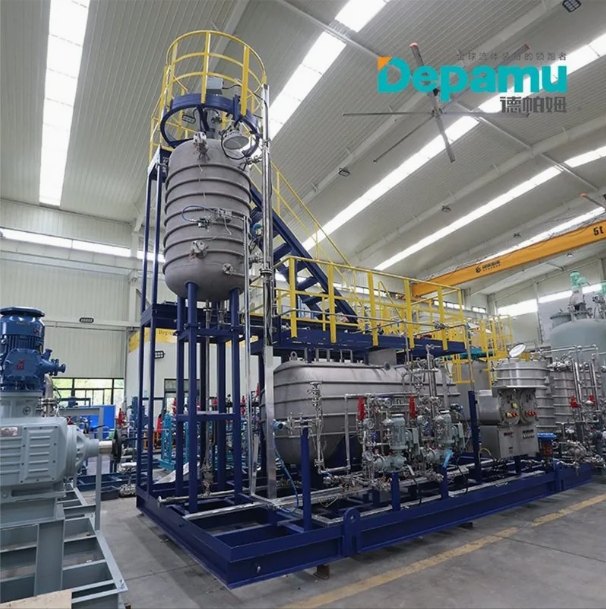
The Depamu Demulsifier Injection Package is a modular, skid-mounted system that integrates all necessary components for chemical storage, metering, and injection into a compact, self-contained unit. The typical configuration includes the following key components:
Solution Tank: The storage vessel for the demulsifier chemical, available in various materials including 316 or 304 stainless steel, carbon steel, carbon steel with rubber (plastic) lining, FRP, and PE, depending on corrosion resistance requirements. Tank volumes range from 0.5 to 20 cubic meters, accommodating different chemical consumption rates and operational intervals.
Metering Pump: The heart of the injection system, Depamu employs high-precision plunger or diaphragm metering pumps that deliver the chemical at accurately controlled flow rates. The DP(M)DA Plunger Metering Pump features direct fluid contact through a reciprocating plunger mechanism, with flow rates up to 12,100 L/h and discharge pressures reaching 228 MPa. The metering accuracy is ±0.5% within the 10% to 100% adjustment range. Multiple pump heads (up to twelve in parallel configuration) can be employed for either transporting the same fluid to reduce pulsation or delivering multiple media as a proportional pump.
Piping and Valving: Complete piping systems including safety relief valves, pressure gauges, pulsation dampeners, check valves, and all necessary fittings.
Control System: Electrical control cabinets enabling local manual control, semi-automatic operation, or fully automatic control. All status and fault signals can be transmitted to a Distributed Control System (DCS) or host computer, enabling remote start/stop functionality.
Support Structure: A robust steel base frame with walkways, handrails, and access ladders for safe operation and maintenance.
Technical Specifications and Performance
The Depamu Demulsifier Injection Package is available in multiple configurations to suit diverse operational requirements. Common configurations include:
| Configuration | Tank Volume (M³) | Pump Capacity (L/H) | Discharge Pressure (MPa) | Weight (kg) | Dimensions (mm) |
|---|---|---|---|---|---|
| 1 Tank + 2 Pumps | 0.5~20 | 10~200 | 0.5~4.0 | 1600~4200 | 1800×1900×2500 |
| 2 Tanks + 3 Pumps | 0.5~20 | 10~200 | 0.5~4.0 | 1800~5500 | 3000×1900×2500 |
For demulsifier applications specifically, the package can achieve injection concentrations ranging from 10 to 200 L/H at discharge pressures from 0.5 to 4.0 MPa. Field application concentrations for demulsifiers typically range from 20 to 100 ppm, determined through laboratory bottle testing.
One of the most significant performance characteristics of the Depamu system is its exceptional injection accuracy. Equipped with high-precision flow recorders or weightless flow control systems, the chemical injection accuracy can reach ±0.5% to ±0.2%. This level of precision is critical in demulsifier applications, where both under-dosing (resulting in incomplete separation) and over-dosing (wasting expensive chemicals and potentially creating secondary emulsions) must be avoided.
Intelligent Control and Automation
Modern oilfield operations demand increasing levels of automation, and the Depamu injection package delivers on this requirement through its intelligent control capabilities. The system can concentratively or remotely receive real-time parameters of process media through online instrument testing. It automatically regulates the ratio between chemical injection volume and process medium flow (the PPM value) according to these parameters. Simultaneously, it receives feedback data on the actual effect after chemical injection, achieving intelligent online closed-loop control with optimal chemical injection volume and accuracy better than ±1%.
This closed-loop control capability represents a significant advancement over traditional open-loop dosing systems. By continuously monitoring process conditions and adjusting injection rates accordingly, the system maintains optimal demulsifier concentration despite variations in production rates, water cuts, and emulsion characteristics.
Multiple control modes are available, including manual mode, automatic mode, and remote control via DCS integration. The flow rate can be adjusted through manual, electric, pneumatic, or frequency conversion mechanisms, providing flexibility for different operational scenarios.
Application in Oilfield Extraction
In oilfield extraction, demulsifier injection packages are deployed at multiple points throughout the production system. Common injection points include:
Wellhead Injection: High-pressure injection directly into the wellbore or flowline, where the demulsifier begins acting immediately upon emulsion formation.
Collection Points: Medium-to-low pressure injection at gathering stations where multiple wells' production is combined.
Separator Inlets: Injection upstream of primary, secondary, and electrostatic dehydrator separators to enhance oil-water separation.
Storage Tanks: Low-pressure intermittent metering injection into storage vessels.
The Depamu system's flexible design allows it to address all these applications with appropriate pressure ratings and flow capacities.
Design Philosophy and Engineering Excellence
The Depamu Demulsifier Injection Package embodies several key design principles that distinguish it from conventional chemical injection systems:
Systematic Design: The package employs a systematic design approach that avoids the systematic differences inherent in traditional products designed under single-equipment or single-part paradigms.
Advanced Technology Integration: Brand-new design concepts based on absorption of the essence in domestic and foreign dosing technologies result in more reasonable and effective techniques.
Modular Construction: The product structure features modular design in an integrated combination, allowing for convenient extension in aspects of capacity and function. This modularity was demonstrated in the company's delivery of 29 chemical injection skid units for the Kingfisher oilfield project in Uganda, where the units featured modular design, integrated combination, compact structure, and high automation to meet complex operational conditions.
Customization Flexibility: The system can provide the best solution flexibly according to different media and user demands. Users can randomly select equipment and parts of famous domestic and foreign brands in various materials at all levels.
Corrosion Resistance: Depending on anti-corrosion requirements, the solution tank can be fabricated from 316 or 304 stainless steel, carbon steel, carbon steel with rubber (plastic) lining, FRP, PE, and other materials. Pump heads can be made from 304, 316, 316L, 904, Hastelloy C, and high-performance polymer materials.
Case Study: Offshore Platform Deployment
Depamu has demonstrated its capability in demanding environments through successful deliveries to major operators. The company recently delivered multiple sets of offshore platform chemical injection skid equipment and high-pressure Reciprocating Pumps to China National Offshore Oil Corporation (CNOOC). This equipment achieved domestic substitution of key core technologies, a significant milestone for Chinese manufacturing in the offshore oil and gas sector. The offshore environment presents unique challenges including space constraints, corrosion concerns, and the need for exceptional reliability—challenges that the Depamu package is engineered to meet.
Conclusion
The Depamu Demulsifier Injection Package represents a comprehensive, technologically advanced solution to one of the petroleum industry's most persistent challenges: the efficient separation of emulsified water from crude oil. By integrating high-precision metering pumps, intelligent closed-loop control systems, modular design, and robust construction, the package delivers the precise chemical dosing essential for effective demulsification while minimizing chemical waste and operational costs.
As oilfields worldwide mature and produce increasing volumes of water alongside hydrocarbons, the importance of effective demulsification will only grow. The Depamu system, with its combination of international technology, domestic adaptation, and continuous innovation, is well-positioned to meet these evolving challenges. Whether deployed on offshore platforms, in remote onshore fields, or in large-scale processing facilities, the Depamu Demulsifier Injection Package provides the reliability, accuracy, and automation that modern petroleum production demands.