

What is a Lubricating Oil Transfer Pump Double Depamu-pumps.com/Screw-Pump.html target='_blank'>Screw Pump?
In the intricate world of industrial fluid handling, few pieces of equipment are as vital to the smooth operation of large-scale machinery as the lubricating oil transfer pump. Among the various technologies available, the double screw pump—often referred to as a Twin-Screw Pump—stands out as a premier solution for moving lubricating oils. This positive displacement pump is engineered to handle a wide range of viscosities, provide a steady flow, and operate with high reliability in demanding environments, from marine engine rooms to petrochemical refineries .
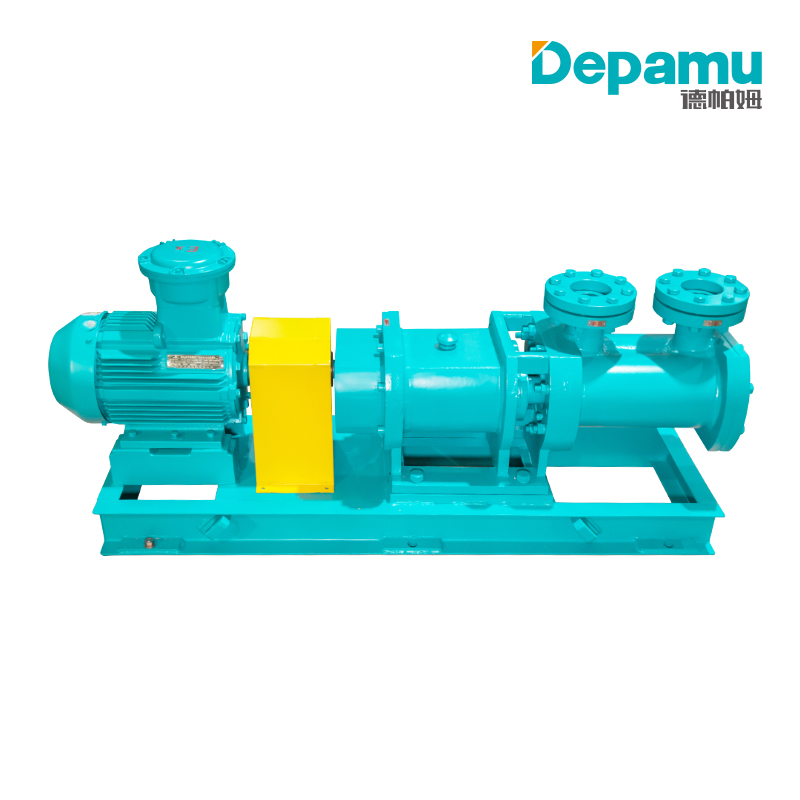
Core Principles of Operation
A double screw pump is a type of positive displacement rotary pump. Its fundamental operating principle is based on the interaction of two intermeshing screws, or rotors, which rotate within a tightly fitted casing .
As the screws counter-rotate, fluid is drawn into the suction port. The fluid becomes trapped in the cavities between the screw threads and the pump casing. The screws' rotation then pushes this trapped volume of fluid axially—along the length of the screws—from the inlet side to the discharge side . A critical feature of this design is that the cavities maintain a constant volume; this action translates to a non-pulsating, continuous flow . Unlike centrifugal pumps, which are speed-dependent, a positive displacement pump like the twin-screw moves a fixed amount of fluid with each revolution, making it ideal for high-viscosity fluids and applications requiring a consistent, metered flow.
There are two primary configurations for twin-screw pumps, which are determined by how the driving and driven screws are synchronized .
With Timing Gear (WTG)
In this design, the screws do not make physical contact with each other. Instead, a set of external timing gears ensures that the screws are synchronized and rotate without metal-to-metal contact . This design offers several key advantages:
-
High Reliability with Non-Lubricating Fluids: Because there is no contact between the screws, the pump can handle fluids that do not provide their own lubrication, such as some chemicals or light solvents .
-
Dry-Run Capability: The absence of metal-to-metal contact means the pump can run dry for short periods without catastrophic damage .
-
Low Shear: The fluid is moved gently, making it suitable for shear-sensitive emulsions and polymers .
Without Timing Gear (NTG)
In this more straightforward and cost-effective design, one screw directly drives the other through contact . This configuration relies on the pumped fluid itself to lubricate the contacting screw surfaces.
-
Ideal for Lubricating Fluids: This design is perfectly suited for transferring lubricating oils because the fluid acts as a lubricant between the screw profiles, reducing wear .
-
Higher Efficiency for High-Viscosity Fluids: The direct contact can be more efficient for very thick fluids like heavy fuel oil, asphalt, and bitumen .
A Closer Look at Lubricating Oil Transfer
The transfer of lubricating oil presents a distinct set of challenges. Lubricating oils, particularly heavy grades, are highly viscous, meaning they resist flow. This high viscosity is precisely why twin-screw pumps are so well-suited for the task.
Key Performance Characteristics
-
Viscosity Handling: A double screw pump can efficiently transfer fluids with viscosities ranging from as thin as 0.5 mm²/s to extremely thick 100,000 mm²/s (or 100,000 cSt) .
-
Self-Priming Capability: These pumps are inherently self-priming, a crucial feature when dealing with tanks that may need to be fully emptied (tank stripping) where the pump may have to handle a significant amount of air or gas mixed with the liquid .
-
High Flow and Pressure: They are capable of achieving substantial flow rates, with some models moving up to 1500 m³/h at pressures up to 2.0 MPa (approx. 20 bar) or more .
-
Low Pulsation: The constant-volume cavity movement ensures a smooth, steady flow that avoids pressure spikes that can damage sensitive system components .
Internal Lubrication: A Critical Design Innovation
In the context of twin-screw pumps used for oil, the lubrication system itself is a marvel of engineering. Many designs use the process fluid (the oil being pumped) to lubricate the pump's internal bearings and gears. This is often achieved by diverting a portion of the discharge flow through a separator and back into a circulation circuit that feeds the bearings .
For instance, in a typical system, after the pump pressurizes the oil, some of it is routed through a separator to remove particulate matter and ensure cleanliness. This cleaned, high-pressure fluid is then sent to the end chambers of the pump to lubricate the bearings and timing gears. This circulation path serves a dual purpose: it lubricates the moving parts and removes heat from the friction surfaces . By using the process fluid itself, the system eliminates the need for a separate, expensive lubrication system, reducing maintenance costs and improving reliability .
Common Applications and Industries
The reliability and versatility of the double screw pump make it an indispensable asset across multiple sectors .
-
Petrochemical Industry: These pumps are the workhorses for transferring a vast array of products, including crude oil, heavy fuel oil, bitumen, diesel, and gasoline. They are also integral to the blending processes used to create finished lubricating oils .
-
Marine Industry: On ships, these pumps serve as engine lubricating pumps, fuel transfer pumps, and cargo oil pumps. Their ability to handle tank stripping operations and their self-priming capabilities are particularly valuable in marine environments .
-
Industrial Manufacturing: In general manufacturing, they are used to move hydraulic fluids, gear oils, and other process lubricants within large production machinery.
-
Terminal and Pipeline Operations: In tank terminals, these pumps are the standard for unloading ships and railcars, transferring oil between tanks, and feeding pipeline systems .
Conclusion
The lubricating oil transfer pump double screw pump is a masterclass in fluid dynamics engineering. Its ability to handle high-viscosity fluids with minimal shear, combined with its self-priming capability, low pulsation, and robust construction, makes it the ideal choice for a task as critical as moving the lifeblood of an industrial operation. Whether configured with timing gears for maximum versatility or without for ultimate efficiency with lubricating fluids, the twin-screw pump provides a reliable, high-performance solution essential for the modern oil and gas, marine, and petrochemical industries