

Depamu Positive Displacement Twin Screw Pump for Fuel Oil and Other Oils
Introduction
The efficient and reliable transfer of fuel oil and other petroleum-based liquids is a critical operation across industries ranging from marine shipping and power generation to petrochemical refining and tank storage. In these demanding environments, pump selection directly influences operational efficiency, maintenance costs, and overall system safety. Among the various pump technologies available, the positive displacement twin screw pump has emerged as a preferred solution for handling the diverse range of viscosities, temperatures, and flow conditions encountered in fuel oil and lubricating oil applications. Depamu, a Hangzhou-based pump technology company founded in 2003, has developed a comprehensive line of twin screw pumps that leverage advanced German engineering principles to address these challenges. This article examines the technical characteristics, working principles, and practical applications of Depamu positive displacement twin screw pumps in fuel oil and other oil service, providing a detailed assessment of why this technology has become indispensable in modern fluid handling operations.
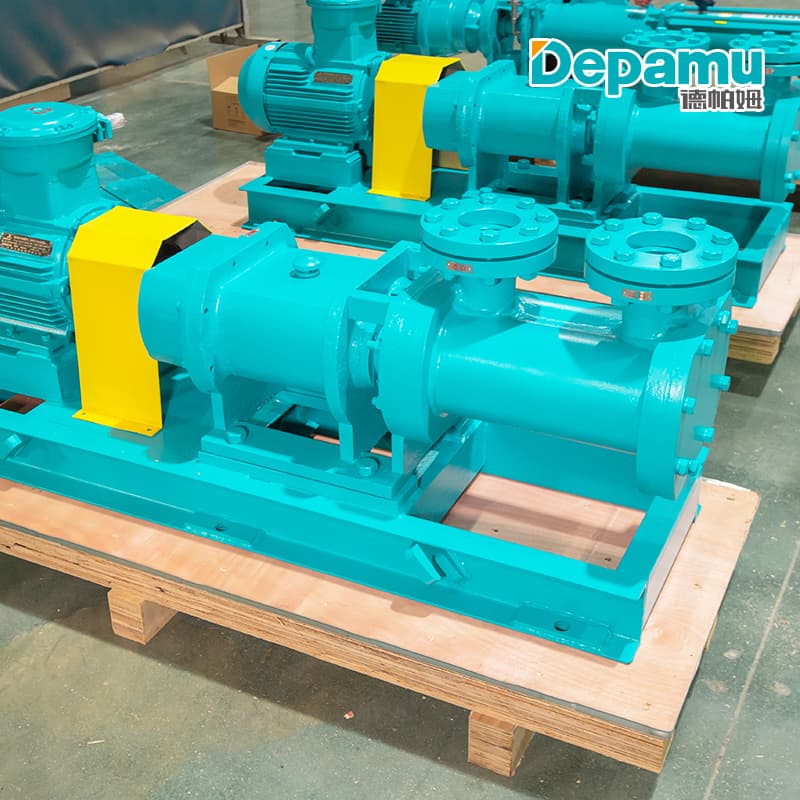
Understanding the Positive Displacement Twin Screw Pump
At its core, the twin screw pump is a positive displacement Metering Pump that operates through the precise intermeshing of two counter-rotating screws within a pump chamber. The helical grooves on the screws, combined with the inner wall of the pump casing, form a series of interconnected sealed cavities. As the screws rotate continuously, these sealed cavities move steadily along the axial direction, transporting the pumped fluid from the suction side to the discharge side without agitation or turbulence. This working principle distinguishes twin screw pumps from centrifugal pumps, which rely on impeller-generated velocity to move fluids and are inherently sensitive to changes in viscosity and system pressure.
The positive displacement nature of the twin screw design offers several fundamental advantages for oil transfer applications. Unlike centrifugal pumps, whose flow rate varies significantly with changes in discharge pressure and fluid viscosity, twin screw pumps deliver a constant flow rate regardless of pressure fluctuations within their operational range. This characteristic is particularly valuable in fuel oil systems where precise metering and consistent delivery are essential, such as in burner feed applications, engine fuel supply systems, and custody transfer operations.
Depamu's twin screw pumps incorporate synchronized timing gears that ensure the rotating screws do not come into direct contact with each other. This design feature eliminates metal-to-metal contact within the pumping chamber, substantially reducing wear and extending service life. The timing gears and roller bearings are located externally, isolated from the process liquid, which allows the pump to handle both lubricating and non-lubricating media without compromising bearing performance. The external bearing arrangement also facilitates maintenance and inspection, as critical components remain accessible without dismantling the entire pump assembly.
Technical Specifications and Performance Capabilities
Depamu's twin screw pumps are engineered to meet the stringent requirements of fuel oil and oil transfer applications. The pumps are designed in accordance with API 676 standards, the recognized international specification for positive displacement rotary pumps used in the petroleum, petrochemical, and natural gas industries. This compliance ensures that Depamu pumps meet the dimensional, performance, and material requirements expected by oil and gas operators worldwide.
The performance envelope of Depamu twin screw pumps covers a broad spectrum of operating conditions. The pumps can handle flow rates ranging from 0.1 to 3,000 cubic meters per hour, with discharge pressures reaching up to 4.8 MPa or higher depending on configuration. Fluid temperatures can range from -12°C to +150°C, accommodating both ambient-temperature light oils and heated heavy fuel oils that require elevated temperatures to achieve pumpable viscosity. Perhaps most significantly for fuel oil applications, these pumps can handle fluids with viscosities up to 100,000 cP and solid contents up to 60%, making them suitable for the most challenging heavy oil and residual fuel streams.
The self-priming capability of Depamu twin screw pumps is another critical performance attribute. The pumps can achieve suction lifts of up to 8 meters of water column, allowing them to draw fuel oil from underground storage tanks, vessel bunkers, or tanker compartments without the need for priming systems or foot valves. The excellent suction performance, characterized by a low Net Positive Suction Head (NPSH) requirement of only 1.5 meters, further enhances the pump's ability to operate reliably under challenging suction conditions that would cause cavitation and performance degradation in centrifugal alternatives.
Design Features for Fuel Oil and Oil Service
Several design features of Depamu twin screw pumps are specifically advantageous for fuel oil and other oil transfer applications. The non-agitating and pulsation-free flow characteristics are particularly important when handling shear-sensitive fluids or emulsions that could be destabilized by excessive turbulence. Unlike gear pumps or lobe pumps, which can subject fluids to high shear stresses, the twin screw design conveys the product gently through the pumping chamber, preserving the molecular structure and physical properties of the fluid. This characteristic is especially valuable in refineries where intermediate streams may be sensitive to shear-induced property changes.
The pump's ability to handle oil-gas multiphase mixtures is a distinctive capability that sets twin screw pumps apart from most other positive displacement technologies. Depamu twin screw pumps can transport fluids with gas content up to 98%, a feature that is particularly relevant in crude oil gathering systems, wellhead operations, and situations where dissolved gases may come out of solution during pumping. For fuel oil applications, this capability provides an additional margin of operational reliability when handling heated oils that may contain entrained vapors or when pumping from tanks that have not been fully degassed.
For heavy fuel oil and residual oil service, the availability of heating jackets on the pump casing is an important design option. Heavy fuel oils, such as those designated as No. 6 fuel oil or marine heavy fuel oil (HFO), typically require heating to reduce viscosity to pumpable levels. Depamu offers heating jacket configurations that maintain the pump casing at elevated temperatures, preventing solidification or gelling of the product during transfer operations. This feature is particularly critical in marine applications where the fuel oil transfer system must reliably move heavy fuel from storage tanks to the engine room's day tanks, often across significant distances and in adverse environmental conditions.
The reversible rotation capability of Depamu twin screw pumps provides operational flexibility that is advantageous in tank farm and terminal operations. Simply changing the direction of rotation reverses the flow direction, allowing the same pump to be used for both loading and unloading operations. This bidirectional functionality simplifies piping design and reduces the number of pumps required in complex transfer systems. The valveless design of the pump, which inherently functions as a check valve, further contributes to system simplicity and reliability.
Applications in Fuel Oil Transfer
The primary application for Depamu positive displacement twin screw pumps in the oil sector is the transfer of fuel oils of various grades and specifications. In marine shipping, twin screw pumps serve as fuel oil transfer pumps for marine gas oil (MGO), light gas oil (LGO), and heavy fuel oil (HFO). The pumps are typically installed in the engine room or fuel oil handling space, where they transfer fuel from storage tanks to settling tanks and day tanks, as well as for bunkering operations when receiving fuel from supply vessels or shore facilities. The ability to handle both low-viscosity distillate fuels and high-viscosity residual fuels with the same pump design provides significant operational and inventory advantages for vessel operators.
In power generation facilities, Depamu twin screw pumps are used to transfer heavy fuel oil from storage tanks to burner front systems. The constant flow characteristic of positive displacement pumps ensures that the correct fuel quantity is delivered to the combustion system regardless of variations in fuel viscosity or system back pressure. This precision is essential for maintaining stable combustion and meeting emissions requirements. The pumps are also employed in fuel oil forwarding service, where they transfer fuel between storage tanks within the plant or from receiving facilities to the main storage area.
Tank storage terminals represent another major application area for twin screw pump technology. At terminals where marine tankers, rail cars, and road tankers are loaded and unloaded, twin screw pumps provide the reliable, high-volume transfer capability required for efficient terminal operations. The pumps can handle the wide range of petroleum products encountered at such facilities, from light distillates to heavy residual fuels, with a single pump design, reducing spare parts inventory and simplifying maintenance training requirements. The self-priming capability and excellent suction performance are particularly valuable for tank stripping operations, where the pump must remove the last remaining quantities of product from a tank that is being emptied for inspection or change of service.
In refinery operations, twin screw pumps are used in various fuel oil service applications, including the transfer of atmospheric residue, vacuum residue, and other heavy process streams. The pumps' ability to handle high temperatures and high viscosities makes them suitable for the demanding conditions encountered in refinery bottoms handling and fuel oil blending operations. Typical products handled by twin screw pumps in refinery service include mazut, bitumen, tar, and heavy fuel oil, as well as lighter products such as diesel and naphtha.
Applications in Other Oil Service
Beyond fuel oil transfer, Depamu twin screw pumps find extensive application in the handling of other oil types across industrial and marine sectors. Lubricating oil service is a particularly important application, where the pumps are used for lube oil transfer, circulation, and supply to machinery bearings and hydraulic systems. The gentle, non-agitating pumping action preserves the integrity of lubricant additives and prevents aeration, which can degrade lubricating performance and cause premature equipment wear. In marine engine rooms, twin screw pumps serve as lube oil pumps for main engines and auxiliary machinery, as well as hydraulic oil pumps for steering gear and deck machinery.
Crude oil transfer represents another significant application area. Twin screw pumps are employed in crude oil gathering systems, where they move produced fluids from individual wellheads to central processing facilities. The ability to handle oil-water-gas mixtures without separation makes these pumps ideal for multiphase boosting applications, eliminating the need for costly and complex separation equipment at remote well sites. In crude oil transportation pipelines, twin screw pumps serve as booster pumps, maintaining pressure and flow through long-distance pipeline systems.
The versatility of twin screw pump technology extends to the transfer of specialty oils and non-petroleum oils. In the food and pharmaceutical industries, twin screw pumps handle vegetable oils, fish oils, and other edible oil products where gentle handling and contamination-free operation are essential. The pumps can also transfer synthetic oils, thermal oils, and heat transfer fluids used in industrial heating and cooling systems. The ability to handle high-viscosity fluids without shear degradation is particularly valuable when pumping polymer-containing oils, such as those used in enhanced oil recovery operations.
Manufacturing, Quality, and Support
Depamu operates from a 35,000-square-meter manufacturing facility in Hangzhou, China, with registered capital of 54 million yuan and a workforce of over 200 employees. The company maintains a strong commitment to research and development, employing approximately 20 senior and mid-level engineers and holding more than 20 patents related to pump technology. This engineering focus has enabled Depamu to develop pump designs that incorporate advanced German technology while optimizing for manufacturability and cost-effectiveness.
Quality assurance is a fundamental component of Depamu's manufacturing philosophy. The company employs advanced digital testing systems to validate pump performance before shipment, ensuring that each unit meets specified flow, pressure, and efficiency parameters. The pumps are manufactured under a rigorous quality control system, with materials of construction selected based on the specific requirements of each application. For fuel oil service, materials are chosen for compatibility with petroleum products and resistance to corrosion, with options for various stainless steels and specialty alloys where required by the process conditions.
Depamu provides comprehensive technical support to customers, including application engineering assistance, installation guidance, and after-sales service. The company's engineering team works closely with customers to select the appropriate pump model, materials, and configuration for each specific application, ensuring optimal performance and reliability. Spare parts availability and maintenance support are structured to minimize downtime and extend pump service life, recognizing that in continuous process industries such as refining and power generation, pump reliability is paramount.
Conclusion
The Depamu positive displacement twin screw pump represents a mature, well-engineered solution for the demanding requirements of fuel oil and other oil transfer applications. Its working principle—based on the precise intermeshing of counter-rotating screws to create moving sealed cavities—provides inherent advantages in terms of constant flow, self-priming capability, gentle product handling, and adaptability to a wide range of viscosities and fluid conditions. These characteristics make twin screw pumps particularly well-suited for the fuel oil transfer requirements of marine vessels, power plants, storage terminals, and refineries, where reliability, efficiency, and operational flexibility are essential.
The technical specifications of Depamu twin screw pumps, including flow rates to 3,000 m³/h, discharge pressures to 4.8 MPa and beyond, viscosity handling to 100,000 cP, and temperature capabilities from -12°C to +150°C, demonstrate the broad performance envelope of this technology. Design features such as external timing gears and bearings, heating jacket options, reversible rotation, and multiphase pumping capability further enhance the pumps' applicability to the diverse challenges of oil handling operations.
As industries continue to demand higher efficiency, greater reliability, and lower total cost of ownership from their fluid handling equipment, the positive displacement twin screw pump is well-positioned to meet these expectations. Depamu's commitment to engineering excellence, manufacturing quality, and customer support ensures that its twin screw pumps will continue to serve as reliable workhorses in fuel oil and oil transfer applications worldwide. For engineers and operators seeking a pumping solution that combines precision, durability, and versatility, the Depamu twin screw pump offers a compelling combination of performance and value that merits serious consideration.