

Depamu Electric Operated Double Diaphragm (EODD) Pump for Sodium Hypochlorite: A Technical Overview
Abstract
The handling of sodium hypochlorite (NaOCl) in industrial applications presents significant engineering challenges due to its corrosive nature, oxidizing properties, and tendency to gas off. Depamu (Hangzhou) Pumps Technology Co., Ltd. offers a specialized solution through its Electric Operated Double Diaphragm (EODD) pump technology. This article provides a comprehensive technical examination of Depamu EODD pumps as applied to sodium hypochlorite transfer and dosing services. It explores the pump's operating principles, material compatibility considerations, design features including double diaphragm containment, electric drive advantages over air-operated alternatives, and application best practices. The analysis draws upon Depamu's established engineering capabilities, certifications, and over two decades of fluid handling experience in demanding chemical environments.
1. Introduction
Sodium hypochlorite is among the most widely used disinfectants and bleaching agents across water treatment, pulp and paper, textile, and sanitation industries. However, its effective and safe handling demands pumping equipment that can withstand its aggressive chemical properties while maintaining reliable, leak-free operation. The selection of appropriate pumping technology directly impacts operational safety, maintenance costs, and process reliability.
Depamu (Hangzhou) Pumps Technology Co., Ltd., established in 2003 and headquartered in Hangzhou Qiantang Area, has developed a strong reputation in fluid handling equipment across multiple industries . The company's product portfolio includes Metering Pumps, high-pressure process Reciprocating Pumps, and Diaphragm Pumps, supported by ISO 9001, ISO 14001, ISO 45001, API, and CE certifications . With over 100 technical patents and applications spanning oil and gas, chemical, nuclear power, and water treatment sectors, Depamu brings substantial engineering expertise to the challenge of sodium hypochlorite pumping .
The Electric Operated Double Diaphragm (EODD) pump represents a significant evolution in positive displacement pumping technology. Unlike air-operated double diaphragm (AODD) pumps that rely on compressed air, EODD pumps utilize an electric motor-driven mechanism to actuate diaphragms, offering distinct advantages in precision, energy efficiency, and operational consistency .
2. Sodium Hypochlorite: Properties and Handling Challenges
Sodium hypochlorite presents specific challenges that directly influence pump selection and material specification.
2.1 Chemical Characteristics
Sodium hypochlorite is a powerful oxidizing agent with high alkalinity (pH typically 11–13). Commercially available solutions range from 5% to 15% concentration for water treatment applications, with industrial grades reaching higher concentrations. The chemical is corrosive to many metals and can degrade elastomers over time, making material selection critical .
2.2 Gas Evolution
One of the most significant operational challenges with sodium hypochlorite is its tendency to decompose and release oxygen gas, particularly under increased temperature or pressure conditions. This gas evolution can cause vapour lock in pumps, reducing efficiency and potentially causing cavitation damage .
2.3 Crystallization and Temperature Sensitivity
Sodium hypochlorite can form salt crystals at low temperatures or when concentration levels fluctuate, potentially damaging seals and internal pump components. Maintaining appropriate temperature control is essential to prevent these issues.
3. Operating Principles of Depamu EODD Pumps
3.1 Fundamental Mechanism
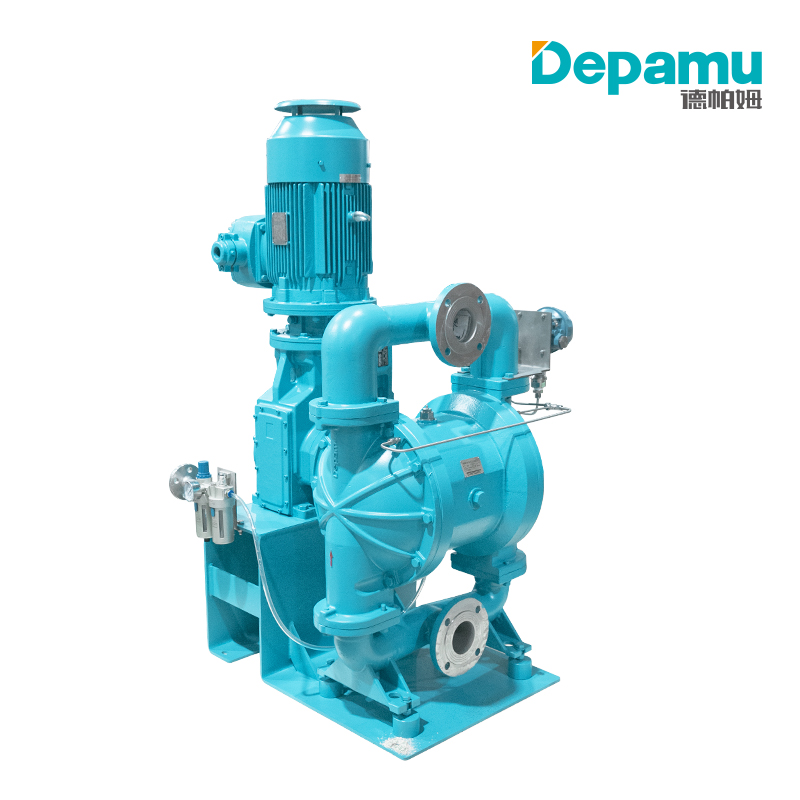
The Electric Operated Double Diaphragm pump operates on a positive displacement principle that differentiates it from both centrifugal pumps and air-operated diaphragm designs. The pump's core mechanism involves a motor-driven center section that creates reciprocating motion to actuate two opposing diaphragms .
As one diaphragm moves forward, it expels fluid from its chamber through the discharge manifold. Simultaneously, the opposing diaphragm retracts, creating vacuum that draws fluid into its chamber through the inlet manifold. This alternating action produces a continuous, pulsating flow that can be smoothed with appropriate dampening systems .
3.2 Distinction from AODD Pumps
While air-operated double diaphragm pumps utilize compressed air to drive the diaphragms, Depamu EODD pumps employ electric motor-driven mechanical actuation. This distinction yields several operational advantages:
-
Precise flow control: Electric drive enables accurate flow rate adjustments through motor speed control
-
Energy efficiency: Eliminates energy losses associated with compressed air generation
-
Quiet operation: Reduces noise pollution typical of pneumatic systems
-
Consistent performance: Maintains stable output regardless of air supply fluctuations
3.3 Double Diaphragm Configuration
The double diaphragm arrangement is particularly valuable for hazardous chemical applications. Depamu offers double diaphragm configurations with rupture alarm capability, enabling real-time diaphragm condition monitoring . In the event of a primary diaphragm failure, the secondary diaphragm maintains containment while the alarm alerts operators, allowing planned maintenance rather than emergency shutdown .
4. Material Compatibility: The Critical Selection Parameter
4.1 Wetted Component Materials
For sodium hypochlorite service, material selection is arguably the most critical factor in pump specification. Depamu provides extensive material options for wetted parts, enabling customization to specific chemical requirements .
Housing Materials: For sodium hypochlorite applications, metallic options include stainless steel grades 316 and 316L, which offer good corrosion resistance to hypochlorite solutions. For more aggressive conditions, higher alloys such as 904L, duplex stainless steels, and Hastelloy C are available . Non-metallic options including PTFE, PVDF, and polypropylene are also offered, with the understanding that application temperatures must remain below specified limits .
Elastomer Selection: The choice of diaphragm and seal materials is equally critical. For sodium hypochlorite, appropriate elastomers include EPDM, PTFE, and FKM (Viton), with selection depending on temperature, concentration, and duration of exposure. PTFE diaphragms are particularly favored for their exceptional chemical resistance across a wide range of aggressive chemicals .
4.2 Material Selection Considerations
Depamu provides comprehensive guidance on material selection, requiring customers to specify key application parameters including fluid name and concentration, operating temperature, density, viscosity, pH, and any solids content . This rigorous approach ensures that material selection matches actual operating conditions rather than nominal specifications.
5. Design Features for Enhanced Safety and Reliability
5.1 Leak-Free Operation
Depamu diaphragm pumps feature fully enclosed fluid chambers with diaphragm isolation structures, ensuring no leakage of process fluids . This is particularly crucial for sodium hypochlorite, which can cause severe damage to surrounding equipment and pose environmental hazards. The sealless design eliminates the leak paths inherent in mechanical seal pumps .
5.2 Double Diaphragm Rupture Alarm
The availability of double diaphragm configurations with rupture detection represents a significant safety enhancement. This system provides real-time monitoring of diaphragm integrity, enabling predictive maintenance and preventing unplanned downtime .
5.3 Dry-Run Capability
Diaphragm pumps offer the ability to run dry for periods without damage, a valuable feature when handling sodium hypochlorite in batch operations or when suction conditions may be interrupted .
5.4 Self-Priming Capability
EODD pumps are self-priming, enabling them to lift fluid from sources below the pump centerline—a valuable characteristic for tank unloading applications .
6. Electric Drive Advantages for Sodium Hypochlorite Applications
6.1 Precision Dosing
In water treatment applications where sodium hypochlorite dosing accuracy is critical, electric drive provides superior control over flow rate. Speed control allows precise adjustment of dosing rates without the variability associated with air supply pressure fluctuations.
6.2 Reduced Operational Costs
The elimination of compressed air requirements reduces both capital expenditure (air compressors) and operational expenses (compressed air production, which typically represents a significant energy cost). This is particularly relevant for continuous-duty sodium hypochlorite pumping applications.
6.3 Simplified Maintenance
Electric drive systems typically require less maintenance than pneumatic systems, with no air filters, lubricators, or moisture separators to maintain. This reduces maintenance burden in water treatment facilities where operational simplicity is valued.
7. Application Best Practices
7.1 System Design Considerations
For sodium hypochlorite pumping systems, appropriate suction piping design is essential to minimize gas accumulation. Suction lines should be designed to prevent gas pockets from forming, and vertical suction lifts should be minimized where possible.
7.2 Temperature Control
Maintaining sodium hypochlorite below 25°C (77°F) during pumping is advisable to minimize decomposition and gas evolution. Depamu pumps can be configured with temperature monitoring and cooling features as required .
7.3 Flow Smoothing
Due to the pulsating nature of diaphragm pump flow, pulsation dampeners may be recommended for applications requiring constant flow, such as continuous disinfection processes.
8. Depamu's Engineering Capabilities and Industry Standing
Depamu's qualifications for supplying pumps for demanding sodium hypochlorite service are reinforced by its industry certifications and technical resources. The company maintains ISO 9001 quality management certification, ISO 14001 environmental management, and ISO 45001 occupational health and safety certification, alongside API and CE approvals .
The company's 35,000-square-meter facilities in Hangzhou and over 20 years of operating history support its claims to engineering expertise. Depamu serves as a contributor to pump industry standards , indicating recognized technical authority in the field.
Products are exported to over 50 countries, including the United States, United Kingdom, and France , and the company has established long-term partnerships with major enterprises including CNPC, SINOPEC, CNOOC, and CNNC .
9. Conclusion
The handling of sodium hypochlorite requires pumping equipment that combines chemical resistance, reliability, and safety features. Depamu's Electric Operated Double Diaphragm pumps offer a compelling solution for this challenging application. By combining double diaphragm containment with electric drive precision and broad material compatibility options, these pumps address the key operational concerns associated with sodium hypochlorite transfer and dosing.
The availability of double diaphragm rupture detection, self-priming capability, and dry-run tolerance provides additional operational security. Backed by Depamu's engineering experience, industry certifications, and established track record across demanding applications, the EODD pump represents a viable solution for sodium hypochlorite service in water treatment, chemical processing, and related industries.
As process industries continue to prioritize safety, efficiency, and reliability, the role of specialized pumping solutions such as the Depamu EODD series will likely expand. Proper application engineering, including careful material selection and system design, remains essential to maximizing pump performance and service life when handling aggressive chemicals like sodium hypochlorite