

Introduction
In the landscape of industrial fluid handling, the circulation of lubricating oil represents a critical lifeline for rotating machinery. For turbines, compressors, gearboxes, and large industrial drives, the lube oil system is not merely an accessory; it is the component that determines reliability, lifespan, and operational safety. When these systems are located in potentially explosive atmospheres—such as petrochemical refineries, offshore platforms, or gas processing plants—the specification of pumping equipment transcends standard performance metrics and enters the realm of stringent safety compliance. The Depamu ATEX-certified Triple Screw Pump has emerged as a leading solution in this demanding niche, combining the inherent advantages of screw pump technology with the rigorous safety requirements mandated by the European Union’s ATEX directives .
The Fundamentals of Triple Screw Pump Technology
To appreciate the Depamu pump’s capabilities, one must first understand the operating principle of the triple screw pump. Unlike centrifugal pumps that impart velocity to fluid or Reciprocating Pumps that rely on positive displacement through pistons, the triple screw pump belongs to the rotodynamic positive displacement family. It consists of three intermeshing screw shafts: one central power rotor (driven) and two idler rotors (sealing rotors) that flank it .
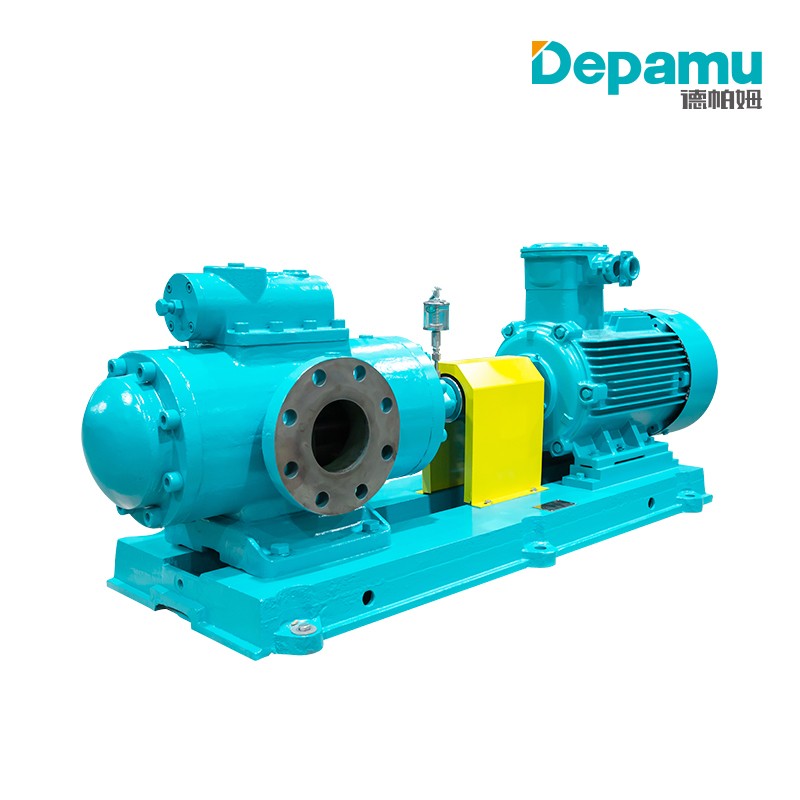
As the power rotor rotates, the cavities formed between the screw threads and the housing move axially, transporting the fluid from the suction port to the discharge port without pulsation. This design yields several inherent advantages crucial for lube oil service:
-
Axial Flow with Low Shear: The fluid moves in a straight, laminar flow path, which prevents emulsification of the oil—a common risk when lubricants are agitated.
-
Pulsation-Free Delivery: The continuous meshing action eliminates the pressure spikes common in piston pumps, extending the life of downstream filters and heat exchangers.
-
Quiet Operation: The submerged mechanical operation results in significantly lower noise levels compared to gear or vane pumps.
Depamu’s Engineering Heritage
Depamu (Hangzhou) Pumps Technology Co., Ltd., established in 2003 and located in the Qiantang Area of Hangzhou, has spent over two decades refining its fluid transfer technology. The company has positioned itself as a high-tech enterprise with a comprehensive portfolio ranging from Metering Pumps to high-pressure process pumps . However, their screw pump division—specifically the triple screw series—represents a convergence of international standards and localized manufacturing efficiency.
Depamu holds API Q1 and ISO 9001 certifications, ensuring that the design, material selection, and testing protocols align with global petroleum industry expectations . The company has successfully applied for over 100 technical patents, demonstrating a consistent commitment to addressing real-world operational friction points such as cavitation, vibration, and seal failure .
The ATEX Imperative for Lubrication Systems
The ATEX certification is not a performance rating but a safety directive. It originates from EU Directive 2014/34/EU, governing equipment intended for use in potentially explosive atmospheres. For a lube oil pump, the need for ATEX stems from two primary hazards: Mechanical sparking and Surface temperature ignition.
In a lube oil recirculation system, the pump is often located in the "skid" beneath a gas turbine or a compressor. In the event of a bearing failure or a dry start, metallic contact between the rotors or between the rotor and the casing could generate a spark hot enough to ignite ambient hydrocarbon gas. Furthermore, a pump operating under extreme friction (e.g., zero flow condition) could raise its external surface temperature above the auto-ignition temperature of the surrounding atmosphere.
The Depamu ATEX Triple Screw Pump addresses these risks through specific design interventions:
-
Controlled Clearances: The screws are machined with high precision to maintain a thin fluid film between the rotors. This non-contact design ensures that metal-to-metal contact does not occur during normal operation, eliminating a primary ignition source.
-
Temperature Monitoring Integration: The casing is designed with ports for thermocouples and resistance temperature detectors (RTDs) to integrate with plant safety shutdown systems.
-
Earthing Continuity: The assembly ensures electrical continuity to prevent static discharge across non-conductive lubricants.
Application Deep Dive: Lube Oil Recirculation
The recirculation loop of a turbine lube oil system is a closed-loop hydraulic circuit. Oil is drawn from a reservoir, passed through a strainer, pumped through a cooler and fine filter, and then distributed to bearings, couplings, and gear meshes. The oil then drains back to the reservoir by gravity.
The Depamu triple screw pump is optimized for this specific closed-loop duty cycle for several reasons:
1. High Suction Performance (NPSHr)
Lube oil reservoirs are often designed with minimal height differentials to keep the center of gravity low on offshore platforms. Consequently, the Net Positive Suction Head Required (NPSHr) of the pump must be low. Triple screw pumps excel here due to their large, open inlet cavities. Depamu’s design specifically optimizes the inlet port geometry to prevent cavitation damage when drawing viscous oil at ambient temperatures during cold starts.
2. Viscosity Tolerance
Lube oils typically range from ISO VG 32 to VG 68 (approximately 32 cSt to 68 cSt at 40°C). However, start-up temperatures can result in viscosities exceeding 1000 cSt. Gear pumps struggle with high viscosity, leading to shaft deflection or breakage. Centrifugal pumps suffer from "viscous drag" that drastically reduces flow. The Depamu triple screw pump, however, maintains volumetric efficiency across a wide viscosity range because the fluid acts as the lubricant and sealant between the screws. As viscosity increases, internal slip decreases, and volumetric efficiency actually improves slightly.
3. Integration with Heat Exchangers
Lube oil systems require precise temperature control (typically 45°C to 55°C) to maintain film strength. The pulsation-free flow from the Depamu pump is critical for shell-and-tube or plate heat exchangers. Pressure pulsations can cause vibration-induced fatigue in heat exchanger tube bundles. The sinusoidal flow profile of the triple screw pump maximizes the lifespan of these thermal components.
ATEX Compliance and Zone Classification
For plant operators and safety engineers, understanding the Zone classification is key to verifying that the Depamu pump is suitable for their installation.
-
Zone 1 (High probability): An area where an explosive atmosphere is likely to occur in normal operation. Depamu ATEX pumps for these zones require specific monitoring (bearing temperature, vibration) and flameproof (Ex d) motor couplings.
-
Zone 2 (Low probability): An area where an explosive atmosphere is not likely to occur, and if it does, it will be for a short period. Most standard Depamu ATEX II 3G classifications apply here, suitable for "Increased Safety" (Ex e) motors that prevent arcs and sparks during operation.
Depamu’s technical documentation allows engineers to select the appropriate Equipment Protection Level (EPL) matching their site’s hazardous area classification . The pumps are typically constructed with cast iron or carbon steel casings, providing a rugged barrier against external ignition of internal leaks, while external coatings are anti-static to prevent surface charging.
Material Selection and Mechanical Seal Strategy
One of the most frequent failure points in lube oil pumps is the shaft seal. For ATEX compliance, a leaking seal represents a release of flammable fluid (oil mist) into the atmosphere, creating a potential hazard.
Depamu employs several strategies for the triple screw pump in this regard:
-
Magnetic Drive Option: For zero-emission requirements, Depamu offers a magnetic coupling (canned pump principle) where the motor isolates the fluid completely from the atmosphere via a static containment shell. This is the gold standard for ATEX Zone 1 lube oil applications, though it comes with efficiency trade-offs.
-
Cartridge Mechanical Seals: For standard applications, Depamu utilizes balanced, cartridge-type mechanical seals (often silicon carbide vs. carbon). The cartridge design ensures that the seal is pre-compressed and set, eliminating installation errors that could lead to leakage.
-
API 682 Compliance: Where specified, the pump stuffing box can be configured to accept API 682 Type A or B seals (Pusher or Bellows), with flush plans (e.g., Plan 11 or 23) to ensure the seal face remains cool and lubricated, thus preventing thermal degradation—a hidden ignition source.
Operational Advantages in Recirculation Loops
Beyond safety, the Depamu ATEX Triple Screw Pump offers operational efficiencies that reduce the Total Cost of Ownership (TCO) for lube oil systems.
No Relief Valve Required (Self-Limiting Pressure)
Unlike progressive cavity or gear pumps, the triple screw pump is often considered "pressure limited." In a closed discharge scenario, the pressure rises until the motor stalls or the shaft breaks. However, because the screws "slip" hydraulically, the maximum pressure is limited by the driver’s torque. In practice, lube oil systems always require a relief valve for safety (to protect the cooler and filter housings), but the screw pump’s characteristics allow for lower safety margins compared to rigid positive displacement pumps.
Low Vibration Signature
Vibration monitoring is a cornerstone of predictive maintenance. The hydraulic balance of the triple screw pump (hydraulic radial forces cancel each other out due to the three-screw geometry) results in a very low vibration footprint. This allows condition monitoring systems to easily distinguish between pump cavitation/mechanical looseness and background noise from the turbine or compressor.
Start-Up Reliability
The self-priming capability of the Depamu Screw Pump is vital for lube oil systems after maintenance. Even if the suction line contains air, the pump can evacuate the line and establish prime, preventing bearing starvation on the main turbine.
Case Study Scenario: Offshore Gas Platform
Consider a hypothetical scenario: an offshore gas platform in the North Sea requires a new lube oil skid for an existing compressor. The area is classified as ATEX Zone 2 due to potential venting from wellheads. The oil is ISO VG 46, and the ambient temperature can drop to -10°C.
The engineering firm selects the Depamu ATEX Triple Screw Pump. The rationale includes:
-
Certification: Depamu provides the ATEX Certificate of Conformity (CE), essential for EU legal compliance.
-
Viscosity handling: The pump handles the cold-start surge viscosity without relief valve chatter or cavitation.
-
Footprint: The triple screw pump has a smaller footprint than a comparable duplex piston pump, saving valuable offshore deck space.
-
Material: Depamu specifies a low-temperature carbon steel (LCB) casing to handle the brittle transition risks of the North Sea environment.
The pump is specified with an ATEX-certified Ex e (Increased Safety) motor. The installation results in a 98% availability rate for the lube oil system over a two-year period, with seal replacement intervals exceeding 25,000 hours.
Maintenance and Serviceability
While ATEX often implies "complex," the mechanical design of the Depamu triple screw pump remains straightforward for maintenance crews. The typical maintenance strategy involves:
-
Bearing Inspection: Heavy-duty angular contact ball bearings absorb residual axial thrust. ATEX compliance requires that these bearings be non-sparking (often bronze-caged or specially coated) and run in an oil bath.
-
Screw Set Replacement: The power rotor and twin idler rotors are manufactured as a matched set. Depamu provides pre-measured sets that can be replaced without re-machining the housing, assuming the housing bore is within tolerance.
-
Timing Gears: Unlike Twin-Screw Pumps, triple screw pumps generally do not require external timing gears; the screws are self-driving via the fluid film. This removes a potential gearbox ignition source from the exterior of the pump.
Depamu’s service network, exporting to over 50 countries including the USA, UK, and France, ensures that spare parts are available for these critical maintenance operations .
Future Trends and Digital Integration
As industry moves toward Industry 4.0 and IIoT (Industrial Internet of Things), the Depamu ATEX Triple Screw Pump is evolving. Current iterations are being integrated with smart sensors that monitor differential pressure across the screw set. A drop in differential pressure indicates excessive internal wear (increased slip), which lowers volumetric efficiency. Conversely, a spike indicates viscosity increase or blockages.
For ATEX areas, these sensors must be intrinsically safe (Ex i). Depamu designs the pump housing with pre-tapped ports for these low-energy sensors, allowing operators to retrofit condition monitoring without re-certifying the entire pressure boundary.
Conclusion
The Depamu ATEX Triple Screw Pump for lube oil recirculation represents a synthesis of mechanical efficiency and explosion safety. In an industry where downtime costs can reach millions of dollars per hour and safety failures can result in catastrophic loss, the choice of a pump is not trivial.
By leveraging the three-screw principle—quiet, pulsation-free, and highly tolerant of viscous fluids—Depamu provides a solution that preserves the integrity of the lubricant, protects the heat exchange equipment, and ensures the continuous flow of oil to the most critical bearings. When combined with ATEX certification, the pump transcends its role as a mere fluid mover to become a certified safety device, permitting operations in the volatile environments where energy is found.
For engineers specifying equipment for refineries, power plants, or offshore installations, the Depamu unit offers a reliable path forward: compliance without compromise, and performance without peril. As global standards for emissions and safety tighten, the demand for ATEX-certified, highly efficient positive displacement pumps like Depamu’s triple screw range will only continue to grow.