

The Intelligent Workhorse: An In-Depth Analysis of Depamu Pneumatic Diaphragm Pumps (AODDP)
Abstract
In the landscape of industrial fluid transfer, the Air-Operated Double Diaphragm Pump (AODDP) occupies a unique position, bridging the gap between the simplicity of centrifugal pumps and the high-pressure capabilities of positive displacement pumps. Depamu (Hangzhou) Pump Technology Co., Ltd., a manufacturer integrating American, German, and Japanese process technologies, has developed a range of AODDPs that exemplify the evolution of this technology. This article provides a comprehensive engineering analysis of how Depamu pneumatic diaphragm pumps operate and explores their diverse industrial applications, from chemical processing to food production.
1. Introduction
The modern industrial environment demands pumping solutions that can handle aggressive chemicals, viscous slurries, shear-sensitive emulsions, and flammable solvents—often in remote or hazardous locations where electricity is unavailable or dangerous. The pneumatic diaphragm pump meets these challenges through a design that is at once remarkably simple and ingeniously effective.
Depamu, headquartered in Hangzhou's Qiantang New District, has positioned itself as a significant player in this technology sector. Their DPQ series of air-powered double diaphragm pumps represents a mature application of AODD (Air-Operated Double Diaphragm) principles, offering capabilities that include dry-running protection, explosion-proof operation, and the handling of solids up to 10mm in diameter.
2. The Fundamental Operating Principle
2.1 The Core Mechanism
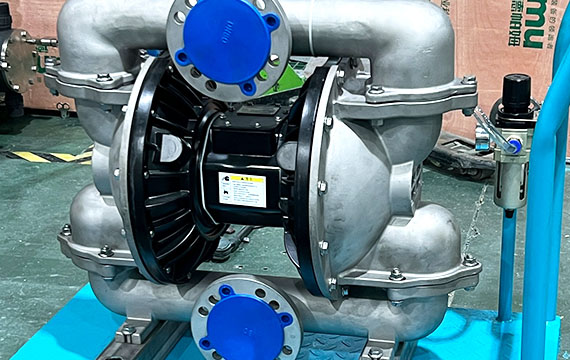
At its heart, the Depamu AODDP operates on a principle of balanced pneumatic reciprocation. Unlike electrically driven pumps that use rotating impellers or crankshafts, the AODDP uses compressed air as its sole power source. The system consists of two symmetrical fluid chambers, each containing a flexible diaphragm, connected by a common center block housing an air distribution valve.
The operating cycle can be broken down into four distinct phases:
Phase 1: The Power Stroke
Compressed air (typically at 2-7 kgf/cm² or 30-100 psi) is directed by the air valve to the backside of the right diaphragm. This pressurized air pushes the diaphragm outward into the fluid chamber, displacing the liquid in front of it. Simultaneously, a connecting rod (the diaphragm shaft) mechanically links the right diaphragm to the left diaphragm. As the right diaphragm moves inward (toward the fluid chamber), it pulls the left diaphragm in the opposite direction—outward (toward the air chamber).
Phase 2: Suction and Discharge
As the left diaphragm retracts (moving toward the air side), it creates a vacuum within its corresponding fluid chamber. This negative pressure causes the inlet check valve (ball or flap type) to lift, drawing fluid from the suction line into the chamber. Simultaneously, on the right side, the displaced fluid is being forced out through the discharge check valve.
Phase 3: The Shift
When the right diaphragm reaches the end of its discharge stroke (or a pilot valve detects the end of travel), it triggers the air distribution valve to shift. This is the critical moment in the cycle, facilitated by a pilot valve mechanism that senses back pressure or mechanical position.
Phase 4: The Return Stroke
The air valve now directs compressed air to the backside of the left diaphragm. The left diaphragm moves forward, discharging its fluid, while the right diaphragm retracts, drawing in a new charge of liquid. The cycle then repeats continuously, creating a smooth, pulsating flow.
2.2 The Air Valve: The Pump's "Brain"
Depamu's engineering emphasis on the air distribution system reflects a crucial reality: the air valve determines the pump's reliability. In Depamu AODDPs, the air valve is designed for "lubrication-free" operation, meaning it can run on standard plant air without requiring oil mist lubricators, which reduces maintenance overhead.
The valve operates on a differential pressure principle. When the diaphragms reach the end of their stroke, pressure differentials across the pilot valve cause it to shift, redirecting air flow. Modern Depamu designs utilize a "spool and sleeve" configuration made of wear-resistant materials (often stainless steel or engineered plastics) that can withstand millions of cycles without failure.
2.3 Flow Characteristics
Depamu AODDPs produce what engineers call a "near-linear" flow characteristic. Doubling the air pressure roughly doubles the fluid pressure, while increasing the air volume flow rate increases the cycling speed and thus the fluid flow rate. This relationship allows for simple flow control using a standard pressure regulator and needle valve on the air supply line—a stepless adjustment capability.
However, it is important to note that AODDPs produce pulsating flow. During each shift, there is a momentary pressure drop as the valves reposition. For applications requiring smooth flow, Depamu offers pulsation dampeners that attach to the discharge port to smooth these transients.
3. Technical Specifications and Capabilities
Depamu's DPQ series encompasses models from DPQ-10 (½-inch port) to DPQ-100 (4-inch port), offering flow rates from 0.8 m³/h to 30 m³/h (approximately 3.5 to 132 GPM).
3.2 Key Engineering Advantages
Self-Priming Capability: Depamu pumps can achieve suction lifts of 5-7 meters (16-23 feet) depending on model. This dry-priming ability is critical for applications where the pump is located above the fluid source, such as drum emptying or sump pumping.
Run-Dry Tolerance: Unlike centrifugal pumps that experience seal failure within minutes when run dry, or gear pumps that seize catastrophically, Depamu AODDPs suffer no damage from dry operation. The diaphragms simply reciprocate without fluid, and the wetted components are designed to tolerate this condition indefinitely.
Sealless Design: The diaphragm is the only component separating the fluid from the atmosphere. There are no rotating shaft seals, which are the most common leak points in conventional pumps. This makes AODDPs the default choice for hazardous, toxic, or expensive fluids where fugitive emissions cannot be tolerated.
Deadhead Capability: If a Depamu pump's discharge line is closed while the pump continues to operate, the fluid pressure will equalize with the air pressure, and the pump will simply stop cycling, drawing no additional power and suffering no damage. This is a significant safety feature for chemical injection applications.
3.3 Material Combinations for Fluid Compatibility
Depamu offers extensive material flexibility. The DPQ series can be specified with:
-
Housings: Aluminum (standard), 316L Stainless Steel (for corrosive or sanitary applications), Polypropylene/PTFE (for aggressive chemicals)
-
Diaphragms: NBR (oils and fuels), EPDM (hot water and dilute acids), FKM/Viton® (aggressive chemicals and solvents), PTFE (maximum chemical resistance)
-
Valve Balls/Seats: Matching elastomer or solid PTFE options
This modularity allows a single pump frame to be configured for applications ranging from deionized water to concentrated sulfuric acid.
4. Industrial Applications
The unique characteristics of Depamu AODDPs—sealless operation, dry-running tolerance, variable flow, and explosion-proof design—make them suitable for a remarkably broad spectrum of industries.
4.1 Chemical and Petrochemical Processing
The chemical industry presents perhaps the most demanding pumping challenges: aggressive solvents, abrasive catalysts, and toxic intermediates. Depamu has developed specific configurations for this sector.
Phosphate Injection in Boiler Systems: In power generation and chemical plants, boiler feed water must be treated to prevent scale formation. Calcium and magnesium ions naturally present in water react at high temperatures to form calcium carbonate scale, which insulates boiler tubes and can lead to catastrophic tube rupture. The standard mitigation method is phosphate injection.
The reaction is:
10Ca²⁺ + 6PO₄³⁻ + 2OH⁻ → Ca₁₀(OH)₂(PO₄)₆
This produces basic calcium carbonate—a soft, non-adherent sludge that can be removed via boiler blowdown rather than forming damaging scale. Depamu's Injection Packages combine AODDP Metering Pumps with solution tanks, pulsation dampeners, and PLC-based control systems that adjust injection rates based on real-time pH and phosphate readings.
Advantages in Chemical Service:
-
Zero leakage: Eliminates operator exposure to toxic substances
-
Explosion-proof: No electrical components in the pump head; suitable for Class I, Division I environments
-
Viscosity tolerance: Can handle fluids up to 10,000 centipoise (approximately the viscosity of heavy motor oil or corn syrup)
4.2 Wastewater and Environmental Treatment
Municipal and industrial wastewater treatment relies heavily on AODDP technology. Depamu's equipment is deployed in several key applications:
Polymer and Flocculant Dosing: The dewatering of sludge requires precise addition of high-molecular-weight polymers (flocculants). These fluids are notoriously shear-sensitive; high-speed centrifugal pumps or progressive cavity pumps can mechanically degrade the polymer chains, reducing effectiveness. The gentle, low-shear action of Depamu diaphragm pumps preserves polymer molecular weight, allowing lower dosing rates and reduced chemical costs.
Lime Slurry Transfer: Lime (calcium hydroxide) slurry is abrasive and prone to settling. Depamu pumps with EPDM diaphragms and aluminum or stainless steel housings handle this demanding fluid effectively. The ability to pass particles up to 10mm without clogging is particularly valuable here.
Chemical Dosing for pH Adjustment: Acid and alkali dosing for pH control requires accurate, reliable metering. Depamu's DPQ series with PTFE diaphragms and FKM valve seats resists chemical attack while providing the linear flow characteristic needed for closed-loop pH control systems.
4.3 Food and Beverage Processing
The sanitary requirements of food production demand pumps that are cleanable, non-contaminating, and gentle on products. While Depamu's standard DPQ series is suitable for many food applications, their engineering approach aligns with industry best practices observed in DEPA's DL-SFS series, which features electropolished 316L stainless steel housings with surface finishes of Ra ≤ 3.2 μm—smooth enough to prevent bacterial adherence and facilitate clean-in-place (CIP) procedures.
Typical Food Applications:
-
Beverage transfer: Wine, beer, fruit juices (requires gentle handling to prevent foaming or oxidation)
-
Confectionery: Chocolate, caramel, fillings (viscous, temperature-sensitive)
-
Dairy: Cream, yogurt, cheese curds (shear-sensitive, requires sanitary construction)
-
Edible oils: Vegetable oils, fish oils, glycerin
Sanitary Design Features:
-
Tri-clamp® or similar quick-disconnect fittings for easy disassembly
-
FDA-approved elastomers for diaphragms and valve seats
-
Polished fluid contact surfaces that resist bacterial growth
-
Drainable pump geometry without dead legs where product could stagnate
4.4 Paints, Coatings, and Inks
The printing and coatings industry relies heavily on AODDP technology. Depamu pumps are widely used for:
-
Solvent-based paints (requires FKM diaphragms for solvent resistance)
-
Water-based emulsions (less demanding, EPDM suitable)
-
Printing inks (high viscosity, abrasive pigments)
-
Adhesives and glues (viscous, quick-setting)
In these applications, the pump is often feeding a gravure printing press or coating head, where consistent, pulseless flow is critical for uniform application thickness. Depamu's pumps can be equipped with active pulsation dampeners that sense discharge pressure and automatically adjust air supply to minimize pressure fluctuations.
Key advantage: The infinitely variable flow control allows operators to "dial in" the exact transfer rate needed, from a trickle to full flow, without complex variable frequency drives or bypass systems.
4.5 Oil and Gas
The oilfield environment is harsh: remote locations, explosive atmospheres, limited access to electricity, and fluids ranging from produced water (highly saline) to crude oil (viscous) to methanol (for hydrate inhibition). Depamu's AODDPs excel here for several reasons:
-
Pneumatic operation: Compressed air is often available at wellheads for instrumentation; no electrical installation required
-
Portability: Lightweight aluminum models (the DPQ-25 weighs approximately 18 kg) can be carried to well pads or mounted on skids
-
Chemical injection: Methanol, corrosion inhibitors, demulsifiers, and scale inhibitors can be precisely metered into well streams or pipelines
A specific application is methanol injection for hydrate prevention. Natural gas hydrates (ice-like crystalline structures) can block pipelines at low temperatures and high pressures. Methanol injection lowers the hydrate formation temperature. Depamu packages combine a solution tank, metering pump (often a double-head configuration for blending two chemicals), and solar-powered controls for remote operation.
4.6 Pharmaceutical and Biotechnology
In pharmaceutical manufacturing, purity is paramount. Depamu (and similar manufacturers like DEPA) offer pumps with:
-
Electropolished 316L stainless steel (surface finish Ra ≤ 0.5 μm achievable)
-
Sanitary clamps and connections
-
PTFE diaphragms (chemically inert, non-leaching)
-
Validatable cleaning procedures
Typical applications:
-
Transfer of bulk drug intermediates
-
Filling of tablet coating solutions
-
Transfer of bioreactor media and harvest fluids
-
Diaphragm pump designs are preferred here because they have no dynamic seals that could shed particles or leak contaminants into the product stream.
5. Operational Considerations and Maintenance
5.1 Air Supply Quality
The single most important factor in Depamu AODDP reliability is compressed air quality. While the pumps are designed for lubrication-free operation, they are sensitive to moisture and particulates. Depamu recommends:
-
A 5-micron particulate filter
-
A coalescing filter for water and oil aerosols (if using lubricated plant air)
-
A pressure regulator (to maintain consistent operating pressure)
-
Ideally, a "slow start" valve that gradually pressurizes the pump to prevent hydraulic shock
Warning: Many plant air systems are lubricated for pneumatic tools. If the Depamu pump is not specified for lubricated air (i.e., if it uses a non-lubricated air valve design), the oil mist can cause elastomer swelling and valve sticking. A coalescing filter is required to remove oil aerosols.
The Depamu Pneumatic Diaphragm Pump (AODDP) represents a mature, reliable solution to some of industry's most challenging fluid transfer problems. Its operating principle—using compressed air to reciprocate diaphragms, with integral check valves controlling flow direction—is elegantly simple yet extraordinarily versatile.
The technical advantages are clear and significant:
Sealless, leak-free operation eliminates environmental and safety hazards
Run-dry tolerance provides operational robustness
Variable flow and pressure enable simple control without complex drives
Self-priming capability allows installation above fluid sources
Solid handling ability reduces clogging and maintenance
These characteristics have earned Depamu AODDPs a place in diverse industries: chemical processing, wastewater treatment, food and beverage, paints and coatings, oil and gas, and pharmaceuticals. In each sector, the pump is not merely a commodity component but an enabler of processes that would be difficult or impossible with other technologies.
For the plant engineer selecting a pump for a challenging application, the Depamu AODDP deserves serious consideration. When properly sized, supplied with clean, dry compressed air, and maintained on a reasonable schedule, these pumps provide years of reliable service. Their design philosophy—modular, repairable, and forgiving of less-than-ideal operating conditions—aligns well with the practical realities of industrial fluid handling.
The pneumatic diaphragm pump may lack the glamour of magnetic drive or canned motor pumps, but in the demanding environments of the factory floor, the wellhead, and the treatment plant, its robust simplicity continues to prove its worth, day after day, stroke after stroke.
Conclusion