

Depamu Metal Rotor Pumps for High-Viscosity Service: Customizable Mechanical Sealing and Flushing as the Decisive Engineering Variable
High-viscosity pumping is rarely limited by the rotor geometry alone. Positive displacement lobe pumps, by design, perform better as viscosity rises because the fluid fills the running clearances more effectively, suppressing internal slip and lifting volumetric efficiency rather than degrading it. The decisive failure mode in such service migrates downstream—to the shaft seal. A mechanical seal that functions flawlessly on water can fail within hours on a medium that polymerizes, solidifies upon cooling, or deposits a tenacious film across the seal faces. The Depamu metal rotor pump platform, engineered in accordance with API 676, addresses this bottleneck not as an afterthought but as a configurable subsystem: a generously dimensioned seal chamber that accepts a range of mechanical seal types, paired with a flushing strategy selected to match the thermal and rheological behavior of the process fluid.
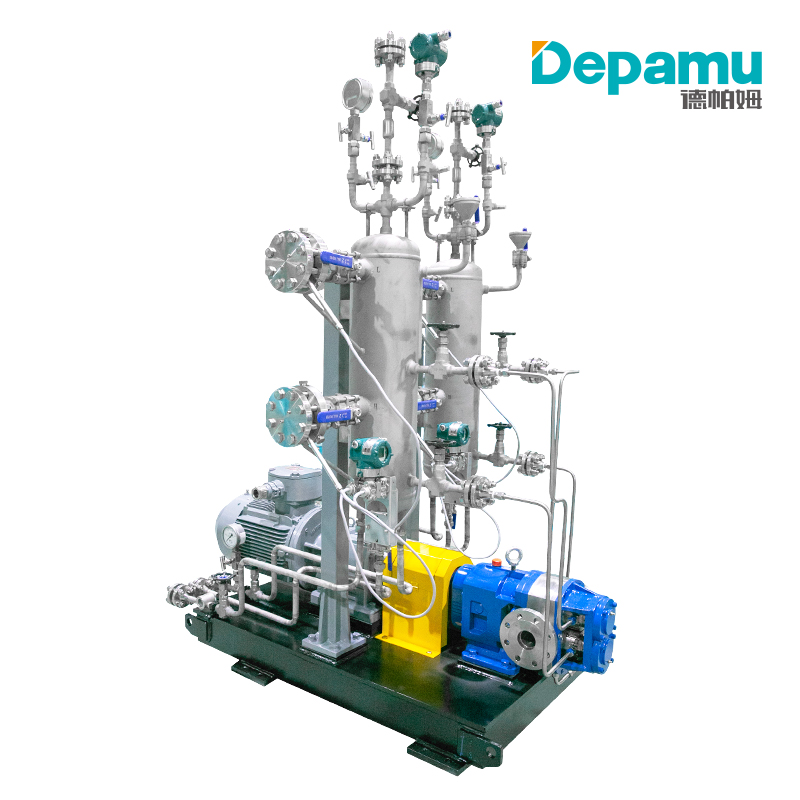
The Seal Chamber as a Configuration Platform
The architectural premise behind Depamu’s approach is the large seal chamber integrated into the Conilowa lobe pump series. Rather than forcing a single proprietary cartridge into a restrictive gland, the design accommodates a broad selection of mechanical seals—single, double, and tandem configurations—with face materials including silicon carbide and carbon. The same series shares common rotors, gears, bearings, axial lining plates, and mechanical seals, which simplifies spare-parts logistics across a multi-pump installation while preserving the freedom to specify seal hardware per service. This modularity matters because viscosity is not a single operating point. A fluid that is comfortably pumpable at 80 °C may become a near-solid at ambient startup, and the seal must survive both states.
Why Viscosity Breaks Seals—and What Flushing Does About It
Mechanical seals rely on a lubricating film between the primary faces. High-viscosity fluids complicate this in several ways. At low temperatures, the film may become so viscous that it generates excessive shear heat; if the fluid also tends to polymerize or crystallize, the seal faces can be glued together or abraded by solid deposits. At elevated temperatures, the reverse problem emerges: the fluid film thins, face cooling becomes inadequate, and the seal runs hot. External flush plans are the standard industrial answer, but their suitability is not universal. API Plan 01, an internal recirculation from pump discharge to the seal chamber, is specifically suited to highly viscous fluids that tend to thicken, solidify, or polymerize when exposed to atmosphere, because the internal line prevents the stagnant cooling that occurs in exposed external piping. It is, however, vulnerable to clogging by dirty products and is not recommended where solids are present. API Plan 32, by contrast, injects a clean external liquid directly into the seal chamber, diluting or displacing viscous, crystallizing, or polymerizing compounds before they can damage the faces. The trade-off is process dilution and the need for a reliable, compatible flush supply maintained at least two bar above seal-chamber pressure.
The engineering implication is that no single flushing arrangement is universally correct. A Depamu pump handling a shear-sensitive food syrup at moderate temperature may be optimally served by an internal flush that avoids product dilution. The same pump platform handling a hot, crystallizing chemical intermediate may demand an external flush with controlled flow, pressure indication, and a strainer to protect the injection orifice. The customizable interface between the seal chamber and the flushing circuit is therefore what converts a capable rotor pump into a reliable high-viscosity asset.
Matching Flush Strategy to Fluid Behavior
The selection logic begins with the fluid’s rheological profile and its thermal sensitivity. For fluids that are merely thick at ambient conditions but stable at operating temperature, an internal circulation plan can provide adequate face cooling without introducing a foreign liquid into the process. For fluids that exhibit a steep viscosity–temperature curve—glycerin, for example, can lose more than 80% of its viscosity with a 30 °C rise—temperature maintenance becomes inseparable from seal reliability, and a heated or insulated flush path may be required to prevent seal-chamber stagnation during standby. For fluids containing suspended solids or those prone to adhesive deposits, the seal chamber and flush piping must be designed for cleanability; external flush with filtration is generally preferred over an internal line that can blind over time.
Depamu’s API 676-compliant construction provides a robust baseline for these adaptations. The pumps operate across a temperature range from −40 °C to 280 °C, with capacity ranges from 0.1 to 10,000 m³/h and maximum discharge pressures to 2.0 MPa, and the rotor-to-rotor and rotor-to-body clearances are held between 0.05 and 0.30 mm according to the viscosity and characteristics of the transported fluid. That clearance band is not arbitrary: it represents the balance between minimizing slip on low-viscosity media and avoiding excessive shear or contact risk on highly viscous, thermally expanding fluids. A seal that is properly matched to this hydraulic environment—and to the flush regime that sustains it—completes the system.
Customization as a Lifecycle Decision
The value of a customizable seal-and-flush package extends beyond the initial installation. Mechanical seals in high-viscosity service are often the first components to announce a process upset: a rising flush temperature, a pressure drift, or a visible weep signals a change in fluid condition before the rotor or timing gears are affected. By specifying seal materials resistive to dry running and idling—a standard feature of the Depamu seal arrangement—the pump gains a margin of tolerance for upset conditions such as temporary loss of flush or unexpected viscosity excursions. The same logic applies to material selection for wetted seal components: silicon carbide faces offer hardness and thermal conductivity, while carbon faces provide dry-running tolerance and conformity, and the choice should follow the lubricity and abrasiveness of the specific product rather than a generic default.
For plants handling multiple viscous products through a common pump fleet, the modular Depamu architecture reduces the engineering burden of this customization. Because pumps of the same series share seal and rotor interfaces, a seal specification developed for one high-viscosity duty can be replicated across sister units, with flush-plan adjustments confined to the external piping and instrumentation rather than a complete seal redesign. This is the practical meaning of “customizable” in an industrial pump context: not infinite bespoke variation, but a structured configuration space in which the seal and its flushing environment are tuned to the fluid without destabilizing the proven hydraulic core.
Conclusion
The Depamu metal rotor pump is, at its foundation, a high-viscosity positive displacement machine with the clearances, temperature range, and API 676 pedigree to move demanding fluids efficiently. Its differentiating contribution to difficult viscous service lies in the decision to treat the mechanical seal and its flushing system as configurable engineering variables rather than fixed accessories. By offering a large seal chamber compatible with multiple seal types and by supporting both internal and external flush strategies, Depamu allows the seal environment to be matched to the fluid’s thermal and rheological behavior—the condition upon which sustained high-viscosity performance ultimately depends. In applications where a seal failure stops production, that configurability is not a convenience; it is the margin between a pump that runs and a process that holds.