

Abstract
In the demanding environment of liquefied natural gas (LNG) production and subsea hydrocarbon extraction, the prevention of gas hydrate formation is a critical operational priority. Monoethylene glycol (MEG) serves as the primary thermodynamic hydrate inhibitor, injected at high pressure to lower the freezing point of gas hydrates and ensure uninterrupted flow through pipelines and subsea equipment. This paper examines Depamu (Hangzhou) Pumps Technology Co., Ltd.'s high-pressure chemical injection skids designed for MEG service, evaluating their technical specifications, engineering philosophy, and operational significance within the broader context of the oil and gas industry. Drawing upon industry case studies, technical specifications, and the company's adherence to international standards, this analysis demonstrates that Depamu's skid systems represent a convergence of German engineering heritage and Chinese manufacturing capability, providing robust, API-compliant solutions for one of the industry's most persistent flow assurance challenges.
1. Introduction
The global energy industry's pursuit of natural gas from increasingly remote and challenging environments has necessitated sophisticated engineering solutions for flow assurance. Among the most significant threats to subsea production infrastructure is the formation of gas hydrates—crystalline ice-like compounds that form when water molecules trap gas molecules under conditions of low temperature and high pressure . These hydrates can solidify within pipelines and valves, impeding the transfer of oil and gas and potentially leading to costly shutdowns or, in worst-case scenarios, catastrophic hydrocarbon releases .
Monoethylene glycol (MEG) has emerged as the industry's preferred thermodynamic hydrate inhibitor, injected at high pressure at wellhead locations where hydrate risk is most acute . The precise measurement and delivery of MEG under extreme conditions—often exceeding pressures of 400 bar—requires specialized chemical injection skids that combine metering accuracy, material integrity, and operational reliability.
This paper examines Depamu's high-pressure chemical injection skids for MEG applications, situating their technical capabilities within the broader industry context of LNG and subsea development. Through analysis of the company's engineering heritage, product specifications, and quality certifications, this study argues that Depamu's skid systems offer a compelling solution for operators facing the dual challenges of hydrate prevention and operational efficiency.
2. The Hydrate Challenge and the Role of MEG
2.1 Formation Mechanisms and Operational Risks
Gas hydrates form when small hydrocarbon molecules—primarily methane, ethane, and propane—become trapped within a lattice of water molecules under conditions of elevated pressure and reduced temperature. In subsea environments, where ambient temperatures can fall below 4°C and pressures exceed 100 bar, the thermodynamic conditions are ideal for hydrate formation . The resulting crystalline structures can accumulate within pipeline walls, reducing flow capacity and, in severe cases, completely blocking the line.
The consequences of hydrate-induced blockages extend beyond mere operational inconvenience. Pipeline blockages may require shutdown, depressurization, and intervention—each carrying significant economic and environmental risks. The potential for uncontrolled hydrocarbon release during remediation operations underscores the critical importance of prevention over cure .
2.2 MEG as a Hydrate Inhibitor
MEG functions as a thermodynamic hydrate inhibitor by lowering the temperature at which hydrates form. The injection of MEG at the wellhead shifts the hydrate equilibrium curve, effectively acting as an "antifreeze" for the production stream . This process, known as "bullheading" in industry parlance, involves pumping MEG down the borehole to protect subsurface valves and wellhead equipment from hydrate formation during extended shutdowns .
The volume and rate of MEG injection must be carefully controlled to achieve optimal inhibition without excessive chemical consumption. Industry practice typically employs lean MEG (approximately 85 wt% MEG with 15% water) delivered at pressures reaching 419 bar and flow rates varying from low-dose applications to high-volume injection exceeding 10 m³ per hour .
3. Depamu: Engineering Heritage and Manufacturing Capability
3.1 Corporate Foundation and Technical Lineage
Depamu (Hangzhou) Pumps Technology Co., Ltd., established in 2003 and located within Hangzhou's National High-tech Development Zone, has emerged as a significant player in the global chemical injection equipment market . The company's foundational strength derives from a strategic technology transfer initiated in the early 1990s, when it introduced hydraulic diaphragm Metering Pump technology and advanced dosing device design from Germany .
This German engineering heritage has been combined with Chinese manufacturing capability to create a product portfolio that competes effectively in international markets. Depamu's products are now exported to over 20 countries, including France, Australia, South Africa, and Southeast Asian nations, demonstrating the company's ability to meet diverse regulatory and operational requirements .
3.2 Product Portfolio and Engineering Focus
Depamu has developed an extensive product range encompassing metering pumps, high-pressure Reciprocating Pumps, and complete chemical dosing devices. The company's engineering catalog includes 86 housing designs and over 4,000 specifications of metering and chemical pumps . Notable innovations include internationally leading three-diaphragm, four-diaphragm, and diaphragm leakage alarm pumps, each protected by multiple patents .
The company's product portfolio specifically addresses the needs of the oil and gas industry, with chemical injection skids designed for demulsifier, corrosion inhibitor, deoxidant, and MEG/ethylene glycol service . These skid systems are available with solution tank volumes ranging from 0.5 to 20 m³ and can accommodate single-pump or multi-pump configurations depending on operational requirements .
4. Technical Specifications and Design Philosophy
4.1 Adherence to API Standards
Depamu's chemical injection skids are designed and manufactured in accordance with American Petroleum Institute (API) Standard 675, which governs positive displacement metering pumps and their associated systems . This compliance ensures that the equipment meets internationally recognized requirements for safety, reliability, and performance. The company has also obtained certifications from Det Norske Veritas (DNV) and maintains ISO 9001:2000 Quality Management System certification .
4.2 Component Architecture
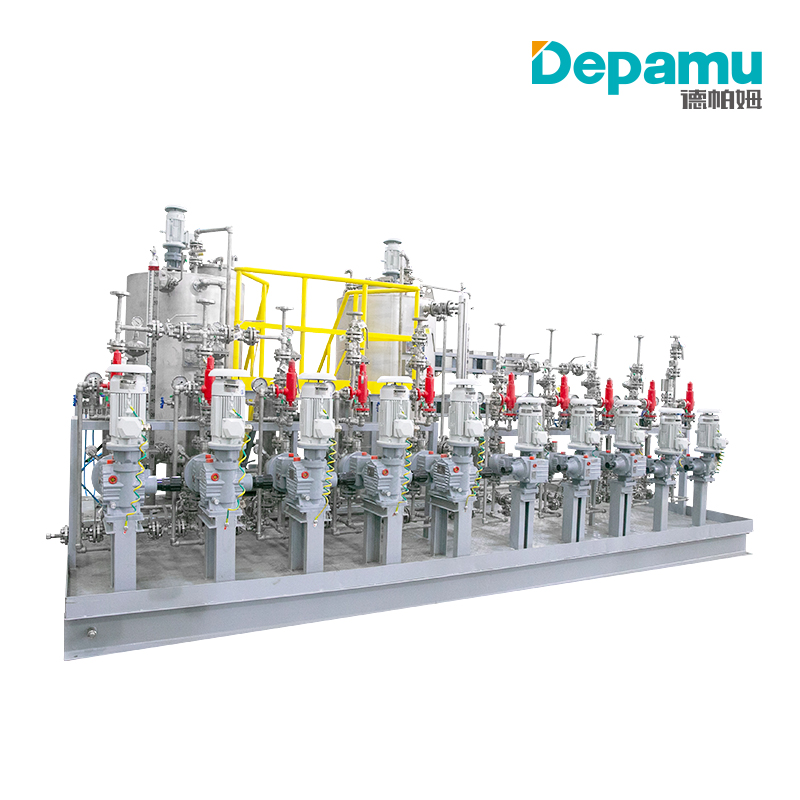
A typical Depamu MEG injection skid comprises several integrated components :
-
Solution Storage Tank: Constructed from 316 or 304 stainless steel to resist corrosion, with volumes ranging from 0.5 to 20 m³ depending on service requirements.
-
Hydraulic Diaphragm Metering Pump: The core of the injection system, featuring patented integrated sleeve adjustable eccentric transmission mechanisms for stepless stroke adjustment from 0% to 100%. The hydraulic diaphragm design incorporates internal safety valves and compensation valves for automatic air discharge and oil replenishment .
-
Pulsation Dampeners: Essential for mitigating pressure fluctuations in high-pressure MEG service, ensuring consistent delivery rates.
-
Control System: Electrical control cabinets support local manual control, semi-automatic operation, or fully automatic control via PLC or DCS integration. Frequency converter-driven adjustment allows pump speed to respond to signals from flow meters, pressure transducers, or turbidity sensors .
-
Safety and Instrumentation: Level gauges, safety relief valves, and pressure/temperature instrumentation ensure safe operation and provide data for remote monitoring.
4.3 High-Pressure Performance Capabilities
The demanding nature of MEG injection—particularly in deepwater subsea applications—requires equipment capable of operating at extreme pressures. Depamu's reciprocating pump designs, meeting API 674 standards, are available with discharge pressures exceeding 50 MPa (7,250 psi) and flow rates up to 16.8 m³/h depending on configuration and motor power .
This pressure capability is consistent with the requirements of major LNG projects, where MEG injection skids must deliver lean MEG at pressures up to 419 bar with flows ranging from approximately 3 to 10.8 m³/h . The ability to scale pump configurations—from single-head to multiple-head arrangements—allows Depamu to tailor solutions for both low-dose and high-volume injection applications .
4.4 Material Selection for Corrosive Service
MEG service, particularly in subsea environments, presents material compatibility challenges. Depamu offers wetted parts in materials including alloy steel, stainless steel, duplex stainless steel, titanium, and Hastelloy, allowing customization based on the specific chemical and environmental conditions . This material flexibility is critical for ensuring long-term reliability and minimizing maintenance requirements in offshore applications, where equipment design life may exceed 25 years .
5. Industry Context and Case Applications
5.1 The Ichthys LNG Project
The Ichthys LNG project, located in the Browse Basin off Western Australia, provides instructive context for understanding the operational demands placed on MEG injection equipment. Litre Meter supplied 45 positive displacement flow meters to the project's chemical injection skid, with the V125 meter specifically designed to measure MEG discharge at the wellhead pump .
The V125 meter's specifications—duplex construction, PVD-coated stainless steel nitronic rotor, 2-inch ANSI 2500 RTJ connection, and pressure rating of 414 bar—illustrate the extreme conditions under which MEG injection equipment must operate . The HF60 flow meter, also deployed on the Ichthys skid, is rated to 690 bar, demonstrating the industry's push toward ever-higher pressure capabilities .
5.2 Mozambique LNG and Subsea Support Systems
More recently, Total's Mozambique LNG project has required onshore subsea support equipment modules (OSSEMs) incorporating MEG injection systems. W-Industries, awarded a significant contract for these modules, will provide comprehensive systems including subsea production hydraulic power units, MEG injection systems, methanol injection systems, and independent chemical injection skids .
While Depamu is not directly named in this specific contract, the project's requirements—integrated process control, automation capabilities, and compliance with subsea operational standards—align closely with Depamu's product capabilities and API-certified design philosophy. The project's scale and technical demands underscore the importance of reliable chemical injection systems in modern LNG development.
5.3 Chemical Distribution Skid Integration
Industry practice increasingly favors modular chemical distribution skids that integrate multiple services within a unified framework. A recent equipment specification for a floating production system called for a chemical distribution skid divided into two cabinets: one dedicated to MEG injection (including Lean MEG High Dose, Low Dose, and AML services) and one for other chemicals .
This approach offers several operational advantages: centralized control, reduced footprint, simplified maintenance, and the ability to route multiple chemicals through common utility swivels to subsea umbilical paths. Depamu's skid configurations—available with up to 3 tanks and 5 pumps in a single unit—are well-suited to such integrated applications .
6. Quality Assurance and Compliance
6.1 Certification and Standards
Depamu's commitment to quality is evidenced by its multiple authoritative certifications. The company's hydraulic Diaphragm Pumps meet API 675 standards, and its reciprocating pumps are compliant with API 674 . DNV certification provides independent verification of the company's quality management systems and product reliability .
The company's adherence to recognized international standards is particularly important for export markets, where regulatory compliance is often a prerequisite for project participation. Depamu's ability to supply equipment meeting the requirements of major oil and gas operators, including those operating in Europe, Australia, and Southeast Asia, demonstrates its standing as a credible supplier in the global market .
6.2 Testing and Validation
Industry practice for chemical injection skids requires comprehensive factory acceptance testing (FAT) and system integration testing (SIT) prior to delivery. Depamu's manufacturing facilities, located in the Hangzhou Economic and Technology Development Zone, include test capabilities for verifying pump performance, control system functionality, and safety system operation .
The 25-year design life typically specified for offshore equipment necessitates rigorous testing protocols covering corrosion resistance, fatigue performance, and seal integrity under cycling pressure loads . While Depamu's specific test procedures are not detailed in available public documentation, its ISO 9001 certification and DNV approval suggest robust quality control processes.
7. Conclusions and Recommendations
7.1 Summary of Key Findings
Depamu's high-pressure MEG chemical injection skids represent a mature product offering that addresses one of the oil and gas industry's most persistent flow assurance challenges. The company's technical lineage, combining German pump design heritage with Chinese manufacturing capability, positions it as a competitive supplier in the global chemical injection equipment market.
The critical importance of MEG injection for hydrate prevention, validated by projects such as Ichthys LNG and Mozambique LNG, underscores the operational significance of reliable chemical injection equipment. Depamu's adherence to API 675 and 674 standards, coupled with DNV certification and material flexibility, provides operators with confidence in the equipment's suitability for demanding service conditions.
7.2 Recommendations for Operators
For operators evaluating chemical injection skid suppliers for MEG service, the following considerations are recommended:
-
Pressure and Flow Requirements: Carefully match skid specifications—including pump pressure rating, flow capacity, and control range—to the specific wellhead and pipeline conditions. Depamu's modular designs and wide range of pump models provide flexibility for both low-dose and high-volume applications.
-
Material Compatibility: Given the corrosivity of MEG solutions and the potential for contaminants, verify that wetted parts are appropriate for the specific fluid composition and operating temperature.
-
Automation and Integration: For subsea and offshore applications, ensure that control systems are compatible with existing DCS/PLC infrastructure and support remote monitoring and control.
-
Service and Support: Assess the supplier's ability to provide after-sales support, spare parts availability, and technical assistance, particularly for projects in remote locations.
7.3 Future Directions
As the oil and gas industry continues to push into deeper waters and more challenging environments, the demands on chemical injection equipment will only intensify. Future MEG injection systems will likely require even higher pressure ratings, improved efficiency, and greater integration with digital monitoring and predictive maintenance systems.
Depamu's continued investment in research and development, as evidenced by its multiple patents and ongoing product innovations, suggests that the company is well-positioned to meet these evolving requirements. The deep integration of German technology and Chinese manufacturing capability provides a foundation for continued competitiveness in the global chemical injection equipment market.