

Depamu Chemical Injection Pumps: Precise Dosing for Diverse Industrial Applications
In modern process industries, the accurate delivery of small volumes of chemicals often determines whether an operation succeeds or fails. A corrosion inhibitor injected at the wrong rate can leave a pipeline vulnerable to internal attack; an underdosed coagulant can allow suspended solids to pass through a water-treatment train; an overdosed demulsifier can waste expensive chemistry and destabilise downstream separation. Chemical injection is therefore not a peripheral utility but a core engineering function, and the Metering Pump at its centre must combine hydraulic robustness with repeatable precision. Depamu, a Hangzhou-based pump manufacturer founded in 2003, has built a product portfolio around exactly this requirement, offering plunger, hydraulic diaphragm and Mechanical Diaphragm Metering Pumps that deliver dosing accuracy down to ±0.5% across a wide range of flows, pressures and chemical media.
A Company Built Around Metering Precision
Depamu (Hangzhou) Pumps Technology Co., Ltd. was established in 2003 in the Hangzhou Economic and Technological Development Zone, with registered capital of 54 million yuan and a manufacturing area of approximately 35,000 square metres. From its early years the company focused on fluid-handling equipment, drawing on advanced technology and scientific management practices and collaborating with universities and research institutes on design and manufacturing. Its product range has since expanded from individual metering pumps to high-pressure Reciprocating Pumps, high-pressure process Diaphragm Pumps, air-operated diaphragm pumps, Screw Pumps, Rotor Pumps, complete chemical dosing packages, water-treatment equipment and water/steam sampling devices.
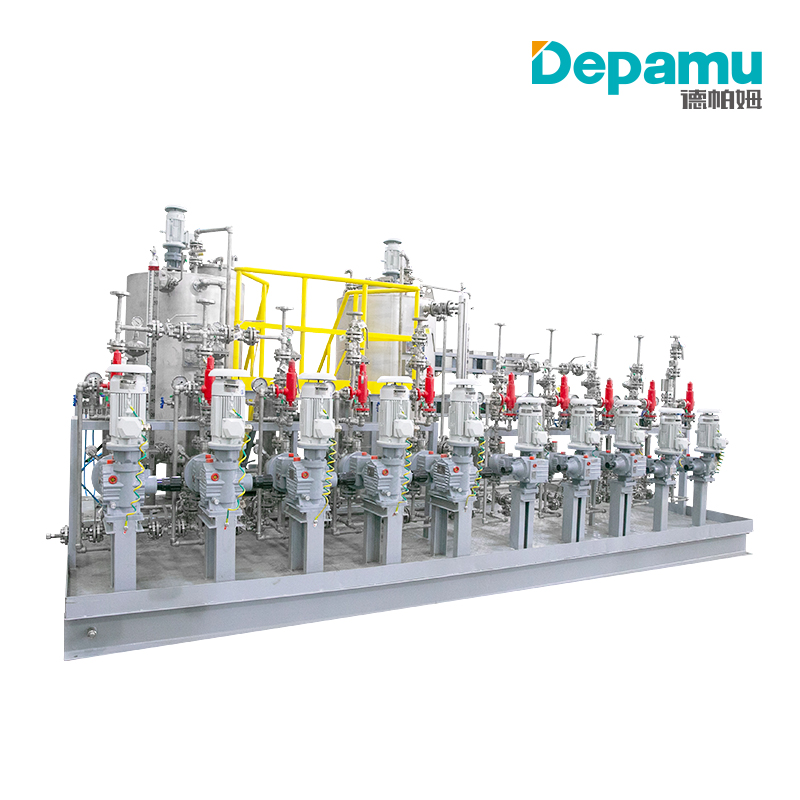
This evolution from component supplier to integrated fluid-system provider is significant. In chemical injection service, a pump is rarely installed in isolation: it must be matched to a solution tank, calibrated against a flowmeter, protected by a relief valve, connected to pulsation dampeners and integrated with a plant control system. Depamu's DPJY-series Injection Packages address this system-level requirement, combining tanks, metering pumps, level indicators, safety valves, pulsation dampeners, piping and electrical controls into skid-mounted units that simplify installation and commissioning.
The company's market position reflects this breadth. Depamu has established long-term partnerships with major national and international oil companies, including CNPC, Sinopec, CNOOC and CNNC, and its products are exported to more than 50 countries and regions, including the United States, the United Kingdom, France, Russia, Brazil, Australia, Iran, Sudan and Turkmenistan. Its products are designed to API 675 standards and have passed DNV and ISO 9001 certification.
The Precision Principle: Patented Eccentric Transmission and High-Accuracy Check Valves
The common thread running through Depamu's metering pump families is a patented integral-sleeve adjustable eccentric transmission mechanism. The motor drives a worm gear pair, converting rotary motion into reciprocating motion through an eccentric mechanism; the stroke length of the plunger or diaphragm is adjusted by changing the eccentric position, allowing continuous flow adjustment from 0 to 100%. Because the adjustment is mechanical and acts directly on stroke length rather than on motor speed alone, the pump can be calibrated across its full range with a high degree of repeatability.
The stated metering accuracy is ±0.5% over the 10–100% adjustment range for the plunger and hydraulic diaphragm families, while mechanical diaphragm pumps are typically rated at ±2% steady-state accuracy. This distinction is important: not every application requires the same precision. High-pressure chemical injection into a wellhead, where the cost of overdosing may be measured in barrels of wasted inhibitor, justifies the ±0.5% capability; a low-pressure dosing duty in a water-treatment plant may be adequately served by a mechanical diaphragm pump at lower capital cost.
Precision also depends on the inlet and outlet check valves. Depamu specifies high-precision check valve groups on its plunger and hydraulic diaphragm pumps to ensure that each stroke displaces a consistent volume and that reverse leakage does not corrupt the dose. In the DP(M)TA hydraulic diaphragm pump, the limit valve is machined to an accuracy of ±0.002 mm, with surface hardness of 60–70 HRC and roughness of 0.4 μm, and the diaphragm assembly is tested for 80 million cycles over a temperature range of −80°C to 160°C. These are the details that separate a metering pump from a generic positive-displacement pump.
A Product Portfolio for Diverse Duty Conditions
Depamu's chemical injection range is organised around three pump-head technologies, each suited to a different combination of pressure, flow, chemical compatibility and containment requirement.
Plunger Metering Pumps (DP(M)ZA, DP(M)DA, DP(M)WA and related series) place a high-performance plunger in direct contact with the process medium. The reciprocating plunger periodically changes the working-chamber volume, drawing in and discharging precise volumes through the check valves. The advantages are high pressure capability and mechanical simplicity: single-head flows reach 12,100 L/h and discharge pressures reach 228 MPa, making these pumps suitable for deep-well chemical injection, high-pressure pipeline service and oilfield water, polymer and alcohol injection. The direct-contact design demands careful selection of plunger material and packing; Depamu offers pump heads in 304, 316, 316L, 904 stainless steel, Hastelloy C and polymer materials to suit corrosive and high-temperature duties.
Hydraulic Diaphragm Metering Pumps (DP(M)TA, DP(M)DAA and DP(M)WA series) interpose a diaphragm between the process fluid and the hydraulic drive. The diaphragm is actuated by hydraulic oil, and internal safety and compensation valves automatically discharge air and replenish oil, maintaining reliable operation as process conditions vary. The principal benefit is zero-leakage containment: the pumped chemical never contacts the plunger or packing, which is particularly valuable for toxic, flammable, explosive or strongly corrosive media and for environmentally sensitive locations such as offshore platforms. Flow adjustment remains stepless from 0 to 100%, and metering accuracy is ±0.5% over the 10–100% range. Double or multiple diaphragms can be specified for hazardous fluids, and a diaphragm-rupture alarm prevents process fluid from contacting hydraulic oil in the event of a failure.
Mechanical diaphragm metering pumps (DPMFWA and related series) use a mechanically driven PTFE diaphragm without hydraulic oil. A slide rod driven by the eccentric mechanism deforms the diaphragm periodically to produce suction and discharge. These pumps are intended for lower-pressure applications, with maximum discharge pressures up to 1.2 MPa and flows up to 700 L/h in the DPMFWA range, or up to 3,200 L/h in larger mechanical diaphragm models. The PTFE diaphragm provides broad chemical compatibility, and the pump-head construction can be single- or double-diaphragm, with self-cleaning check valves and a maintenance interval of up to 8,000 hours at pressures of 0.7 MPa or below.
Across all three families, Depamu offers multiple flow-adjustment modes: manual handwheel adjustment, electric actuator adjustment for remote automatic control, pneumatic adjustment and variable-frequency motor speed control. Multi-head configurations of up to 12 pump heads in parallel allow either pulsation reduction when a single fluid is being dosed or proportional dosing of several different chemicals from one drive frame.
From Pumps to Packages: The DPJY-Series Injection Systems
The diversity of chemical injection duties becomes most visible in Depamu's DPJY-series dosing packages. These skid-mounted systems are configured for specific process functions rather than as generic pump assemblies. In oil and gas production, a demulsifier injection package may operate at 10–200 L/h against discharge pressures up to 4.0 MPa, breaking water-in-oil emulsions before crude enters the treatment train; a corrosion-inhibitor package typically covers 10–200 L/h at pressures up to 2.5 MPa; and a methanol or ethylene glycol injection package for hydrate prevention may be sized for 10–500 L/h at pressures up to 32 MPa, reflecting the severe conditions of cold-weather and deepwater operations. Biocide, oxygen-scavenger and scale-inhibitor packages follow similar modular logic, with tank volumes, pump capacities and control interfaces selected to suit the site.
In water and wastewater treatment, the same package architecture is applied to different chemistry. DPJY packages are configured for boiler-water injection, circulating-water treatment, raw-water pretreatment, wastewater treatment and sewage-treatment duties. Reagent dosing in municipal and industrial water treatment often involves coagulants, flocculants, pH adjusters, disinfectants and antiscalants, each with its own flow range, corrosivity and viscosity. The modular package approach allows the pump head material, diaphragm or plunger type, tank material and control mode to be selected independently, so that a single skid can accommodate, for example, a corrosive acid duty alongside a viscous polymer duty without compromising either.
The packages are also designed for automation. Depamu specifies manual and automatic control modes, with PLC-based control systems available for automatic dissolving and dosing in flocculation and sludge-dewatering applications. This matters because precise dosing is only useful if the dose can be adjusted in response to changing process conditions—flow-paced control, pH feedback, or concentration measurement. A metering pump with ±0.5% mechanical accuracy can still produce a poor result if the control loop cannot translate a process signal into a reliable stroke adjustment; the availability of electric, pneumatic and frequency-conversion stroke adjustment across the range addresses this system-level requirement.
Materials, Corrosion Resistance and Difficult Media
Chemical injection pumps are exposed to some of the most aggressive fluids in industry. Depamu's material strategy reflects this. Pump heads are available in 304, 316 and 316L stainless steels, superaustenitic 904L, Hastelloy C and polymer materials, while solution tanks can be supplied in stainless steel, carbon steel with rubber or plastic lining, PRV, PE or PVC. This allows the wetted path to be matched to the specific chemistry, whether the duty involves acidic stimulation fluids, alkaline scale inhibitors, hypochlorite solutions, methanol or produced water containing CO₂ and H₂S.
The pump families also address difficult physical properties. High-viscosity media are common in heavy-oil production and pipeline transport; high-temperature duties are accommodated by PTFE-wetted components rated to 80°C in mechanical diaphragm pumps, with special configurations available for higher temperatures. For fluids containing solids, Depamu's broader rotor-pump range is designed to handle solids up to 60% by weight, while the metering pump families are generally applied to clean or lightly contaminated chemical solutions. The critical point is that the injection system is selected as a whole—pump, valves, piping and tank—rather than as a pump alone, so that compatibility and cleanability are considered together.
Operational Reliability and Maintenance
In remote oilfields, offshore platforms and unmanned water-treatment sites, maintenance access is limited, and a pump that cannot be serviced with basic tools becomes a liability. Depamu's plunger and hydraulic diaphragm pumps use oil-immersion lubrication for the transmission mechanism, which extends the service life of the worm gear and eccentric components and reduces routine maintenance to oil changes and seal inspection. Mechanical diaphragm pumps similarly use bath lubrication of the drive parts, with the pump-head check valves designed in a self-cleaning structure to reduce fouling-related drift. Maintenance intervals of up to 8,000 hours are cited for mechanical diaphragm units under favourable pressure conditions, while the hydraulic diaphragm design's automatic air-discharge and oil-replenishment functions reduce the need for manual intervention after commissioning.
Why Precision Matters Across Industries
The unifying argument for Depamu's approach is economic as well as technical. In large-scale oil and gas operations consuming thousands of litres of treatment chemical per year, a dosing error of even a few percent represents a significant cost—either wasted chemical or inadequate protection. In water treatment, overdosing a coagulant can increase sludge production and alter treated-water chemistry, while underdosing can fail to meet turbidity targets. In chemical and petrochemical plants, precise addition of inhibitors, antioxidants and pH-control agents protects reactors, heat exchangers and storage systems from corrosion and fouling. The ±0.5% metering accuracy of the plunger and hydraulic diaphragm families, combined with stepless stroke adjustment and a choice of manual, electric, pneumatic or frequency-based control, provides the mechanical foundation for these process-control outcomes.
Conclusion
Depamu's chemical injection pumps are best understood not as a single product but as a coordinated engineering platform for precise liquid dosing. The portfolio spans direct-contact plunger pumps for the highest pressures, hydraulic diaphragm pumps for zero-leakage containment of hazardous chemicals, and mechanical diaphragm pumps for cost-effective lower-pressure duties. Around these pump heads, the company has built a family of skid-mounted injection packages configured for demulsifier, corrosion-inhibitor, hydrate-prevention, biocide, boiler-water and wastewater-treatment duties, with materials and control options matched to the chemistry and the process environment. The common design principles—patented eccentric stroke adjustment, high-precision check valves, oil-immersion lubrication and multi-mode flow control—allow the same precision philosophy to be applied across pressures from a few bar to 228 MPa and flows from a few litres per hour to more than 12,000 L/h. For industries where the correct dose is the difference between protection and failure, that combination of precision, breadth and system integration is the core value proposition.