

Engineering Analysis: Divergent Philosophies in Depamu-pumps.com/Screw-Pump.html target='_blank'>Screw Pump Technology – Allweiler vs. Depamu
Abstract
The global pump industry is broadly segmented between original equipment manufacturers with deep engineering histories and emerging manufacturers offering cost-optimized alternatives. This paper presents a technical comparison between Allweiler (a brand of CIRCOR International with German heritage) and Depamu (Hangzhou) Pumps Technology Co., a Chinese manufacturer. While both companies produce machinery classified under the "screw pump" category, a rigorous analysis of their patents, product specifications, and mechanical architectures reveals that they operate in fundamentally different segments of the positive displacement market. This article explores the mechanical, operational, and application-specific differences between these two entities.
1. Introduction
Selecting an industrial pump requires more than a comparison of flow charts; it demands an understanding of the manufacturer's engineering pedigree and design intent. The term "screw pump" is often used as a generic descriptor for any pump utilizing a screw-like rotor. However, the mechanical complexity varies drastically—from high-pressure triple-screw hydraulic units to single-screw progressive cavity designs used for sludge.
This analysis distinguishes Allweiler AG, a century-old German firm now under CIRCOR, known for precision-engineered three-screw spindles for high-pressure oil and gas applications, from Depamu, a modern Chinese manufacturer specializing in dosing, metering, and progressive cavity technologies. The primary differentiation lies not in quality, but in architecture: Allweiler focuses on "multiple-screw" (specifically three-screw) kinetics, while Depamu focuses on "single-screw" (progressive cavity) and metering diaphragm hybrids.
2. Mechanical Architecture: The Core Differentiation
The fundamental difference between these brands begins with the number of rotors and the physics of fluid transportation.
2.1 Allweiler: The Triple-Screw Synchronization
Allweiler is globally recognized for its Three-Screw Pump technology, specifically the SN, SM, and EMTEC series . The architecture is consistent and highly engineered:
-
Components: One central "power rotor" (driving screw) and two symmetrically opposed "idler rotors" (sealing screws).
-
Kinetics: The power rotor is driven by the motor. The fluid acts as a lubricant, causing the two idler rotors to rotate in the opposite direction via hydraulic pressure, not mechanical gear contact.
-
Hydraulic Balance: A defining feature of Allweiler design is the hydraulic axial thrust compensation. Patents dating back to the 1970s (US Patent 3597133) detail specific collars and bearing arrangements where the axial thrust of the driving rotor and idler screws are counterbalanced within the suction chamber, eliminating the need for massive thrust bearings at high pressures . Later patents (US Patent 5123821) refined the "profile termination" (the start and end of the screw threads) into conical shapes to reduce pressure pulsation, achieving smooth, vibration-free flow at high RPMs .
2.2 Depamu: The Progressive Cavity and Metering Focus
Depamu’s catalog reveals a different mechanical focus. While Depamu offers multiple pump types, their "screw pump" marketing primarily refers to Single Screw (Progressive Cavity) Pumps and advanced Metering Pumps .
-
Single Screw (Progressive Cavity): This architecture utilizes a single metal rotor (screw) turning inside a double-helix elastomeric (rubber) stator. Unlike Allweiler’s rigid triple-screw setup, Depamu’s single螺杆设计 creates progressive cavities that are ideal for shear-sensitive media.
-
专利技术: Depamu’s intellectual property, such as CN103362769B, focuses on "Metering Pumps with Integral Eccentric Wheel Stroke Adjustment Mechanisms." This indicates innovation in dosing accuracy and variable stroke adjustment rather than high-pressure hydraulic sealing .
-
混合设计: Some Depamu Dosing Pumps utilize worm gear pairs and mechanical diaphragms, which is a completely different principle from Allweiler’s pure rotary screw classification .
2.3 Summary of Mechanical Differences
| Feature | Allweiler (Three-Screw) | Depamu (Single-Screw / Metering) |
|---|---|---|
| Rotor Count | 3 (One power, two idlers) | 1 (Metal rotor) + 1 Elastomer Stator |
| Contact | Rolling/Hydrodynamic film (Non-contact) | Sliding contact (Rotor/Stator friction) |
| Flow Type | Axial, continuous, non-pulsating | Low pulsation, but shear occurs in stator |
| Primary Physics | Hydrodynamic lifting & sealing | Cavity progression & displacement |
3. Performance Envelopes: Pressure, Flow, and Viscosity
The application of a pump is dictated by its performance curve. The data extracted from manufacturer specifications show minimal overlap between these two brands.
3.1 Pressure Capabilities
Allweiler is designed for high hydraulics. Standard SN series pumps operate at differential pressures up to 64 bar (928 psi) , with specialized EMTEC series reaching 100 bar (1,450 psi) . This is achieved through the "thrust absorber" technology mentioned in their patents, which allows the pump to handle the axial forces generated by high pressure without mechanical failure .
Depamu single-screw pumps generally operate in lower pressure ranges. Standard progressive cavity pumps are often rated for lower pressures due to the limitations of the elastomeric stator. While Depamu offers high-pressure plunger pumps (up to 350 MPa in their THP series), these are not screw pumps. Their chemical dosing screw pumps typically max out around 1.2 MPa (174 psi) .
3.2 Viscosity and Temperature
-
Allweiler: Excels with low to medium viscosity fluids. They can handle up to 2,000 cSt (similar to heavy fuel oil) but are also highly efficient with thin hydraulic fluids due to their tight clearances . They handle high temperatures up to 250°C (482°F) in the SM series .
-
Depamu: The single-screw design is a "progressive cavity" pump, making it superior for extremely high viscosities (up to 1,000,000 mPas) and fluids containing solids (particles up to 30mm) . However, the elastomeric stator limits temperature resistance generally to ~150°C, depending on rubber compound.
4. Application Ecology: Where they are specified
4.1 Allweiler: The Industrial Hydraulic Spine
Given its high pressure, low pulsation, and ability to run dry for short periods (self-priming), Allweiler is specified for critical infrastructure.
-
Marine: Main engine lubrication, fuel oil supply, and boosters.
-
Oil & Gas: Crude oil transfer, pipeline pressure boosting.
-
Power Generation: Turbine lube oil.
-
High-End Hydraulics: Machine tools due to the "pulse-free flow" .
Case Study: Allweiler's R&D has specifically focused on reducing pulsation in high-speed spindles (US5123821), making them suitable for precision cutting tools where vibration affects surface finish .
4.2 Depamu: The Chemical and Sanitary Workhorse
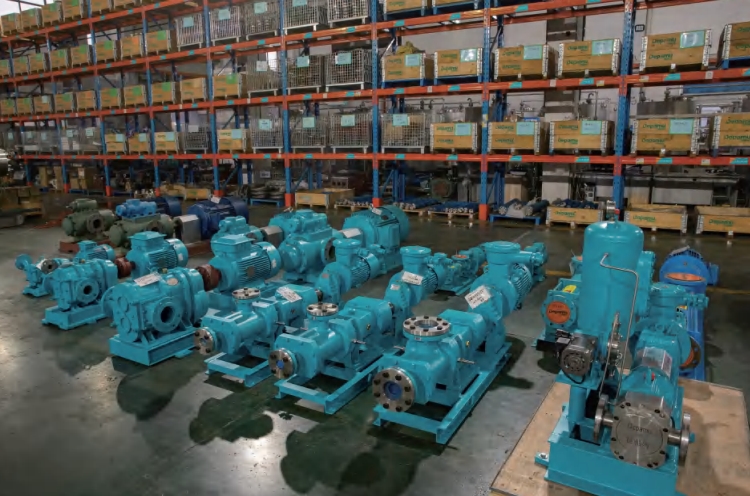
Depamu’s strengths lie in metering and handling difficult media.
-
Water Treatment: Dosing polymers, coagulants, and acids (using PVC/PTFE heads).
-
Food and Beverage: Transferring yoghurt, jam, or dough without shearing the molecular structure. Depamu explicitly markets "no shearing or mixing" to protect the product .
-
Chemical Processing: Handling abrasive slurries and corrosive chemicals (pH 0-14) .
Case Study: The Depamu hopper-fed screw pump is designed to pull viscous sludge off a hopper floor, something a traditional Allweiler three-screw pump cannot do due to the risk of dry running and solid particle damage .
5. Operational Nuances: Maintenance and Efficiency
5.1 Reliability and Simplicity (Allweiler)
The Allweiler three-screw design has a "Total Cost of Ownership" advantage due to its simplicity. There are only three moving parts and one shaft seal. Because the idler screws are driven hydraulically (not mechanically), there is no gear wear. Furthermore, Allweiler has developed "Allspeed" control systems using adaptive algorithms to adjust pump speed in real-time (<500ms), significantly reducing standby power losses .
5.2 Maintenance Intervals (Depamu)
The single-screw architecture of Depamu has a consumable part: the elastomeric stator. Over time, the rubber stator wears out, especially when handling abrasives. Depamu lists a maintenance period of "≤4000 h" under high pressure . Allweiler, conversely, is known for decades of service in lubrication circuits if clean fluid is maintained, as the screws never touch each other (hydrodynamic film).
6. Conclusion
The difference between an Allweiler Screw Pump and a Depamu Screw Pump is primarily a difference of taxonomy versus technology.
Allweiler represents the German heavy-industrial standard for three-screw rotary pumps. It is a high-pressure, high-temperature, high-speed precision machine designed for energy transfer (hydraulics, fuel, lube oil). Its engineering priorities are dynamic balancing (US3597133), pulsation reduction (US5123821), and longevity in continuous duty.
Depamu represents the Chinese modern solution for single-screw progressive cavity and metering pumps. It is designed for process control, chemical dosing, and handling non-Newtonian fluids. Its priorities are material compatibility (PTFE, PVC), abrasive handling, shear-sensitive transport, and metering accuracy (via eccentric stroke mechanisms ).
For an engineer, the choice is binary: If you are pumping hydraulic oil at 100 bar in a marine engine, you require Allweiler. If you are dosing poly-aluminum chloride into a water tank or pumping marmalade with fruit chunks, you require Depamu. Confusing the two based on the "screw" nomenclature would lead to rapid mechanical failure or inefficient system design.