

Engineering Safety and Precision: The Depamu High-Pressure Plunger Reciprocating Pump For Ethylene Oxide (EO)
1. Introduction: The Challenge of Ethylene Oxide Transfer
In the landscape of industrial chemical processing, few substances present a handling challenge as formidable as Ethylene Oxide (EO). As a vital intermediate in the production of ethylene glycol, polyesters, detergents, and sterilants, EO is the lifeblood of modern manufacturing . However, its physical and chemical properties—specifically its extreme volatility, low boiling point (10.7°C), high vapor pressure, and acute toxicity—classify it as a hazardous material requiring the highest levels of engineering control.
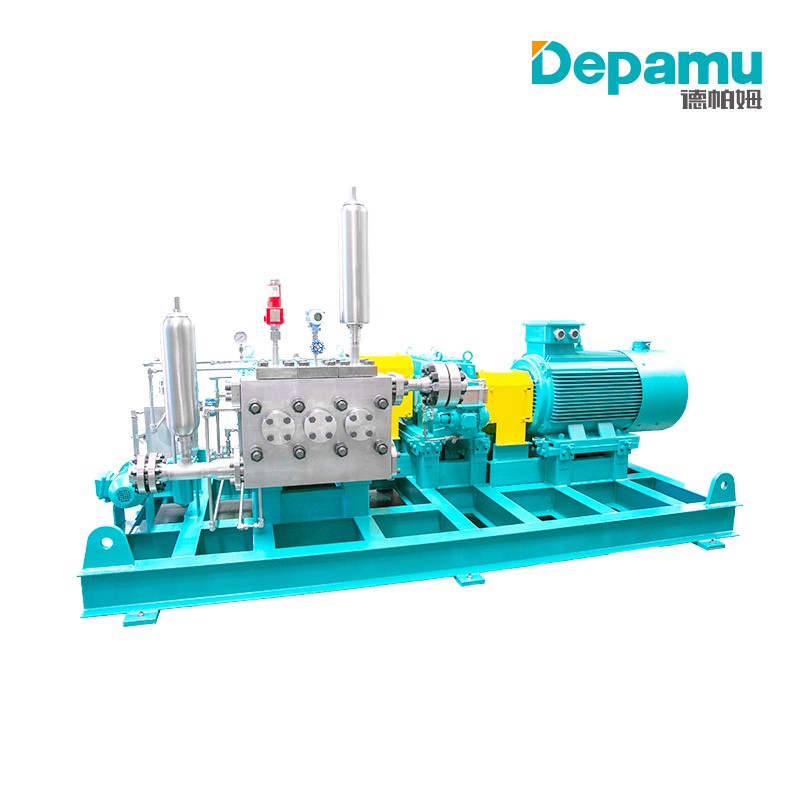
This article explores the technical specifications and engineering rationale behind the Depamu high-pressure plunger reciprocating pump, specifically the 3HD120B-MSBD10.0-0.3W model, designed for the safe and efficient transfer of Ethylene Oxide . We will analyze why the reciprocating positive displacement mechanism, combined with specific metallurgical choices, is currently the industry standard for mitigating the risks associated with EO.
2. Why EO Demands Reciprocating Plunger Technology
2.1 The Limitations of Conventional Pumps
Centrifugal pumps, while common for water or oil, are generally unsuitable for high-risk EO transfer. The high shear rates within centrifugal impellers can generate localized heat, raising the fluid temperature and risking vaporization. Furthermore, the dynamic seals (mechanical seals) required for centrifugal pumps are a potential leak path. Even micro-leaks of EO are dangerous as they form flammable mixtures with air.
2.2 The Positive Displacement Advantage
Reciprocating plunger pumps, such as those manufactured by Depamu, operate on the positive displacement principle. As the plunger retracts, fluid is drawn into the cylinder; as it advances, the fluid is displaced into the discharge line at high pressure . This mechanism offers two critical advantages for EO:
-
High-Pressure Capability: EO is often stored under its own vapor pressure or requires injection into high-pressure reactors. Plunger pumps can easily achieve pressures exceeding 228 MPa (approx. 33,000 PSI) .
-
Sealing Integrity: The plunger packing or stuffing box, when engineered correctly, provides a reliable seal that can handle the low viscosity and high penetrability of EO better than mechanical faces that require a fluid film.
3. Depamu 3HD120B-MSBD10.0-0.3W: Technical Deep Dive
The model 3HD120B-MSBD10.0-0.3W represents a specific configuration within Depamu’s industrial range, designed to meet API 674 standards (reciprocating positive displacement pumps for petroleum, petrochemical, and gas industry services) .
3.1 Hydraulic Performance
The nomenclature suggests specific hydraulic capabilities tailored for chemical feedstock transfer:
-
Power Configuration: The "3HD" prefix typically denotes a triplex plunger design (three plungers). Triplex designs are preferred over simplex (single) or duplex (double) because they significantly reduce flow pulsation, which is vital for stabilizing chemical reactions and reducing stress on downstream piping when moving EO.
-
Drive Mechanism: The pump utilizes an "Oude" worm gear pair or integrated eccentric adjustable transmission. This provides a mechanical efficiency that is crucial for maintaining the viscosity of EO, which is relatively low compared to oils, ensuring that the mechanical slip is minimized .
3.2 Leak-Free Operation
The most critical requirement for EO pumps is zero fugitive emissions. Depamu addresses this through high-performance stuffing and sealing components. The "MSBD" variant in the model number often indicates specific material certifications (Metallurgy, Special, Bushing, Diaphragm?).
-
Pulsation Dampening: Unlike air-operated double-diaphragm (AODD) pumps that require venting, the Depamu plunger pump is a sealed system, preventing EO vapor from escaping into the atmosphere .
-
Relief Valve Integration: Depamu literature explicitly notes that because these Metering Pumps lack internal relief devices, a relief valve on the outlet pipeline is "suggested" – though for EO, it is considered mandatory engineering practice to prevent dead-head pressure build-up .
4. The Metallurgy of Safety
Ethylene Oxide is chemically aggressive. It reacts with water to form ethylene glycol, but more importantly, it is incompatible with many standard elastomers and metals, particularly those containing Aluminum, Zinc, Cadmium, or Silver. EO reacts violently with these metals, potentially leading to explosive decomposition.
Depamu addresses this by offering wetted parts (the components that touch the fluid) in specific high-grade materials :
| Material Option | Compatibility with EO | Application Justification |
|---|---|---|
| Stainless Steel (316L) | Excellent | Standard for EO. The passive oxide layer resists corrosion. Prevents catalytic decomposition. |
| Hastelloy C | Superior | Used in environments where trace chlorides or acids might be present alongside EO. |
| PTFE / Polymer | Excellent | Used for sealing rings and check valve seats due to its chemical inertness. |
Avoidance of Non-Metallics: While standard pumps use Buna-N or Viton seals, EO requires specialized PTFE (Teflon) or Kalrez seals. The plunger packing must be constructed with PTFE impregnated with carbon or glass fiber to prevent extrusion under high pressure .
5. Metering Accuracy and Process Control
In EO applications, such as the production of surfactants or ethanolamines, the ratio of EO to other reactants (like alcohol or ammonia) dictates the final product quality.
5.1 Precision of ±0.5%
Depamu plunger pumps are engineered for high metering accuracy. The transmission mechanism allows for stroke adjustment from 0-100% while maintaining a metering accuracy of ±0.5% in the 10%-100% adjustment range . This is achieved through high-precision inlet and outlet check valves (ball and seat designs) that seat positively, preventing the slippage of low-viscosity EO back through the valve during the pressure stroke.
5.2 Control Mechanisms
To manage the varying demands of a chemical plant, the Depamu series supports multiple adjustment modes:
-
Manual Adjustment: For fixed flow rates.
-
Electric Actuation: For remote control via the DCS (Distributed Control System).
-
Frequency Conversion (VFD): Changing the motor speed to alter flow rate.
This remote automatic control capability is vital for EO, as it keeps operators away from the pump skid and potential leak points .
6. Operational Hazards and Mitigation
6.1 The "Dry Running" Risk
EO is often a "non-lubricating" fluid. Unlike crude oil, EO does not provide significant boundary lubrication to the plunger.
-
The Solution: Depamu designs feature oil-immersed lubrication for the transmission components . However, for the fluid end, the plunger material (often ceramic-coated or hardened stainless steel) is selected for its wear resistance. Some systems utilize a "jacketed" packing with a lubricant isolator, though this must be strictly compatible with EO to avoid contamination.
6.2 Pressure Pulsation Management
Reciprocating Pumps generate pulsating flow. In EO liquid lines, pulsation can cause cavitation if the Net Positive Suction Head (NPSH) is not maintained, or vibration that loosens fittings.
-
Design Response: While the triplex design reduces pulsation by 66% compared to a single plunger, Depamu often recommends (or supplies) pulsation dampeners specifically charged with Nitrogen (not air, due to the fire risk) to ensure smooth flow .
7. Maintenance and Safety Protocols
Operating a Depamu pump for EO requires strict adherence to protocols to ensure the integrity of the mechanical seal and packing.
-
Plunger Alignment: Misalignment between the drive end and the fluid end causes uneven packing wear. Depamu’s modular compact design ensures that the plunger is perfectly aligned with the stuffing box, minimizing this risk .
-
Packing Adjustment: The stuffing box uses a series of PTFE V-rings. A leak-tight condition is essential. Standard practice for EO is to have a "tell-tale" port (leak-off port) connected to a closed collection system. If EO leaks past the primary packing, it is captured and safely flared or vented to a scrubber, not the floor.
-
Pre-Start Flushing: The pump head must be thoroughly dried and purged with Nitrogen before EO introduction. Even trace moisture in the pump head will react with EO to form glycol, which is sticky and can cause the check valves to stick open, destroying the pump’s priming ability.
8. Comparative Analysis: Plunger vs. Diaphragm
It is important to note that Depamu manufactures both Plunger (Plunger) and Hydraulic Diaphragm (Process Diaphragm) pumps . Which is better for EO?
| Feature | Depamu Plunger Pump (3HD Series) | Depamu Process Diaphragm Pump (HD Series) |
|---|---|---|
| Pressure Capability | Very High (Up to 228 MPa) | High (Up to 83.5 MPa typical) |
| Leak Potential | Low (Packing/gland seal) | Zero (Hermetic seal) |
| Cost | Lower initial cost | Higher cost |
| Best Use Case | High-pressure injection, metering, where minor maintenance is acceptable | Toxic, absolute zero-leak scenarios, abrasive fluids |
For Ethylene Oxide, while a diaphragm pump (hydraulically actuated) offers "zero leakage" of the pumped fluid to the atmosphere, a high-quality plunger pump with a packed plunger is still widely used because it handles the thermal expansion of EO better and is generally more robust against the transient pressures of gas entrainment.
9. Conclusion
The Depamu 3HD120B-MSBD10.0-0.3W high-pressure plunger reciprocating pump represents a convergence of mechanical strength and chemical prudence. By leveraging a triplex positive displacement design, offering wetted parts in 316L or Hastelloy C, and providing precise metering capabilities (±0.5%), Depamu provides a solution that addresses the dual mandates of the petrochemical industry: Productivity and Safety.
Transferring Ethylene Oxide is not merely a pumping application; it is a risk management exercise. The robust construction of the Depamu series, compliant with API 674 standards, ensures that even as the pump operates at pressures capable of injecting EO into deep polymerization reactors, the integrity of the seal and the stability of the flow remain uncompromised .
For engineering managers selecting a pump for EO, the choice hinges on total cost of ownership and safety. The Depamu plunger pump offers the high-pressure performance required for downstream processing with the predictable maintenance intervals of a high-quality reciprocating pump—provided the supporting relief and collection systems are correctly installed. As chemical engineering pushes toward higher efficiency, the reliable, linear response of the Depamu reciprocating pump will continue to be the actuator of choice for the world’s most challenging chemicals