

Engineering Analysis of the Depamu Calcium Carbonate Transfer Pump: A Technical Review of Metal Rotor Pump Technology in Harsh Slurry Services
Abstract
In the industrial processing of minerals, particularly in paper manufacturing and coating preparation, the transfer of calcium carbonate (CaCO₃) slurry presents a unique set of engineering challenges. The fluid’s high solids content (typically 15-65%), specific gravity (1.1–1.6 g/cm³), and abrasive crystalline structure make it a "killer application" for conventional centrifugal pumping technology. This paper provides a detailed technical analysis of the Depamu Metal Rotor Pump (specifically the Conilowa/CLZ series) as a solution for calcium carbonate transfer. It examines the positive displacement mechanism, material science considerations for corrosion and abrasion resistance (Duplex 2205/SS316), hydraulic performance parameters, and lifecycle cost benefits over traditional pump architectures.
1. Introduction
Calcium carbonate is ubiquitous in modern industry, serving as a filler and coating pigment in paper, a key component in paints, and an excipient in pharmaceuticals. The transfer of this medium requires a pump that can handle high viscosity, high density, and the abrasive nature of the solids without damaging the particle size distribution (PSD) of the slurry .
Depamu (Hangzhou) Pumps Technology Co., Ltd., established in 2003, has positioned itself as a high-tech enterprise specializing in fluid transfer equipment, holding API 676 and CE certifications . Their metal rotor pump, often branded under the "Conilowa" series, is engineered specifically for these challenging conditions. Unlike centrifugal pumps that lose efficiency with viscous fluids or progressive cavity pumps that struggle with abrasives, the Depamu metal rotor pump offers a robust, positive-displacement solution characterized by low shear and high suction lift .
2. Operating Principle of the Metal Rotor Pump
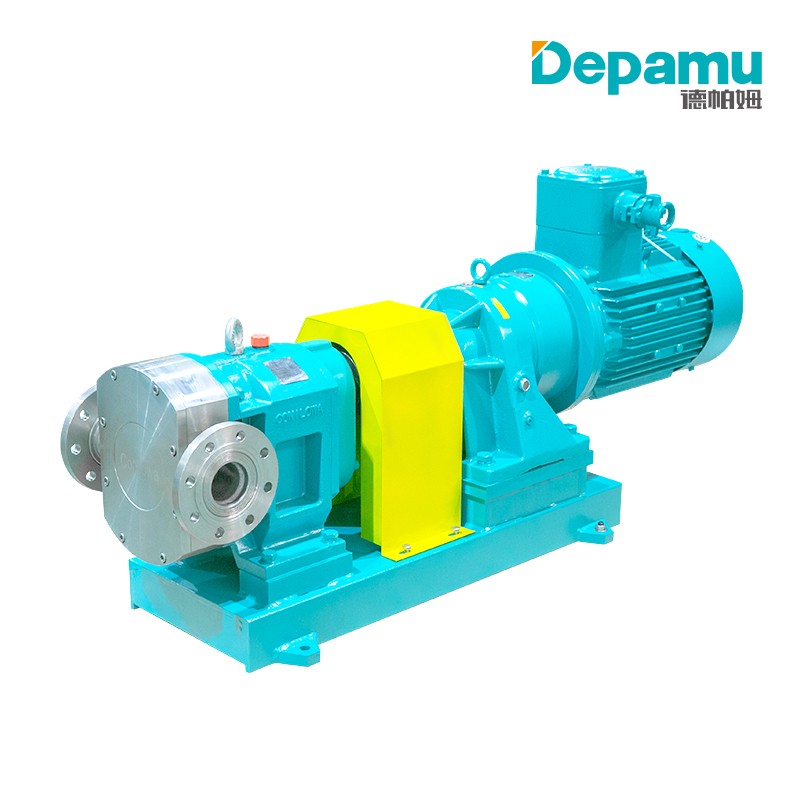
The Depamu metal rotor pump is a synchronous rotary lobe pump, a subtype of positive displacement pumps. It does not rely on impellers or vanes but on the counter-rotation of two (or three) rotors.
2.1 The Volumetric Cycle
The pumping action occurs in three distinct phases:
-
Vacuum Creation: As the rotors counter-rotate, they separate in the inlet port, creating an expanding cavity. This generates a vacuum that draws the calcium carbonate slurry into the pump body.
-
Transport: The slurry is trapped in the pockets formed between the rotors and the casing. Because the rotors are non-contacting (maintaining a precision gap of 0.05–0.3 mm), the fluid is not squeezed or sheared aggressively .
-
Displacement: The rotors converge at the discharge port, reducing the cavity volume and forcing the fluid out against the system pressure.
2.2 The "Gap" Principle
A critical engineering feature of the Depamu pump is the specific gap tolerance. The clearance between the rotors (metal-to-metal) and between the rotors and the pump housing is precisely calculated (approximately 5 to 30丝的, or 0.05-0.3mm) .
-
Engineering Trade-off: For calcium carbonate, a slightly larger gap might be specified to allow fine particles to pass without seizing, while relying on the fluid's surface tension and viscosity to create the dynamic seal necessary for pressure holding.
3. Material Science: Combating Abrasion and Corrosion
Calcium carbonate slurry is generally alkaline (pH 8-11) but often contains impurities or interacts with process chemicals that can be corrosive. Furthermore, the solid particles act as a grinding paste.
3.1 Rotor Metallurgy
Depamu offers various rotor materials, but for calcium carbonate, specific alloys are preferred :
-
Duplex Stainless Steel (2205): This is the optimal choice for high-velocity carbonate transfer. It offers twice the stress corrosion cracking resistance of SS316 and 35% higher yield strength. This prevents rotor deformation under high pressure (up to 1.2–1.5 Mpa) and resists erosion from the solid particles .
-
SS316 (L): Used for less abrasive, chemically aggressive applications where chloride levels are lower.
-
Special Alloys/Hastelloy: Specified for environments where the carbonate slurry is mixed with acidic bleaching agents.
3.2 Mechanical Sealing Technology
The most common failure point in slurry pumps is the seal. The Depamu pump utilizes advanced mechanical seal configurations to handle the abrasive nature of CaCO₃ :
-
Tandem Mechanical Seals: Typically Silicon Carbide (SiC) faces are used. SiC is one of the hardest materials available, capable of withstanding the lapping action of the calcium carbonate crystals.
-
Flush Plans: For optimal longevity, API 676 standards suggest a flush plan that allows clean water or a barrier fluid to lubricate the seal faces, preventing the "dry grinding" of carbonate particles between the seal faces.
4. Performance Characteristics and Technical Specifications
The Depamu metal rotor pump is highly scalable. Based on the "Conilowa" modular design, it covers flow rates from 0.1 m³/h up to 3000 m³/h, though specific models for carbonate duty typically fall within the CLZ, DPZ, or 50BV to 125BV ranges .
4.1 Key Technical Parameters for CaCO₃ Transfer
-
Flow Range (Optimal): 2 m³/h to 150 m³/h (depending on pipeline diameter).
-
Pressure Capability: Up to 1.2 MPa (12 bar), sufficient for feeding paper machine headboxes or coating distribution systems.
-
Viscosity Range: Capable of handling up to 2,000,000 cP, though carbonate slurry is typically lower (~500-2000 cP) .
-
Temperature: Up to 282°C (540°F), allowing for the transfer of hot coating colors .
-
Self-Priming: Dry lift capability up to 9 meters, crucial for emptying sumps or tanker trucks .
4.2 Rotor Configuration Selection
The term "metal rotor pump" encompasses several geometries, each suited for specific fluid properties:
-
Two-Lobe/Butterfly Rotors: Ideal for high-viscosity or large-particle slurries. For coarse calcium carbonate (GCC) with particles up to 25mm, this geometry minimizes jamming risk .
-
Three-Lobe Rotors: Offers the highest displacement volume and lower pulsation. Best for fine ground calcium carbonate (FGC) where high flow rates are needed.
-
Six-Lobe/Helical Rotors: Used when pressure pulsation must be eliminated (e.g., precise coating heads).
5. Comparative Advantage: Depamu vs. Alternative Technologies
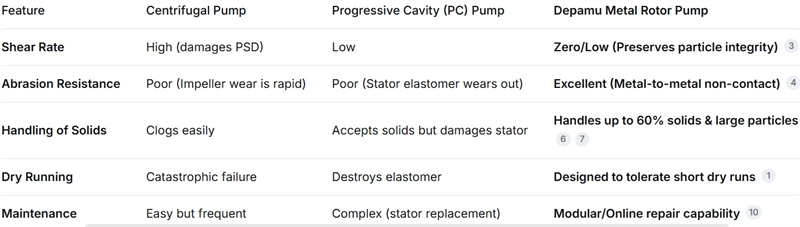
To justify the selection of a metal rotor pump, one must compare it against standard alternatives for calcium carbonate duty.
6. Industrial Applications and Case Scenarios
While the search results do not contain proprietary case studies, the technical specifications align with standard industry pain points for which the Depamu pump is suited.
6.1 Paper Coating Preparation
In the coating kitchen, calcium carbonate is mixed with binders and additives to create a high-solid coating color. Depamu pumps are utilized for:
-
Filler Transfer: Moving 68-70% solids slurry from storage tanks to the coating head.
-
Screening Feed: Feeding pressure screens that remove agglomerates.
6.2 Mining and Mineral Processing
The pump can handle the tailings or the concentrate. The use of Double Support Structure (bearing housing at both ends of the shaft) ensures that the rotor remains concentric even under the high radial loads generated by dense slurry, preventing stator/rotor rub .
7. Maintenance and Lifecycle Costs
The total cost of ownership (TCO) for the Depamu Rotor Pump is a key selling point.
-
Wear Parts: Unlike PC pumps where the entire stator is a consumable, Depamu rotor pumps primarily wear on the rotors and the lining/joints. However, the rotor clearance can sometimes be adjusted, or rotors can be rebuilt with tips.
-
Accessibility: The pump features a "pull-out" design. The front cover can be removed without disconnecting piping, allowing for direct inspection of the rotors and seals . On-site repair time is reported to be reduced by up to 70% compared to split-case pumps .
-
Safety Valve: Given the positive displacement nature (flow is proportional to speed regardless of pressure), a safety valve is often integrated to protect the pipeline or the pump casing from over-pressurization if a valve is accidentally closed downstream .
8. Conclusion
The Depamu Calcium Carbonate Transfer Pump (Metal Rotor Pump) represents a sophisticated engineering response to the material handling challenges of the 21st century. For industries reliant on the gentle, high-pressure, and efficient transfer of abrasive slurries like CaCO₃, the limitations of centrifugal and PC pumps are well-documented.
By utilizing precision-machined duplex stainless steel rotors, maintaining critical clearances for abrasive passage, and offering self-priming capabilities, the Depamu rotor pump ensures high volumetric efficiency (up to 90%+) with minimal shear . The adherence to API 676 standards ensures that the equipment is robust enough for 24/7 industrial environments, while the modular design promises lower maintenance costs and higher uptime.
For plant engineers specifying equipment for new paper mills or chemical processing plants, the Depamu metal rotor pump offers a reliable, corrosion-resistant, and highly efficient solution for one of the industry's most difficult fluids.