

In the demanding world of liquefied natural gas (LNG) production, the margin between operational profitability and catastrophic downtime is often measured in microns and milligrams. As the global energy landscape pivots relentlessly toward natural gas as a bridge fuel, the technological demands placed on LNG infrastructure have escalated exponentially. Among the most challenging of these is the management of carbon dioxide in the feed gas. The raw natural gas extracted from reservoirs often contains significant amounts of CO₂, which must be removed before liquefaction to prevent freeze-out in the cryogenic heat exchangers. This removal process, typically an amine-based acid gas removal unit, concentrates the CO₂ into a stream that is often vented, sequestered, or, for enhanced oil recovery, compressed and re-injected. It is at this precise nexus—the CO₂ compression train—that a critical, yet often underappreciated, piece of equipment comes into play: the chemical injection skid. Specifically, the engineered systems required for high-pressure Monoethylene Glycol (MEG) dosing. In this niche, where precision, pressure, and reliability converge, Depamu has established itself as a standard-bearer, delivering custom-engineered skids that redefine operational certainty.
To understand the profound importance of a Depamu MEG injection skid, one must first appreciate the thermodynamic peril it is designed to avert. The CO₂ stream leaving the amine regenerator is saturated with water. As this stream is compressed in multi-stage, intercooled centrifugal compressors, its pressure and temperature profile passes directly through the hydrate formation region. CO₂ hydrates are crystalline, ice-like solids that can form at temperatures well above the freezing point of water, especially under high pressures. Their formation is not gradual; it can be swift and devastating, plugging interstage coolers, scrubbers, piping, and the delicate internals of the compressor casing itself. The resulting pressure drops, flow restrictions, and mechanical damage can lead to unplanned shutdowns with an economic toll that in a world-scale LNG plant can run into millions of dollars per day of lost production.
Monoethylene glycol serves as the thermodynamic inhibitor, a chemical sentinel that disrupts the hydrogen bonding necessary for hydrate cage formation, effectively depressing the hydrate formation temperature below the minimum operating temperature of the system. However, the act of injecting MEG into a high-pressure CO₂ compression train is far from a trivial plumbing exercise. The injection system must overcome discharge pressures that can exceed 100 bar (1,450 psi) and, in some cutting-edge high-pressure designs, approach 345 bar (5,000 psi). The MEG must be delivered with a continuous, pulse-free flow of high accuracy, regardless of fluctuating suction conditions or back-pressure. A momentary interruption or an inaccurate dose can shift the thermodynamic equilibrium, allowing hydrate nuclei to form and agglomerate in seconds. This is the unforgiving operational context into which Depamu deploys its custom-engineered chemical injection skids, and it is a context that precludes any off-the-shelf solution.
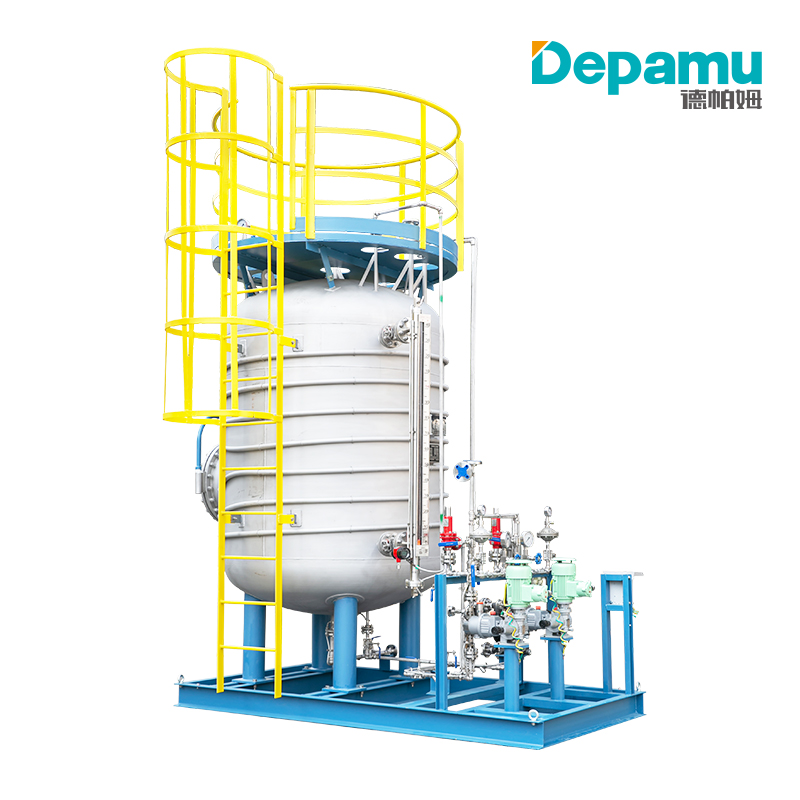
A Depamu skid is not a mere aggregation of components; it is an integrated, process-engineered package born from a design philosophy rooted in system-level optimization. The core of the system is the high-pressure Metering Pump. For MEG services, Depamu’s engineers typically select hydraulically actuated Diaphragm Pumps or packed plunger pumps, depending on the required flow rate, discharge pressure, and the cleanliness of the MEG supply. For the ultra-high-pressure duties of modern CO₂ trains, a modified packed plunger design with a robust, high-strength stainless steel duplex or super duplex fluid end is often the preferred choice. The selection process involves a meticulous review of the fluid’s temperature-viscosity profile, as the viscosity of MEG can increase significantly in colder climates, affecting Net Positive Suction Head (NPSH) calculations and pump volumetric efficiency. Depamu’s expertise is evident here: they often incorporate a jacketed or heat-traced MEG supply line and pump head to maintain optimal viscosity and ensure consistent suction performance, a nuance often missed by generalist skid fabricators.
The pump’s driver and power train are equally critical. Given the continuous, critical nature of the process, a fixed-speed electric motor driving the pump through a robust, high-reduction gearbox is standard. However, for applications with wide turndown requirements, Depamu integrates Variable Frequency Drives (VFDs) into the control architecture. The VFD modulates the motor speed in response to a 4-20 mA signal from the plant’s distributed control system (DCS), directly adjusting the MEG flow rate to match the real-time mass flow of the CO₂ stream. This speed control loop is often cascaded, with the primary DCS output being a flow setpoint that an onboard Programmable Logic Controller (PLC) uses to command the VFD, using feedback from a highly accurate Coriolis mass flow meter. This architectural decision—placing the flow control loop on the skid’s PLC rather than relying on a remote DCS loop with its inherent latency—is a signature of Depamu’s design. It ensures that the critical control function remains deterministic and fast, operating on a 10-100 millisecond cycle, immune to plant-wide network scan times.
The heart of the system’s precision is the instrumentation package, and here Depamu makes no compromises. The primary flow element is invariably a Coriolis mass flow meter. Unlike volumetric meters, a Coriolis meter directly measures mass flow and density, providing an instantaneous, highly accurate (typically ±0.10% of rate) measurement that is independent of fluid property changes. This is crucial as MEG concentration and temperature can drift slightly. The meter provides a three-in-one benefit: real-time mass flow for the dosing control loop, density-based quality measurement to confirm correct MEG concentration, and integrated diagnostics. Depamu’s control panel uses this density signal as a process health indicator; a deviation could indicate a low MEG tank level allowing water carryover or a contamination issue, triggering a pre-alarm well before a hydrate risk materializes.
Downstream of the pump and meter, the skid incorporates a pulsation dampener that is hydraulically tuned to the pump’s stroke frequency. This is not a generic accumulator; Depamu’s engineers calculate the precise gas pre-charge pressure and dampener volume based on the pump’s instantaneous flow profile, piping geometry, and the allowable pressure pulsation limit at the injection point. A poorly dampened flow not only generates inaccurate Coriolis meter readings due to entrained noise but, more critically, creates cyclic stress on the injection quill and its check valve, leading to premature fatigue failure. The final pressure boundary is the injection quill and its specialized, positive-seal check valve, designed to open with a precise cracking pressure and seal bubble-tight against the full system pressure, preventing backflow of high-pressure, wet, acidic CO₂ into the skid—a scenario that would cause catastrophic carbonic acid corrosion of the skid’s internals.
The structural and material engineering of a Depamu skid directly combats the harsh reality of its operating environment. The carbon steel structural base frame is designed with secondary containment as an integral feature. A fully welded, epoxy-coated drip pan captures any fugitive emissions from pump seals or instrumentation, protecting the environment and personnel. The entire piping system is fabricated from 316L stainless steel as a baseline, with the wetted parts of the high-pressure fluid end often upgraded to super duplex stainless steel (e.g., UNS S32750) for its superior resistance to chloride-induced pitting and stress corrosion cracking, a risk if the MEG has picked up chlorides from a recycled inventory. All welds are fully purged and passivated, then subjected to 100% radiography or phased array ultrasonic testing. The assembled skid undergoes a hydrostatic pressure test at 1.5 times the design pressure, followed by a sensitive pneumatic leak test with nitrogen and a helium tracer gas. This uncompromising quality assurance regime is a direct recognition that the skid is a frontline defense against a high-pressure hazard.
However, the true differentiator of a Depamu solution extends beyond the hardware into the embedded control and safety logic. The skid’s local control panel, built around a safety-rated PLC, acts as an autonomous island of protection. The logic is programmed to execute a range of automated, multi-layered safety responses. A primary loop monitors the coriolis meter’s output against the flow setpoint. If a deviation exceeds a tight deadband for a user-defined persistence period, the PLC does not merely flag an alarm; it executes a pre-programmed failure mode. This usually initiates an automatic switchover to a redundant, idle 100%-capacity standby pump unit, a hallmark of a Depamu skid. The switchover sequence is engineered for bumpless transfer: the standby pump’s VFD ramps up, its discharge isolation valve opens, the primary pump’s discharge valves close, and the control loop is smoothly transferred, all within a pre-configured window that ensures no interruption in MEG flow.
The safety instrumented system (SIS) functionality is embedded for critical alarms and trips. A hardwired, independent pressure switch or transmitter, separate from the control instrumentation, provides a permissive signal to the compressor’s UCP (Unit Control Panel). If the MEG discharge pressure falls below a minimum threshold, indicating a total loss of injection, a hardwired shutdown signal is sent to the compressor train to initiate a safe coast-down, preventing it from operating for even a second without hydrate protection. Depamu’s design philosophy also incorporates an intelligent auto-start sequence. Upon receiving a "compressor start" permissive from the DCS, the PLC first runs a pre-lube and line-packing sequence, pressurizing the injection line up to the quill check valve. Only after confirming successful line pack and that the pressure is higher than the interstage pressure, it signals a "ready for injection" status. The MEG pump only ramps up to full flow upon receiving confirmation that the compressor’s main driver has started, a logical interlock that prevents wasteful MEG consumption and potential liquid slug injection into a non-rotating compressor.
The custom engineering that Depamu brings to bear is perhaps most visible in the handling of the MEG itself. For large-scale LNG facilities, MEG recovery and regeneration are economically vital. Depamu skids are often designed with multiple suction sources: one from the fresh MEG supply and another from the lean MEG return of a regeneration unit. A three-way, automated diverter valve on the skid can be programmed to blend fresh and lean MEG to a target concentration, monitored by the Coriolis meter’s density function. Furthermore, in cold-climate installations, the MEG, though an antifreeze, can become highly viscous. Depamu’s thermal design encompasses a complete heat conservation and input strategy, including mineral-insulated (MI) heat trace cables spiraled on the pump fluid ends, heat-traced and insulated tubing runs, and an enclosure for the skid with a thermostatically controlled fan-forced heater. This ensures the skid can start reliably from a cold soak at -40°C and achieve full operational readiness within minutes.
The culmination of this engineering is operational resilience. A plant operator engages with the system not through a tangle of local gauges but through a color Human-Machine Interface (HMI) touchscreen mounted on the panel door. The HMI provides a synoptic overview of the process, real-time trending of pump speed, flow rate, and discharge pressure, a log of alarms and events, and a suite of diagnostic screens for the pumps and VFDs. This local intelligence dramatically reduces the Mean Time To Repair (MTTR). A technician can see a record of historical motor current draw, which, when trended, might indicate incipient bearing failure in the pump gearbox weeks before a vibration sensor would trip. This predictive maintenance capability, enabled by the onboard data historian and trend visualization, aligns the skid’s maintenance cycle with the plant’s planned turnaround windows, effectively preventing unplanned corrective maintenance.
In a final, telling detail, every Depamu high-pressure MEG injection skid undergoes a complete Factory Acceptance Test (FAT) before shipment. This is not a simple rotational check. It is a multi-day, simulated operational run using a test fluid that matches the viscosity of the service MEG, recirculated through a test loop that simulates the actual system back-pressure. All control loops are tuned, the auto-switchover sequence is activated and its timing measured with precision, and the entire integrated safety logic is functionally tested in the presence of the customer. When the skid arrives on site, it is, in the jargon of commissioning engineers, effectively "plug and produce." The civil works are reduced to landing a single, fully wired and instrumented package on a pre-poured plinth, connecting the suction and discharge flanges, and landing a single multi-pin power and communications cable.
In the grand schematic of a multi-billion-dollar LNG facility, a chemical injection skid is a modest capital line item. Yet, its functional significance is inversely proportional to its cost. It stands as the guardian of the CO₂ compression train, a silent, high-pressure heartbeat that repels the thermodynamic chaos of hydrate formation. Depamu’s custom-engineered skids have elevated this duty from a simple pumping operation to a fully integrated, intelligent process system. Through meticulous hydraulic design, corrosion-resilient materials, deterministic and autonomous control, and a relentless focus on reliability as an engineered property, Depamu delivers not just a skid, but a shield. It is a guarantee of operability, ensuring that the modern giants of LNG production can compress, dispose of, or utilize their CO₂ with a certainty as unyielding as the steel from which its skids are forged. For the plant operator and the process engineer alike, a Depamu skid is the engineered articulation of a singular, crucial promise: the hydrates will not form, the process will not falter, and the flow of energy to the world will not be interrupted.