

In the demanding landscape of modern fluid handling, the convergence of high volumetric capacity and aggressive chemical resistance is one of the most persistent engineering challenges. Industrial operators in petrochemical refining, wastewater management, and heavy chemical processing routinely confront media that are simultaneously viscous, abrasive, and chemically hostile. Conventional metal pumps, even those constructed from advanced alloys, often fall victim to pitting, stress corrosion cracking, or erosive wear, leading to unplanned downtime and escalating maintenance costs. It is within this operational crucible that the Depamu corrosion-proof rubber Rotor Pump emerges as a purpose-built solution, specifically engineered to deliver sustained high flow performance without succumbing to the chemical and mechanical degradation that compromises lesser equipment.
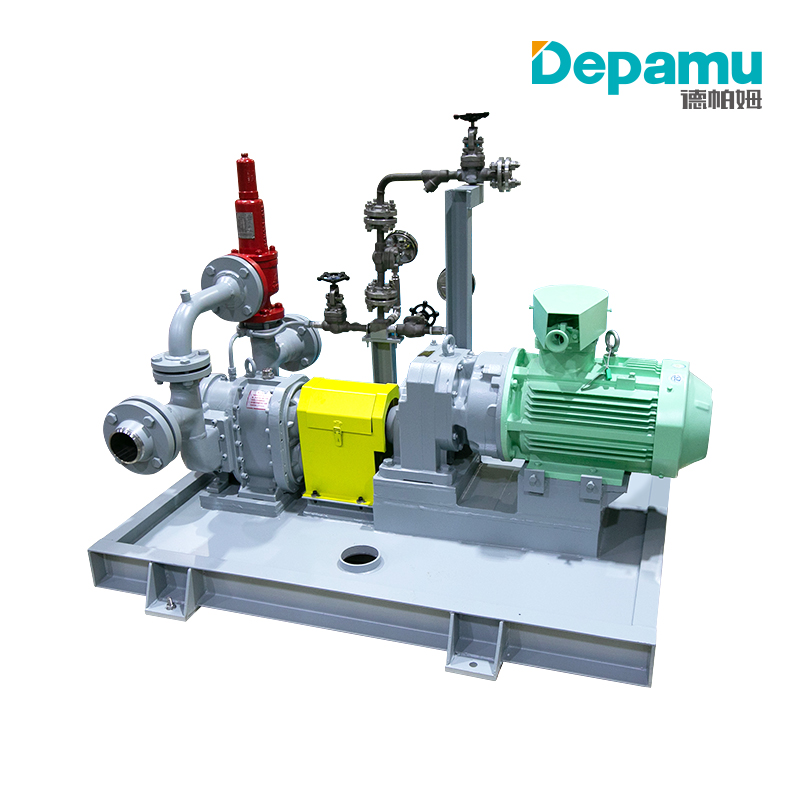
Depamu (Hangzhou) Pumps Technology Co., Ltd., a high-tech enterprise founded in 2003 and headquartered in the Qiantang District of Hangzhou, China, has built its reputation on addressing precisely these kinds of extreme fluid transfer problems. The company’s product portfolio spans Metering Pumps, high-pressure Reciprocating Pumps, Diaphragm Pumps, Screw Pumps, and notably, its advanced line of rotor pumps, which includes both metal and rubber variants. The rubber rotor pump, often categorized under the Conilowa lobe pump series, represents a deliberate rethinking of positive displacement technology, leveraging elastomeric materials not merely as a seal or a liner, but as the primary fluid-contacting energy-transfer element. This design philosophy allows the pump to achieve remarkable flow rates—in some configurations reaching up to 10,000 cubic meters per hour—while maintaining a robust defense against corrosive attack.
The Engineering Philosophy: Rubber as a Strategic Material
The defining characteristic of the Depamu rubber rotor pump lies in its rotor construction. Unlike traditional lobe pumps that rely on rigid metal lobes, the Depamu design employs an elastomeric wide-blade rotor manufactured through a process of five-axis linkage or three-dimensional flow precision molding. This manufacturing approach ensures that the rotor’s geometry is optimized for circumferential flow within the pump cavity, minimizing hydraulic losses and shear stress on the pumped medium. The elastomeric material—which can be specified as nitrile rubber (NBR), ethylene propylene diene monomer (EPDM), fluoroelastomer (FKM), or other specialized compounds—provides a dual function. First, it offers intrinsic chemical inertness against a wide spectrum of acids, bases, and solvents that would rapidly degrade standard cast iron or even certain grades of stainless steel. Second, the compliant nature of rubber allows the rotor to absorb the shock loads associated with the passage of solid particles or abrasive slurries, effectively “yielding” rather than fracturing when encountering incompressible debris.
This material strategy is particularly crucial for high-flow applications. In a high-flow regime, the pump operates at elevated rotational speeds—typically ranging from 10 to 650 revolutions per minute—to displace large volumes of fluid. At these speeds, any imbalance or wear in the rotor assembly can rapidly escalate into vibration and premature failure. The Depamu rubber rotor, being both lightweight and precisely balanced, mitigates these dynamic stresses. Furthermore, the low-speed operation characteristic of positive displacement lobe pumps means that the fluid is moved gently, without the high-shear turbulence generated by centrifugal pumps. This is a critical advantage when the high-flow medium contains shear-sensitive polymers, biological solids, or emulsion systems that must retain their structural integrity during transfer.
Corrosion-Proof Design: Beyond the Rotor
While the rubber rotor is the primary defense against corrosion, the Depamu engineering team has extended the corrosion-proof philosophy throughout the pump’s wetted path. The axial and radial bushings, which support the rotor shaft and bear the brunt of radial loads, are supplied in wear-proof and corrosion-resistant materials. This detail is frequently overlooked in conventional pump designs, where bushing degradation can lead to shaft deflection, seal misalignment, and eventual catastrophic failure. By specifying corrosion-resistant bushings, Depamu ensures that the internal alignment of the pump remains true even after prolonged exposure to chemically aggressive fluids.
The seal chamber is another critical frontier in the battle against corrosion. Depamu has designed a large seal chamber that can accommodate a variety of mechanical seal types, including those constructed from silicon carbide, tungsten carbide, or PTFE-faced components. This flexibility allows operators to tailor the sealing solution to the specific chemistry of the process fluid, whether it is a strong acid requiring a dual-pressurized seal or a volatile organic compound demanding a high-integrity containment seal. The pump’s casing and gear cavity are designed as an integral unit, reducing potential leak paths and ensuring that the structural integrity of the pump is maintained even under the pressure pulsations inherent to positive displacement operation.
High-Flow Performance: Breaking the Trade-Off
There is a persistent misconception in industrial pumping that corrosion-resistant materials must inherently compromise flow capacity. Elastomers, while chemically robust, are sometimes perceived as being limited in their ability to handle high flow rates due to concerns over deformation or fatigue. The Depamu rubber rotor pump decisively refutes this trade-off. The Conilowa series, under which the rubber rotor pumps are categorized, encompasses five series and seven models with a capacity range spanning from 0.1 to 10,000 cubic meters per hour. This volumetric breadth means that the same fundamental corrosion-proof architecture can be scaled from a modest chemical dosing transfer to a massive wastewater bypass or stormwater management application.
At the upper end of the performance envelope, models such as the CLJ650 are capable of achieving flow rates of up to 3,500 cubic meters per hour, while the CLJ450 reaches 1,400 cubic meters per hour and the CLJ300 delivers 670 cubic meters per hour. These figures are not achieved through high rotational velocity—which would exacerbate wear and shear damage—but through the positive displacement principle, where a fixed volume of fluid is trapped and transported per revolution. The result is a “constant capacity” characteristic: the pump’s output remains largely independent of backpressure, ensuring that the high-flow rate is maintained even as system resistance fluctuates.
The high-flow capability is further enhanced by the pump’s superior self-priming ability. The Depamu rubber rotor pump can achieve a maximum suction lift of up to nine meters without the need for auxiliary priming devices or foot valves. In high-flow applications where the pump is drawing from a pit, sump, or storage tank, this self-priming capability simplifies system design, reduces installation costs, and minimizes the risk of dry-running damage—a critical consideration given that the pump is designed to tolerate short periods of idling. The double-support bearing structure, meanwhile, provides the rigidity necessary to handle the hydraulic loads associated with high-capacity operation, with output pressures reaching 1.8 MPa in single-stage configurations and up to 3.0 MPa in multistage arrangements.
Handling the Unpumpable: Solids, Slurries, and Viscosity
The true test of a corrosion-proof pump is not merely its ability to move clean, chemically aggressive liquids, but its capacity to manage the complex, multiphase mixtures that characterize real industrial processes. The Depamu rubber rotor pump is engineered to transport media with viscosities of up to two million centipoise and solid contents as high as sixty percent. In high-flow scenarios, this translates into the ability to move thick sludges, fibrous slurries, and particle-laden waste streams without clogging—a failure mode that frequently incapacitates centrifugal and even some positive displacement pumps.
The rotor geometry plays a decisive role here. The two-blade linear rotor, covered in rubber, is described as an all-purpose configuration suitable for corrosive and wear-proof fluids. For media with larger or more irregular solids, the three-blade linear rotor offers replaceable rotor tips and a long sealing-face life. The three-blade helical rotor, meanwhile, is designed for low-pulsation transport of fluids with many impurities, with the rubber covering ensuring that the rotor core remains isolated from the corrosive medium. This modularity of rotor selection, combined with the availability of different elastomer compounds, allows the pump to be precisely matched to the chemical and physical profile of the process fluid, ensuring that both corrosion resistance and high-flow throughput are optimized simultaneously.
Operational Efficiency and Maintenance in High-Flow Environments
In high-flow installations, the cost of maintenance and downtime can quickly dwarf the initial capital expenditure of the pump. Depamu has addressed this reality through a design philosophy centered on online maintainability and modular interchangeability. The pump features an easy-open cover that allows operators to inspect or replace wetted parts without dismantling the suction or discharge piping, or removing the driver from its baseplate. This “online maintenance” capability is particularly valuable in continuous-process industries where every hour of unscheduled downtime carries significant financial penalties.
The modular design of the Conilowa series further reduces the spare-parts burden. Pumps within the same series share common rotors, gears, bearings, axial lining boards, and mechanical seals. For a facility operating multiple high-flow rubber rotor pumps in different duty points, this interchangeability simplifies inventory management and reduces the lead time for critical spares. The replaceable rotor tips—a patented feature—allow worn or damaged elastomer surfaces to be renewed without replacing the entire rotor assembly, extending the service life of the pump and lowering the total cost of ownership.
Energy efficiency is another dimension of operational performance that Depamu has prioritized. The combination of precise rotor molding, low internal clearances, and low rotational speed yields a volumetric efficiency that, in many configurations, reaches seventy to eighty-five percent. In high-flow applications, where even a small percentage improvement in efficiency translates into substantial energy savings over thousands of operating hours, this performance characteristic carries significant economic weight. The smooth, low-pulsation flow also reduces the hydraulic transients that can stress downstream piping and instrumentation, contributing to the overall reliability of the fluid transfer system.
Applications Where Corrosion-Proof High Flow Matters
The practical value of the Depamu rubber rotor pump is best understood through the lens of its applications. In petrochemical and refining operations, the pump is deployed for the transfer of crude oil, refinery intermediates, and chemical additives that are both corrosive and viscous. The rubber rotor’s resistance to hydrocarbons and its ability to handle high solid content make it suitable for tank farm management, loading and unloading operations, and the movement of refinery slurries.
In wastewater treatment and environmental protection, the pump’s high-flow capability is leveraged for the transportation of primary and secondary sludge, grit, and screened screenings. The corrosion-proof construction is essential here, as wastewater streams often contain hydrogen sulfide, chlorides, and other aggressive species that attack metallic components. The pump’s self-priming ability and tolerance for entrained air make it well-suited for sump and wet-well applications where the liquid level fluctuates.
The chemical and pharmaceutical industries utilize the rubber rotor pump for the transfer of strong acids, bases, and solvent-laden streams. The availability of FDA-compliant elastomer options and sanitary configurations also opens applications in food and beverage processing, where the pump’s gentle, low-shear handling preserves the texture and integrity of sensitive products such as egg liquids, fruit concentrates, and dairy slurries. In offshore oil pollution recovery and emergency rescue, the pump’s ability to handle oil-water-solid mixtures and its reversible operation—which allows the pump to act as either a transfer or suction device—make it an indispensable tool for environmental response teams.
Conclusion: A Coherent Solution to a Complex Problem
The Depamu corrosion-proof rubber rotor pump is not simply a pump with a rubber coating; it is an integrated engineering system in which material science, rotor geometry, sealing technology, and maintenance accessibility are harmonized to address the dual demands of chemical resistance and high volumetric throughput. By utilizing advanced elastomers as the primary fluid-contacting surface, Depamu has created a positive displacement pump that can withstand the corrosive onslaught of aggressive media while delivering flow rates that compete with—and in many cases exceed—those of conventional metallic pumps. The modular architecture, online maintenance capability, and broad range of rotor and material options further ensure that the pump can be adapted to the specific chemical, thermal, and physical profile of each application.
For industries where a single point of failure in the fluid transfer chain can cascade into production losses, environmental incidents, and safety hazards, the value of this integrated approach cannot be overstated. The Depamu rubber rotor pump represents a mature, field-proven answer to the question of how to move large volumes of corrosive, abrasive, and viscous fluids reliably—a question that will only grow more urgent as industrial processes become more chemically complex and environmental standards more stringent. In that context, the pump is not merely a component of the process; it is a strategic asset for operational continuity and long-term sustainability.