

Precision Engineered for Harsh Environments: The Role of Depamu Skid-Mounted Chemical Injection Packages
In the complex ecosystems of modern heavy industry—whether refining crude oil, treating industrial wastewater, or generating high-pressure steam—the margin between operational efficiency and catastrophic failure often comes down to chemistry. Maintaining the precise balance of water chemistry, preventing scaling in pipelines, or inhibiting corrosion in deep-well extraction requires not just the right chemical agents, but the absolute precision of their delivery. This is where Depamu Skid-Mounted Chemical Injection Packages (DPJY series) establish themselves as mission-critical assets . These modular, pre-engineered systems represent a paradigm shift from fragmented, site-built chemical dosing setups to integrated, automated, and highly reliable turnkey solutions.
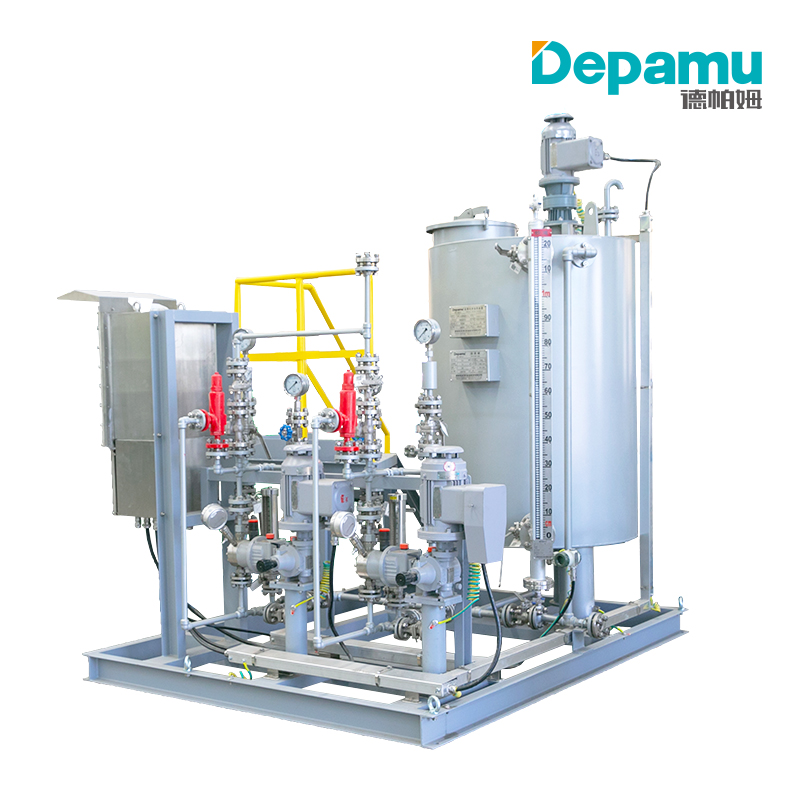
While the chemical injection market is crowded with component suppliers, Depamu has differentiated itself through systematic engineering. Drawing on advanced manufacturing philosophies from the United States, Germany, and Japan, these packages are designed to solve a singular industrial challenge: how to accurately, safely, and consistently inject various chemicals into a process stream under varying pressures, temperatures, and environmental conditions .
This article provides a deep technical analysis of the Depamu DPJY series, exploring the engineering philosophy, the critical chemical applications across verticals, and the automation capabilities that make these skids the backbone of modern industrial fluid control.
The Engineering Philosophy: Modularity and Integration
Traditional chemical dosing systems are often assembled in situ. A plant procures a Metering Pump from one vendor, tanks from another, and control panels from a third. This "mix-and-match" approach frequently leads to systemic inefficiencies, compatibility issues, and "dead zones" in piping layout that cause chemical precipitation or air locking. Depamu addresses this through a systematic design approach .
The DPJY series is a factory-assembled, modular skid where every component—from the pulsation damper to the safety valve—is selected to work in harmony. The skid-mounted configuration offers significant logistical and operational advantages over stick-built systems:
-
Reduced Footprint: By integrating multiple functions (dissolving, metering, and control) onto a single steel base, the package minimizes the physical space required in a chemical dosing room .
-
Pre-commissioning: Because the system is built and tested at Depamu’s facility (certified under standards like CE), the risk of field installation errors is virtually eliminated. The skid arrives as a "plug-and-play" unit .
-
Material Compatibility: Depending on the chemical aggression, Depamu offers solution tanks and wetted parts in a range of materials including 304 stainless steel, 316L stainless steel, Carbon Steel with rubber lining, FRP, and UPVC .
Core Components of the Skid
A standard Depamu injection package is not merely a pump; it is a hydraulic circuit. The typical configuration includes:
-
Solution Tank (Day Tank): Volumes ranging from 0.5 m³ up to 20 m³ for large-scale oilfield operations .
-
Metering Pump (The Heart): Precision plunger or hydraulic Diaphragm Pumps capable of flows from 10 L/H to 1500 L/H and pressures up to 32 MPa .
-
Agitator/Mixer: Ensures that powdered or concentrated chemicals are fully dissolved before injection.
-
Piping & Valving: Includes safety valves, back-pressure valves, calibration columns, and pulsation dampeners to ensure smooth flow.
-
PLC Control Cabinet: The "brain" of the operation, allowing for local or remote automation .
Critical Applications: Injecting the Right Chemistry
The versatility of the Depamu skid lies in its ability to handle a vast array of chemicals. By altering the metallurgy of the wetted parts and the calibration of the pump, a single DPJY chassis can be adapted for dozens of different processes. Below is a breakdown of the key chemical applications across core industries.
1. Oil & Gas Exploration and Transportation (Upstream/Midstream)
The extraction of crude oil and natural gas is perhaps the most demanding environment for chemical injection. Wellheads are often located in remote, frozen tundras or offshore platforms with limited space. Downhole conditions involve high pressures and the presence of hydrogen sulfide (H₂S) or carbon dioxide (CO₂).
Depamu provides specialized packages for this sector designed to handle capacities up to 500 L/H at extreme pressures . The specific applications include:
-
Methanol/Glycol Injection (Hydrate Inhibition): In deepwater or cold-climate pipelines, natural gas forms ice-like hydrates that can block flow. Depamu skids inject methanol (CH₃OH) or monoethylene glycol (MEG) directly into the wellhead to lower the hydrate formation temperature. The DPJY series supports pressures up to 32 MPa to inject against high wellhead backpressure .
-
Corrosion & Scale Inhibition: Produced fluids are often corrosive. The skid injects film-forming amines or corrosion inhibitors that coat the internal surface of the pipeline. Simultaneously, threshold inhibitors are injected to prevent calcium carbonate scaling.
-
Demulsifiers: When water mixes with crude oil, it forms an emulsion. Demulsifier chemicals are injected to break this emulsion, allowing the water to be separated and disposed of, meeting the pipeline specification of Basic Sediment and Water (BS&W) .
2. Power Generation and Boiler Water Treatment
High-pressure boilers in thermal power plants are extremely sensitive to impurities. Even trace amounts of dissolved oxygen or hardness can lead to tube failure. Depamu has engineered specific configurations for boiler houses, including the Phosphate Treatment and the Reducing/Oxidizing (Redox) systems .
-
Phosphate Injection (Internal Treatment): Historically, the "Phosphate Treatment" is the gold standard for drum boilers. As feed water enters the boiler, any residual hardness (Calcium/Magnesium) would otherwise form tenacious scale. Depamu skids inject Tri-Sodium Phosphate, which reacts with the calcium to form Hydroxyapatite—a non-adherent sludge that can be easily removed via blowdown .
-
Chemistry:
-
-
Hydrazine & Ammonia Injection (Oxygen Scavenging & pH Adjustment): Dissolved oxygen is the primary cause of pitting corrosion in boiler feedwater lines. Depamu's Hydrazine injection packages automatically meter N₂H₄ into the deaerator storage tank to react with residual oxygen, converting it to harmless water and nitrogen . For pH control, Ammonia is injected to neutralize carbonic acid corrosion in the condensate return lines.
3. Water & Wastewater Treatment (Municipal & Industrial)
Water scarcity and strict discharge regulations (e.g., EPA standards) necessitate rigorous treatment of both incoming raw water and outgoing effluent. The Depamu skid is essential for physiochemical treatment processes.
-
Flocculant & Coagulant Dosing: For raw water clarification or sludge dewatering, Depamu offers specific "Automatic Dissolving and Injection Packages" for powdered polymers (PAM) and inorganic coagulants (PAC, Alum) . The skid utilizes a unique powder transport system that prevents the "fish-eye" (un-dissolved gel balls) effect common in polymer mixing, ensuring that the full chemical potential is utilized.
-
pH Correction (Acid/Alkali): Before discharge or reuse, effluent must be neutralized. Depamu packages equipped with PVDF pump heads inject H₂SO₄ (Acid) or NaOH (Caustic) based on feedback from a pH analyzer.
4. Circulating Cooling Water
Cooling towers are breeding grounds for biological growth (Legionella), scale, and corrosion. Depamu circulating water injection packages utilize a "bleed and feed" control logic. Conductivity controllers signal the skid to blowdown concentrated water and inject fresh scale/corrosion inhibitors and biocides (usually sodium hypochlorite or isothiazolinones) to keep the system clean .
Automation and Control: The Digital Advantage
The move toward Industry 4.0 and "unmanned" operation in industries like petrochemicals demands that chemical dosing systems do more than just pump. They must think, adapt, and report.
The Depamu DPJY series integrates advanced Programmable Logic Controllers (PLC) and Variable Frequency Drives (VFD) to enable closed-loop control .
How the Closed Loop Works
In a manual system, an operator visually checks a meter and adjusts a pump dial. In the Depamu automated skid:
-
Sensing: An inline probe (e.g., a pH meter, dissolved oxygen sensor, or flow meter) continuously reads the process fluid.
-
Signal Processing: The sensor sends a 4-20mA signal to the PLC or DCS (Distributed Control System).
-
Action: The PLC compares the reading to the setpoint. If the pH is too low (acidic), the PLC instructs the VFD on the caustic pump to increase speed, thereby increasing the stroke rate of the metering pump.
-
Feedback Loop: The system continuously adjusts until the target value is achieved .
Control Modes
To cater to varying site requirements, Depamu packages support multiple operational hierarchies:
-
Manual Mode: Local control via pushbuttons for maintenance and commissioning.
-
Automatic Mode: The PLC governs the VFD and pump stroke (0-100% turndown ratio) based on real-time process variables.
-
Remote Mode: The skid communicates via Modbus, Profibus, or hardwired signals to a central control room, allowing operators to start/stop pumps or change setpoints from a desk .
In the demanding landscapes of oil fields, refineries, and power plants, the ability to precisely inject various chemicals is not a luxury—it is a requirement for asset integrity and operational continuity. The Depamu Skid-Mounted Chemical Injection Package (DPJY series) transcends the definition of a simple pump. It is a holistic, pre-engineered chemical dosing station.
By integrating American and German dosing technologies with localized engineering for harsh conditions, Depamu has created a solution that addresses the three core pains of industrial fluid management: accuracy (via VFD/PLC control), reliability (via systematic design), and safety (via contained, robust construction)
Conclusion