

Depamu high-pressure pumps for Seawater Wellbore Injection: Engineering, Performance, and Offshore Deployment
Abstract
Seawater injection into the wellbore is the circulatory system of modern offshore oil and gas production. As mature fields decline and new reservoirs are pursued in ultra-deepwater and ultra-deep wellbores, the high-pressure pump has evolved from auxiliary equipment into the defining constraint on field economics and recovery efficiency. Depamu (Hangzhou) Pumps Technology Co., Ltd., a Chinese manufacturer established in 2003, has emerged as a disruptive force in this domain, offering reciprocating pump platforms that match Western incumbents on durability while integrating digital control architectures that legacy suppliers have been slower to adopt. This article examines the engineering principles, performance envelope, material science, and field-proven deployments of Depamu high-pressure pumps for seawater wellbore service, with particular attention to the CNOOC FPSO project in the South China Sea and the Enping 21-4 ultra-deep well campaign. It argues that Depamu’s significance lies not merely in import substitution but in redefining the operational relationship between the pump, the reservoir, and the digital production ecosystem.
1. Introduction: The Strategic Necessity of Seawater Injection
A hydrocarbon reservoir is not a subterranean cavern awaiting drainage. It is a porous rock formation saturated with oil, gas, and water, and its natural energy—the pressure that drives hydrocarbons toward the wellbore during primary recovery—declines inexorably as production proceeds. Waterflooding is the most cost-effective secondary recovery method available: engineers inject treated seawater or produced water back into the formation to sweep remaining oil toward production wells and to maintain reservoir pressure. On an offshore platform, the high-pressure injection pump is therefore not a peripheral utility but the “heart” of the pressure-maintenance system.
The offshore operating envelope imposes a convergence of demands that few pump technologies can satisfy simultaneously. Pressures frequently exceed 30 MPa to fracture or displace oil from tight formations; continuous injection requires throughputs measured in thousands of cubic meters per day; seawater introduces highly corrosive chlorides that attack wetted components; and the intervention costs associated with pump failure in the South China Sea or the Gulf of Mexico are prohibitive. Historically, this market was dominated by European and American incumbents—Lewa, Geveke, and Cat Pumps among them—whose reputations were built on metallurgical conservatism and conservative maintenance intervals. Depamu’s entry into this space represents a reconfiguration of that competitive logic: a manufacturer that couples API 674-compliant mechanical engineering with advanced digital control and a cost structure that substantially alters the capital expenditure calculus for operators.
2. Depamu’s Engineering Architecture: Positive Displacement as First Principle
Depamu’s core competence lies in reciprocating positive-displacement pumps. The choice is technically consequential. Centrifugal pumps lose volumetric efficiency at low flow and high pressure—precisely the regime that characterizes wellbore injection into tight or deep formations—whereas Reciprocating Pumps maintain essentially constant volumetric efficiency regardless of pressure variation. This characteristic is what allows a Depamu unit to hold a specified injection rate against a formation whose permeability, and therefore back-pressure, changes over the life of the flood.
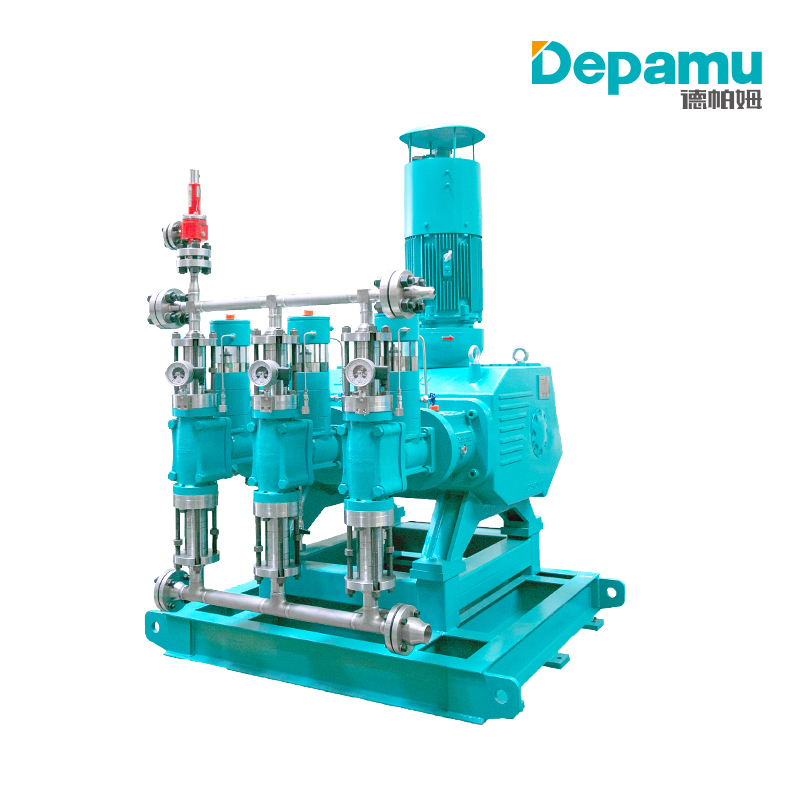
The product architecture bifurcates into two principal fluid-end families. Plunger pumps, exemplified by the THP series, are deployed for clean, high-pressure water injection. The THP series employs high-precision double-helical gears, a design choice that distributes load across multiple teeth in simultaneous contact, reducing noise and increasing load-bearing capacity relative to standard straight-cut gears. The practical consequence is a longer mean time between failures—an economic variable of considerable weight on a platform where crane access and deck space are rationed. Diaphragm Pumps, represented by the 3HD series, serve chemical injection duties where the pumped medium—methanol, corrosion inhibitors, or hydrate suppressants—must be isolated from the hydraulic drive fluid. The hydraulically actuated diaphragm creates a hermetic seal, achieving zero leakage, which is an indispensable requirement when handling H₂S-bearing fluids or methanol on an offshore installation.
Depamu also manufactures hose pumps within its high-pressure process portfolio, capable of capacities up to 450 m³/h and discharge pressures up to 35 MPa, with the ability to handle fluids with solid content as high as 80% and viscosities below 1500 cP. While the hose platform is more commonly associated with abrasive and viscous media in petrochemical and mining contexts, it completes a fluid-end triad—plunger, diaphragm, and hose—that allows Depamu to specify the correct sealing and containment strategy for the specific solids, corrosives, and shear sensitivities of the injection duty.
3. The Performance Envelope: From Standard Waterflood to Ultra-High Pressure
Depamu’s high-pressure Water Injection Pumps are regularly configured from 10 MPa to 50 MPa (approximately 100 to 500 bar) for standard waterflood service, with advanced enhanced oil recovery (EOR) or polymer units capable of exceeding 120 MPa. The power end spans 1.5 kW to 800 kW when paired with high-output electric motors, and specialized ultra-high-pressure units reach 350 MPa (approximately 50,000 psi). Flow capabilities scale from 20 liters per hour in chemical injection skids to 2,000 cubic meters per day in water injection modules.
These figures are not merely catalog maxima. They define a modular performance space in which a single platform architecture can be tuned to the specific pressure-flow operating point of a given reservoir. The 3HD130G-MSBD-16-14.5-III model, for instance, delivers 1.02–14.53 m³/h at 4.9–35.4 MPa, accommodates fluid temperatures from −40 °C to 150 °C, and handles viscosities up to 3000 cP. The HD3E(M) variant covers 2.74–32.14 m³/h at 2.2–41.6 MPa, while the HD5P(M) platform extends the pressure ceiling to 104 MPa. This granularity matters because seawater injection is rarely a single operating point: as a field matures, injection pressure requirements rise, and a pump specified only for initial conditions becomes a bottleneck. Depamu’s modular fluid-end and power-end combinations allow the injection system to be reconfigured rather than replaced when reservoir conditions evolve.
4. Material Science and Corrosion Resistance in Seawater Service
Seawater is an aggressive electrolyte. Chloride concentration, dissolved oxygen, temperature, and the presence of biological organisms combine to produce pitting, crevice corrosion, and stress-corrosion cracking in materials that would perform adequately in fresh water or hydrocarbon service. Depamu addresses this through a comprehensive wetted-parts material menu that spans the corrosion spectrum required by marine and offshore duty.
For general seawater service, 316 and 316L stainless steel provide baseline resistance. For high-chloride offshore environments, duplex stainless steel offers a higher pitting resistance equivalent number and improved mechanical strength. Hastelloy C is specified for extreme chemical resistance in aggressive media, while 904L addresses sulfuric acid and chloride-rich conditions. Titanium alloys are available for seawater service where exceptional corrosion resistance justifies the cost premium. This material flexibility is not a marketing abstraction: it allows the operator to match the pump’s wetted metallurgy to the specific water chemistry of the injection source—whether treated seawater, produced water, or a blended stream—rather than accepting a single “marine-grade” specification that may be over-engineered for benign service or under-engineered for the most corrosive conditions.
The corrosion challenge is compounded at the power end, where the drive train must transmit the full torque required to compress the fluid at pressures that can exceed 120 MPa. Depamu’s API 674-compliant power end incorporates a high-strength forged steel crankshaft supported by heavy-duty roller bearings. This is not a superficial compliance gesture: API 674 imposes explicit requirements on crankshaft design, bearing life, and structural rigidity that distinguish a pump engineered for continuous oilfield duty from a general industrial reciprocating pump adapted for the application.
5. Field Validation: The CNOOC FPSO and Enping 21-4 Deployments
The most consequential validation of Depamu’s seawater injection technology is its selection for a CNOOC floating production, storage, and offloading (FPSO) unit operating in the South China Sea. The environmental conditions in that basin—high ambient temperatures, extreme humidity, and salt-laden air—accelerate corrosion and degrade elastomeric and electronic components. CNOOC required a core injection module for secondary recovery that could operate within the FPSO’s stringent space and weight constraints while minimizing vibration transmission to topside processing equipment.
Depamu delivered a custom super-large water injection system with an 800 kW electric motor, a maximum working pressure of 30 MPa, and a daily throughput of 2,000 m³ per unit. The system was integrated with a PLC-based closed-loop control architecture that adjusts pressure and flow in real time based on downhole sensor data, with a reported fault-prediction accuracy exceeding 99%. The pump received DNV-GL certification, confirming compliance with the safety and reliability standards required for international offshore operations. The strategic significance of this deployment extends beyond the individual sale: it has been characterized by the China General Machinery Industry Association as breaking the long-standing monopoly of European and American suppliers in FPSO core injection modules, reducing CNOOC’s capital expenditure and shortening delivery lead times.
A second, technically distinct validation comes from the Enping 21-4 oilfield, where the ENHY-1 well established a Chinese record with a depth of 9,508 meters and a horizontal displacement of 8,689 meters. At such depths, friction losses in the injection conduit become extreme, and maintaining fluid circulation or injecting additives requires pressures that test the dimensional and metallurgical limits of reciprocating equipment. Depamu met the challenge at 120 MPa (17,400 psi). At this pressure, pipe walls must thicken, valves are subjected to water-hammer phenomena capable of shattering standard steel, and seals tend to extrude from their grooves. Depamu’s engineering response—advanced metallurgy combined with vacuum quenching of valve seats and cone valves—produced a hard, wear-resistant surface while preserving a tough, impact-resistant core, a combination necessary to survive the high-speed cycling of a 120 MPa reciprocating pump. The Enping deployment demonstrates that Depamu’s platform is not confined to the 30 MPa envelope that defines conventional waterflood; it extends into the ultra-high-pressure regime where wellbore depth itself becomes the dominant engineering constraint.
6. Digitalization and the Predictive Maintenance Paradigm
The modern offshore pump is no longer an isolated mechanical artifact; it is a data node within the production control ecosystem. Depamu has invested substantially in the digital layer of its pump systems, and the FPSO package illustrates the architecture. The PLC-based closed-loop system monitors thermal characteristics to predict bearing degradation, pulsation damping efficiency to track valve wear, and flow stability to detect diaphragm rupture, with fault-prediction accuracy reported at 99% or higher. This is a meaningful departure from calendar-based maintenance, which is the default mode in much of the offshore pumping fleet. Predictive maintenance on a reciprocating pump is technically demanding because the failure modes—valve wear, seal leakage, bearing fatigue—manifest as subtle changes in vibration signature, discharge pressure ripple, and power draw rather than as abrupt failures. The ability to resolve those signatures into actionable maintenance triggers is what converts a pump from a reactive cost center into a managed asset.
The digital integration also extends to variable frequency drives (VFDs) on chemical injection skids, which adjust stroke speed automatically and interface with the platform’s distributed control system (DCS) to meter chemicals precisely as production flow rates fluctuate. For seawater injection specifically, the closed-loop control allows the pump to follow the reservoir’s changing pressure response without operator intervention, maintaining injection rate within the tolerance required for effective sweep while avoiding the formation damage that can result from over-pressure.
7. Conclusion: Depamu and the Reconfiguration of Offshore Injection Economics
The significance of Depamu in the seawater wellbore injection market is not that it has produced a pump that can reach 30 MPa or 120 MPa. It is that the company has demonstrated that the performance envelope historically guarded by Western incumbents—API 674 durability, DNV-GL certification, metallurgical depth, and field-proven reliability in corrosive offshore service—can be matched by a Chinese manufacturer while simultaneously integrating a digital control layer that many legacy platforms still treat as an afterthought. The CNOOC FPSO deployment and the Enping 21-4 ultra-deep well campaign are not laboratory demonstrations; they are commercial installations in which the pump is the binding constraint on production and recovery. Depamu’s 47% share of the Chinese Metering Pump market and its ranking among the global top three in metering and reciprocating pumps provide the scale context, but the offshore injection deployments provide the technical proof.
For operators navigating the twin pressures of declining reservoir pressure and rising intervention costs, the practical implication is that the high-pressure injection pump is no longer a commodity procured solely on capital cost and nameplate pressure. It is a system whose material configuration, control architecture, and predictive maintenance capability determine the reliability of the entire pressure-maintenance strategy. Depamu’s trajectory suggests that the competitive frontier in this domain will be defined not by the maximum pressure a pump can survive, but by how intelligently it manages the pressure the reservoir actually requires.