

Precision Under Pressure: The Role of Depamu Injection Pumps in Modern Oil & Gas Exploration & Production
Abstract
The Exploration & Production (E&P) sector operates under some of the most punishing conditions in industrial manufacturing. As easy oil disappears, operators are moving into deepwater environments, high-pressure/high-temperature (HP/HT) reservoirs, and heavy oil fields, placing extreme demands on surface facilities. In this landscape, chemical injection is not merely an auxiliary process; it is the critical frontline defense for asset integrity, flow assurance, and production optimization. Depamu (Hangzhou) Pump Technology Co., Ltd. has emerged as a pivotal player in this arena, challenging long-standing Western monopolies through high-pressure precision, hydraulic diaphragm innovation, and modular skid solutions. This article examines the technical architecture, application scope, and engineering value of Depamu injection systems in the global E&P sector.
1. Introduction: The Criticality of Chemical Injection in E&P
In upstream oil and gas operations, the journey from reservoir to refinery is fraught with thermodynamic and chemical challenges. As crude oil and natural gas traverse from high-pressure reservoirs through wellheads, flowlines, and separators, they undergo dramatic pressure and temperature drops. This environment creates the "perfect storm" for flow assurance issues: hydrate formation, paraffin deposition, asphaltene precipitation, scale buildup, and corrosive sweet/sour gas attacks .
To mitigate these risks, operators employ continuous chemical injection. Corrosion inhibitors protect carbon steel pipelines from H2S and CO2; scale inhibitors prevent mineral crystal growth; demulsifiers break water-oil emulsions; and hydrate inhibitors (like MEG or Methanol) prevent ice-like blockages that could choke subsea umbilicals . A failure in the injection pump is not a maintenance nuisance—it is a production shutdown event, potentially costing millions in deferred revenue and well integrity remediation.
For decades, the high-pressure precision pumps required for these tasks were dominated by a handful of European and American manufacturers. However, the industry has recently witnessed a shift. Depamu has successfully broken this technological monopoly, particularly in the Asian and African markets, by delivering pumps that withstand "ultra-high pressure" (approaching 120 MPa / 17,400 psi) and extreme corrosivity .
2. Product Architecture: Metering Pumps and Skid Integration
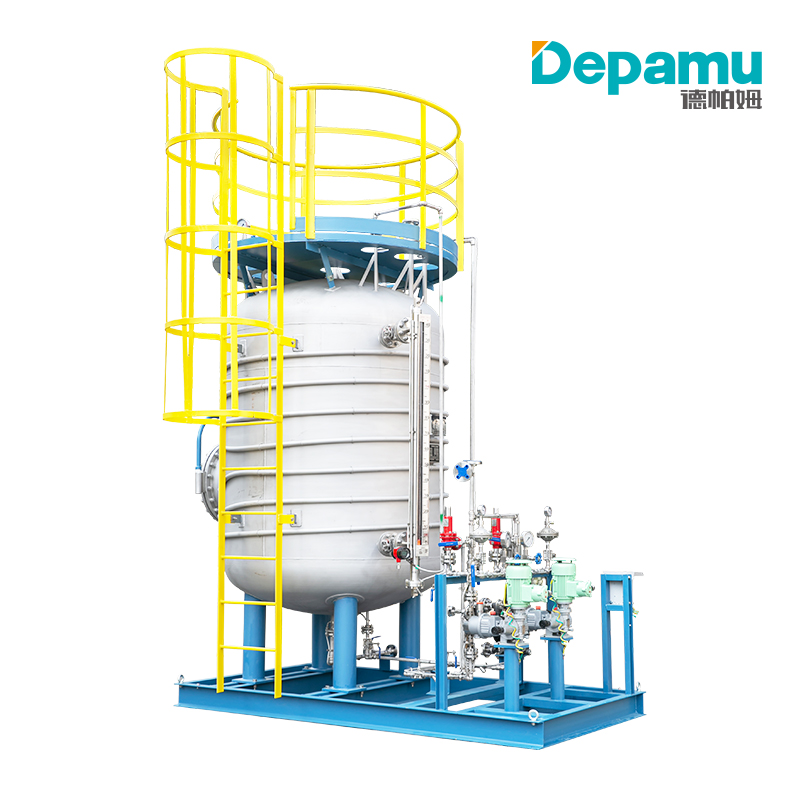
Depamu’s E&P portfolio is not limited to bare pumps; it focuses heavily on modular chemical Injection Packages (skids) . These skids integrate tanks, piping, control valves, and instrumentation into a single, factory-tested unit ready for "plug-and-play" deployment on offshore platforms or remote onshore pads . The two primary pump technologies deployed in these packages are Mechanical Diaphragm Metering Pumps and Hydraulic Diaphragm Metering Pumps.
2.1 Mechanical Diaphragm Technology (DP Series)
For lower to medium pressure applications (typically up to 1.2 MPa / 174 psi), the DP-Series mechanical Diaphragm Pumps offer a cost-effective, reliable solution. The mechanism converts the motor’s rotary motion into reciprocating movement via a worm gear and an adjustable eccentric mechanism. This drives a PTFE (Teflon) diaphragm to expand and contract, drawing in and discharging chemical fluid .
-
Key Feature: The PTFE diaphragm in the DPMFWSA models is mechanically driven without a protection plate, ensuring smooth material transfer and safety.
-
Steady-State Accuracy: ±2%.
-
Application Suitability: Ideal for water treatment, corrosion inhibitor injection in low-pressure gathering lines, and chemical dosing where suction lift is moderate (< 4M) .
2.2 Hydraulic Diaphragm Technology (3DP Series)
This is where Depamu competes at the high-end of the E&P market. Hydraulic diaphragm pumps are designed for ultra-high pressure and zero leakage—two non-negotiable requirements for subsea and HP/HT wells.
The 3DP(M)ZA series utilizes a hydraulic fluid layer to drive the diaphragm. An internal safety valve and automatic compensation valve manage the hydraulic oil, ensuring the diaphragm does not over-stress. The patented integrated sleeve adjustable eccentric mechanism allows for 0-100% stepless stroke adjustment .
-
Critical Advantage: Unlike plunger pumps, the hydraulic diaphragm isolates the process fluid from the moving parts entirely. For the E&P sector, which handles toxic chemicals (like H2S scavengers) and volatile solvents, this zero-leakage characteristic is mandatory.
-
Performance Boundaries: These units can achieve metering accuracy within ±0.5% .
-
Parallel Configuration: Up to 12 pump heads can be connected in parallel on a single drive, allowing operators to inject multiple distinct chemicals (e.g., Demulsifier + Corrosion Inhibitor + Scale Inhibitor) simultaneously from one power source .
3. Case Studies: Breaking the Monopoly in Extreme Environments
The true measure of industrial equipment is its performance in the field. Depamu has recently validated its technology against the highest global benchmarks.
3.1 The China Record: Enping 21-4 Oilfield
The South China Sea represents a frontier for deep-water drilling. In the Enping 21-4油田 project, operators drilled a horizontal displacement of 8,689 meters with a total depth of 9,508 meters—setting a record for the deepest well in China’s offshore history .
The challenge here was 120 MPa (17,400 psi) high-pressure injection. At these pressures, standard pumps fail due to valve plate fatigue, packing leakage, and cavitation. Depamu supplied pumps that successfully handled the high-pressure kick-off and continuous injection requirements for this ultra-deep extended-reach well. Successfully breaking the "foreign monopoly" in this context saved the operator significant capital expenditure (CAPEX) and reduced lead times from months to weeks .
3.2 International Standards: The Kingfisher Project (Uganda)
In 2023, Depamu delivered 29 complete chemical injection skids to the Kingfisher油田 development in Uganda—the first commercial oil project in the East African country .
The Albertine Graben environment presents unique logistical and chemical challenges. The crude is waxy, requiring high-temperature maintenance to keep chemicals fluid, and the local content requirements demanded a robust training and support package. Depamu utilized modular design principles (1 Tank + 2 Pumps, 2 Tanks + 3 Pumps configurations) to handle flow rates ranging from 10 L/h to 400 L/h and pressures up to 32 MPa . The successful delivery of this project highlights Depamu’s ability to compete with legacy Western brands on the international stage, even for turnkey "intelligent" Chemical Injection Packages.
4. Technical Deep Dive: The "Smart" Injection Package
Modern E&P is shifting toward digital oilfields. Depamu has moved beyond mechanical skids into Intelligence Chemical Injection Packages.
These packages utilize online instrument testing to monitor real-time process media parameters. They automatically regulate the PPM (parts per million) ratio of chemical injection based on the flow rate of the crude .
-
Closed-Loop Control: The system receives feedback data on the "actual effect" of the chemical injection downstream.
-
Precision: These systems can achieve accuracy lower than ±1%, with high-precision variants reaching ±0.2% .
-
Scenario: If a well experiences a water cut jump (sudden increase in produced water), the system instantly ramps up scale/corrosion inhibitor to match the new load, saving chemical costs and preventing pipeline failures.
Heavy Oil and Polymer Injection
Beyond standard chemicals, Depamu produces high-pressure Reciprocating Pumps suitable for polymer injection. Polymer flooding (pushing viscous goo into the reservoir to sweep oil toward the producer) requires pumps that can handle non-Newtonian fluids. Depamu’s HD3M series handles flow ranges up to 94 m³/h and pressures up to 160 MPa, specifically designed for this Enhanced Oil Recovery (EOR) application .
6. Competitive Advantage: Why Depamu in the E&P Sector?
Several engineering differentiators position Depamu favorably against competitors:
-
High-Pressure Diaphragm Expertise: While many manufacturers use packed plungers (which leak over time), Depamu’s reliance on hydraulically actuated diaphragms (PTFE) ensures zero emission of volatile organic compounds (VOCs) and toxic chemicals. This is critical for meeting tightening environmental regulations (e.g., IMO 2025, EPA methane rules).
-
Material Versatility: Downstream chemicals are often acidic or alkaline. Depamu offers wetted parts in 304, 316L, PVC, PVDF, PP, and PTFE. For aggressive hydrochloric acid washes or high-sulfur environments, this material flexibility is essential .
-
Modular Skid Design: The DPJY-series skids feature systematic design integration. By modularizing the product structure, Depamu allows for capacity expansion without scrapping existing units. This "future-proofs" the operator's investment .
7. Future Outlook and Innovation
Depamu is currently looking to close the gap with top-tier German manufacturers regarding maximum pressure output. Industry reports note that while a leading German firm produces pumps at 350 MPa (sufficient to cut stone), Depamu has successfully field-tested units at 120 MPa. The company’s R&D strategy focuses on scaling this pressure tolerance while improving energy efficiency and predictive maintenance capabilities .
With the delivery of the Kingfisher project and the Enping deep-well success, Depamu is building a reference library that proves reliability under extreme duress. For E&P operators looking to reduce reliance on a single source of supply (a common pain point in the oilfield service industry), Depamu offers a "high-quality alternative" without compromising on the precision required for flow assurance .
8. Conclusion
The Depamu injection pump systems represent a significant evolution in the upstream oil and gas supply chain. By mastering the twin challenges of ultra-high pressure (120 MPa) and chemical metering accuracy (±0.5%) , Depamu has transformed from a regional manufacturer into a global contender.
From the frigid depths of the South China Sea to the waxy crudes of the East African Rift Valley, Depamu’s mechanical and hydraulic diaphragm pumps are ensuring that the right chemical is delivered to the right place at the right rate. As the E&P sector pushes further into extreme environments, the reliability and precision of Depamu injection skids will continue to be a critical factor in operational success and asset longevity.
-