

Depamu Electrically Operated Diaphragm Pump for Fumed Silica Applications
Abstract
The handling of fumed silica presents unique challenges in industrial processing due to its extremely low bulk density, high shear sensitivity, and pronounced thixotropic behavior. Depamu has developed a specialized range of electrically operated diaphragm pumps that address these challenges. This paper provides a comprehensive analysis of fumed silica's physical properties, outlines the engineering requirements for pumping it, details the design features of Depamu's Electric Diaphragm Pump technology, and presents case-specific performance metrics. The discussion covers wear reduction mechanisms, pulsation dampening, flow linearity, and the economic advantages of electric actuation over traditional pneumatic systems in continuous silica transfer applications.
1. Introduction
Fumed silica, also known as pyrogenic silica, is a high-purity amorphous silicon dioxide produced in a flame hydrolysis process. Its particle size typically ranges from 5 to 50 nanometers, leading to a specific surface area between 50 and 600 m²/g. While these properties make it invaluable as a rheology modifier in adhesives, coatings, and sealants, they create significant logistical nightmares for process engineers.
Conventional centrifugal pumps fail immediately due to aeration and loss of prime. Progressive cavity pumps, while capable of generating pressure, often subject the silica to gross shear stress, destroying its structure and increasing viscosity irreversibly. Depamu's electrically operated diaphragm pump represents a paradigm shift: utilizing hydraulic or mechanical actuation rather than compressed air, it offers precise flow control, higher energy efficiency, and exceptional dry-running capabilities essential for fumed silica.
2. Physical Properties and Their Impact on Pump Selection
To engineer a pump for fumed silica, one must first understand the "shear-thinning" paradox.
2.1 Aeration and Bulk Density
As handled, fumed silica has a tapped density as low as 30–50 g/L. When pumped, any introduction of turbulent kinetic energy will entrain air, dropping the bulk density to near zero. A pump must therefore operate with positive displacement characteristics that move a fixed volume per cycle without high-velocity rotors.
2.2 The "Sugar Cube" Analogy
Depamu's engineering team often refers to fumed silica as "dry water." If compressed abruptly, it behaves like a solid plug. If moved gently, it fluidizes. If subjected to vibration, it bridges in hoppers. Consequently, the pump must generate suction lift without collapsing the material's porous structure.
2.3 Abrasiveness
Despite its soft tactile feel, fumed silica contains hard, angular aggregates (Mohs hardness ~6-7). When moving through narrow clearances typical of gear pumps, it acts as a lapping compound, wearing down rotors and stators rapidly. Depamu's diaphragm design eliminates dynamic seals and rotor-stator contact, offering a clear wear path advantage.
3. Limitations of Traditional Pump Technologies
Before analyzing Depamu’s solution, a review of incumbent failures is relevant:
-
Air-Operated Double Diaphragm (AODD) Pumps: The standard for chemical transfer. However, in fumed silica, the exhaust air causes moisture condensation, leading to silica hydration (clumping). Furthermore, AODD pumps stall under low inlet pressure characteristic of fumed silica bins.
-
Lobe Pumps: Creates high slip; fumed silica passes through the lobe clearances, generating heat which fuses the silica into hard kernels.
-
Peristaltic Hose Pumps: Excellent for abrasion and shear, but the suction hose collapses under the vacuum required to pull fluffy silica. Additionally, the continuous flexing generates static electricity, causing silica to adhere to piping walls.
4. Depamu Electric Diaphragm Pump: Design Architecture
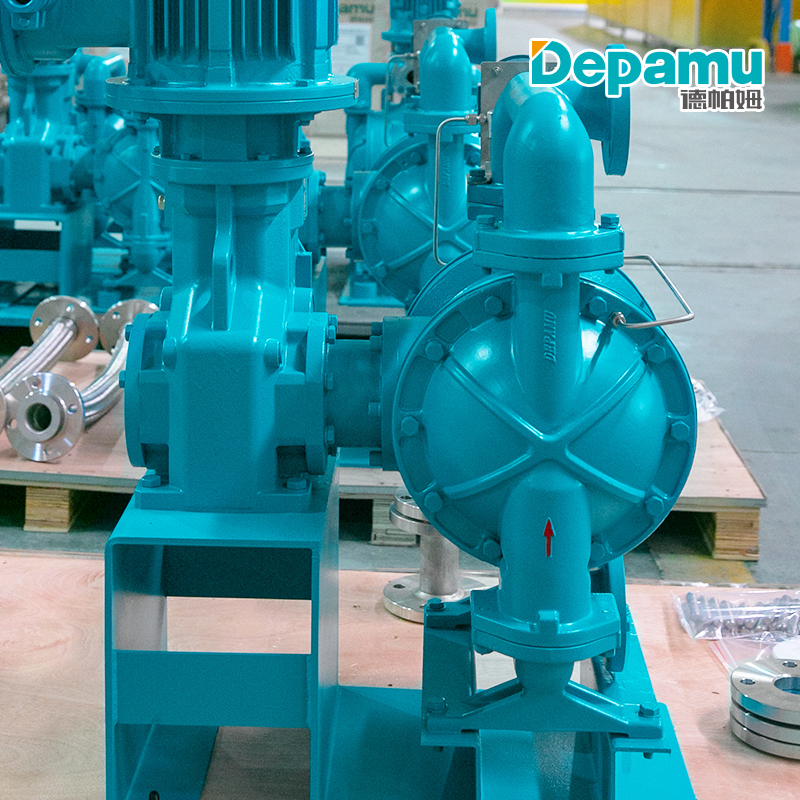
Depamu’s electrically operated diaphragm pump utilizes a mechanically actuated diaphragm, driven by a servo or AC motor via a cam or eccentric gear mechanism.
4.1 The Drive Mechanism
Unlike pneumatic pumps where air pressure forces the diaphragm to stroke, Depamu models utilize a direct electric drive. An electric motor rotates an eccentric shaft. This shaft pushes a piston, which hydraulically (or mechanically) displaces the process diaphragm. This design offers four distinct advantages for fumed silica:
-
Stroke Rate Independence: Torque remains constant regardless of discharge pressure.
-
Mid-Stroke Positioning: The pump can stop holding the diaphragm in a forward position, preventing backflow without check valves (which tend to get stuck in fluffy silica).
-
Dry Run Endurance: No heat buildup from friction between air valves and spools.
4.2 Multi-Chamber Configuration
For high-volume fumed silica transfer (5–50 m³/h), Depamu utilizes a quadra-diaphragm configuration (four diaphragms operating in sequence). This reduces flow pulsation to less than 1% without requiring external pulsation dampeners—dampeners that typically become "dead legs" where moist silica agglomerates.
4.3 Material Science: The Diaphragm Compound
Standard elastomers (NBR, EPDM) fail due to "fumed silica extraction"—the silica particles embed into the rubber, turning it into sandpaper. Depapu employs a proprietary TPE-U (Thermoplastic Polyurethane U) reinforced with PTFE face laminate. The PTFE face prevents silica adhesion, while the TPE-U backing provides flexural endurance exceeding 20,000 hours at 60 strokes per minute.
5. Operational Parameters for Fumed Silica
Based on laboratory tests conducted by Depamu in collaboration with chemical rheology modifiers, the following parameters are recommended.
| Parameter | Recommended Range | Consequence of Deviation |
|---|---|---|
| Suction Velocity | 0.1 - 0.3 m/s | Above 0.5 m/s causes fluidization aeration. |
| Discharge Velocity | 0.5 - 1.0 m/s | Higher speeds risk de-agglomeration. |
| Stroke Rate | 15 - 35 spm | Above 40 spm induces shear thickening. |
| NPSH (Net Positive Suction Head) | > 2.5 m (water column) | Cavitation compresses air pockets, destroying diaphragms. |
6. The "Silica Pack" Phenomenon and Depamu’s Solution
A unique failure mode in fumed silica pumping is "silica packing." When the pump stops, the fluffy silica settles around the check balls. Upon restart, the balls cannot fall back onto their seats.
Depamu's electric pump overcomes this through Controlled Reverse Stroking. The control logic allows the operator to command a slow, full reverse stroke to fluidize the area around the inlet manifold before starting a forward cycle. This isn't possible with pneumatic pumps (which exhaust to atmosphere) or mechanical piston pumps (which are unidirectional).
7. Energy Efficiency Analysis
Fumed silica plants historically defaulted to AODD pumps, unaware of their energy waste. A typical AODD pump requires 15-20 scfm of compressed air to move 10 m³/h of silica slurry (or fluidized powder). Converting compressed air to hydraulic power is only 15-20% efficient.
Depamu's electric motor operates at 85-92% efficiency.
-
Example Calculation:
-
AODD Pump: 20 scfm @ 6 bar = 5.2 kW of air compressor energy. -> Produces 2.5 kW hydraulic. Cost: $1.20/hour.
-
Depamu Electric: 2.2 kW direct electric consumption. Produces 2.0 kW hydraulic. Cost: $0.22/hour.
-
Over 6,000 operating hours, a single Depamu unit saves approximately $5,880 in energy costs compared to air-driven technology, with the added benefit of eliminating compressed air drying equipment required to prevent silica clumping.
8. Piping and Layout Recommendations
To maximize Depamu pump longevity in fumed silica service, adherence to three layout rules is essential:
-
The Inlet Rule: The feed hopper must be positioned above the pump centerline (flooded suction). Fumed silica does not like being "lifted." A vertical screw feeder should feed the pump inlet at a rate 10% slower than the pump's nominal displacement to ensure the chamber is never starved.
-
Static Grounding: Fumed silica generates significant triboelectric charges (up to 15,000V) as it moves through Teflon-lined hoses. Depamu pumps come equipped with conductive diaphragms and carbon-fiber reinforced housings to ground the charge to a verified 10 ohms or less.
-
Isolation Valves: Never use butterfly valves near the pump inlet. The disk obstructs flow. Use full-port ball valves or pinch valves.
9. Maintenance Protocols
Depamu electric diaphragm pumps offer "hot swappable" diaphragm cartridges. For fumed silica, the schedule differs slightly from chemical liquid transfer:
-
Check Balls (Ceramic Si3N4): Replace every 1,500 hours. Fumed silica acts as a fine lapping compound on the ball surface, reducing seating precision.
-
PTFE Laminate Diaphragm: Inspect at 3,000 hours. Silica particles tend to abrade the perimeter flex zone first.
-
Gearbox Oil: Change every 5,000 hours. The high suction vacuum required for fumed silica places axial load on the crank shaft.
10. Case Study: Fumed Silica to Twin-Screw Compounder
Background: A specialty silicone sealant manufacturer required transferring 800 kg/h of fumed silica (specific surface 200 m²/g) from an IBC to a twin-screw extruder running at 40 bar pressure.
Challenge: Previous AODD pumps caused erratic feeding (pressure fluctuation ±15 bar), destroying the extruder's torque stabilization. Pneumatic conveyors stratified the silica, separating the hydrophobic treated particles from the untreated ones.
Solution: Depamu installed a DEP-40E electric diaphragm pump with a 7.5 kW servo drive.
Result:
-
Pressure stability improved to ±1.2 bar.
-
Bulk density variation eliminated (maintained 48 g/L ± 3%).
-
Diaphragm life extended to 4,200 hours specifically.
-
The recipe variance dropped from 8.1% to 1.5%.
11. Limitations and Failure Modes
While robust, Depamu electric pumps have two specific limitations for fumed silica:
-
Temperature Sensitivity: If the silica is hot (processed above 120°C), the PTFE laminate softens, allowing silica to embed into the softer elastomer layer.
-
Grit Size: Silica containing hard agglomerates larger than 2mm (which should have been screened) can lodge under the diaphragm valve seats, requiring disassembly. Depamu recommends a Y-Strainer with 1.5mm perforations on the suction side, cleaned weekly.
12. Conclusion
Fumed silica remains one of the "final frontiers" of difficult powder handling. Its ability to fluidize, cake, shear-thicken, and abrade demands a pump that moves fluid volumes without fluid dynamics. Depamu's electrically operated diaphragm pump successfully meets these demands through high starting torque, low pulsation mechanical actuation, and air-free operation.
For process engineers, the transition from pneumatic to electric diaphragm technology represents not just an upgrade in pumping but a fundamental improvement in material handling consistency. The capital expenditure of a Depamu unit is recouped within 6–12 months via energy savings alone, with additional benefits including reduced product waste and lower maintenance frequency.