

Design and Operation of Depamu Phosphate Dosing and Hydrazine Hydrate Dosing Systems for Thermal Power Plants
Abstract
Chemical dosing systems are vital for maintaining water chemistry in thermal power plants, directly impacting equipment longevity, operational efficiency, and safety. This article provides a comprehensive technical overview of two critical chemical conditioning systems: the phosphate dosing system for boiler water internal treatment and the hydrazine hydrate dosing system for oxygen scavenging and feedwater conditioning. Drawing on industry specifications, operational case studies, and equipment design principles, this paper examines system architecture, chemical functions, operational challenges, and safety considerations. Particular attention is paid to the Depamu phosphate Injection Package as a representative modern dosing skid and the hydrazine preparation and injection system as employed in contemporary power generation facilities.
1. Introduction
The reliable operation of thermal power plants depends significantly on stringent control of water chemistry. Impurities in feedwater and boiler water can cause scale formation, corrosion, and fouling of critical components including boiler tubes, turbines, and condensers. Chemical dosing systems serve as the primary means of maintaining water quality parameters within prescribed limits .
Two chemical treatment systems are fundamental to drum-type boiler operations: phosphate dosing and hydrazine hydrate dosing. The phosphate system controls boiler water chemistry through the precipitation of scale-forming compounds and pH maintenance, while the hydrazine system removes dissolved oxygen and promotes passivation of metal surfaces. Both systems must operate with high reliability, precision, and safety, given the aggressive chemicals involved and the critical nature of the systems they protect.
This article presents a detailed examination of these systems based on industry practice, equipment specifications, and operational experience, with focus on the Depamu phosphate injection package as a representative modern dosing solution.
2. Phosphate Dosing System: Design and Function
2.1 Chemical Principles and Application
The phosphate dosing system injects a solution of tri-sodium phosphate into the boiler drum to maintain boiler water chemistry within prescribed limits. Typical operating parameters for drum-type boilers specify phosphate residuals between 5 to 10 ppm, with pH maintained between 9.1 and 9.8 . Phosphate performs three critical functions:
Firstly, it precipitates calcium and magnesium hardness salts as insoluble phosphate compounds that can be removed via blowdown, preventing scale formation on heat transfer surfaces. Secondly, it maintains boiler water alkalinity, counteracting acidic contaminants that may enter the system. Thirdly, it provides a buffering effect against acid-forming contaminants, protecting against acidic corrosion.
The reaction mechanisms are well-established: phosphate reacts with calcium hardness to form hydroxyapatite precipitates, and with magnesium to form serpentine compounds. These precipitates remain in suspension and are removed through continuous or intermittent blowdown, rather than depositing on tube surfaces .
2.2 System Architecture
A typical phosphate dosing system comprises four functional sections: chemical preparation, storage, metering and injection, and control.
The preparation section includes a dissolving tank where solid phosphate is mixed with demineralized water or condensate to create a dilute solution. Motorized stirrers operate at approximately 180-200 rpm to ensure complete dissolution and uniform concentration . The tank is equipped with level gauges, transmitters, and overflow protection.
Storage is integrated with preparation through mixing-cum-storage tanks. For larger installations, separate storage capacity may be provided to buffer against supply interruptions .
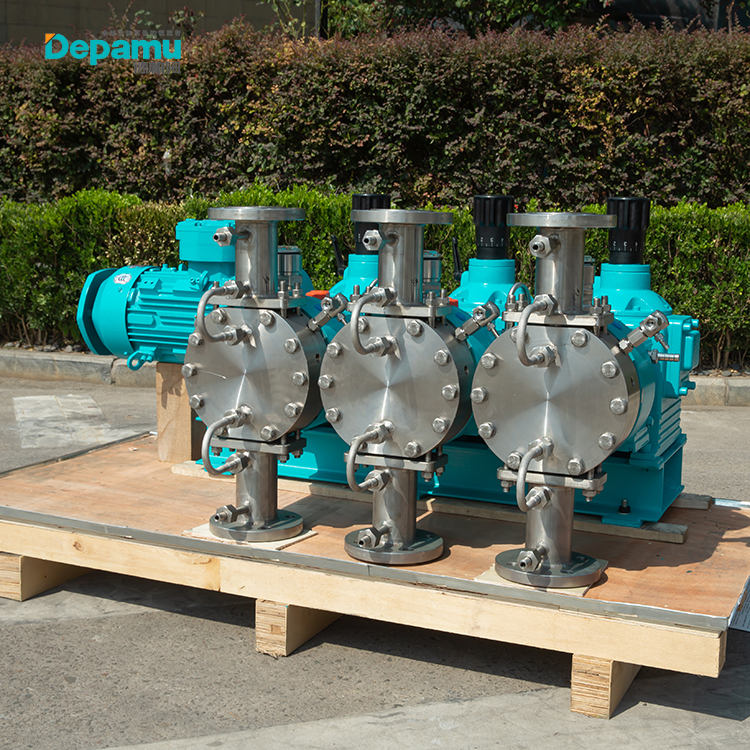
The metering and injection section employs positive displacement plunger-type Metering Pumps, typically configured as 1 working + 1 standby per unit. These pumps must generate discharge pressure exceeding the boiler drum pressure to admit chemical into the drum system through distribution headers. The pumps feature adjustable stroke mechanisms allowing 0-100% capacity variation even during operation, enabling precise dosing control . Relief valves protect against overpressure conditions, and duplex strainers on suction lines prevent debris ingress.
Control and instrumentation includes local control panels with start/stop push buttons, status indication, and annunciation of faults. For automated operation, the system accepts 4-20 mA signals from plant distributed control systems (DCS) for stroke length control, with stroke position feedback transmitted to the control room .
2.3 The Depamu Phosphate Injection Package
The Depamu phosphate injection package exemplifies modern skid-mounted dosing solutions. Built to modular design principles, these packages integrate all system components on a single structural base, simplifying installation and commissioning .
The DPJY-series injection packages are manufactured according to process specifications derived from American, German, and Japanese technologies, adapted for local conditions. Key features include systematic design that eliminates inconsistencies associated with traditional single-equipment approaches; modular structure enabling convenient capacity and function extension; and flexible component selection allowing users to specify materials and brands according to application requirements .
The package includes all necessary piping, with ASTM 312 Gr. TP 304 seamless stainless steel used for corrosion resistance. Valve materials are SS-304, rated to ASA 800, providing compatibility with the chemical environment and pressure requirements .
Application scope for these packages extends beyond phosphate dosing to include circulating water treatment, raw water pretreatment, wastewater treatment, and oilfield chemical additive injection .
2.4 Operational Case Study: Phosphate Dosing System Modification
A documented operational case from a 210 MW thermal power plant illustrates the criticality of phosphate dosing system reliability. The plant experienced continuous decline in boiler water pH and increasing silica levels, with chemical section reporting inability to dose required phosphate quantities. Investigation revealed that the dosing distribution header inside the boiler drum was completely choked, preventing chemical injection .
With grid conditions preventing unit shutdown for the estimated 10-day repair period, engineers developed an emergency solution. The dosing line was modified to inject phosphate through the economizer vent line, which connected to economizer link pipes at the drum top. A separate line with higher-grade piping and a non-return valve was installed, utilizing the economizer vent line as an alternative injection path .
Within 10 hours of modification work, dosing was restored, with tank level drop confirming chemical flow after two hours. Drum water pH began improving after six hours, with normal parameters restored by the following day. The modification successfully prevented a 10-day unit shutdown and avoided loss of approximately 50 MU of generation. The temporary modification remained in service for six months until the next scheduled overhaul .
This case demonstrates the operational philosophy of maintaining alternative dosing paths, the value of rapid engineering solutions, and the critical role of phosphate dosing in maintaining boiler water chemistry.
3. Hydrazine Hydrate Dosing System
3.1 Chemical Principles and Function
Hydrazine hydrate (N₂H₄·H₂O) serves as a multifunctional chemical agent in power plant water treatment. Its primary function is as an oxygen scavenger, removing dissolved oxygen that would otherwise cause corrosion of feedwater and boiler components .
The reaction of hydrazine with dissolved oxygen proceeds as:
N₂H₄ + O₂ → N₂ + 2H₂O
The reaction products—nitrogen and water—are non-damaging and do not increase total dissolved solids, unlike sulfite treatment which contributes to solids loading requiring increased blowdown .
Hydrazine provides three protective mechanisms . First, it scavenges dissolved oxygen, preventing the cathodic depolarization that drives corrosion cells. Second, residual hydrazine decomposes above 205°C to form ammonia, which raises feedwater pH and provides alkalinity protection . Third, hydrazine reacts with hematite (Fe₂O₃) layers on boiler tubes to form stable magnetite (Fe₃O₄), creating a protective oxide film that passivates metal surfaces against further corrosion .
The theoretical dosage requires 1 ppm hydrazine per 1 ppm dissolved oxygen, but practical dosing typically employs 1.5-3 times stoichiometric ratio to account for reaction kinetics. A common guideline specifies maintaining residual hydrazine between 0.05-0.2 ppm depending on operating pressure .
3.2 System Architecture
The hydrazine dosing system comprises receiving and storage facilities, preparation tanks, Dosing Pumps, and control systems. A representative system configuration includes:
Measuring Tank: A dedicated tank for receiving concentrated hydrazine solution (typically 24-55% concentration delivered in barrels or drums). The tank includes breather vents, level gauges, level transmitters, and overflow protection. Concentrated solution is transferred manually via hand pump with flexible hose and couplings .
Mixing Cum Storage Tank: Dilute solution is prepared in this tank using condensate, with motorized stirrer mixing to uniform concentration. The tank includes all standard instrumentation and an overflow drain with sealing arrangement to contain vapors .
Dosing Pumps: Two 100% capacity positive displacement plunger-type metering pumps, electrically operated with auto adjustment. As with phosphate systems, stroke adjustment from 0-100% during operation enables precise control. A duplex strainer on suction lines with differential pressure transmitter provides blockage indication .
Piping and Valves: All wetted piping is stainless steel (ASTM 312 Gr. TP 304), with SS-304 valves rated ASA 800. Interconnecting piping on the skid is routed to a common drain header .
The injection point for hydrazine is typically at the deaerator outlet (boiler feed pump suction), though provision for injection at condensate extraction pump discharge or other points may be included .
3.3 Safety Considerations for Hydrazine Handling
Hydrazine presents significant occupational health and safety concerns requiring careful system design and operating procedures. Hydrazine is classified with potential carcinogenic risk, requiring special handling precautions . The occupational exposure limit is stringent, with alarm systems typically configured to activate at 70% of the workplace limit .
Modern installations incorporate vapor confinement systems with sealed tank lids and gas detection monitoring. Sensors are positioned strategically in both storage and preparation areas, with alarms sent to the human-machine interface and visual warnings at area entrances . Personal protective equipment including face shields, rubber aprons, and gloves is standard practice for personnel handling the chemical .
The safety design for chemical dosing systems increasingly follows comprehensive approaches. For ammonia (used in some pH adjustment applications), safety requirements include locating storage areas at plant edges, downwind of prevailing winds, with appropriate leak detection and emergency response systems . Similar principles apply to hydrazine installations.
3.4 Operational Control and Performance Monitoring
Hydrazine dosing control requires continuous measurement of dissolved oxygen and residual hydrazine. Modern analyzers provide rapid response (90% response in less than one minute) enabling precise dosing adjustment . Control logic adjusts dosing based on flow rate, oxygen content, and other signals, maintaining hydrazine concentration within optimal range .
Both underdosing and overdosing carry consequences. Insufficient hydrazine results in oxygen breakthrough, causing corrosion and deposition that reduce plant efficiency. Excessive dosing leads to unnecessary chemical costs and potential copper corrosion in condensers and feedwater heaters, as unreacted hydrazine decomposes to ammonia and forms copper-ammonia complexes that precipitate copper on turbine blades .
For boiler cleaning operations, higher hydrazine concentrations are employed. A documented procedure for alkaline hydrazine hydrate cleaning (AHHC) maintains hydrazine concentration between 0.1-0.5 mg/L in feedwater during normal passivation, with higher concentrations up to 500 mg/L used for passivation after acid cleaning .
3.5 Alternative Oxygen Scavengers
While hydrazine has historically been considered the preferred oxygen scavenger, some plants are transitioning to alternatives such as carbohydrazide. Carbohydrazide provides similar benefits—ammonia generation for pH increase, magnetite formation for corrosion protection—without the carcinogenic risk classification. The theoretical dosage for carbohydrazide is 1.4 parts per part dissolved oxygen .
The choice between hydrazine and alternatives involves balancing the proven effectiveness of hydrazine against handling and regulatory considerations. Many large, steam-generated power plants continue to find value in hydrazine use .
4. System Integration and Control Philosophy
Both phosphate and hydrazine dosing systems operate within the broader plant control architecture. Modern installations follow a distributed control philosophy with the following characteristics :
Local Control Panel: Each dosing skid includes a local panel with start/stop push buttons, status indicators (on/off/trip), local/remote selection, stroke position indication, and local annunciation of faults.
Remote Control: The plant DCS provides start/stop commands, automatic stroke control via 4-20 mA signals, and receives stroke position feedback and status indications.
Interlocks: Pumps and stirrers are interlocked with tank level (low-low level trips pumps, prevents stirrer start without adequate level), strainer condition, and MCC status.
Alarm and Annunciation: Fault conditions including high/low pressure at pump discharge, strainer blockage, and motor trips are annunciated both locally and in the control room.
Signal exchange between local panel, MCC, and DCS follows standardized protocols with isolated contacts (24V DC for control signals) to prevent voltage conflicts.
5. Conclusion
Phosphate dosing and hydrazine hydrate dosing systems are essential components of thermal power plant water chemistry control. The phosphate system maintains boiler water chemistry within prescribed limits through precipitation of hardness salts and pH control, while the hydrazine system removes dissolved oxygen and promotes passivation of metal surfaces.
The Depamu phosphate injection package represents a modern skid-mounted solution integrating preparation, storage, metering, and control functions with modular flexibility and component selection options. System reliability is paramount, as demonstrated by the emergency modification case that prevented a 10-day unit shutdown through creative engineering.
Hydrazine handling requires careful attention to safety, with vapor confinement, gas detection, and proper personal protective equipment essential. The trend toward alternatives such as carbohydrazide reflects growing concern about hydrazine's hazard profile, though hydrazine remains widely used in established installations.
Both systems increasingly incorporate advanced automation, with distributed control enabling precise dosing based on continuous water quality monitoring. As power plant efficiency and environmental requirements become more stringent, the role of chemical dosing systems in protecting equipment and ensuring reliable operation will continue to grow in importance