

Depamu Metal Rotor Pumps for Glycerin (Glycerol, Propanetriol-1,2,3): Engineering Solutions for High-Viscosity Transfer
Abstract
The transfer of glycerin (glycerol)—a high-viscosity, non-Newtonian fluid—presents significant engineering challenges across pharmaceutical, food, cosmetic, and chemical industries. Depamu (Hangzhou) Pumps Technology Co., Ltd., a Chinese high-tech enterprise with over two decades of specialized fluid handling experience, has developed metal rotor pumps (also known as lobe pumps) that address these challenges through innovative positive displacement technology. This article comprehensively examines the technical specifications, operational principles, material science considerations, and application-specific advantages of Depamu metal rotor pumps for glycerin service. Key features discussed include ultra-high viscosity handling capability (up to 1,000,000 cP), dry-run protection, self-priming capacity exceeding 8 meters, and compliance with international standards including API 676, CE, and ISO certifications.
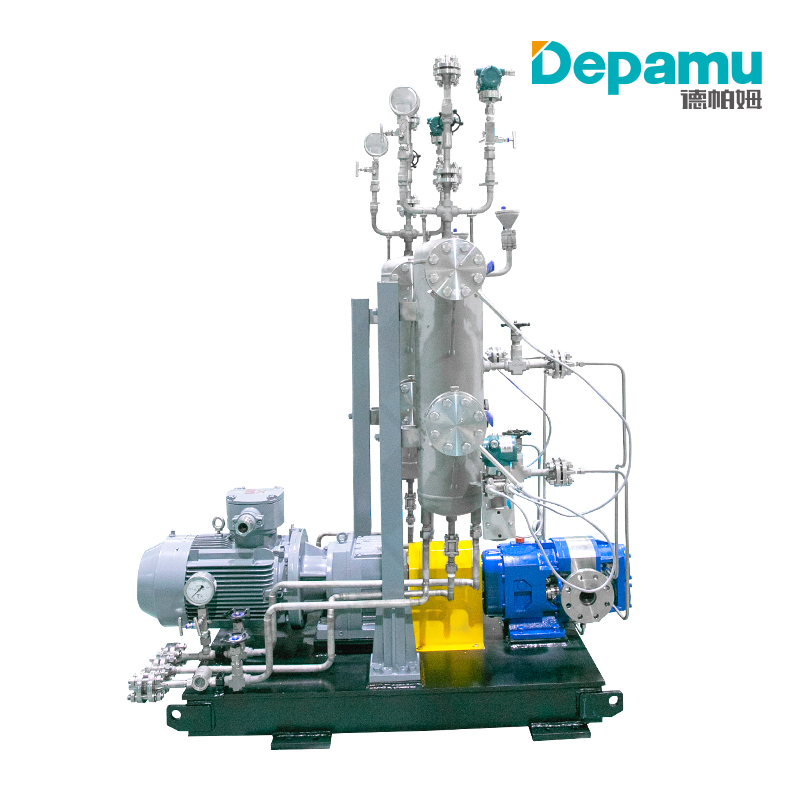
1. Introduction: The Glycerin Handling Challenge
Glycerin (C₃H₈O₃), also known as glycerol or propanetriol-1,2,3, is a simple polyol compound with three hydrophilic hydroxyl groups. It is colorless, odorless, viscous, and sweet-tasting. While these properties make it invaluable across industries—from pharmaceutical syrups and food preservatives to cosmetic moisturizers and chemical intermediates—they create substantial difficulties for conventional pumping technologies.
The primary challenges when pumping glycerin include:
-
High Dynamic Viscosity: Pure glycerin exhibits viscosities ranging from approximately 950 cP at 25°C to over 3,000 cP at lower temperatures. Under cold conditions, viscosity can exceed 10,000 cP, rendering centrifugal pumps ineffective.
-
Non-Newtonian Behavior: Glycerin displays shear-thinning characteristics, meaning its apparent viscosity changes with shear rate, complicating flow rate predictions with traditional pump types.
-
Temperature Sensitivity: Glycerin viscosity is highly temperature-dependent. A 30°C temperature increase can reduce viscosity by over 80%, requiring careful thermal management.
-
Cavitation Risk: Low vapor pressure combined with high suction lift requirements can lead to cavitation damage in improperly specified pumps.
-
Cleanliness Requirements: Food-grade and pharmaceutical applications demand pumps with sanitary designs, smooth surfaces, and materials resistant to both corrosion and bacterial adhesion.
Depamu metal rotor pumps have emerged as an optimal solution for these challenges, offering robust construction, precise clearance control, and versatility across the full spectrum of glycerin applications.
2. Depamu: Company Background and Industry Position
Depamu (Hangzhou) Pumps Technology Co., Ltd. was established in 2003 and is headquartered in Hangzhou Qiantang Area, China. The company has grown from a specialized pump manufacturer into a high-tech enterprise holding over 100 technical patents. Significantly, Depamu serves as a drafter of pump industry standards in China, indicating its technical authority within the domestic and international pump manufacturing sector.
The company has achieved multiple international certifications, including:
-
API 676 (American Petroleum Institute standard for positive displacement pumps—rotary)
-
CE (European Conformity)
-
ISO 9001 (Quality Management)
-
ISO 14001 (Environmental Management)
-
ISO 45001 (Occupational Health and Safety Management)
Depamu‘s customer base includes China’s largest state-owned enterprises—CNPC, SINOPEC, CNOOC, and CNNC—with exports extending to over 50 countries including the United States, the United Kingdom, and France.
3. Operating Principle of Metal Rotor Pumps
3.1 Fundamental Mechanism
Depamu metal rotor pumps operate on the positive displacement, rotary lobe principle. Unlike centrifugal pumps that impart velocity to fluids, lobe pumps trap fluid between rotating lobes and the pump casing, mechanically displacing it from suction to discharge ports.
The operational sequence is as follows:
-
Suction Phase: As rotors rotate away from each other, a vacuum forms at the suction port, drawing glycerin into the pump cavity.
-
Transport Phase: Fluid fills the spaces between rotor lobes and the casing. The rotors’ synchronized rotation carries the fluid around the casing perimeter.
-
Discharge Phase: Meshing of the rotors forces fluid out through the discharge port at controlled pressure.
3.2 Critical Clearance Design
A distinguishing engineering feature of Depamu metal rotor pumps is the precision clearance maintained between rotors and between rotors and pump housing: typically 0.05–0.30 mm (5–30丝, where 1丝 = 0.01 mm). For glycerin applications, these clearances are selected based on:
-
Fluid viscosity
-
Operating temperature
-
Presence of particulate matter
-
Required volumetric efficiency
At higher viscosities, slightly larger clearances may be specified because the fluid‘s surface tension effectively “seals” the gap, preventing excessive slip while reducing mechanical friction. This intelligent clearance design enables Depamu pumps to maintain volumetric efficiencies of 70–85% across a broad viscosity range.
4. Technical Specifications for Glycerin Service
4.1 Performance Parameters
Depamu offers metal rotor pumps in 5 series and 17 models, with specifications directly relevant to glycerin handling:
| Parameter | Range |
|---|---|
| Flow Rate | 0.2 – 3000 m³/h (0.88 – 13,200 GPM) |
| Maximum Pressure | Up to 3.0 MPa (435 psi) |
| Operating Temperature | -40°C to +280°C (-40°F to +536°F) |
| Viscosity Range | Up to 1,000,000 cP |
| Rotational Speed | 10 – 650 RPM |
| Self-Priming Capacity | Vertical suction lift ≥ 8 meters (26 feet) |
| Dry-Run Capability | ≥ 15 minutes |
4.2 Flow Rate Control Characteristics
A significant advantage for glycerin processing is the linear relationship between pump speed and flow rate. Depamu metal rotor pumps maintain constant displacement per revolution regardless of system backpressure (within design limits). This positive displacement characteristic enables:
-
Precise metering for batch processing
-
Reproducible filling operations
-
Direct flow rate adjustment via variable frequency drives (VFDs)
-
Consistent performance despite viscosity fluctuations
5. Rotor Design Selection for Glycerin Applications
Depamu offers multiple rotor geometries, each providing distinct advantages for specific glycerin applications.
5.1 Three-Blade Rotors (通用最广)
Characteristics: Highest displacement among all options; moderate particle breakage.
Glycerin Applications: This is the most universally applicable rotor for pure glycerin transfer. Three-blade rotors provide the highest volumetric efficiency—delivering maximum flow per rotation—making them ideal for:
-
Bulk transfer operations
-
Tanker loading and unloading
-
Inter-process transfer of refined glycerin
The minimal pulsation associated with three-lobe designs ensures stable pressure delivery, critical for downstream processes with sensitive instrumentation.
5.2 Butterfly Rotors (蝶形转子)
Characteristics: Low breakage; suitable for medium-small particles; low pulsation.
Glycerin Applications: When glycerin contains additive particles—such as cosmetic scrubs, pharmaceutical suspensions, or food-grade preparations with emulsified components—butterfly rotors minimize mechanical damage while maintaining gentle flow characteristics.
5.3 Single-Blade Rotors (单叶转子)
Characteristics: Highest particle pass-through capability; larger pulsation; lower pressure capability.
Glycerin Applications: For crude glycerin streams containing unrefined solids (catalyst residues, organic byproducts from biodiesel production), single-blade rotors prevent clogging and damage.
5.4 Multiple-Blade Rotors (多叶转子)
Characteristics: Decreasing displacement with increased blade count; highest flow stability; maximum shear.
Glycerin Applications: Suitable for final blending and emulsification where glycerin must be homogenized with other ingredients.
6. Material Compatibility and Construction
6.1 Wetted Materials
Depamu provides extensive material options to address the corrosion and purity requirements of different glycerin grades:
| Material Code | Material | Glycerin Application Suitability |
|---|---|---|
| F | 304 Stainless Steel | General industrial glycerin, non-critical applications |
| M | 316 Stainless Steel | Pharmaceutical grade, food grade, corrosion-resistant requirements |
| L | 316L Stainless Steel (Low Carbon) | Highest purity requirements; weld-fabricated systems |
| Q | 2205 Duplex Stainless Steel | Crude glycerin with chlorides; aggressive chemical processing |
| H | Hastelloy | Specialty chemical applications with corrosive contaminants |
| T | Titanium Alloy | Extreme corrosion resistance; pharmaceutical synthesis |
For food-grade and pharmaceutical glycerin applications, Depamu offers sanitary configurations with stainless steel cladding covering all external surfaces, preventing contamination risks.
6.2 Mechanical Seals
Given glycerin‘s tendency to crystallize when dehydrated and its high surface tension, mechanical seal selection is critical. Depamu employs seal materials resistant to dry running, with designs specifically engineered to withstand the“scouring”action of high-viscosity fluids.
6.3 Bearing and Gearbox Design
Depamu metal rotor pumps feature heavy-duty cast iron gearboxes supporting the rotors through double-bearing, through-shaft designs. This configuration provides: