

Depamu Dosing Pumps for Oil & Gas: Precision Engineering for Critical Fluid Control
Introduction
In the demanding landscape of oil and gas operations, precise chemical injection is not merely an operational preference—it is a fundamental requirement for production efficiency, asset integrity, and safety. From upstream extraction to downstream refining, the accurate dosing of corrosion inhibitors, demulsifiers, scale inhibitors, and hydrate preventatives determines the difference between optimized production and costly operational failures. Depamu (Hangzhou) Pumps Technology Co., Ltd., established in 2003, has positioned itself as a significant player in this specialized field, offering dosing pump solutions engineered specifically for the rigorous demands of the petroleum industry .
Technical Foundation and Engineering Philosophy
API Compliance and Quality Standards
Depamu's dosing pumps are manufactured following the stringent American Petroleum Institute (API) standards, specifically API 674 (reciprocating positive displacement pumps) and API 675 (controlled-volume pumps) . This compliance is not merely a certification checkbox—it represents a commitment to the reliability, safety, and performance standards demanded by major oil and gas operators worldwide. The company has secured ISO 9001, ISO 14001, ISO 45001, and CE certifications, with third-party verification from DNV and other internationally recognized bodies .
The company's engineering pedigree includes over 100 technical patents and active participation in drafting pump industry standards, reflecting its role as a technical authority rather than merely a manufacturer . This innovation-driven approach is particularly relevant in oil and gas applications, where operating conditions frequently push equipment beyond conventional limits.
Core Product Portfolio for Oil and Gas Applications
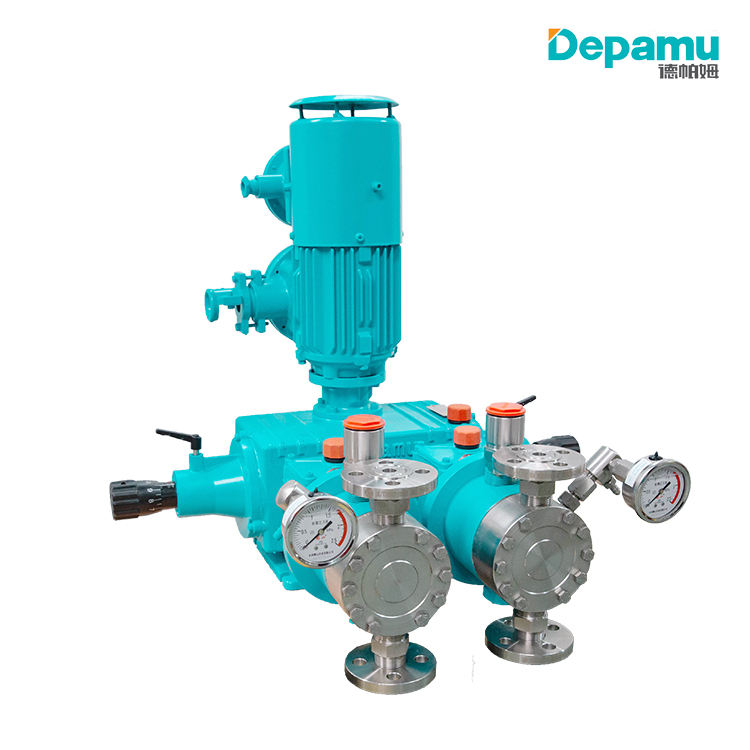
Plunger Metering Pumps (DP(M)ZA Series)
The DP(M)ZA series Plunger Metering Pumps represent the flagship technology for high-pressure oil and gas dosing applications . These pumps feature a single-pump-head flow capacity up to 12,100 L/H and pressure ratings reaching 228 MPa—capabilities essential for deep-well chemical injection and high-pressure pipeline applications .
The working principle is fundamentally robust: a motor drives a worm gear pair, converting rotary motion into reciprocating movement through an eccentric mechanism. The plunger directly contacts the process fluid, displacing precise volumes with each stroke while high-precision inlet and outlet check valves ensure metering accuracy .
Key engineering features include:
-
High-performance plungers with specialized packing and sealing components delivering extended service life and superior sealing performance—critical for preventing fluid loss and environmental contamination
-
Patented integrated sleeve adjustable eccentric transmission enabling 0-100% stepless flow adjustment with ±0.5% metering accuracy across the 10-100% adjustment range
-
Diverse flow adjustment modes including manual, electrical, pneumatic, and frequency conversion—allowing integration with automated control systems
-
Multi-head configurations supporting up to 12 pump heads in parallel, enabling either pulsation reduction (when pumping the same fluid) or proportional pumping of multiple media
Hydraulic Diaphragm Metering Pumps
For applications where zero leakage is paramount—particularly when handling toxic, hazardous, or environmentally sensitive chemicals—Depamu's hydraulic Diaphragm Pumps offer an alternative to direct plunger designs . These units incorporate internal safety valves and compensation valves that enable automatic air discharge and oil replenishment, ensuring reliable operation even under varying process conditions .
The hydraulic diaphragm design effectively isolates the pumped chemical from the pump's mechanical components, eliminating the risk of leakage through packing seals. This feature is particularly valuable for offshore platforms and environmentally sensitive production areas.
Mechanical Diaphragm Metering Pumps
For lower-pressure applications, Depamu offers mechanical diaphragm metering pumps with maximum discharge pressures up to 0.6 MPa and flow rates reaching 3,200 L/H . While operating at lower pressures, these pumps maintain the precision and reliability expected in oil and gas service, with PTFE diaphragm construction ensuring chemical compatibility with a wide range of injection chemicals .
Chemical Injection Packages: Integrated Solutions
Depamu's DPJY-series injection packages represent the company's comprehensive approach to oil and gas fluid handling—transforming individual pump components into complete, engineered systems . These skid-mounted units integrate solution tanks, metering pumps, level gauges, safety valves, pulsation dampers, piping, and electrical control systems into coordinated packages that simplify installation and operation .
Specific Applications in Petroleum Operations
The DPJY-series packages are configured for specific oil and gas applications, each with tailored specifications:
Demulsifier Injection facilitates the separation of water from crude oil emulsions, a critical upstream processing step that directly impacts product quality and downstream refining efficiency. These packages typically operate at capacities of 10-200 L/H at pressures up to 4.0 MPa .
Corrosion Inhibitor Injection protects pipelines and production equipment from internal corrosion—a persistent challenge in oil and gas operations where produced fluids often contain corrosive components such as CO₂ and H₂S. These systems operate in the 10-200 L/H range at pressures up to 2.5 MPa .
Methanol/Ethylene Glycol Injection for hydrate prevention is essential in cold-weather operations and deepwater production, where gas hydrates can form and block pipelines. These packages are engineered for capacities of 10-500 L/H at pressures up to 32 MPa, reflecting the challenging conditions of hydrate suppression .
Boiler Feed Water Treatment packages for ammonia, hydrazine, and phosphate injection ensure water quality in steam generation systems, protecting boilers from scale and corrosion that can lead to catastrophic failures .
The integrated package design offers significant advantages for oil and gas operators: compact footprint suitable for offshore platforms and space-constrained facilities; reduced installation complexity with pre-assembled, pre-tested systems; and standardized interfaces for consistent operation across multiple sites .
Materials Selection and Corrosion Resistance
Oil and gas applications subject equipment to some of the most aggressive chemical environments in industry. Depamu's material selection strategy reflects this reality, offering pump heads in 304, 316, 316L stainless steels, 904L superaustenitic stainless, Hastelloy C, and various high-polymer materials .
Solution tanks for injection packages can be fabricated from 304 or 316 stainless steel, carbon steel, carbon steel with rubber or plastic linings, FRP, PE, or PVC, allowing operators to match materials to specific chemical service requirements . This versatility is crucial when handling the diverse chemical cocktails used in modern oilfield operations—from acidic stimulation fluids to alkaline scale inhibitors.
Operational Advantages in Oil and Gas Service
Accuracy and Reliability
Metering accuracy of ±0.5% across the operational range distinguishes Depamu pumps from lower-precision alternatives . In oil and gas production, this precision translates directly to chemical cost optimization: over-dosing wastes expensive chemicals and may cause downstream processing issues; under-dosing compromises asset protection. The economic impact of precise chemical injection can be substantial, particularly in large-scale operations consuming thousands of gallons of treatment chemicals annually.
Versatility in Challenging Media
Depamu's pump designs accommodate the challenging fluids encountered in petroleum operations, including:
-
High-viscosity media common in heavy oil production and pipeline transportation
-
High-pressure applications with pressure capacities up to 228 MPa for plunger pumps
-
High-temperature fluids with operating temperatures up to 80°C for PTFE-wetted components
-
Multi-phase fluids containing solids, liquids, and gases—particularly relevant in Rotor Pump designs that handle solids up to 60% content by weight
Maintenance and Serviceability
The oil and gas industry values equipment that can be serviced efficiently, particularly in remote locations where specialist support may be days away. Depamu's plunger pumps feature simple structures that facilitate maintenance, with oil-immersion lubrication ensuring long transmission component life . Maintenance intervals of up to 8,000 hours under appropriate operating conditions reduce downtime and total cost of ownership .
Global Presence and Industry Recognition
Depamu has established long-term strategic partnerships with major national and international oil companies, including CNPC, Sinopec, CNOOC, and CNNC . The company's products are exported to more than 50 countries and regions, including the United States, United Kingdom, France, Russia, Brazil, Australia, Iran, Sudan, and Turkmenistan .
This global footprint reflects the universal applicability of Depamu's technology across diverse oil and gas environments—from Middle Eastern desert fields to North Sea offshore platforms to Siberian permafrost operations. The company's participation in the China International Petroleum & Petrochemical Technology and Equipment Exhibition (cippe) demonstrates its ongoing engagement with the industry's technical community and its commitment to evolving with industry requirements .
Conclusion
Depamu dosing pumps for oil and gas represent more than a product line—they embody a comprehensive engineering approach to the critical challenge of precise chemical injection in demanding hydrocarbon production environments. Through API-compliant designs, broad material selection, integrated package solutions, and an unwavering focus on metering accuracy, these pumps address the specific needs of upstream, midstream, and downstream petroleum operations.
The company's evolution from a specialized pump manufacturer to a comprehensive fluid systems provider mirrors the oil and gas industry's own shift toward integrated solutions that reduce complexity and improve operational reliability. As production challenges intensify—with deeper wells, more aggressive fluids, and tighter environmental constraints—the precision engineering embodied in Depamu's dosing pump portfolio becomes not merely advantageous but essential for sustainable petroleum operations