

Engineering Precision: The Operation of Depamu MEG Chemical Injection Packages
In the complex ecosystem of oil and gas production, flow assurance stands as a critical challenge—one that directly impacts operational continuity, safety, and economic viability. Among the most effective solutions for preventing hydrate formation in subsea pipelines is the injection of Monoethylene Glycol (MEG) through specialized Chemical Injection Packages. Depamu (Hangzhou) Pumps Technology Co., Ltd. has positioned itself as a significant manufacturer in this space, offering engineered skid-mounted systems that integrate pumping, control, and chemical preparation functions into cohesive units. Understanding how these packages work requires examining their technical architecture, operational principles, and the broader engineering context in which they function.
The Hydrate Challenge and MEG's Role
The operational rationale for MEG injection packages stems from a fundamental problem in hydrocarbon transportation: gas hydrates. These ice-like crystalline compounds form when water and natural gas combine under high pressure and low temperature—conditions routinely encountered in subsea pipelines and deepwater production environments. First discovered in 1811, hydrates remained a "chemical curiosity" for nearly a century before their destructive potential became apparent. When hydrates form in pipelines, they can cause catastrophic blockages, leading to production shutdowns and significant financial losses.
Monoethylene glycol addresses this challenge as a thermodynamic hydrate inhibitor. When injected into production streams, MEG lowers the temperature at which hydrates form, effectively preventing their crystallization. Beyond hydrate inhibition, MEG serves a secondary function in gas drying, making it particularly valuable in offshore operations where space and logistics are constrained. The compound's recyclability further enhances its appeal—MEG can be recovered from produced fluids, regenerated, and reinjected, reducing both environmental impact and the logistical burden of transporting fresh chemical supplies to remote platforms.
Depamu's Package Architecture: A Systems Perspective
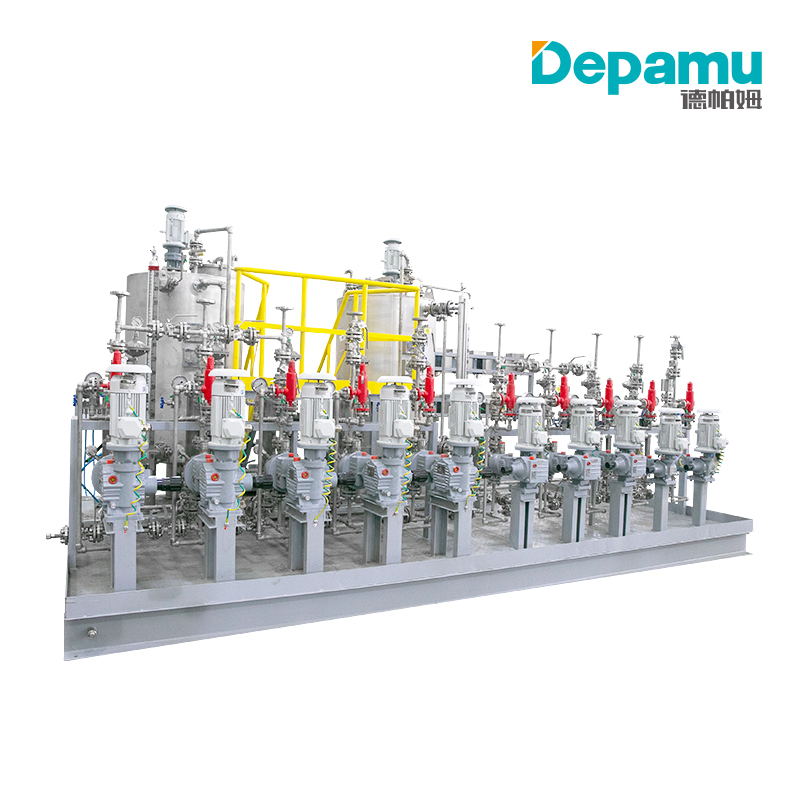
Depamu's MEG chemical injection packages represent a departure from traditional single-equipment design. Rather than assembling disparate components on-site—a practice that can introduce compatibility issues and installation complexities—Depamu employs a modular, skid-mounted approach that integrates all necessary subsystems onto a common base. This systematic design philosophy addresses what the company identifies as a key limitation of conventional approaches: the "systematic differences existing in traditional products under single-equipment or single-part design".
Core Components and Their Functions
The complete package comprises several interdependent subsystems, each performing a specific role in the chemical preparation and injection process. The solution tank serves as the primary storage and mixing vessel, where MEG is prepared to the required concentration. Depending on corrosion resistance requirements, these tanks can be fabricated from various materials, including 304 or 316 stainless steel, fiberglass-reinforced plastic (FRP), or polyethylene. The material selection reflects the harsh environments in which these packages operate—offshore platforms face extremely salty atmospheres that demand corrosion-protected materials, with duplex and super duplex stainless steels specified in especially demanding cases.
The Metering Pump constitutes the heart of the injection system, responsible for delivering precise chemical volumes against pipeline pressures that can reach significant levels. Depamu's packages accommodate both diaphragm and plunger pump configurations, with the choice depending on flow rate requirements and safety considerations. Diaphragm Pumps offer the advantage of hermetic sealing, eliminating leakage pathways—a critical feature when handling toxic substances like MEG. Plunger pumps, while capable of handling larger flow rates, require dynamic sealing through packings and therefore demand more rigorous leak prevention measures.
Control Systems and Automation
Modern MEG injection packages incorporate sophisticated control architectures that enable precise, responsive chemical dosing. The control system operates through programmable logic controllers (PLC) that interface with host computers or distributed control systems (DCS). These controllers process signals from various sensors—measuring parameters such as flow rate, pH, electrical conductivity, and turbidity—and adjust pump operation accordingly.
The automation capability extends to variable frequency drives that modulate pump speed and stroke, providing a flow adjustment range of 0-100%. This responsiveness allows the system to adapt to changing process conditions in real-time, maintaining optimal MEG concentrations without manual intervention. Standard control signals utilize the 4-20mA industrial protocol, enabling seamless integration with broader plant control systems. Status and fault signals from pumps and mixers can be transmitted to remote control centers, supporting supervisory control and data acquisition (SCADA) functions.
Operational Workflow and Process Integration
The operational sequence of a Depamu MEG injection package follows a logical progression from chemical preparation to injection. The process begins with chemical dissolution and preparation within the solution tank, where mixers ensure proper concentration uniformity. From the tank, the prepared MEG solution is drawn by the metering pump and pressurized to the required discharge pressure before being injected into the production stream.
Pump Selection and Performance Characteristics
The choice between diaphragm and plunger pump technologies reflects specific operational priorities. For MEG applications, diaphragm pumps are often preferred due to their leak-free operation—a critical safety consideration given MEG's toxicity. These pumps use a flexible diaphragm to separate the hydraulic fluid from the process fluid, creating a barrier that prevents leakage even under high pressures. Plunger pumps, while offering advantages in high-flow applications, require careful monitoring of packing seals and may incorporate leak detection systems to identify seal degradation before significant leakage occurs.
Auxiliary Systems and Safety Features
Comprehensive safety features complement the primary pumping and control functions. Pressure relief valves protect against overpressure events, while pulsation dampeners smooth the pressure pulses inherent in positive displacement pumping, reducing system stress and improving injection consistency. Level gauges provide visual and electronic monitoring of tank contents, ensuring operators can verify chemical availability and detect potential issues before they affect operations.
The skid-based design incorporates practical operational considerations as well. Depamu packages include support bases with stairways and handrails, facilitating safe access for maintenance and inspection. The modular construction allows for flexible configuration—operators can select single-tank or multi-tank arrangements, with pump combinations ranging from single units to multiple pumps with standby redundancy.
Engineering Considerations for Offshore Deployment
Offshore environments impose particularly demanding requirements on chemical injection packages. The limited space available on platforms and floating production units necessitates compact, efficiently arranged designs that maximize functionality within constrained footprints. Material selection becomes critical in the highly corrosive salt-laden atmosphere, with stainless steel construction serving as the baseline and more exotic materials specified for the most demanding applications.
Noise and vibration emissions present additional engineering challenges, particularly as offshore installations increasingly operate in environmentally sensitive areas or proximity to residential zones. Depamu packages incorporate various noise mitigation strategies, including vibration-isolating mounts and acoustic enclosures. These measures can achieve significant noise reduction—some installations have demonstrated reductions from 93 dB to 75 dB through careful acoustic engineering. Pressure pulsation analysis, following standards such as API 674 Approach 2, ensures that the pumping system operates smoothly, minimizing vibration that could lead to premature component failure.
Operational Challenges and System Reliability
Despite robust design, MEG injection systems face significant operational challenges that demand ongoing attention. The closed-loop nature of MEG systems means that recovered MEG carries impurities from produced fluids, including salts, hydrocarbons, and acid gases. When MEG is regenerated for reinjection, these contaminants can accumulate and cause fouling of process equipment. Experience from Saudi Aramco's onshore sour-gas processing operations illustrates these challenges vividly—poor system design led to frequent filter plugging, exchanger leakage, and inability to meet required MEG specifications.
These operational realities underscore the importance of pretreatment sections within MEG injection packages. Proper pH adjustment through acid injection liberates dissolved hydrogen sulfide from the MEG stream, while caustic addition precipitates divalent cations that would otherwise form scale. Clarifiers and filters remove suspended solids before the MEG enters the regeneration train, protecting downstream equipment from fouling.
Maintenance and Long-Term Reliability
Depamu packages are designed for extended operational lifetimes with minimal maintenance intervention. The fully automatic nature of the control systems reduces the need for manual adjustment, while mechanical redundancy ensures continued operation even during maintenance events. Features such as self-diagnostic instrumentation and comprehensive leakage monitoring systems contribute to reliability by detecting potential issues before they escalate into failures.
Conclusion
Depamu MEG chemical injection packages represent a sophisticated integration of fluid handling, control, and safety technologies, engineered to address the demanding requirements of hydrate prevention in oil and gas operations. By combining precision metering pumps, automated control systems, and robust auxiliary components into cohesive skid-mounted units, these packages deliver the reliable chemical injection essential for flow assurance in subsea and onshore production environments. The systematic design philosophy, incorporating extensive safety features and operational flexibility, reflects an understanding of both the technical challenges and the commercial realities of hydrocarbon production. As offshore operations push into increasingly challenging environments, the role of reliable, well-engineered chemical injection systems will only grow in importance, and designs that prioritize reliability, safety, and operational efficiency will continue to set the standard for the industry