

Depamu Hydraulic Plunger Mechanical Diaphragm Metering Pumps: Precision Acid Dosing for Swimming Pool Water Treatment
Introduction
Swimming pool water treatment is a continuous chemical balancing act. Among the variables that must be controlled, pH occupies a uniquely sensitive position. When pH drifts above the ideal range of approximately 7.2 to 7.6, chlorine loses much of its disinfection potency, scale begins to form on surfaces and in circulation equipment, and bathers experience irritation. Muriatic acid—typically 31.45% hydrochloric acid—is the most common remedy, but it is a harsh, fuming liquid that punishes imprecise dosing. A small excess can crash the pH, corrode metallic fittings, and create an unsafe environment; too little leaves the pool vulnerable to scaling and ineffective sanitization. The metering pump therefore does more than move liquid: it becomes the final guarantor of water chemistry stability.
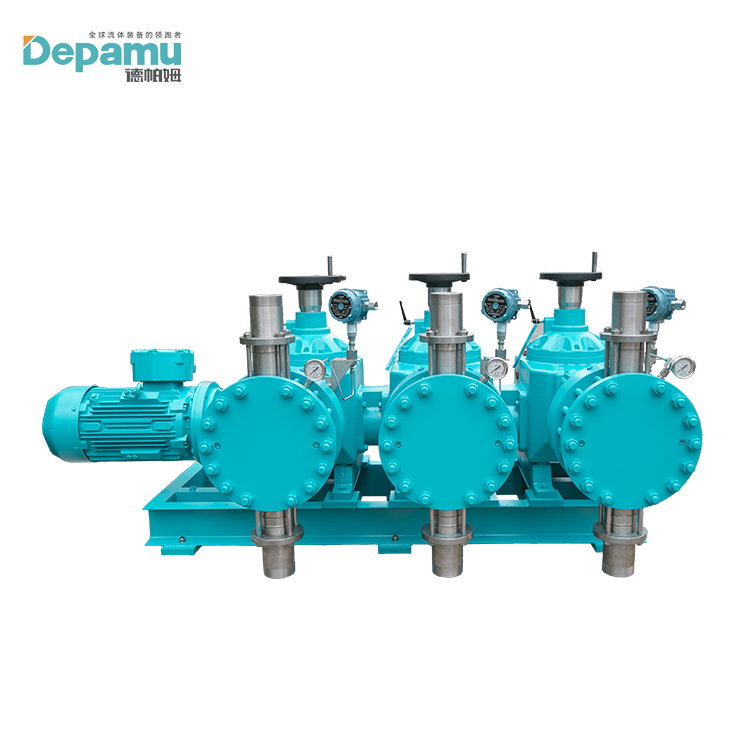
Depamu, a Chinese pump manufacturer with origins in the early 1990s and a product range exported to more than fifty countries, has positioned its hydraulic plunger mechanical diaphragm metering pumps as a solution for precisely this kind of duty. The design sits at a deliberate intersection: it retains the leak-proof safety of a Diaphragm Pump while borrowing the hydraulic force transmission and pressure tolerance of a plunger machine. For pool acid dosing, where the fluid is corrosive, the required flow rates are modest, and the consequences of drift are immediate, this combination has practical consequences worth examining in detail.
The Architectural Logic: Why a Hybrid Pump Head Matters
Conventional metering pumps for pool treatment have largely fallen into two camps. Solenoid-driven diaphragm pumps are compact and inexpensive, but their pulsating output and limited pressure capability make them less suited to systems with significant backpressure or long discharge lines. Pure mechanical diaphragm pumps drive the diaphragm through a direct mechanical linkage—an eccentric or crank acting on a pushrod. They are simple and leak-free, but the diaphragm experiences concentrated mechanical stress, and accuracy typically settles around ±2% of setpoint. Plunger pumps, by contrast, offer excellent accuracy and high pressure capability, but the plunger reciprocates in direct contact with the process fluid, relying on packing to contain a corrosive liquid. For hydrochloric acid, that packing represents a chronic leakage risk and a maintenance burden.
Depamu’s hydraulic plunger mechanical diaphragm architecture resolves this tension by separating the drive from the process fluid through an intermediate hydraulic oil chamber. The motor drives a worm gear pair, converting rotary motion into the reciprocating stroke of a plunger. That plunger does not touch the acid. Instead, it displaces a precisely metered volume of non-compressible hydraulic oil. The oil pressure acts uniformly across the entire face of a PTFE diaphragm, which in turn flexes to draw in and discharge the process liquid through inlet and outlet check valves. Because the hydraulic force is distributed evenly rather than concentrated at a mechanical attachment point, the diaphragm undergoes lower localized stress. The result is a pumping action that is both leak-proof on the process side and hydraulically smooth on the drive side.
This arrangement is not merely a theoretical refinement. In pool acid service, the diaphragm is the only barrier between hydrochloric acid and the pump mechanism. Any mechanical attachment through the diaphragm creates a potential fatigue point; any uneven loading accelerates failure. The hydraulic transmission eliminates that attachment altogether. The diaphragm is driven by fluid pressure and returned by its own resilience and the system’s hydraulic balance, so its motion is smooth and its stress distribution is uniform. For an acid that attacks both metals and many elastomers, that separation is a fundamental durability advantage.
Accuracy and Turndown in the Context of Pool pH Control
Depamu specifies metering accuracy of ±0.5% for its Hydraulic Diaphragm Metering Pump lines, with a flow adjustment range of 10% to 100% and stepless stroke adjustment from 0% to 100%. On a pool system, these figures translate into something concrete. If a 50,000-litre pool requires a maintenance acid dose on the order of a few litres per hour to hold pH at 7.4, a ±0.5% deviation at the setpoint amounts to millilitres per hour, not litres. That margin matters because pH is a logarithmic scale: a small volumetric overdose of strong acid produces a disproportionately large pH excursion. Hydraulic diaphragm pumps are generally recognised as delivering repeatable accuracy in the ±0.5–1% range, largely independent of discharge pressure variations, whereas purely mechanical diaphragm designs typically land closer to ±2%.
The 10:1 turndown ratio also has operational value that is easy to overlook in steady-state calculations. Pool bather loads fluctuate dramatically—a quiet weekday morning and a crowded summer afternoon impose very different acid demands. A pump that can be turned down to 10% of maximum capacity without losing accuracy or priming stability allows the controller to modulate output across a meaningful range rather than resorting to on/off cycling with a fixed stroke. Depamu’s stepless eccentric adjustment permits this modulation whether the pump is running or stationary, and the same mechanism can be fitted with manual, electric, or variable-frequency stroke control. In practice, a pool operator can set a base stroke manually and then allow a pH controller to trim the output through a 4–20 mA signal, achieving smooth, proportional correction rather than abrupt chemical slugs.
Safety Architecture for Corrosive Acid Service
Hydrochloric acid introduces failure modes that are not purely about accuracy. The pump must tolerate accidental overpressure if a discharge valve is closed or a line becomes blocked. It must manage any air or vapour that enters the hydraulic circuit, because entrained gas destroys metering precision and can cause the diaphragm to lose its hydraulic support. Depamu’s hydraulic diaphragm head addresses these risks through a set of internal automatic valves. A makeup valve replenishes hydraulic oil lost past the plunger during normal operation, preserving the hydraulic balance stroke after stroke. A bypass or relief valve releases oil and terminates the Hydraulic Pumping action if pressure ahead of the plunger exceeds a safe limit, protecting the diaphragm and pump head from rupture. A bleeder valve continuously releases entrained air or oil vapour, maintaining what is often called a “hard” hydraulic system so that the diaphragm responds immediately and predictably to plunger motion. These functions are largely automatic; they do not depend on the operator remembering to vent the head or manually reset a relief device after every pressure event.
Material selection completes the corrosion-resistance picture. Depamu offers pump heads in PVC and stainless steel, with PTFE diaphragms as the standard hydraulic barrier. For hydrochloric acid service, PVC and PTFE are the appropriate wetted materials: PVC is resistant to inorganic mineral acids, and PTFE is effectively inert to hydrochloric acid across the full pH range. The check valves are designed with a self-cleaning geometry, which reduces the risk of crystallised acid salts or particulate matter holding a valve open and corrupting the dose. The cast aluminium power-end housing is plastic-spray coated for corrosion resistance and heat dissipation, separating the robust mechanical drive from the aggressive chemical environment.
Duty Cycle, Sizing, and the Temptation to Oversize
One of the more common causes of poor metering performance in pool acid systems is not pump failure but oversizing. A pump selected for a maximum flow far above the actual acid demand will spend its life running at the extreme bottom of its turndown range, where pulsation becomes more pronounced, check-valve seating becomes less reliable, and the risk of vapour locking increases if the acid source contains dissolved gases or volatiles. The Depamu DPMFWA series spans flow rates from 200 L/h to 700 L/h per head at discharge pressures up to 1.2 MPa, with smaller models in the wider Depamu range covering the lower flows typical of smaller pools. A pool with a modest acid demand is better served by a smaller pump head running at a comfortable mid-range stroke than by a large head throttled almost closed. The same logic applies to pressure: while the DPMFWA can deliver 1.2 MPa, a pool injection point downstream of a filter often requires only a fraction of that, and selecting a pump with excessive pressure capability can mask underlying hydraulic problems rather than solve them.
The maintenance schedule reinforces the value of correct sizing. Depamu specifies a maintenance interval of 4,000 hours at pressures up to 1.0 MPa and 8,000 hours at pressures up to 0.7 MPa. For a pool pump running continuously, that translates to roughly six months to a year between overhauls—a predictable interval that aligns with routine pool equipment servicing. At each overhaul, the consumable items are the diaphragm, check valves, and seals; the hydraulic drive and worm gear are oil-lubricated and largely shielded from the acid. This separation of wear parts from the drive mechanism is the practical dividend of the hydraulic diaphragm design: the components exposed to acid are relatively few, accessible, and replaceable without rebuilding the entire pump.
Installation and Control Considerations
A metering pump is only as precise as the system around it. For pool acid dosing, the pump should draw from a flooded suction or a tank outlet at the bottom of the storage vessel, because diaphragm pumps rely on a positive inlet pressure to fill the head completely and avoid losing prime. A suction strainer protects the check valves from debris, and a backpressure or anti-siphon valve on the discharge side prevents acid from being drawn into the pool circulation when the pump is off. The injection point should be located downstream of the filter and heater, where the acid can mix into turbulent flow and where the materials of construction are compatible with a locally lowered pH. A calibration column or a drawdown test after commissioning confirms that the pump’s theoretical output matches the actual volume delivered, closing the loop between the dial setting and the chemical reality.
For automated pH control, the pump’s stroke adjustment can be linked to a pool controller through a 4–20 mA or pulse signal. The controller reads pH continuously and modulates the pump stroke or speed proportionally, so the acid dose tracks demand rather than following a fixed timer. This mode of operation is where the hydraulic diaphragm’s pressure-independent accuracy becomes most valuable: as the controller trims output up and down, the pump must deliver a consistent volume per stroke regardless of minor fluctuations in discharge pressure. A mechanically actuated diaphragm pump may exhibit slight accuracy drift as backpressure changes; the hydraulic intermediate chamber absorbs those variations and keeps the dose tied to the stroke setting rather than to system hydraulics.
Conclusion
Depamu’s hydraulic plunger mechanical diaphragm metering pumps are best understood not as a compromise between plunger and diaphragm technologies but as a deliberate synthesis of their respective strengths. The plunger provides the force and the precise displacement; the hydraulic oil transmits that force without mechanical attachment; the diaphragm contains the acid without leakage; and the internal valves maintain hydraulic integrity automatically. For swimming pool acid dosing, this architecture delivers the combination that matters most: accuracy in the range where pH excursions are prevented rather than merely corrected, material compatibility with hydrochloric acid, and a maintenance profile that separates the acid-wetted consumables from the protected drive mechanism. The pump does not eliminate the need for disciplined water testing, correct sizing, or a well-designed injection system, but within that system it provides a stable, repeatable acid feed—the quiet prerequisite for clear, balanced, and safe pool water.