

Introduction
The helical rotor mono Depamu-pumps.com/Screw-Pump.html target='_blank'>Screw Pump—also known as a progressive cavity pump (PCP), eccentric screw pump, or Moineau pump—is a type of positive displacement pump that has become indispensable in the oil and gas industry, particularly for handling oil slurry. Invented in 1932 by French engineer René Moineau, this pump design is celebrated for its ability to convey highly viscous, abrasive, and particle-laden fluids with remarkable gentleness and consistency. Oil slurry, a challenging mixture of crude oil, water, solid particles, and often corrosive chemical compounds, represents one of the most demanding media for any pumping system. Understanding how the helical rotor mono screw pump operates reveals why it is uniquely suited to this task.
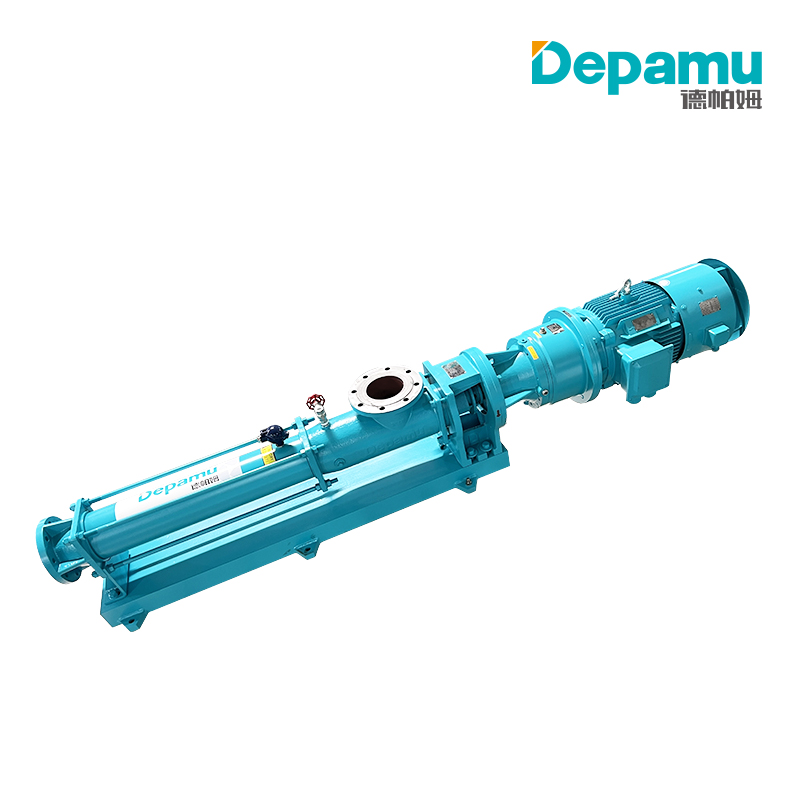
The Fundamental Components
At its core, the helical rotor mono screw pump consists of two primary components: a rotating rotor and a stationary stator. The rotor is a single-threaded helical screw made of hardened metal, typically chrome-plated or boronized steel to resist abrasion. Its geometry is precisely defined: any cross-section of the rotor is a circle of radius R, whose center is offset from the rotor's axis by a fixed eccentricity *e*. This circle's center moves along a helical path as it translates along the axis.
The stator, by contrast, is a hollow, double-threaded helical cavity typically made of an elastomer—such as nitrile rubber (NBR), ethylene propylene diene monomer (EPDM), or fluoroelastomer (FKM)—bonded to a metal casing. The stator's internal cross-section is an elongated oval shape with semicircular ends of radius R, connected by straight segments of length 4*e*. This geometry is not arbitrary: it is mathematically designed to complement the rotor's motion perfectly.
The key relationship between the two components is the lobe ratio. The stator always has one more thread start (or “lobe”) than the rotor, creating a ratio such as 1:2 for a single-lobe rotor. This ratio determines the pump's torque and speed characteristics: higher lobe ratios produce greater torque at lower speeds, while lower ratios yield higher speeds with reduced torque.
The Working Principle: A Traveling Sealed Cavity
The genius of the helical Rotor Pump lies in how the rotor and stator interact to create moving sealed chambers. When the rotor is inserted into the stator, its helical surface continuously contacts the stator's internal helical surface along a series of sealing lines. These contact lines divide the space between rotor and stator into a sequence of discrete, completely sealed cavities, each containing a fixed volume of fluid.
When the rotor is driven by an input shaft through a universal joint, it performs a compound motion: it rotates about its own axis while simultaneously orbiting around the center of the stator in a planetary fashion. As the rotor turns, the sealing lines between rotor and stator travel continuously along the length of the stator, from the suction end to the discharge end. This traveling seal effectively “screws” the sealed cavities—and the fluid within them—in the direction of flow.
Critically, the volume of each cavity remains constant as it moves axially. The fluid is not compressed or agitated during transport; it is simply displaced from the inlet to the outlet. This distinguishes the helical rotor pump from centrifugal pumps, which impart kinetic energy to the fluid, and from Reciprocating Pumps, which rely on suction and discharge valves. The absence of valves is a significant operational advantage, as it eliminates the clogging and wear issues that plague valve-based designs when handling slurries.
Why It Excels with Oil Slurry
Oil slurry presents a uniquely difficult pumping challenge. It typically contains a mixture of heavy crude oil, water, sand, drill cuttings, and sometimes corrosive chemical additives. Its viscosity can range from a few hundred to over 200,000 centipoise, and it may contain solid particles ranging from fine sand to coarse debris. Conventional centrifugal pumps struggle with such media because their impellers tend to slip in high-viscosity fluids and can be rapidly eroded by abrasive particles.
The helical rotor pump's positive displacement principle allows it to generate the required flow regardless of changes in process pressure, making it independent of fluid viscosity. The large, unobstructed cavities between rotor and stator can accommodate solid particles up to 30 mm in diameter and fibrous materials up to 350 mm in length. Solid content can reach 40% by volume for general slurries, and even higher for fine powdered solids. The gentle, low-shear pumping action preserves the integrity of the slurry, preventing the emulsification of oil and water that can occur with high-shear pumps and complicate downstream separation processes.
Furthermore, the elastomeric stator provides a degree of flexibility that absorbs the impact of abrasive particles, significantly extending the pump's service life compared to rigid, all-metal designs.
Managing Wear and Optimizing Performance
While the helical rotor pump is robust, oil slurry service does introduce wear challenges. Abrasive particles trapped between the rotor and stator can gradually erode both surfaces, reducing the sealing efficiency and the pump's volumetric efficiency. Several strategies are employed to mitigate this. Operating the pump at lower rotational speeds reduces the relative velocity between rotor and stator, thereby decreasing abrasive wear. Selecting appropriate elastomer compounds for the stator—such as highly saturated nitrile (HSN) for oil resistance or EPDM for broader chemical compatibility—also plays a critical role. Rotor coatings, including hard chrome and boronized surfaces, further enhance wear resistance.
Proper selection and maintenance are equally important. The pump should be sized so that the slurry maintains a sufficient lubrication layer around the particles, protecting the stator from direct abrasive contact. Dry running must be avoided, as the elastomer requires the pumped fluid for cooling and lubrication. Regular inspection of rotor-stator clearances and timely replacement of worn components ensure continued reliable operation.
Industrial Applications and Standards
In the oil and gas industry, helical rotor pumps are deployed across a wide spectrum of slurry-handling duties. They are used to transfer drill cuttings and drilling mud, to pump oily sludge from storage tanks and separators, and to move heavy crude oil in pipeline applications. The pumps also serve in downstream operations, handling bitumen, pitch, and heavy vacuum gas oil.
The industry has developed rigorous standards for these pumps. API 676, issued by the American Petroleum Institute, specifies minimum requirements for rotary positive displacement pumps used in oil and gas applications. Modern helical rotor pumps designed for oil slurry service are engineered to meet API 676 requirements, ensuring they can withstand the demanding conditions of refinery and oilfield environments.
Conclusion
The helical rotor mono screw pump operates on a deceptively simple principle: a single-helix rotor turning inside a double-helix elastomeric stator, creating sealed cavities that travel continuously from suction to discharge. Yet this simplicity belies its remarkable capability. For oil slurry—a medium that defeats many other pump types—the helical rotor pump offers a unique combination of high viscosity tolerance, large solids handling capability, low-shear gentle transfer, and reliable, pulsation-free flow. As the oil and gas industry continues to confront increasingly complex fluids and stricter environmental standards, the helical rotor mono screw pump remains an essential tool, embodying a design that has proven its worth for nearly a century and continues to evolve to meet new challenges.