

While “Depamu” may represent a specific manufacturer or model line, the core engineering distinction between an Air-Operated Double Diaphragm (AODD) pump and an Electric Diaphragm Pump (EDP) lies in their prime mover and displacement characteristics. In the context of fluid handling, the choice between pneumatic and electric drive fundamentally alters the pump’s performance curve, safety profile, and total cost of ownership.
The operational differences between the air and electric versions of a Depamu diaphragm pump are rooted in their power source, which dictates their flow control mechanisms, stall characteristics, and application suitability. Here is a breakdown of their primary distinctions.
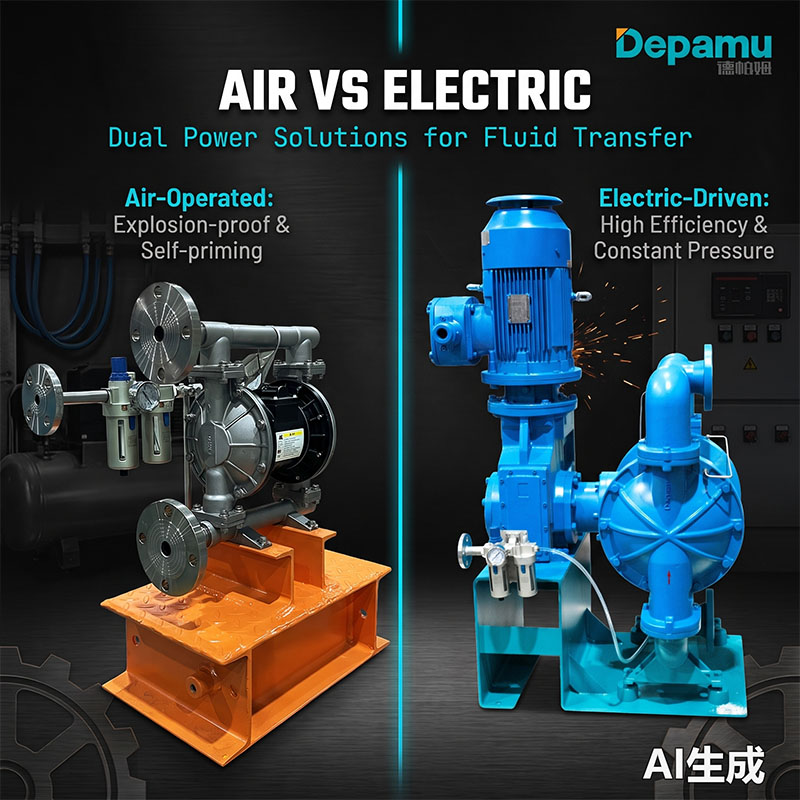
1. Power Source and Prime Mover
-
Air (Pneumatic): These pumps utilize compressed air as the power source. The air is directed into a center block via an air distribution system, which alternates the air supply to the two outer chambers. This design creates a reciprocating motion of the diaphragms without the need for electrical motors.
-
Electric: These pumps are driven by an AC or DC electric motor. The motor rotates a mechanical linkage, such as a cam or eccentric shaft, which converts rotational motion into the linear, reciprocating movement required to move the diaphragms back and forth.
2. Flow Control and Performance Curves
-
Air: AODD pumps exhibit a "centrifugal-like" curve. Flow rate is directly proportional to the air inlet pressure and volume, but inversely proportional to the discharge pressure. If the discharge valve is closed, the pump stalls, ceasing movement and holding pressure without consuming air (assuming no leaks)[citation:1]. This is a “dead-head” capability that is inherently safe and energy-efficient in such situations.
-
Electric: Electric diaphragm pumps generally have a positive displacement curve that is closer to a constant flow rate, regardless of pressure changes, up to the motor's maximum torque limit. If the discharge is blocked and the motor does not have a current overload cut-off, the motor will continue to attempt to turn, potentially leading to overheating, motor burnout, or mechanical failure of the diaphragm linkage[citation:2].
3. Safety and Hazardous Environments
-
Air: The primary advantage of the air-operated version is its inherent explosion-proof nature. Because they run on compressed air and do not generate sparks or heat from electrical components, they are ideal for Class 1 Division 1 hazardous locations (flammable gases, vapors, or combustible dust). They can safely pump solvents, paints, and hydrocarbons.
-
Electric: Standard electric motors produce heat and electrical arcing (at the brushes or starters). To use an electric diaphragm pump in a hazardous area, the motor must be a specialized Explosion-Proof (XP) or intrinsically safe design. This adds significant cost and maintenance requirements. The air version is generally lighter and more portable for temporary applications due to the absence of heavy motor windings.
4. Efficiency and Operating Costs
-
Air: Pneumatic pumps are notoriously inefficient in terms of energy consumption. Compressed air is an expensive utility (often only 15-20% efficient at the point of use). If the pump is running for extended periods, the high CFM (Cubic Feet per Minute) requirement can result in high operational costs.
-
Electric: An electric motor is significantly more energy-efficient (often 80-90% efficient). For continuous, high-volume operation, the electric Depamu pump will have a much lower energy bill[citation:3]. However, the maintenance of the electric motor and gearbox may require specialized electrical technicians.
5. Maintenance and Shear Sensitivity
-
Air: The air distribution system relies on a pilot valve and spool (often requiring lubrication). Maintenance focuses on the air valve and diaphragms. However, the "stall" feature makes them excellent for shear-sensitive fluids (e.g., food products, latex) as the gentle, positive displacement action limits mechanical agitation.
-
Electric: The electric version has more mechanical components in the drive train (bearings, gears, cams). These require periodic greasing and are susceptible to wear. Furthermore, if the linkage is rigid, the electric pump may produce a slightly higher shear force during the reversal of the stroke compared to the air version’s pneumatic cushioning.
Air: AODD pumps are notoriously noisy, typically operating in the range of 80–90 dB(A), particularly if the air exhaust is not fitted with a muffler. They also emit "ice" formation on the exhaust port due to the rapid expansion of air (adiabatic cooling), which can be an issue in humid environments.
Electric: Electric pumps are generally quieter (around 60–70 dB(A)) and do not produce icing. They are cleaner for indoor environments where air quality and noise pollution are concerns.
If the Depamu diaphragm pump is intended for use in a paint shop, chemical plant, or mining operation where explosive fumes are present, the Air version is the mandatory choice due to its safe stall capability and intrinsic spark-free operation. Conversely, if the pump is installed in a water treatment facility or manufacturing plant with clean, non-flammable fluids and runs 24/7, the Electric version is superior due to its lower energy consumption and reduced noise footprint. The selection ultimately depends on prioritizing safety (Air) versus operational efficiency (Electric)
6. Noise and Environmental Factors
Summary Comparison Table
Feature
Air (Pneumatic) Version
Electric Version
Power Source
Compressed air (external compressor)
Electricity (AC/DC power supply)
Stall Condition
Stalls safely under dead-head; no damage[citation:1]
Requires pressure relief or overload protection to prevent burnout[citation:2]
Explosion Proof
Inherently safe; no sparks
Requires expensive XP-rated motors for safety
Energy Efficiency
Low (high operating cost)
High (lower energy bills)[citation:3]
Flow Control
Adjustable via air regulator (throttling)
Adjustable via VFD (Variable Frequency Drive) or by-pass
Maintenance Focus
Air valve, spool, and diaphragms
Motor, bearings, cam, and mechanical linkage
Noise Level
High (requires mufflers)
Low to Moderate
Portability
Lighter (no heavy motor)
Heavier (includes motor weight)
Conclusion