

How Diaphragm AODD Pumps Work: Principles, Components, and Operation
Air-operated double-diaphragm (AODD) pumps occupy a distinctive and remarkably durable niche in fluid handling. They are not the most efficient pumps, nor the quietest, nor the most compact. Yet they remain the default choice in many of the most demanding environments—chemical plants, wastewater treatment works, mines, food-processing lines, and hazardous-area operations—precisely because their working principle is elegantly simple and their tolerance for abuse is extraordinary. Understanding how an AODD pump works is therefore not merely a matter of tracing air through a valve; it is a lesson in how a design that accepts certain inefficiencies can deliver unmatched reliability.
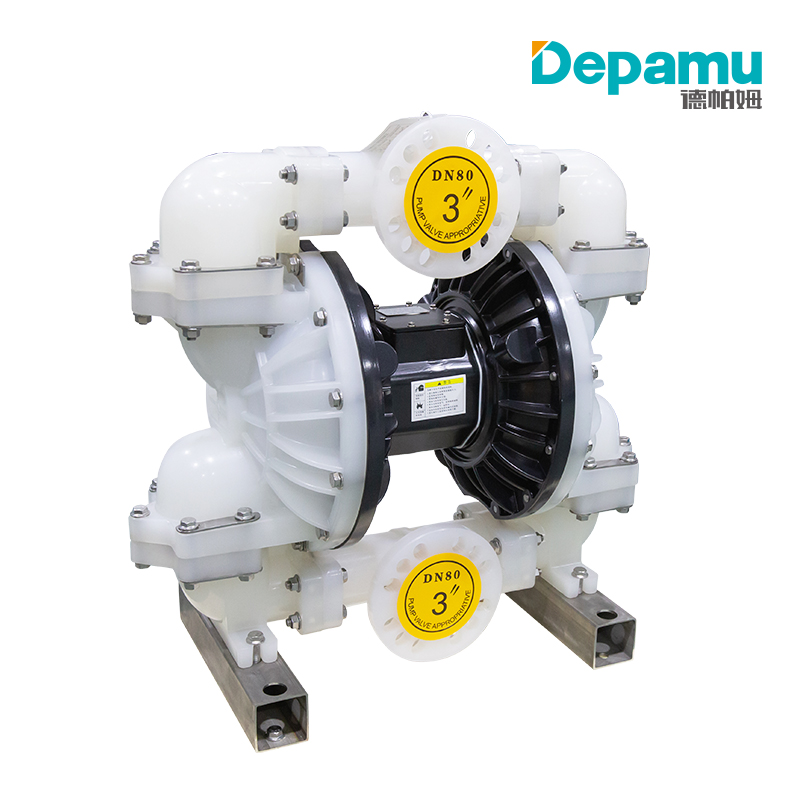
At its core, an AODD pump is a positive-displacement, reciprocating pump driven entirely by compressed air, with no electric motor at the pump head. Two flexible diaphragms, linked by a common shaft, move back and forth in opposition. As one diaphragm pushes liquid out of its chamber, the other pulls liquid in. The result is a self-priming, sealless, and intrinsically safe machine that can run dry, handle viscous slurries and solids-laden fluids, and stall without damage when demand ceases. This article explains the working principle of the diaphragm AODD pump from first principles—component by component, stroke by stroke—and then situates that principle within the practical realities of materials selection, performance limits, and application.
A pump built around a flexible barrier
The fundamental distinction between an AODD pump and a centrifugal or rotary-lobe pump is that the fluid is never touched by a rotating shaft or a mechanical seal. Instead, each of the two pumping chambers is divided by a flexible diaphragm. On one side of the diaphragm is the liquid chamber, which is wetted and connected to the suction and discharge manifolds. On the other side is the air chamber, which receives and exhausts compressed air. The diaphragm itself is the barrier: it transmits the pneumatic driving force to the liquid while keeping the two media physically separated.
This architecture eliminates the single most common failure point in conventional pumps—the shaft seal. There is no seal to leak, no packing to adjust, and no rotating element in contact with the process fluid. The only moving wetted parts are the diaphragms and the check valves, which is why AODD pumps are often described as having a “simple, fuss-free design” with few wear components.
The two diaphragms are mechanically coupled by a central connecting rod (also called a diaphragm shaft), which passes through the centre block of the pump but does not enter the liquid chambers. This rod forces the diaphragms to move in unison: when one diaphragm moves inward toward the centre of the pump, the other must move outward. That rigid coupling is the key to the pump’s self-synchronising action, and it is what allows one side to perform a discharge stroke while the other simultaneously performs a suction stroke.
The other essential components are the air distribution valve and the check valves. The air valve—the “heart” of the pump—alternately routes compressed air to one air chamber while venting the other to atmosphere. The check valves, typically ball, flap, or poppet style, sit at the inlet and outlet of each liquid chamber and enforce one-way flow, preventing backflow when the diaphragm reverses direction. Together, these components form a closed-loop pneumatic-mechanical oscillator: the air valve drives the diaphragms, the diaphragms move the liquid, and the position of the diaphragms signals the air valve to switch.
The four-step operating cycle
The working principle of an AODD pump is best understood as a repeating four-step cycle. The cycle is continuous, but it is useful to freeze it at four successive moments.
Step 1: Pressurisation of Chamber A. Compressed air enters the air-side of Chamber A through the air distribution valve. The pressure acts on the back of Diaphragm A, pushing it inward toward the centre of the pump. Because the liquid chamber on the other side of Diaphragm A is filled with fluid, this inward movement reduces the volume of the liquid chamber and pressurises the liquid. The inlet check valve of Chamber A closes under the pressure, and the discharge check valve opens. Liquid is forced out into the discharge manifold.
Step 2: Simultaneous suction in Chamber B. Because the two diaphragms are joined by the connecting rod, the inward movement of Diaphragm A pulls Diaphragm B outward, away from the centre of the pump. The volume of Liquid Chamber B increases, creating a partial vacuum. The discharge check valve of Chamber B closes, and its inlet check valve opens. Atmospheric pressure—or the pressure in a flooded suction line—pushes liquid from the supply into Chamber B. This simultaneity is the defining feature of the double-diaphragm design: the pump is always discharging from one chamber while priming the other, which is why AODD pumps deliver a relatively continuous—though pulsating—flow rather than the intermittent output of a single-acting piston pump.
Step 3: The end-of-stroke signal. As the diaphragms approach the end of their travel, a pilot mechanism is actuated. Depending on the air-valve design, this may be a mechanical linkage, a pneumatic pilot signal, or an internal porting arrangement that senses the position of the diaphragm shaft. The pilot mechanism tells the main air valve that the stroke is complete and that it is time to reverse the air paths.
Step 4: The “flip” and the reverse stroke. The air distribution valve shifts. The air chamber that was previously pressurised—Chamber A—is now connected to exhaust, and its air is vented to atmosphere. Simultaneously, compressed air is directed to Chamber B. The cycle now runs in reverse: Diaphragm B moves inward and discharges liquid from Chamber B, while Diaphragm A is pulled outward and draws liquid into Chamber A. The check valves reverse their states accordingly. The pump has completed one full cycle and is ready to repeat it indefinitely.
This alternating action produces the characteristic pulsating flow of an AODD pump. The pulsation is not a defect in the principle; it is a direct consequence of the reciprocating nature of the machine. It can be smoothed with a pulsation dampener, larger air plumbing, careful suction design, and appropriate pump sizing, but it cannot be eliminated entirely.
The air distribution system: the pump’s “brain”
If the diaphragms are the muscles of the AODD pump, the air distribution system is its brain and nervous system. The main air valve—also called the air distribution valve (ADV)—is a directional control valve that alternately connects each air chamber to the compressed-air supply and to exhaust. Two broad families of air-valve design dominate the market.
The most common is the pilot-operated spool valve. A cylindrical spool slides axially inside a precision-bored valve body. The spool is shifted not by the main air flow itself but by a small pilot air signal that is triggered at the end of each diaphragm stroke. When the diaphragm shaft reaches its end position, it actuates the pilot spool, which in turn directs pilot air to the large end of the main spool, driving it to the opposite position. The advantage of this piloted arrangement is that the main spool does not have to overcome the full force of the supply air directly; the pilot signal provides a mechanical advantage that makes the shift reliable even at low air pressures or in dirty air conditions.
The second family includes mechanically actuated valves and various poppet or shoe-style designs. In a mechanically actuated valve, the physical movement of the diaphragm shaft or a connected lever trips the valve directly. Poppet valves use seated sealing elements rather than a sliding spool, which can offer better tolerance to contamination in the air supply. Some manufacturers use a “step spool” or “C-spool” design that combines pilot logic with a non-lubricated main valve, reducing maintenance and eliminating the need for oil in the air line.
Regardless of the specific design, the functional principle is the same: the air valve must sense the end of the diaphragm stroke and switch the supply and exhaust paths cleanly and repeatably. A sticking or sluggish air valve is the most common cause of poor AODD performance, which is why clean, dry compressed air is essential for reliable operation.
Check valves and the direction of flow
The check valves are passive components, but they are indispensable to the working principle. Each liquid chamber has an inlet check valve and a discharge check valve. During the suction stroke, the inlet check opens and the discharge check closes. During the discharge stroke, the inlet check closes and the discharge check opens. The valves are oriented so that forward flow opens them and reverse flow seats them.
The choice of check-valve type is dictated by the fluid. Ball check valves are the most common and are well suited to fluids containing small-to-moderate solids; the ball lifts off its seat and allows particles to pass, then reseats under reverse pressure. Flap valves are better for larger solids and fibrous materials because they offer a larger open area and a less obstructed flow path. Poppet valves provide more precise sealing and are often used in metering or dosing applications where repeatable closure is important. In all cases, the check valves are the only wetted moving parts other than the diaphragms, and their condition directly determines the pump’s volumetric efficiency.
Materials: matching the pump to the fluid
The working principle of an AODD pump is material-agnostic in the sense that the pneumatic cycle is the same whether the pump is made of cast iron or polypropylene. But the practical success of the pump depends heavily on selecting the right wetted materials and diaphragm elastomer for the fluid being handled.
Diaphragm materials are the first consideration. Buna-N (nitrile) is a general-purpose elastomer with good resistance to oils and hydrocarbons and a service temperature of up to roughly 82 °C. Neoprene offers good resistance to water, mild chemicals, and weathering. EPDM is excellent for hot water, steam, and many acids and bases but is not compatible with petroleum-based oils. Viton (fluoroelastomer) provides broad chemical resistance, particularly to solvents and aggressive chemicals, at higher cost. PTFE (Teflon) is the most chemically inert option and can handle the widest range of aggressive fluids, but it is less flexible than elastomers and is more susceptible to mechanical damage; it is often used as a two-piece or overmolded construction with an elastomer backing for flexibility. Santoprene, a thermoplastic vulcanizate, offers a useful balance of chemical resistance and flex life and is widely used in general industrial and sanitary applications.
Pump body materials follow the same logic. Aluminium and cast iron are economical and suitable for many non-corrosive or mildly corrosive duties. Stainless steel (316) provides corrosion resistance for food, pharmaceutical, and many chemical applications. Engineering plastics such as polypropylene, PVDF (Kynar), and PTFE are used for highly aggressive chemicals and for applications where metallic contamination must be avoided. The centre block and air-side components are often made of non-metallic materials such as polypropylene, PE, or conductive plastics, the latter being important for ATEX hazardous-area applications where static dissipation is required.
Performance characteristics and inherent limits
The working principle of the AODD pump gives it a distinctive performance envelope. The pump is a 1:1 pressure-ratio device in its standard form: the discharge pressure of the liquid cannot exceed the pressure of the compressed air supplied to the pump, minus friction and valve losses. If the discharge line is blocked or the downstream pressure equals the air supply pressure, the pump simply stalls—the diaphragms stop moving, and no damage occurs. This stall characteristic is a major safety advantage in transfer and dosing applications, but it also means that AODD pumps are not suitable for services requiring very high discharge pressures unless a high-pressure ratio (2:1) variant is used.
Flow rate is proportional to both air pressure and air flow rate, and it is also affected by the pump size, stroke length, and fluid viscosity. At a working pressure of around 6 bar, common industrial AODD pumps achieve flow rates of roughly 5 to 800 litres per minute, depending on size. Larger pumps can exceed this range, but the principle remains the same: the pump’s output is controlled by regulating the air supply, not by a variable-speed drive or a mechanical throttle.
The suction capability of an AODD pump is a direct consequence of its self-priming nature. Because the pump creates a vacuum by expanding the liquid chamber, it can lift liquid from a sump or tank without manual priming. A typical dry suction lift is around 4 metres (13 feet), and this can be extended if the pump is flooded or if the suction line is filled with liquid. However, suction performance is limited by atmospheric pressure and by the vapour pressure of the fluid; a pump cannot lift a liquid above the height at which the column pressure equals atmospheric pressure minus the fluid’s vapour pressure. This is why AODD installations should keep the pump as close as possible to the liquid source and should avoid unnecessarily long or restrictive suction lines.
Why the principle matters: advantages and limitations
The working principle of the AODD pump explains both its greatest strengths and its most persistent weaknesses.
The advantages follow directly from the absence of an electric motor and a shaft seal. Because the pump is powered by compressed air, it is intrinsically safe in hazardous or explosive atmospheres; there is no electric spark risk at the pump, and the pump can be grounded for static dissipation. It is self-priming and dry-run capable, because the diaphragms do not rely on the pumped fluid for lubrication and can flex without damage even when the chambers are empty. It is sealless, eliminating the leak path that plagues mechanical seals on dirty, abrasive, or aggressive fluids. It handles viscous fluids, slurries, and solids that would clog or damage many other pump types, because the ball or flap check valves can pass particles and the diaphragm does not shear the fluid. And it is simple and portable, with few wear parts and a low-maintenance design that can be serviced without specialised tools.
The limitations are equally a product of the principle. The reciprocating action produces pulsating flow, which can be objectionable in metering, coating, and filling applications unless dampened. Compressed air is an expensive energy vector: per kilowatt-hour of useful work, compressed air typically costs five to eight times more than electricity, so an AODD pump running continuously at high flow is usually less energy-efficient than an electric pump. The pump is noisy, largely because of the rapid venting of air at the end of each stroke, and it can be prone to icing at the exhaust when the air is cold and humid. Discharge pressure is limited by the available air pressure, and flow rates, while broad, are lower than those of large centrifugal or rotary pumps. Finally, the elastomeric diaphragms and check valves are wear items; their life depends on chemical compatibility, temperature, and duty cycle, and they must eventually be replaced.
Where the principle finds its applications
The AODD principle is applied wherever the ability to handle difficult fluids safely outweighs the premium of compressed-air operation. In chemical processing, AODD pumps transfer acids, caustics, solvents, and reactive intermediates, often with PTFE or advanced elastomer diaphragms and polypropylene or PVDF bodies. In wastewater and water treatment, they handle sludges, slurries, abrasive grit, and flocculants, and they are frequently found in sump, bund, and dewatering duties. In food and beverage and pharmaceutical production, sanitary AODD pumps with stainless-steel bodies and FDA-compliant diaphragms provide gentle, low-shear handling of shear-sensitive fluids and comply with hygienic cleaning requirements. In mining and construction, they dewater excavations and transfer cementitious grouts and abrasive slurries. In oil and gas and paint and coatings, they provide safe, reliable transfer in hazardous areas and for solvent-based products. The common thread is not a particular industry but a particular set of fluid and environmental conditions: abrasive, viscous, solids-laden, shear-sensitive, hazardous, or intermittently available fluids that would shorten the life of a sealed or electrically driven pump.
Conclusion
The diaphragm AODD pump works by converting the pressure energy of compressed air into a reciprocating mechanical motion, and then into a pulsating but reliable flow of liquid. Compressed air is alternately admitted to and exhausted from two air chambers; the resulting back-and-forth movement of two linked diaphragms alternately pressurises and depressurises two liquid chambers; and a set of one-way check valves converts that alternating chamber action into a single direction of flow. An air distribution valve—pilot-operated, mechanically actuated, spool-type, or poppet-type—senses the end of each stroke and reverses the air paths, allowing the cycle to repeat without any external control system.
The elegance of the principle lies in what it does not require: no electric motor, no rotating shaft, no mechanical seal, no close-tolerance wetted clearances, and no priming. In exchange, the user accepts pulsation, compressed-air cost, noise, and pressure limitations. For a century of industrial practice, that exchange has proven worthwhile in an enormous range of applications, and the AODD pump remains a compelling example of how a simple working principle, executed with the right materials, can outperform more sophisticated machines in the environments where reliability matters most.