

The Great Debate: Depamu Gear Pump vs. Rotor Pump for Syrup, Molasses, and Honey Transfer
Introduction
In the world of industrial food processing, the transfer of high-viscosity fluids such as syrup, molasses, and honey presents a unique engineering challenge. These "liquid gold" products are not only thick and sticky but often shear-sensitive, meaning that aggressive pumping mechanisms can degrade their quality, alter their texture, or introduce unwanted aeration. For plant managers and engineers, selecting the right pump technology is a critical decision that impacts efficiency, product integrity, and maintenance costs.
Two dominant technologies stand out in this space: the Depamu gear pump (specifically the rotor pump variant offered by the Depamu brand) and the general sanitary rotor (lobe) pump. While both fall under the umbrella of Positive Displacement Pumps (PD Pumps), their mechanical designs, operational characteristics, and suitability for sugar-based viscosities differ significantly.
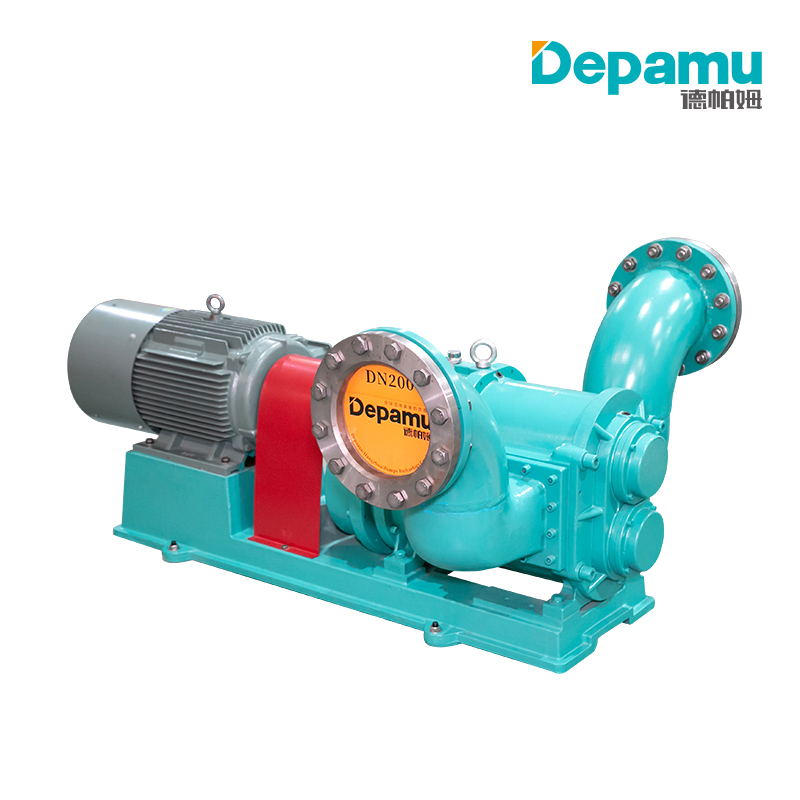
This article provides an exhaustive technical comparison between the Depamu-style rotor pump and standard rotary lobe pumps, specifically analyzing their performance when handling syrup, molasses, and honey.
Understanding the Mechanics: Positive Displacement Principles
Before diving into the brand-specific analysis, it is essential to understand why PD pumps are preferred over centrifugal pumps for these applications.
Centrifugal pumps lose efficiency drastically as viscosity increases. When honey enters a centrifugal pump, the impeller churns the fluid without generating pressure, leading to cavitation and damage. Conversely, Positive Displacement pumps trap a fixed amount of fluid and mechanically force it through the discharge pipe. Flow rate is directly proportional to speed, regardless of pressure.
Both the Depamu Rotor Pump and the lobe pump operate on this principle, but their "trapping" mechanisms are entirely different.
The Depamu Rotor Pump (Internal/External Gear Design)
Depamu’s offering in this category often utilizes a rotor pump design that closely mimics internal gear or progressing cavity principles, though their literature highlights a "double support structure" for stability. Depamu pumps are engineered for extreme viscosities. Their design allows them to handle media up to 2 million CP (centipoise) . In contrast, water is 1 CP, and honey is roughly 2,000–10,000 CP.
The Depamu mechanism typically involves a rotor turning inside a stator or a cavity where the hydraulic action is less reliant on tight metallic contact and more on volumetric efficiency. They emphasize a "no blocking" feature and the ability to pass solids up to 80mm, which is unique for high-viscosity food transfers.
The Rotor (Lobe) Pump Design
Standard sanitary rotary lobe pumps, such as those manufactured by Bonve, Yonjou, or general Alibaba suppliers, utilize two or three lobes (rotors) rotating in opposite directions. As the lobes unmesh on the inlet side, they create a vacuum and a cavity volume. The fluid fills this cavity, and the lobes rotate to seal the cavity, pushing the fluid out the discharge port.
Unlike gear pumps, the lobes in a sanitary rotor pump do not touch each other. There is a microscopic gap maintained by timing gears in the gearbox. This "non-contacting" feature is the defining characteristic of a lobe pump.
Head-to-Head Comparison: Syrup, Molasses, and Honey
To determine which pump is superior, we must evaluate them against the specific physical properties of sweeteners.
1. Shear Sensitivity and Product Integrity
The Challenge: Honey and high-fructose corn syrup can crystallize or break down under high shear. Molasses can change rheology when agitated violently.
-
Rotor Pump (Depamu): Gear pumps, by their nature, are "contacting" pumps. The gears mesh closely. For high-viscosity fluids, this generates significant internal shear. While Depamu pumps are robust and handle the viscosity well, the mechanical action can generate heat and potentially alter the structure of sensitive food products.
-
Lobe Pump: This is where the lobe pump shines. Because the lobes do not contact each other, the fluid experiences low shear. The rotation gently moves the fluid around the pump casing without crushing or emulsifying it. For premium honey, where preserving natural enzymes and preventing crystallization is key, the low-shear action of a lobe pump is superior.
Winner: Rotor Lobe Pump (Low shear preserves honey quality).
2. Handling Extreme Viscosity (The Molasses Test)
The Challenge: Molasses, especially in cold climates or in its raw form, behaves less like a liquid and more like a semi-solid. The pump must have enough suction power to pull the product into the pumping chamber.
-
Depamu Rotor Pump: Depamu explicitly highlights performance up to 2 million CP and a suction lift of 9 meters. They are designed to shove thick sludge and heavy oils. For "B" or "C" grade molasses, the brute force of a gear-type Depamu pump ensures the fluid moves when other pumps stall.
-
Lobe Pump: Standard lobe pumps handle high viscosity well (often up to 1 million CP), but their efficiency drops at the extreme high end unless they are running very slowly. The non-contacting nature means there is slightly more "slip" (fluid leaking backwards) at extremely high pressures compared to a gear pump.
Winner: Depamu Gear/Rotor Pump (Marginally better for ultra-heavy molasses).
3. Hygienic Design and Cleaning (CIP)
The Challenge: Sugar-based products are breeding grounds for bacteria if not cleaned properly. Pumps must be stainless steel (316L) and easy to strip down.
-
Depamu Rotor Pump: Depamu pumps are industrial-grade. While they are stainless steel, their design often involves complex internal geometries, tight clearances, and more internal components. Cleaning in Place (CIP) can be difficult if the pump is not specifically designed for sanitary use. Maintenance requires partial pipeline dismantling, according to some generic specs.
-
Lobe Pump: Sanitary lobe pumps are the gold standard for Food and Beverage (F&B). They feature 316L stainless steel construction, high-polish finishes (Ra < 0.8μm), and are designed for CIP (Clean-in-Place) and SIP (Sterilize-in-Place). The front cover can be removed easily, providing immediate access to the rotors without disturbing the piping.
Winner: Rotor Lobe Pump (Designed explicitly for FDA/USDA/3A sanitary standards).
4. Maintenance and "Repair In Line"
The Challenge: Downtime is expensive. If a pump seizes or loses efficiency, how fast can you fix it?
-
Depamu Rotor Pump: Depamu advertises "online repairing and design, and maintenance without need in pipeline dismantling". This is a significant advantage for gear pumps, as pulling the rotor assembly is theoretically straightforward.
-
Lobe Pump: The lobe pump offers "Maintenance in Place" (MIP). Because of the front-loading design, rotors and seals can be changed in less than an hour. Additionally, the timing gears in a lobe pump are isolated from the product chamber, meaning gear oil does not contaminate the food.
Winner: Tie (Both offer modern "in-place" maintenance features).
5. Flow Rate and Pressure Stability
The Challenge: Syrup filling lines require pulsation-free flow to ensure accurate bottle filling.
-
Depamu Rotor Pump: Gear pumps offer a continuous, non-pulsating discharge. As the gears rotate, the fluid moves in a smooth, constant stream. This is highly desirable for metering and filling.
-
Lobe Pump: Standard 2-lobe pumps create a pulsating flow. However, tri-lobe rotor pumps (common in modern sanitary designs) significantly reduce pulsation, offering near-continuous flow similar to gear pumps. Variable frequency drives (VFDs) allow precise speed control.
Winner: Depamu (Slightly smoother flow) / Tri-lobe (Comparable).
The Specific Case of Honey
Honey is the most demanding fluid in this trio. It is sticky, abrasive (due to pollen and crystals), and subject to strict food safety laws.
When pumping honey, temperature control is vital. Honey is often heated (via jacketed pump heads) to reduce viscosity from 10,000 CP to a manageable 500 CP.
-
Depamu Performance: Depamu handles the viscosity well. However, internal friction in a gear pump can create "hot spots," potentially burning the honey and darkening its color.
-
Lobe Pump Performance: Lobe pumps excel with honey because of the low friction. The fluid is moved in a large cavity without being squeezed. Manufacturers like Shenghui specifically note that the lobe pump preserves the "taste, texture, and nutritional value" of honey.
Cost Analysis: Initial Investment vs. Lifecycle Cost
Depamu Rotor Pump
-
Initial Cost: Generally lower or competitive for medium-duty industrial use.
-
Wear Parts: Gear pumps typically have more friction surfaces (bearings, gear faces). In abrasive media like molasses (which has high ash content), wear parts may need replacement every 12-18 months.
-
Energy Efficiency: More efficient at extreme high pressures (>1.0 Mpa).
Sanitary Rotor Lobe Pump
-
Initial Cost: Generally higher. A Bonve or Alfa Laval lobe pump costs more upfront due to precision castings and sanitary certifications.
-
Wear Parts: Fewer wearing parts. The rotors do not touch, so the primary wear component is the mechanical seal. This leads to a lower total cost of ownership (TCO) over 5 years.
-
Energy Efficiency: Requires slightly more energy to turn the mass due to slip losses at low speeds, but modern designs have closed this gap.
Application Matrix: Which Pump Do You Choose?
Potential Drawbacks to Consider
Depamu Gear/Rotor Pump Flaws
-
Not truly sanitary: While stainless steel, the internal cavities and tight gear clearances can trap product. If you are processing organic honey or high-risk dairy/syrup mixes, auditors may flag a standard gear pump.
-
Heat generation: As viscosity rises, so does friction heat. For temperature-sensitive sugars, this is a risk.
Rotor Lobe Pump Flaws
-
Cost: The initial price tag is typically 30-50% higher than a generic gear pump of the same size.
-
Slip at low viscosity: If you ever switch from honey to water or light liquor, the lobe pump will struggle significantly (slip), whereas a gear pump maintains efficiency.
-
Complexity: The timing gears require precise alignment and high-quality lubricants, adding to maintenance checklists.
Conclusion: The Verdict
The battle between the Depamu pump and the Rotor (Lobe) pump for syrup, molasses, and honey transfer is a classic engineering trade-off between robust force and gentle care.
Choose the Depamu Gear/Rotor Pump if:
Your priority is moving an extremely heavy, abrasive, or solid-laden product (like raw molasses or slurry) over long distances. If the viscosity is above 500,000 CP or you need to lift the product 9 meters vertically, Depamu’s brute force positive displacement is your workhorse.
Choose the Sanitary Rotor Lobe Pump if:
Your priority is product quality and regulatory compliance. If you are pumping premium honey, organic agave, or pharmaceutical-grade syrup, the low shear, easy cleaning, and 316L sanitary finish of the lobe pump are non-negotiable. For 95% of food manufacturers making consumer goods (table honey, soda syrup, baking molasses), the rotary lobe pump is the superior choice because it protects the brand's flavor profile and meets FDA hygiene standards.
Ultimately, while Depamu offers a compelling, cost-effective solution for heavy industrial transfer, the modern food plant manager will find the versatility and sanitary elegance of the tri-lobe rotor pump to be the best long-term investment for transferring liquid gold.