

The Great Divide: Depamu Metering Pumps vs. Diaphragm Pumps
In the complex world of industrial fluid handling, precision is not a luxury—it is a necessity. Whether in a petrochemical plant, a water treatment facility, or an oil and gas field, the accurate and reliable transfer of fluids is critical. Two prominent technologies often dominate the conversation: the Depamu metering pump and the general diaphragm pump. However, for engineers and procurement specialists, understanding the distinction between these two is vital, as they are not always mutually exclusive. In fact, a Depamu pump can be a diaphragm pump, but a diaphragm pump is not always a Depamu metering pump. The core differences lie in their operating principles, precision capabilities, pressure handling, and maintenance requirements.
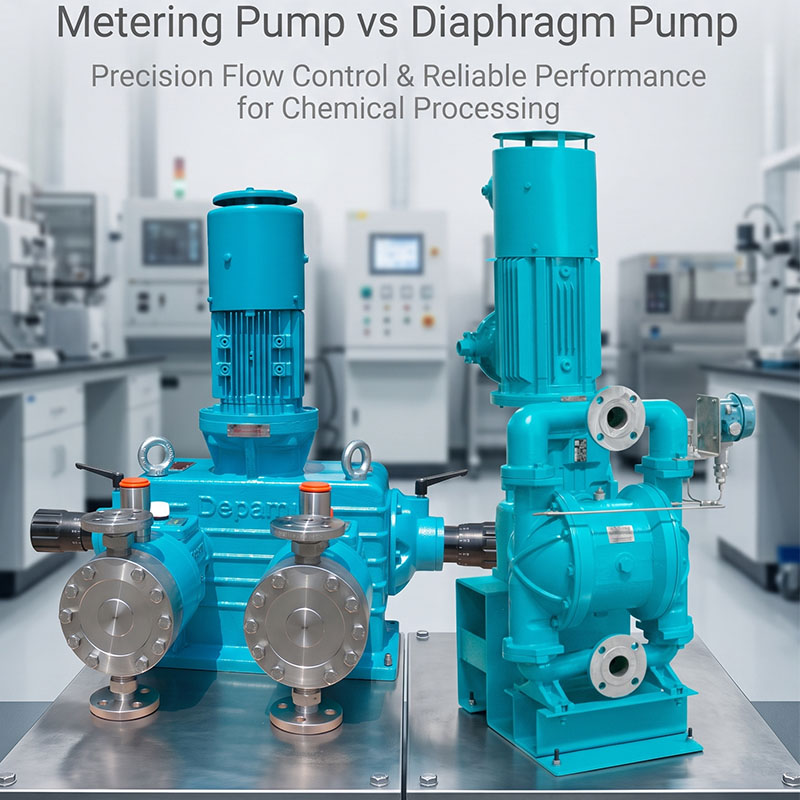
Understanding the Fundamentals
To grasp the differences, one must first define the terms. A metering pump is a type of positive displacement pump designed to move a precise volume of fluid at a specific flow rate, often against high pressure. It is characterized by its ability to maintain a constant and accurate flow, regardless of changes in system pressure. Metering pumps are defined by their function: precision dosing.
A diaphragm pump, on the other hand, is defined by its mechanism. It utilizes a flexible membrane (the diaphragm) to separate the fluid being pumped from the mechanical moving parts. The reciprocating motion of the diaphragm creates a vacuum to draw fluid in and then displaces it out under pressure.
Depamu (Hangzhou) Pumps Technology Co., Ltd. manufactures both types. They produce depamu Plunger Metering Pumps, where a plunger directly contacts the fluid, and depamu diaphragm metering pumps (both mechanical and hydraulic), which use a diaphragm to isolate the fluid. Therefore, when asking "What is the difference between a Depamu metering pump and a diaphragm pump?", we are often comparing a plunger-type Depamu metering pump against a Depamu (or other brand) diaphragm-type metering pump, or comparing a high-precision metering pump against a general-purpose transfer pump.
The Core Distinction: Sealing vs. Precision
The primary difference between a general diaphragm pump and a Depamu metering pump (specifically plunger type) lies in the philosophy of "sealing" versus "precision."
1. Fluid Isolation and Leakage (The Diaphragm Advantage)
The hallmark of any diaphragm pump is its ability to achieve zero leakage. Because the diaphragm creates a hermetic seal between the fluid and the drive mechanism, it is inherently suited for pumping hazardous, toxic, corrosive, or volatile fluids. In contrast, a traditional Depamu plunger metering pump features a plunger that moves back and forth through a seal (packing gland) in direct contact with the fluid. Over time, the abrasive nature of certain fluids can wear down the plunger and seals, potentially leading to leaks or requiring more frequent maintenance.
2. Precision and Pressure (The Plunger Advantage)
Where Depamu plunger metering pumps excel is in high pressure and high precision. Data from Depamu shows that their plunger pumps can handle pressures up to 228 MPa (over 33,000 PSI) , compared to mechanical diaphragm pumps which typically struggle to exceed 1.2 MPa (174 PSI). Furthermore, plunger pumps can achieve a metering accuracy of ±0.5%, compared to a standard mechanical diaphragm pump which might be rated at ±1% to ±2%. This makes the plunger type ideal for high-pressure injection and critical chemical dosing.
A Deeper Dive: Internal Differences
To further clarify, we must look at the subtypes, specifically within the Depamu brand, to understand the nuances.
The Depamu Plunger Metering Pump
-
Working Principle: A motor rotates a crank mechanism to push a plunger back and forth. The plunger directly displaces the fluid in the cylinder head.
-
Pros: Extremely high pressure capacity (up to 228 MPa), high accuracy (±0.5%), simple structure, lower initial cost, suitable for high-viscosity and high-temperature fluids.
-
Cons: High maintenance due to plunger seal wear; risk of leakage; contamination risk as the plunger lubricant can mix with the process fluid.
The Depamu Diaphragm Metering Pump
Depamu produces two main types of diaphragm metering pumps:
-
Mechanical Diaphragm Pump: A motor drives a connecting rod that mechanically pushes the diaphragm back and forth.
-
Hydraulic Diaphragm Metering Pump: This is the gold standard for difficult fluids. A plunger pushes hydraulic oil, which in turn flexes the diaphragm.
-
Pros: Combines the high pressure of a plunger with the leak-free advantage of a diaphragm (can reach high pressures, albeit not as high as pure plunger pumps). Offers superior accuracy (±0.5%) and long diaphragm life due to even hydraulic pressure distribution.
-
Cons: More expensive and mechanically complex than mechanical diaphragms or basic plunger pumps.
-
Practical Comparison: Application Context
The choice between these pumps often comes down to the application requirement.
Industry Example: In an oil and gas field injecting methanol into a high-pressure pipeline (25 MPa), a Depamu plunger pump is often chosen for its ability to meet the pressure requirement. However, if the fluid were a highly toxic amine or a polymer that reacts with air, the Depamu hydraulic diaphragm pump would be preferred to ensure zero leakage, even if it sacrifices some maximum pressure capability.
Interestingly, industry benchmarks suggest that while Depamu is a recognized player, competitors like ProMinent offer diaphragm pumps with advanced features like multi-layer safety diaphragms with rupture indicators, ensuring safety in critical applications. This highlights that while the Depamu hydraulic diaphragm pump is a strong contender, the broader market is highly competitive.
Conclusion
To summarize, the difference is not binary but ternary. A Depamu metering pump is a broad category that includes both plunger and diaphragm designs. The true distinction lies between the plunger and the diaphragm designs, as well as between a metering pump (which is precise) and a standard transfer pump.
-
Choose a Depamu Plunger Metering Pump when you need maximum pressure, extreme accuracy, high viscosity handling, and have a lower concern for leakage or contamination.
-
Choose a Depamu Hydraulic Diaphragm Metering Pump when zero leakage is critical for safety or cost, yet you still need high accuracy and reliable performance.
-
Choose a general diaphragm pump for basic transfer or low-cost dosing where precision is not the primary driver, and fluid compatibility is the main concern.
Ultimately, the decision should be driven by a comprehensive assessment of the fluid's properties (toxicity, viscosity, abrasiveness), the system's pressure requirements, the need for accuracy, and the total cost of ownership. Depamu offers solutions on both sides of the coin, but understanding the fundamental engineering behind these pumps is essential for making the right choice