


The Depamu Injection Package for Chemical Acetone Oxime: A Comprehensive Technical Overview
Introduction
In the realm of industrial boiler feedwater treatment, the management of dissolved oxygen is paramount to ensuring operational efficiency, equipment longevity, and safety. Oxygen corrosion remains one of the most persistent challenges in thermal power plants, oil refineries, and various chemical processing facilities. Among the chemical deoxidants available, acetone oxime (also known as acetoxime, dimethyl ketoxime, or 2-propanone oxime, CAS No. 127-06-0) has emerged as a superior alternative to traditional deoxidizing agents such as hydrazine. However, the effective deployment of acetone oxime requires precise, reliable, and automated dosing equipment. The Depamu Injection Package, manufactured by DEPAMU (Hangzhou) Pumps Technology Co., Ltd., represents a state-of-the-art solution specifically engineered for the accurate injection of acetone oxime and other chemical deoxidants into industrial boiler feedwater systems. This article provides a comprehensive examination of the Depamu Acetoxime Injection Package, covering its design philosophy, core components, operational principles, technical specifications, and the unique advantages it offers to industrial end-users.
Acetone Oxime: The Chemical Foundation
Before examining the injection package itself, it is essential to understand the chemical it is designed to deliver. Acetone oxime is a white flake crystal at room temperature, readily soluble in water, alcohol, ether, and other solvents. Its primary application in industrial settings is as a chemical deoxidant for boiler feedwater, where it serves to remove dissolved oxygen that would otherwise cause severe corrosion to boiler tubes, pipelines, and associated equipment.
The superiority of acetone oxime over traditional deoxidants is well-documented. Compared with conventional boiler chemical deoxidants, acetone oxime offers low consumption, high deoxidization efficiency, non-toxicity, and minimal environmental pollution. It is recognized as the best chemical reagent for subcritical boiler shutdown protection and passivation, and represents an ideal replacement for hydrazine and other traditional chemical deoxidizers in medium- and high-pressure boiler feedwater applications.
The chemical mechanism underlying acetone oxime's effectiveness is its strong reducing properties. Acetoxime readily reacts with dissolved oxygen in water, thereby lowering the oxygen content in feedwater. The primary reaction can be expressed as:
2C₂H₇NO + O₂ → 2C₃H₆CO + N₂O + H₂O
4(CH₃)₂C=N-OH + O₂ → 4(CH₃)₂C=O + 2N₂ + H₂O
Beyond simple oxygen scavenging, acetone oxime also participates in passivation reactions with metal surfaces. The reaction between acetoxime and iron oxide (Fe₂O₃) produces magnetite (Fe₃O₄), which forms a protective layer on boiler metal surfaces:
2C₃H₇NO + 6Fe₂O₃ → 2C₂H₆CO + N₂O + 4Fe₃O₄ + H₂O
This dual functionality—oxygen scavenging and metal passivation—makes acetone oxime exceptionally valuable for boiler water treatment. Additionally, acetone oxime can lower iron content in feedwater, preventing boiler metal tube damage due to overheating and corrosion caused by iron oxide precipitate formation. It also cleans corrosion products of copper deposited in pipelines and economizers.
Importantly, the decomposition products of acetone oxime (often abbreviated as DMKO) are primarily ammonia and water, accompanied by only trace amounts of methanoic acid, acetic acid, and nitrogen oxide. When residual DMKO in feedwater is controlled within 5 to 40 μg/L, these byproducts have been shown to have no adverse effects on the water vapor system.
The Depamu Injection Package: Design Philosophy and Engineering Excellence
The Depamu Acetoxime Injection Package belongs to the broader DPJY-series of injection packages, which are complete sets of equipment manufactured through rigorous research and development. Depamu's engineering approach combines practical experience in the Chinese industrial context with advanced production processes and technologies imported from America, Germany, Japan, and other technologically advanced nations. The result is a product line that meets the stringent demands of industries including petroleum, chemical processing, natural gas, oil refining, water supply, thermoelectric power generation, nuclear energy, pharmaceuticals, and food processing.
The DPJY-series embodies several key design principles that distinguish Depamu injection packages from conventional dosing equipment:
Systematic Design: Unlike traditional approaches that design individual components in isolation, Depamu employs systematic design methodology that eliminates the discrepancies often found in single-equipment or single-part designs. This holistic approach ensures seamless integration of all system components.
Modular Architecture: The product structure features modular design in an integrated combination, allowing for convenient capacity and functional expansion as operational requirements evolve.
Flexible Customization: Depamu can flexibly provide optimal solutions tailored to different media types and user requirements. End-users may select equipment and components from renowned domestic and international brands in various materials at multiple quality levels.
Multiple Control Modes: The packages support manual, automatic, and various hybrid control modes to accommodate diverse operational preferences and requirements.
Core Components of the Acetoxime Injection Package
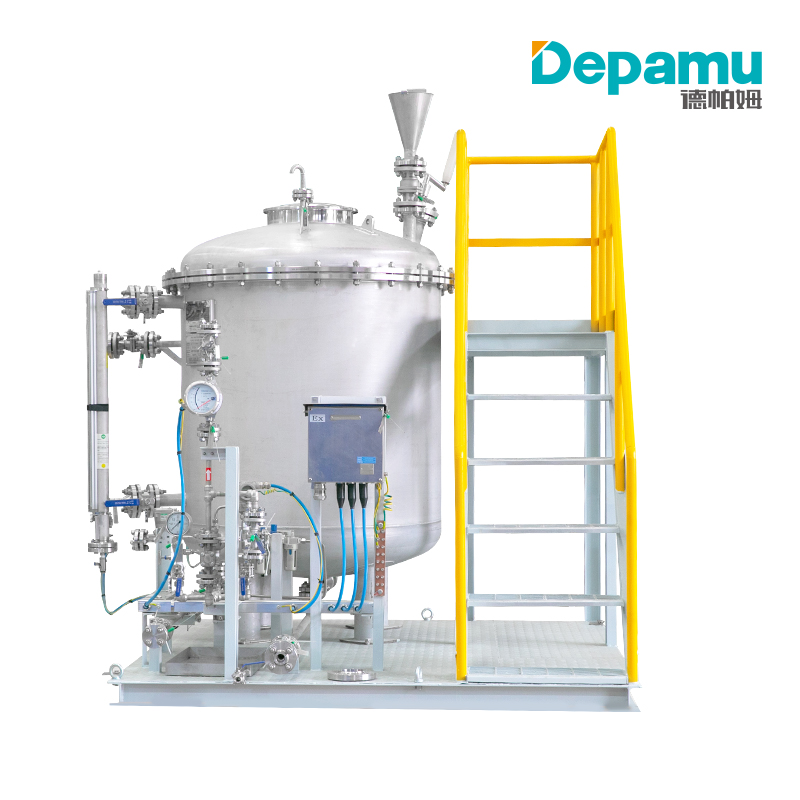
The Depamu Acetoxime Injection Package is a comprehensive, skid-mounted system comprising several essential components that work in concert to ensure precise and reliable chemical dosing.
Solution Tank
The solution tank serves as the primary storage vessel for the acetone oxime solution. Depending on the specific anti-corrosion requirements of the application, the tank can be manufactured from 316 or 304 stainless steel. The tank volume typically ranges from 0.5 to 2.5 cubic meters for standard boiler water injection configurations. The tank is equipped with level gauges to monitor solution inventory and ensure uninterrupted operation.
Metering Pump
The metering pump is arguably the most critical component of the injection package, responsible for delivering the precise quantity of acetone oxime solution into the feedwater system. Depamu injection packages feature metering pumps with capacities ranging from 20 to 70 liters per hour for boiler water applications, with discharge pressures ranging from 0.5 to 2.5 MPa. The pumps are designed to handle the specific properties of acetone oxime solutions, including their corrosive characteristics.
Depamu's expertise in pump technology is noteworthy. The company manufactures metering pumps, Dosing Pumps, high-pressure Reciprocating Pumps, and petrochemical pumps. Their electric Diaphragm Pumps, based on multiple globally leading technologies, feature PTFE diaphragms produced through special compression molding, offering excellent mechanical performance and resistance to corrosion by strong acids, bases, and solvents.
Electrical Control Cabinet
The electrical control cabinet houses the automation and control systems that govern the injection package's operation. It typically includes programmable logic controllers (PLC), frequency converters, and human-machine interface (HMI) panels for local monitoring and control.
Safety and Auxiliary Components
A comprehensive array of auxiliary components ensures safe and reliable operation:
-
Safety valves protect the system from overpressure conditions
-
Pulsation dampers smooth out pressure fluctuations from the metering pump, ensuring consistent flow
-
Various valves and pipes facilitate flow control, isolation, and system maintenance
Integration Options
Depamu offers various combination forms to match specific application requirements. Standard configurations include 1 Tank + 2 Pumps, 2 Tanks + 3 Pumps, and 2 Tanks + 4 Pumps arrangements. The physical footprint of these packages ranges from approximately 1,600 to 4,200 kg in weight, with dimensions of 1,800×1,900×2,500 mm for single-tank configurations and 3,000×1,900×2,500 mm for dual-tank setups.
Operational Principles and Control Systems
The Depamu Acetoxime Injection Package can be operated in both local manual and fully automatic modes, providing flexibility to suit different operational requirements and user preferences.
Manual Control Mode
In manual mode, operators directly control the injection rate and system functions through the local control panel. This mode is particularly useful during system startup, maintenance periods, or when fine-tuning is required.
Automatic Control Mode
The automatic control mode represents the pinnacle of the Depamu injection package's capabilities. Automation is realized through frequency converters that receive and process signals from various process sensors. Key input signals include:
-
Flow rate signals from feedwater flow meters, enabling proportional dosing based on water flow
-
Dissolved oxygen content signals from online oxygen analyzers, allowing closed-loop control to maintain target oxygen levels
-
Turbidity signals or other water quality parameters that may influence dosing requirements
This sophisticated control architecture enables the injection package to respond dynamically to changing process conditions, maintaining optimal deoxidant concentrations while minimizing chemical consumption.