

Depamu Rubber Rotor Pump for Sewage Pipe Cleaning
Introduction
Sewage pipe cleaning remains one of the most challenging tasks in urban infrastructure maintenance. Municipal wastewater systems accumulate grease, sludge, debris, fibrous materials, and mineral deposits over time, leading to reduced flow capacity, unpleasant odors, and ultimately pipe blockages that can cause sewage backups and environmental hazards. The equipment used for cleaning these pipes must contend with highly abrasive, viscous, and solids-laden fluids while maintaining reliable performance under demanding conditions. Among the solutions available, the Depamu rubber rotor pump has emerged as a highly effective tool for sewage pipe cleaning applications. Manufactured by Depamu (Hangzhou) Pumps Technology Co., Ltd., a high-tech enterprise established in 2003 with a registered capital of 54 million yuan, these positive displacement pumps combine robust construction with advanced engineering to address the unique challenges of sewage conveyance and pipeline maintenance.
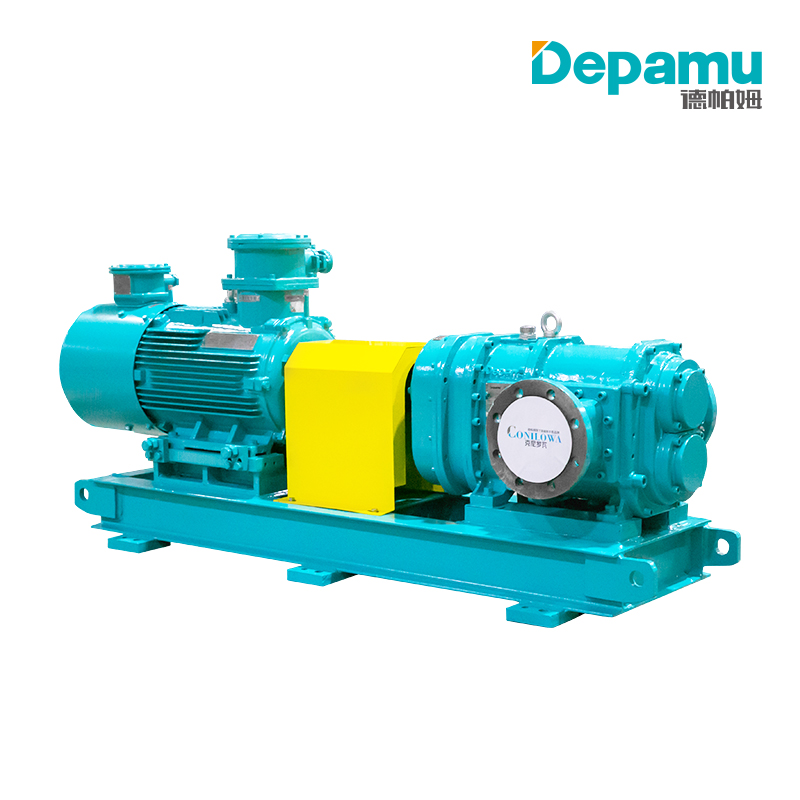
Understanding the Depamu Rubber Rotor Pump
The Depamu rubber rotor pump, also known as a lobe pump, belongs to the family of positive displacement pumps. Unlike centrifugal pumps that rely on high-speed impellers to impart velocity to fluids, positive displacement pumps trap a fixed volume of fluid and mechanically force it through the discharge port. This fundamental difference makes rotor pumps particularly suitable for handling viscous, solids-laden, and shear-sensitive materials commonly encountered in sewage systems.
Working Principle
The operating principle of the Depamu rubber rotor pump is based on the relative motion between elastomeric rotors and the pump body to change the working volume, thereby increasing the energy of the conveyed medium. The pump features wide-blade elastic-covered rotors that rotate within the circumferential flow channel of the pump cavity. These rotors are manufactured using advanced five-axis linkage technology or three-dimensional flow precision molding techniques, ensuring optimal geometry and performance.
As the rotors rotate, the fluid comes into contact with one side of the rotor, where energy is transferred to the medium in the form of static pressure. The squeezing action of the rotating rotor discharges the medium on one side while simultaneously creating a low-pressure zone on the opposite side, enabling continuous suction of fluid. This pumping action exhibits positive displacement characteristics, meaning the flow rate remains constant regardless of back-pressure changes, making the pump highly versatile across a wide range of operating conditions.
Key Technical Parameters
Depamu offers a comprehensive range of rubber rotor pump models to suit various sewage cleaning requirements. The Conilowa series includes five series and seven models with a capacity range of 0.1 to 10,000 m³/h, a temperature range of 40°C to 280°C, and a maximum discharge pressure of 2.0 MPa. For instance, the CLJ50 model delivers a maximum flow rate of 15 m³/h with a maximum pressure of 1.0 MPa at 720 rpm. The DPJ150B0.2-190 model, specifically designated as a sewage pipe cleaning pump, exemplifies the application-focused design philosophy of Depamu.
The pumps are available with various rotor material options, including nitrile rubber, EPDM, fluororubber, hydrogenated rubber, PTFE, ultra-wear-resistant rubber, and engineering plastics. This material flexibility allows the pumps to be customized for specific sewage compositions, whether they contain corrosive chemicals, abrasive particulates, or high-temperature fluids.
Technical Advantages for Sewage Pipe Cleaning
Exceptional Solids Handling Capability
One of the most significant advantages of the Depamu rubber rotor pump for sewage pipe cleaning is its ability to handle fluids with high solid content. The pump can transport media with a solid content of up to 60%. Furthermore, it can pass incompressible materials with a maximum diameter of 80 mm without clogging. This capability is crucial for sewage cleaning operations, where the fluid stream typically contains debris ranging from sand and gravel to fibrous materials and organic waste. The pump's non-clogging design ensures continuous operation even when processing heavily contaminated sewage.
Superior Self-Priming Ability
Sewage pipe cleaning often involves pumping from locations where the fluid source is below the pump level or where the suction line contains air pockets. The Depamu rubber rotor pump addresses this challenge with exceptional self-priming capability. It requires no water irrigation or auxiliary priming devices, with a maximum suction lift of 9 meters. This self-priming feature simplifies installation and operation, particularly in field conditions where access to priming water may be limited.
Handling of High-Viscosity Fluids
Sewage sludge and grease accumulations can exhibit extremely high viscosity. The Depamu rubber rotor pump can transport media with a viscosity of up to 2 million centipoise (cP). This capability ensures that even the most viscous sewage materials can be effectively conveyed during pipe cleaning operations. The pump's low operating speed, typically ranging from 10 to 650 rpm, further contributes to its ability to handle high-viscosity fluids without excessive wear or energy consumption.
Multi-Phase Transport
Sewage pipelines often contain a mixture of liquid, solid, and gas phases. The Depamu rubber rotor pump excels at transporting mixed media of solid, liquid, and gas with minimal pulsation. This multi-phase transport capability is essential for sewage cleaning, where the presence of air entrainment, methane gas, and varying solids concentrations is common. The pump's ability to handle "gas locking" ensures thorough cleaning of pipeline systems.
Bidirectional Operation
The Depamu rubber rotor pump features a completely symmetric structure, allowing a simple change in driving direction to achieve reversal of flow. This positive inversion function is particularly valuable for loading and unloading operations as well as for pipeline flushing and cleaning. By reversing the flow direction, operators can dislodge stubborn deposits and flush debris from both directions, significantly improving cleaning effectiveness.
Robust Construction
The pumps feature a double support structure that provides enhanced stability and enables output pressures up to 1.8 MPa, with multistage configurations reaching 3.0 MPa. The compact structure requires minimal mounting space while delivering exceptional performance. The low-speed operation reduces wear on components, and the availability of wear-resistant and corrosion-resistant axial and radial bushings extends service life.
Easy Maintenance
Field maintenance is a critical consideration for sewage cleaning equipment, where downtime translates directly to service disruptions. The Depamu rubber rotor pump is designed for online repair and maintenance without the need for pipeline dismantling. The modular design ensures that pumps of the same series share common rotors, gears, bearings, axial lining boards, and mechanical seals, simplifying spare parts inventory management. The low failure rate and minimal consumables requirements further reduce maintenance costs and downtime.
Safety and Configuration Options
The pumps can be equipped with head insulation and cooling functions as well as safety valves to meet specific working condition requirements. Explosion-proof motor options are available for applications where flammable gases may be present. These safety features are particularly important in sewage applications where methane and other combustible gases may accumulate.
Applications in Sewage Pipe Cleaning
Municipal Sewer Maintenance
Municipal wastewater systems require regular cleaning to maintain flow capacity and prevent blockages. The Depamu rubber rotor pump is widely used in municipal sewage treatment and pipeline maintenance operations. Its ability to handle sewage, sludge, and debris-laden water makes it ideal for pumping from manholes, wet wells, and lift stations during cleaning operations.
Industrial Wastewater Systems
Industrial facilities generate wastewater streams that often contain aggressive chemicals, abrasive particulates, and high-temperature fluids. The Depamu rubber rotor pump's material options, including various rubber compounds and corrosion-resistant alloys, enable it to handle these challenging industrial sewage applications. The pumps are used in industries ranging from petrochemical and chemical processing to paper manufacturing and textile production.
Emergency Response
The superior self-priming and solids-handling capabilities of the Depamu rubber rotor pump make it valuable for emergency sewage spill response. The pump can be rapidly deployed to contain and transfer sewage spills, preventing environmental contamination. Its ability to run dry without damage allows it to continue operating even when suction conditions are intermittent.
Pipeline Flushing and Descaling
The bidirectional operation capability of the Depamu rubber rotor pump enables effective pipeline flushing and descaling. By alternating flow direction, the pump can dislodge scale deposits and accumulated debris that would otherwise remain in place with unidirectional flow. The pump's low-pulsation operation ensures smooth flow without the damaging pressure spikes that can harm aging pipeline infrastructure.
Economic and Operational Benefits
Energy Efficiency
The positive displacement design of the Depamu rubber rotor pump delivers high efficiency across a wide range of operating conditions. Unlike centrifugal pumps that lose efficiency at off-design points, rotor pumps maintain consistent efficiency regardless of pressure variations. The low-speed operation further reduces energy consumption while extending component life.
Reduced Downtime
The robust construction and easy maintenance features of the Depamu rubber rotor pump minimize operational downtime. The ability to perform online repairs without pipeline dismantling means that cleaning operations can continue with minimal interruption. The low failure rate and extended service life of wear components further contribute to high availability.
Versatility
A single Depamu rubber rotor pump can serve multiple functions in sewage pipe cleaning operations, including pumping, flushing, and transfer. This versatility reduces the need for multiple specialized pumps, simplifying equipment inventory and reducing capital costs.
Conclusion
The Depamu rubber rotor pump represents a sophisticated solution to the demanding requirements of sewage pipe cleaning. Its positive displacement design, exceptional solids-handling capability, superior self-priming ability, and bidirectional operation make it uniquely suited for cleaning municipal and industrial wastewater pipelines. The pump has robust construction, and easy maintenance features ensure reliable performance in the challenging conditions typical of sewage applications.
As urban infrastructure ages and environmental regulations become more stringent, the need for effective sewage pipe cleaning equipment will only grow. The Depamu rubber rotor pump, with its combination of advanced engineering, material flexibility, and operational versatility, is well-positioned to meet these evolving challenges. Whether deployed for routine municipal sewer maintenance, industrial wastewater system cleaning, or emergency spill response, the Depamu rubber rotor pump delivers the performance, reliability, and durability that sewage pipe cleaning operations demand.