

Depamu-pumps.com/Metering-pump.html target='_blank'>Metering Pump vs. Screw Pump: A Comparative Analysis of Design Philosophy, Performance, and Application
In the landscape of industrial positive displacement pumps, the metering pump and the screw pump are often mentioned in the same breath, yet they are designed to solve fundamentally different problems. Both belong to the positive displacement family: they trap a fixed volume of fluid and force it from suction to discharge, making their flow largely independent of system backpressure. Beyond this shared lineage, however, their design philosophies diverge sharply. A metering pump is engineered for precision injection—delivering a chemically exact dose against a process, often at high pressure, with a controllable, repeatable flow rate. A screw pump is engineered for gentle, continuous conveyance—moving viscous, shear-sensitive, or solids-laden media at high volumetric rates with a smooth, pulse-free flow. Confusing one for the other can lead to poor dosing accuracy, damaged fluids, or unnecessary maintenance costs. This article examines the differences between metering pumps and screw pumps across working principle, flow characteristics, accuracy, fluid compatibility, pressure capability, maintenance profile, and application domains, and concludes with a practical selection framework.
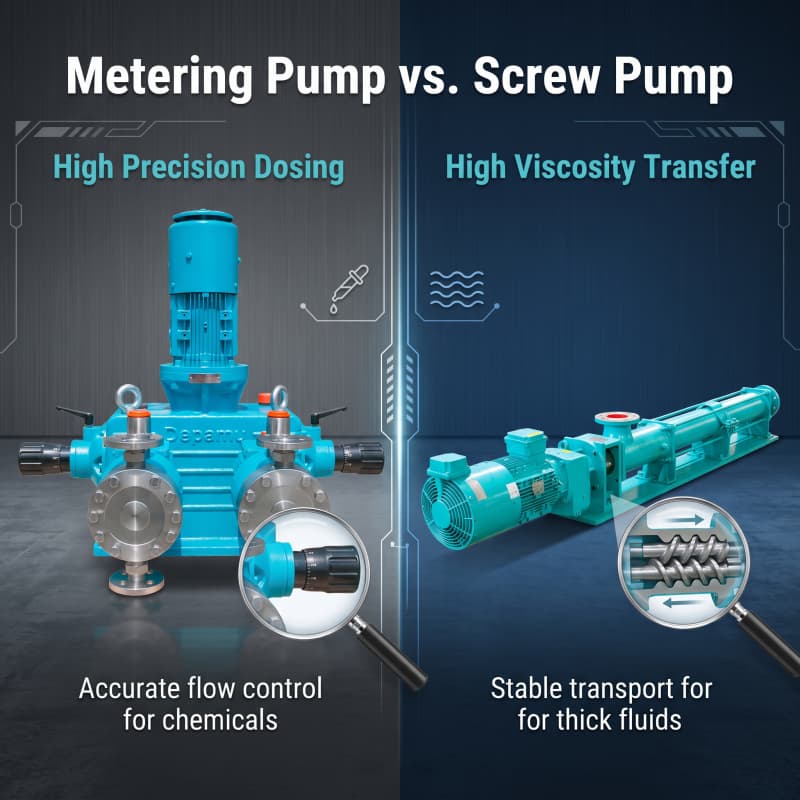
Working Principles: Reciprocating Precision vs. Rotary Conveyance
The metering pump is, in its essential form, a reciprocating volumetric pump with a deliberately adjustable swept volume. Its operation is cyclical. A drive mechanism—whether a solenoid, a mechanical eccentric, or a hydraulic system—moves a piston, plunger, or diaphragm through a discrete stroke. On the suction stroke, fluid is drawn into a cavity; on the discharge stroke, that cavity is reduced and the fluid is forced out through a check valve. The flow delivered per unit time is the product of the swept volume per stroke and the stroke frequency. Critically, the swept volume itself can be adjusted, typically by changing the stroke length from zero to one hundred percent of its maximum, either manually or automatically. This dual means of control—stroke length and stroke speed—is what separates the metering pump from a generic reciprocating pump and allows it to function as a dosing instrument rather than a simple transfer device.
The screw pump, by contrast, is a rotary positive displacement machine. Its most common variant, the progressive cavity pump, consists of a single helical metal rotor turning eccentrically within a stationary elastomeric stator that has one more helical start than the rotor. As the rotor rotates, sealed cavities are continuously formed between the two helical surfaces, and these cavities “progress” axially from the suction end to the discharge end, carrying a fixed volume of fluid with each revolution. Other screw pump configurations use two or three intermeshing screws rotating in a casing, forming sealed chambers that move fluid axially. In every case, the motion is continuous and rotary, not cyclical and reciprocating. There is no discrete stroke, no check valve in the progressive cavity design, and no adjustable swept volume in the manner of a metering pump. The flow rate is governed by rotor geometry and rotational speed.
Flow Characteristics: Pulsation and the Nature of Delivery
The most immediately observable difference between the two pumps is the character of their discharge flow. Because the metering pump delivers fluid in discrete strokes, its instantaneous flow is pulsatile. Each stroke produces a surge, followed by a lull as the pump refills. Diaphragm metering pumps, in particular, are known for delivering fluid “with a high degree of pulsation”. In many dosing applications, this pulsation is tolerable, especially when the injection point is followed by sufficient mixing volume or when the process responds slowly relative to the stroke frequency. Where pulsation would be detrimental—for example, in analytical instrumentation or in processes sensitive to pressure fluctuations—a pulsation dampener is installed on the discharge line to smooth the flow. Some advanced metering pump designs have reduced pulsation through multi-diaphragm or continuous-delivery mechanisms, but the reciprocating heritage remains visible in the flow signature.
Screw pumps, in contrast, are celebrated for their pulse-free, homogeneous delivery. The progressive cavity principle produces a “homogenous flow, free of pulsations”, and rotary screw pumps more generally ensure “a steady flow with minimal turbulence”. Because the sealed cavities move continuously and at a constant volumetric rate per revolution, the discharge is essentially steady. This characteristic is not merely a comfort; it is a functional requirement in lubrication systems, hydraulic drives, and the conveying of emulsions or suspensions where pulsation could cause settling, aeration, or mechanical stress on downstream equipment. In short, if the process demands a smooth, non-pulsating stream, the screw pump has an inherent structural advantage. If the process demands a precisely quantified cumulative dose over time, the metering pump’s pulsation is a manageable byproduct of its dosing mechanism.
Accuracy and Controllability: The ±1% Threshold
Accuracy is the defining virtue of the metering pump. While all positive displacement pumps deliver a theoretically fixed volume per cycle, a metering pump is distinguished by its ability to hold that delivery to a tight tolerance across a wide range of operating conditions. The industry benchmark for a true metering pump is an accuracy of approximately ±1% of setpoint. This accuracy is achieved through careful control of cavity dimensions, minimization of dead volume and internal leakage, and the use of precision check valves that reseat reliably cycle after cycle. Advanced metering pumps can achieve turndown ratios—the ratio of maximum to minimum controllable flow—of 1000:1 or even higher, allowing a single pump to cover duties from a few milliliters per hour to thousands of liters per hour without loss of linearity. The control interface is typically designed for integration with process instrumentation: a 4–20 mA signal, a pulse input from a flow meter, or a digital communication protocol can command the stroke rate or stroke length, turning the pump into an actuator in a closed-loop dosing system.
Screw pumps are volumetric machines and can be highly repeatable, but their design intent is not precision dosing in the metering sense. Their volumetric efficiency is affected by slip—internal leakage across the rotor–stator clearance—which rises with differential pressure and falls with viscosity. At a fixed speed, a screw pump will deliver a consistent flow, and the flow can be varied by changing the speed. However, the turn-down range over which this can be done while maintaining a metered accuracy comparable to a dedicated metering pump is narrower, and the control hardware is typically a variable-frequency drive rather than a purpose-built dosing controller. The screw pump’s strength lies in stable conveyance, not in the fine-grained, calibrated injection of small volumes into a high-pressure process. When engineers speak of “metering” with a screw pump—as in some adhesive dispensing systems—they are usually referring to the repeatability of a positive displacement rotary pump under tightly controlled temperature and fluid conditions, not to the ±1% dosing standard of a reciprocating metering pump.
Fluid Compatibility: Clean Doses vs. Difficult Media
The metering pump is at its best with relatively clean, low-to-moderate viscosity liquids that are compatible with its wetted materials and its check valves. Water-treatment chemicals, acids, bases, coagulants, and solvents are classic metering duties. The presence of suspended solids or abrasive particles is problematic: check valves can foul or erode, and the close clearances in a piston or plunger design can wear rapidly. Diaphragm metering pumps are more forgiving of solids than piston pumps because the diaphragm isolates the drive from the fluid, but the valve assemblies remain the vulnerable component. Highly viscous fluids can also be difficult to meter accurately because they resist rapid refilling of the pump cavity during the suction stroke.
Screw pumps occupy the opposite end of the fluid-handling spectrum. Their progressive cavity and multi-screw designs are specifically suited to high-viscosity, shear-sensitive, and solids-laden media. Progressive cavity pumps can handle viscosities approaching 1,000,000 cP and are widely used for sludge, slurry, pulp, paste, and food products such as dough and chocolate. The gentle, low-shear, axial conveyance protects emulsions and suspensions from degradation. Screw pumps also excel with fluids containing fibrous solids or abrasive particles, although abrasion will eventually wear the rotor and stator. The trade-off is that screw pumps are generally not the first choice for clean, low-viscosity liquids at low flow rates; in that regime, their clearances and slip characteristics make them less efficient and less precise than a dedicated metering pump or a small gear pump.
Pressure Capability: High-Pressure Dosing vs. Staged Conveyance
Metering pumps are capable of remarkably high discharge pressures relative to their size. Piston metering pumps can reach pressures of several thousand psi, and diaphragm metering pumps routinely operate at 100 bar and above in boiler-feed and chemical-injection services. This pressure capability is essential because dosing often occurs into a pressurized main—a pipeline, a reactor, or a boiler—where the pump must overcome the process pressure to inject the additive.
Screw pumps also generate pressure, but the relationship between pressure and design is different. In a progressive cavity pump, each rotor–stator stage contributes a modest pressure increment, typically around 6 bar per stage, so higher pressures require more stages and a longer pump. Multi-screw pumps can achieve higher pressures—three-screw pumps are available for duties above 300 bar—but these are specialized machines with precision-machined clearances, and they are generally applied to clean, lubricating fluids rather than to abrasive slurries. The pressure capability of a screw pump is therefore not a limitation in absolute terms, but it is achieved through staging and precision rather than through the brute-force reciprocating mechanism of a metering pump. For high-pressure injection of a chemical dose, the metering pump is the more direct solution. For high-pressure transfer of a viscous product, a multi-stage or multi-screw pump may be appropriate.
Maintenance, Wear, and Cost of Ownership
The wear profiles of the two pumps reflect their different contact mechanisms. In a metering pump, the primary wear components are the check valves, the diaphragm or piston seal, and the drive mechanism. Diaphragm life depends on the chemical compatibility of the elastomer or PTFE with the pumped fluid, the stroke rate, and the pressure differential. Check valves can foul or lose their seal if the fluid contains particles or if the chemical tends to crystallize. Maintenance is typically periodic and predictable: replacing a diaphragm or a valve cartridge is a routine procedure. The pump’s precision is preserved as long as these consumables are in good condition, and the cost of ownership is driven by the frequency of consumable replacement rather than by catastrophic wear.
In a progressive cavity screw pump, the rotor and stator are the consumable pair. The elastomeric stator is subject to abrasive wear, swelling from chemical attack, and thermal degradation. Stator replacement is a significant maintenance event, and in abrasive or high-temperature services the interval between replacements can be a dominant factor in operating cost. Modern designs have addressed this with adjustable stator tensioning systems that compensate for wear and extend service life, and with improved elastomer formulations, but the fundamental wear mechanism remains. Multi-screw pumps avoid the elastomeric stator but introduce precision-machined metal-to-metal clearances that are sensitive to contamination and require clean, lubricating fluids. Neither pump is maintenance-free, but the nature of the maintenance differs: the metering pump’s upkeep is tied to seals and valves, while the screw pump’s is tied to the rotor–stator interface.
Application Domains: Where Each Pump Belongs
The application profiles of the two pumps are almost complementary. Metering pumps dominate in water and wastewater treatment, where coagulants, disinfectants, and pH-adjustment chemicals must be dosed in precise proportion to flow; in chemical processing, where catalysts and inhibitors are injected into reactors at controlled rates; in the power industry, for boiler-water treatment and emissions-control reagents; and in laboratories and medical devices, where microliter-scale dispensing demands repeatability. The common thread is that the fluid is a relatively clean liquid, the volume to be delivered is small relative to the process stream, and the accuracy of the dose matters more than the smoothness of the instantaneous flow.
Screw pumps, on the other hand, are found wherever the fluid is too viscous, too shear-sensitive, or too laden with solids for a metering pump to handle reliably. They are workhorses in oil and gas production, transferring crude oil and multiphase fluids; in food and beverage processing, moving chocolate, dough, fruit pulp, and dairy products without destroying texture; in wastewater treatment, conveying sludge and screenings; in the paper industry, handling pulp and coatings; and in marine and hydraulic systems, circulating lubricating oil with minimal noise and vibration. The common thread here is that the fluid is the product or a significant process stream, and the pump’s job is to move it gently and continuously without degradation.
Selection Logic: Matching the Pump to the Duty
The choice between a metering pump and a screw pump should follow from a clear statement of the duty. If the primary requirement is to inject a precise, adjustable, and repeatable quantity of a relatively clean liquid into a process, often against pressure, the metering pump is the appropriate technology. Its reciprocating, positive-displacement action, adjustable swept volume, and ±1% accuracy are purpose-built for dosing. Pulsation can be managed with a dampener if necessary, and the pump’s control interface can be integrated into a process control loop.
If the primary requirement is to convey a viscous, shear-sensitive, abrasive, or solids-laden fluid at a steady rate, with minimal pulsation and without damaging the medium, the screw pump is the better choice. Its rotary, cavity-progression principle produces a gentle, pulse-free flow, and its volumetric capacity scales with rotor diameter and speed rather than with stroke frequency. It is not a precision dosing instrument in the metering sense, but it is an exceptionally reliable conveyor of difficult fluids.
In some processes, both functions may be present: a screw pump might transfer a viscous product to a filling line, while a metering pump injects a small additive into that product upstream. Recognizing that these are not competing solutions to the same problem, but complementary tools for different problems, is the key to sound pump selection. The metering pump and the screw pump share a positive-displacement heritage, but they diverge at the point where precision dosing ends and gentle conveyance begins. Understanding that boundary is what allows an engineer to specify the right machine for the duty rather than forcing one technology to perform a task for which it was never designed.