

Depamu Hygienic Electric Double Diaphragm (AODD) Pumps: Engineering Clean Fluid Transfer for Modern Industry
Introduction
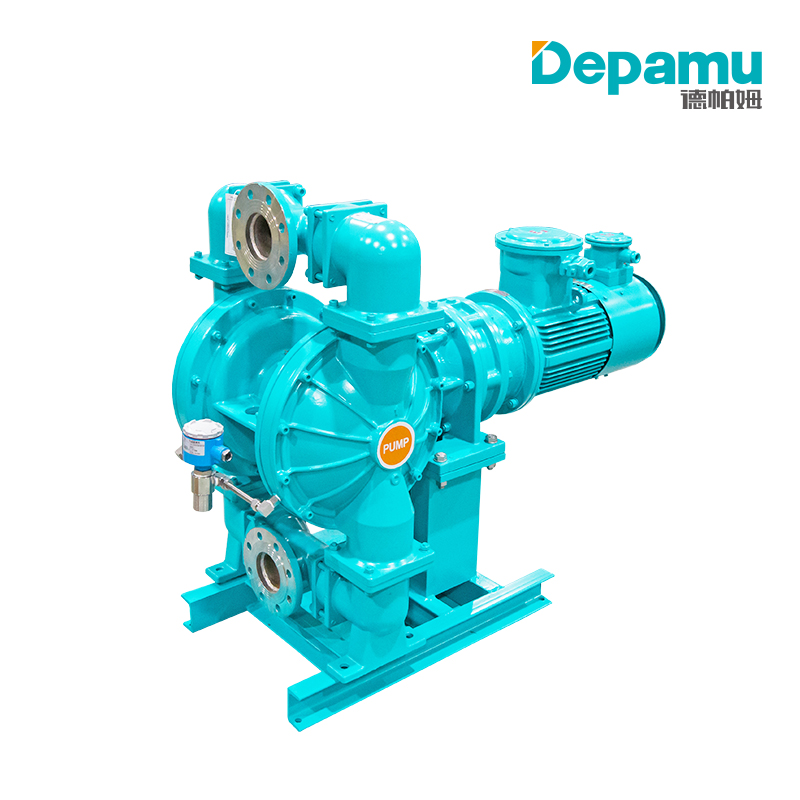
In the pharmaceutical, food and beverage, and personal care industries, the movement of fluids is never merely a logistical concern. Every transfer operation carries implications for product integrity, consumer safety, and regulatory compliance. The pumps selected for these duties must perform a dual function: transporting materials with precision and gentleness while upholding the strictest standards of hygiene and cleanability. Depamu (Hangzhou) Pumps Technology Co., Ltd., a manufacturer with over two decades of fluid handling expertise, has positioned its hygienic Electric Operated Double Diaphragm (EODD) pump technology at the intersection of these demands. By replacing the pneumatic drive of conventional Air Operated Double Diaphragm (AODD) pumps with a precision electric motor, Depamu has created a pumping platform that delivers meaningful advantages in energy efficiency, operational control, and environmental cleanliness—without sacrificing the gentle, sealless characteristics that make Diaphragm Pumps indispensable in sanitary applications.
The Electric Advantage: Why EODD Over AODD?
The traditional AODD pump has long been a workhorse in sanitary fluid transfer, valued for its ability to run dry, handle viscous media, and operate without seals or rotating components in the fluid path. However, the pneumatic drive that powers these pumps introduces a set of well-documented drawbacks. AODD pumps are notoriously noisy, typically operating in the range of 80–90 dB(A), and the rapid expansion of compressed air at the exhaust port can cause ice formation—a particular nuisance in humid environments and cleanroom settings. Compressed air itself is an expensive utility, and the energy conversion losses inherent in pneumatic systems mean that AODD pumps consume significantly more energy than their electric counterparts for equivalent hydraulic output.
Depamu's EODD technology addresses these limitations directly. By actuating the diaphragm through a mechanically driven eccentric or cam mechanism connected to an electric motor, the pump eliminates the need for compressed air entirely. This design change produces several immediate benefits. Electric pumps operate at around 60–70 dB(A), a reduction of roughly 20 decibels compared to air-driven models. There is no exhaust air to chill the surrounding environment, no risk of ice formation, and no discharge of compressed air into cleanrooms or production halls. For facilities where air quality and noise pollution are regulated concerns—as is typical in pharmaceutical manufacturing and food processing—these characteristics alone justify the switch.
Beyond environmental factors, the electric drive delivers superior process control. AODD pumps exhibit a flow curve roughly analogous to that of centrifugal pumps, with output proportional to air inlet pressure and volume. EODD pumps, by contrast, function as true positive displacement devices with a predictable, linear relationship between motor speed and flow rate. Depamu's design incorporates an adjustable eccentric mechanism that ensures smooth, stable flow change with minimal pulsation, and the stroke adjustment range spans 0–100%, allowing flow to be tuned in both static and dynamic operating states. For dosing and metering duties in pharmaceutical production, this level of controllability is not a luxury—it is a functional requirement.
Hygienic Design: Engineering for Cleanability and Product Safety
A pump intended for pharmaceutical or food-contact service must be designed from the ground up with hygiene as a primary constraint, not an afterthought. Depamu's hygienic EODD platform incorporates a suite of design features that address the principal risks in sanitary fluid handling: bacterial harborage, product hold-up, and cleaning difficulty.
The fluid-contact path is constructed from materials selected for both chemical compatibility and regulatory compliance. PTFE diaphragms, formed through specialized compression moulding, provide excellent mechanical performance and resistance to corrosion by strong acids, bases, and solvents. PTFE is inherently hydrophobic and has a smooth, non-porous surface that resists the adhesion of biological materials and facilitates the removal of product residues during cleaning cycles. The pump head is available in multiple material and structural configurations, including single-diaphragm and double-diaphragm arrangements, allowing the wetted path to be tailored to the specific chemistry of the application. For food and pharmaceutical service, wetted components can be supplied in stainless steel (AISI 316L) and FDA-compliant elastomers.
The internal geometry of the pump is designed to minimize dead legs and crevices where product could stagnate and microorganisms could proliferate. Depamu's check valve assemblies employ a self-cleaning structure that resists bonding and precipitation, a critical feature when handling emulsions, suspensions, or any medium prone to leaving sticky residues. The sealless architecture of the diaphragm pump eliminates the shaft seals and packing glands that represent the most common failure points and contamination pathways in rotary and centrifugal pumps. With no dynamic seals to wear or leak, the risk of air entrainment—which can introduce oxygen into shear-sensitive products and accelerate oxidative degradation—is effectively removed.
Cleanability is further enhanced by the pump's compatibility with standard sanitization protocols. Depamu's hygienic pump designs support Clean-in-Place (CIP) and Sterilize-in-Place (SIP) procedures, with flow passages configured to facilitate thorough flushing and drainage. Smooth, electropolished surface finishes and the absence of internal crevices allow cleaning solutions to reach all wetted surfaces without the need for manual disassembly. This capability is essential in multi-product facilities where changeover time directly affects production capacity and where validated cleaning procedures are a regulatory mandate.
Performance Across Critical Applications
Food and Beverage Processing
The food and beverage industry presents a remarkably diverse set of pumping challenges. A single production facility may need to transfer thick emulsions such as mayonnaise and salad dressings, high-viscosity concentrates, temperature-sensitive dairy products, and carbonated or oxygen-sensitive beverages—often through the same hygienic piping infrastructure. Depamu's Electric Diaphragm Pumps are engineered to handle this diversity without compromising product quality.
Emulsions are particularly demanding because they are shear-sensitive: excessive mechanical agitation during pumping can break the emulsion, causing phase separation, texture changes, and reduced shelf life. Depamu EODD pumps address this through their inherently gentle pumping action. The fluid is moved by the reciprocating motion of the diaphragm rather than by rotating impellers or high-speed gears, so the shear forces exerted on the product are minimal. This low-shear characteristic preserves droplet size distribution and prevents coalescence, maintaining the stability of emulsions from the mixing vessel to the filling line.
For dairy products such as milk and cream, the pump's smooth internal passages and gentle handling reduce the risk of mechanical damage to fat globules and protein structures. In craft brewing and beverage production, the sealless design prevents air entrainment that could introduce oxygen and degrade flavor compounds or accelerate staling. The pump's ability to handle fluids across a wide temperature range—from chilled products at near-freezing temperatures to hot process streams—further extends its applicability across the production cycle.
Pharmaceutical and Biopharmaceutical Manufacturing
In pharmaceutical production, the margin for error is vanishingly small. Active pharmaceutical ingredients (APIs), biological products, and sterile formulations demand pumping equipment that can deliver precise volumes without introducing contamination or compromising the integrity of the product. Depamu EODD pumps meet these requirements through a combination of accurate metering capability, hygienic construction, and material compliance.
The positive displacement principle ensures that the volume displaced per stroke is fixed and predictable, making the pump suitable for dosing applications where metering accuracy is critical. The flow rate adjustment range of 10% to 100% with a metering accuracy of ±0.5% provides the precision needed for formulation and filling operations. For biopharmaceutical applications involving shear-sensitive proteins and cell cultures, the low-shear, low-pulsation pumping action minimizes damage to biological molecules. The availability of FDA-compliant and USP Class VI materials for wetted components ensures that the pump meets the material safety requirements for direct product contact in pharmaceutical manufacturing.
The double diaphragm configuration, available with rupture detection and alarm capability, adds an additional layer of process safety. Real-time monitoring of diaphragm condition allows operators to detect impending failures before they result in product contamination or unplanned downtime—a capability that is particularly valuable in continuous or campaign-based pharmaceutical production where even brief interruptions can be costly.
Conclusion
Depamu's hygienic electric double diaphragm pump technology represents a considered response to the evolving requirements of sanitary fluid handling. By replacing the pneumatic drive with a precision electric motor, the design delivers quieter operation, cleaner performance, and more precise flow control than conventional AODD pumps. By engineering the wetted path for cleanability—with PTFE diaphragms, self-cleaning valves, sealless construction, and CIP/SIP compatibility—the pump meets the hygiene standards demanded by pharmaceutical, food and beverage, and personal care applications. And by combining gentle, low-shear pumping action with accurate positive displacement metering, it protects product integrity while maintaining the operational reliability that modern production environments require. For manufacturers seeking a pumping solution that reconciles the competing demands of hygiene, precision, and efficiency, Depamu's EODD platform offers a compelling path forward.