

Depamu Diaphragm Air Pump for Agricultural Boom and Air Blast Sprayer
Introduction
Modern agriculture demands spraying equipment that delivers precise, reliable, and consistent application of crop protection products and liquid fertilizers. Whether in broad-acre row crop operations using boom sprayers or in orchard and vineyard settings employing air blast sprayers, the pump at the heart of the system determines overall performance. Among the various pump technologies available, air-operated double diaphragm (AODD) pumps from Depamu have emerged as a compelling solution for agricultural spraying applications, offering a unique combination of high pressure, chemical compatibility, and operational reliability.
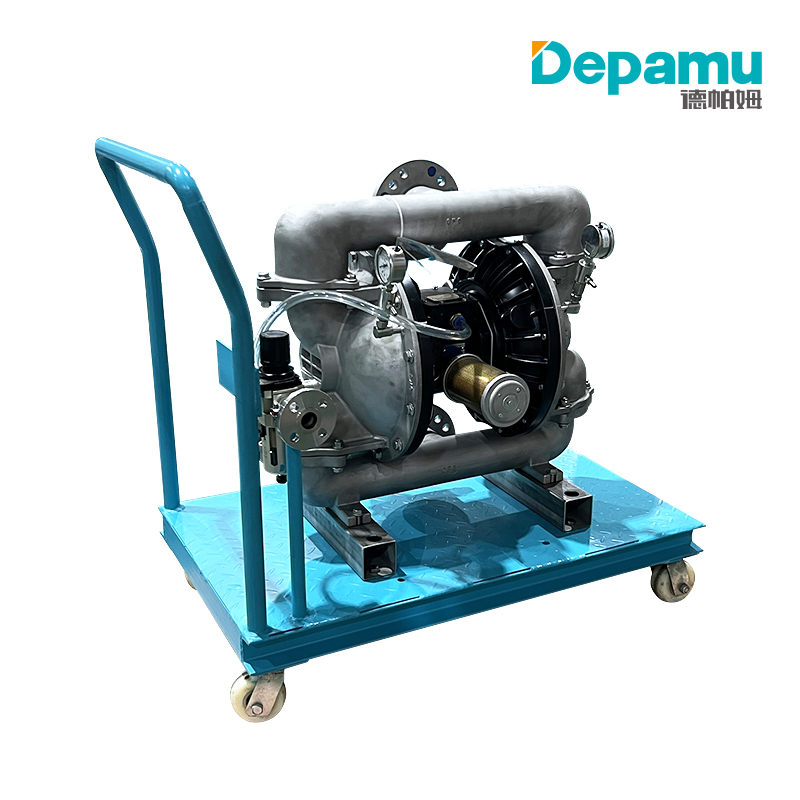
Depamu (Hangzhou) Pumps Technology Co., Ltd., headquartered in Hangzhou's Qiantang New District, has integrated American, German, and Japanese process technologies to develop a range of AODD pumps that address the demanding requirements of agricultural spraying. This article examines the technical characteristics of Depamu diaphragm air pumps, their specific advantages in boom and air blast sprayer configurations, and the engineering considerations that make them suitable for modern agricultural operations.
Understanding the Depamu AODD Pump Technology
Operating Principle
The Depamu pneumatic Diaphragm Pump operates on a principle of balanced pneumatic reciprocation. Unlike electrically driven pumps that rely on rotating impellers or crankshafts, the AODD uses compressed air as its sole power source. The system comprises two symmetrical fluid chambers, each containing a flexible diaphragm, connected by a common center block housing an air distribution valve.
The operating cycle consists of four distinct phases. During the power stroke, compressed air—typically at 2–7 kgf/cm² (30–100 psi)—is directed by the air valve to the backside of one diaphragm, pushing it outward into the fluid chamber and displacing the liquid ahead of it. Simultaneously, a connecting rod links the two diaphragms, so as one moves inward, it pulls the other outward. This creates a vacuum in the retracting chamber, drawing fluid through the inlet check valve while the opposing chamber discharges fluid through its outlet valve. When the discharge stroke completes, a pilot valve triggers the air distribution valve to shift, reversing the cycle.
This design yields several important characteristics: the pump is self-priming, can run dry without damage, and produces a smooth, pulsation-dampened flow that can eliminate 90–95% of pulsation.
Key Performance Specifications
Depamu's pneumatic diaphragm pumps for agricultural applications deliver a suction head lift of 7 meters, a head lift of 50 meters, and an outlet pressure of 6 kgf/cm². Under smooth flow conditions, the maximum allowable particle diameter is 10 mm, meaning the pump can handle slurries and suspensions with minimal wear. Head lift and flow rate can be steplessly adjusted via air valve opening, providing precise control over application rates.
The pumping media are completely separated from the working media (compressed air), ensuring no external leakage and allowing the pump to operate safely even when immersed in media. The pump can handle liquids with viscosity below 10,000 cP and requires no oil lubrication, even when idling.
For agricultural spraying specifically, these specifications translate into practical capabilities: the 6 kgf/cm² (approximately 85 psi) outlet pressure is sufficient for most boom sprayer nozzle configurations, while the self-priming capability simplifies tank filling and system priming.
Application in Agricultural Boom Sprayers
Role of the Pump in Boom Sprayer Systems
Boom sprayers are the workhorse of broad-acre crop protection, applying herbicides, fungicides, insecticides, and liquid fertilizers across wide swaths with uniform coverage. The pump's primary functions are to draw chemical from the tank, pressurize the system, and deliver a consistent flow rate to the boom section valves and nozzles. Diaphragm pumps are particularly valued in this context because they provide lower flow rates but can achieve much higher pressures compared to centrifugal pumps—a 113.9 L/min diaphragm pump, for example, can generate 290 psi (20 bar) of pressure.
This pressure capability is critical for boom sprayers equipped with high-pressure nozzles, particularly for applications requiring fine droplet spectra for improved coverage or for use with certain drift-reduction technologies that depend on specific pressure ranges.
Advantages of Depamu Diaphragm Pumps for Boom Sprayers
Chemical Compatibility. Boom sprayers handle a diverse range of agrochemicals, from acidic herbicides to alkaline fungicides, many of which are corrosive to standard pump materials. Depamu AODD pumps are available with wetted components in stainless steel, carbon steel, PVC, and PTFE-lined configurations, with diaphragm materials including PTFE + rubber (double layer), nitrile rubber, butyl rubber, fluorine rubber, EPDM, and neoprene. This material flexibility ensures compatibility with virtually any agricultural chemical formulation.
Dry-Run Capability. Unlike centrifugal pumps, which can be damaged by dry running, diaphragm pumps are inherently tolerant of dry operation. This is particularly valuable in boom sprayer applications where operators may inadvertently run the tank dry or where priming the system after maintenance would otherwise require careful attention to avoid pump damage. Depamu pumps can operate without oil lubrication and are unaffected by idling.
Self-Priming. The suction head lift of 7 meters eliminates the need for irrigation or water diversion in most boom sprayer tank configurations. The pump can draw chemical directly from the tank without the need for a separate priming circuit, simplifying system design and reducing the number of components that could fail in the field.
Stepless Flow Control. Precise application rates are essential for effective crop protection and regulatory compliance. Depamu pumps allow head lift and flow to be steplessly adjusted via air valve opening, giving operators fine control over application volume without the need for complex electronic control systems.
Handling of Suspensions and Wettable Powders. Many agricultural formulations, particularly wettable powders and suspension concentrates, contain solid particles that can settle or cause wear in other pump types. The Depamu AODD design tolerates particles up to 10 mm in diameter and experiences minimal wear from slurry or sundry pumping, making it well-suited for these challenging formulations.
Application in Air Blast Sprayers
Distinctive Requirements of Air Blast Spraying
Air blast sprayers, also known as orchard sprayers or mist blowers, use a high-volume air stream to carry spray droplets into the canopy of trees and vines. Unlike boom sprayers, which rely primarily on hydraulic pressure to atomize and deliver spray, air blast sprayers depend on the combination of hydraulic nozzles and a powerful fan to create a directed air-liquid stream that penetrates dense foliage.
The pump requirements for air blast sprayers differ from boom sprayers in several respects. Higher pressures are typically needed to achieve adequate atomization with the nozzles used in these systems, and the pump must deliver consistent flow to multiple nozzle clusters positioned around the air outlet. Diaphragm pumps are commonly used in air blast sprayers precisely because they can deliver the higher pressures required for effective canopy penetration. As noted in technical literature, high-pressure diaphragm pumps are suitable for hydraulic and air blast sprayers, with pressure ratings in the 5–40 bar range and flow rates of 20–700 L/min.
Depamu Pump Suitability for Air Blast Applications
High-Pressure Capability. Depamu's AODD pumps can generate outlet pressures of 6 kgf/cm² (approximately 85 psi or 5.9 bar), which meets the pressure requirements of most air blast sprayer nozzle configurations. For applications requiring higher pressures, Depamu also manufactures hydraulic diaphragm Metering Pumps with discharge pressures reaching up to 72.2 MPa, though these are typically used in more specialized agricultural applications such as precision fertilizer injection.
Viscous Formulation Handling. Air blast sprayers are frequently used to apply horticultural oils, emulsifiable concentrates, and other formulations that can have elevated viscosity. The Depamu pump's ability to handle liquids with viscosity below 10,000 cP ensures reliable delivery of these products without the performance degradation that would occur with centrifugal pumps.
Pulsation Dampening. The Depamu AODD design incorporates pulse-absorbing features that smooth 90–95% of flow pulsation, producing a steady spray pattern that is essential for uniform canopy coverage. This is particularly important in air blast applications, where inconsistent flow can lead to streaking and uneven deposition on foliage.
Compact and Lightweight. Depamu's pneumatic diaphragm pumps are relatively compact and lightweight compared to equivalent piston or plunger pumps, making them easier to mount on air blast sprayer frames and reducing the overall weight of the implement—an important consideration for tractor-mounted and trailed sprayers.
Comparative Advantages Over Alternative Pump Technologies
Diaphragm vs. Centrifugal Pumps
Centrifugal pumps are widely used in agricultural spraying for their simplicity and high flow rates. However, they are inherently low-pressure devices, with maximum pressures typically reaching only about 95 psi (6.6 bar). They are also sensitive to changes in system back-pressure, meaning that opening or closing boom sections can significantly affect flow rates and application volumes. Diaphragm pumps, by contrast, are positive displacement devices that maintain consistent flow regardless of pressure variations, making them better suited for precision application and variable-rate spraying systems.
Diaphragm vs. Piston Pumps
Piston and plunger pumps can achieve very high pressures and are sometimes preferred for certain high-pressure spraying applications. However, they contain precision-machined components that are vulnerable to wear from abrasive particles and corrosive chemicals. Diaphragm pumps have no dynamic seals in contact with the pumped fluid, which significantly extends service life when handling aggressive agricultural chemicals. Piston pumps also require careful priming and can be damaged by dry running, whereas diaphragm pumps are inherently tolerant of these conditions.
Diaphragm vs. Roller Pumps
Roller pumps are simple and inexpensive but have limited pressure capabilities and are particularly vulnerable to damage from abrasive particles. The rollers and cam ring wear rapidly when pumping suspensions, and the pump's performance degrades as clearances increase. Diaphragm pumps, with their isolated fluid chambers and lack of sliding contact seals, offer substantially longer service life in demanding agricultural applications.
Selection Considerations for Agricultural Sprayer Applications
When specifying a Depamu diaphragm air pump for a boom or air blast sprayer, several factors should be considered to ensure optimal performance and longevity.
Flow Rate and Pressure Requirements. The pump must be sized to deliver the required flow rate at the system's operating pressure. For boom sprayers, flow rate is typically calculated from the desired application volume (L/ha), forward speed (km/h), and boom width. Air blast sprayers may have different flow requirements depending on the number and type of nozzles and the desired spray volume per tree or vine.
Chemical Compatibility. The wetted materials—diaphragm, valve balls, seats, and housing—must be compatible with all chemicals that will be sprayed. Depamu offers a range of diaphragm materials (PTFE, nitrile, Viton, EPDM) and housing materials (stainless steel, carbon steel, PVC, PTFE-lined) to accommodate different chemical classes.
Air Supply Requirements. AODD pumps require a compressed air source. The air consumption depends on the pump size and operating pressure. For tractor-mounted sprayers, the tractor's air system may be adequate for smaller pumps, but larger units may require an auxiliary compressor.
Pulsation Dampening. While Depamu's AODD design inherently smooths 90–95% of pulsation, some applications—particularly those using certain types of nozzles or flow meters—may benefit from an additional pulsation dampener to further reduce pressure fluctuations.
Mounting and Accessibility. The pump should be mounted in a location that allows easy access for maintenance and inspection. Depamu pumps can be mounted in any orientation, giving sprayer designers flexibility in system layout.