

Depamu Hydraulic Diaphragm Metering Pump for UAN Liquid Fertilizer
Introduction
Urea ammonium nitrate (UAN) solutions have become indispensable in modern agriculture, serving as one of the most widely used liquid nitrogen fertilizers worldwide. Available in concentrations of 28% to 32% nitrogen by weight, UAN offers a unique combination of fast-acting nitrate nitrogen, intermediate ammoniacal nitrogen, and slow-release urea nitrogen, providing crops with both immediate and sustained nutrition. With its high solubility, ease of handling, and compatibility with irrigation systems, UAN has transformed the way farmers deliver nitrogen to their crops.
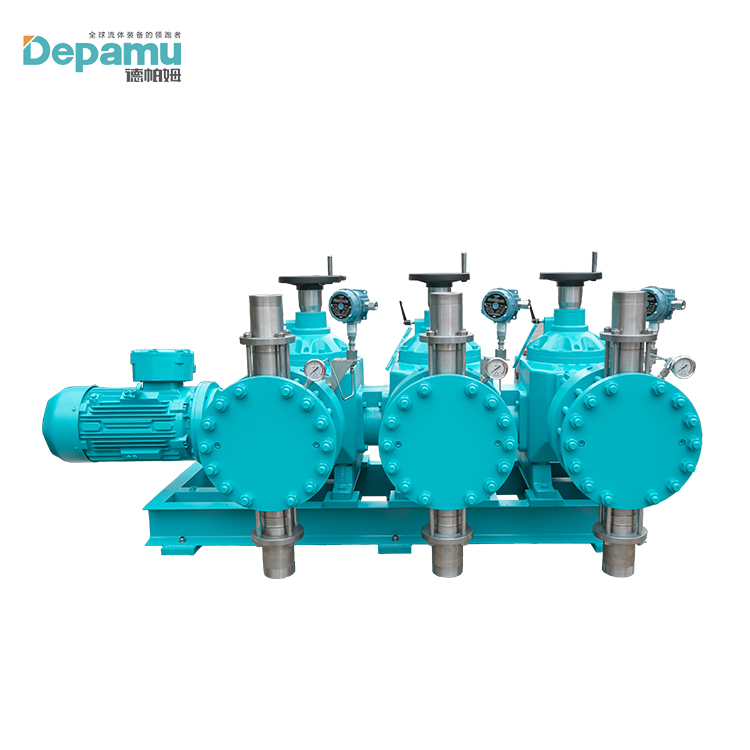
However, the very properties that make UAN an effective fertilizer — its high concentration, chemical activity, and corrosive potential — also make it demanding on the equipment used for its transportation and application. Choosing the right metering pump is critical to ensuring accurate dosing, minimizing maintenance, and achieving consistent crop nutrition. This article examines how the Depamu Hydraulic Diaphragm Metering Pump addresses the specific requirements of UAN handling in agricultural and industrial contexts.
Understanding UAN Liquid Fertilizer
UAN solutions, often designated as 28-0-0, 30-0-0, or 32-0-0, contain three forms of nitrogen: nitrate, ammonium, and urea. In a typical UAN-32 formulation, nitrate nitrogen accounts for 7.75%, ammoniacal nitrogen for 7.75%, and urea nitrogen for 16.50%. The specific gravity of UAN-32 at 68°F is approximately 1.327, and it weighs about 11.06 pounds per gallon. This dense, viscous nature means that the pump must handle a fluid that is significantly heavier than water.
A critical challenge in handling UAN is its corrosive nature. Although UAN solutions contain corrosion inhibitors that reduce the corrosion rate of carbon steel under ambient conditions, the solution remains chemically aggressive. Copper and copper-containing alloys such as brass are strictly incompatible with UAN and must never be used in storage, transfer, or application equipment. UAN-28 is approximately 20% more corrosive than UAN-32, and in general, UAN solutions require careful material selection for all wetted components.
Beyond corrosion, UAN presents several operational challenges. Its salting-out temperature — the point at which dissolved salts begin to crystallize — ranges from 32°F to 40°F depending on the exact formulation. In cold weather, this can cause crystallization that blocks pumps, valves, and nozzles. Furthermore, UAN must be dosed with exceptional accuracy because even small deviations in application rate can affect crop treatment quality, lead to over-fertilization, and contribute to environmental nitrogen runoff.
Why Hydraulic Diaphragm Metering Pumps
Metering pumps are essential components in any liquid fertilizer application system. Among the various types available, hydraulic diaphragm metering pumps stand out as the most advanced solution for challenging process conditions. These pumps use a hydraulic fluid to actuate a flexible diaphragm, which in turn displaces the process fluid. This design offers several fundamental advantages over mechanically actuated Diaphragm Pumps.
First, the hydraulically balanced diaphragm experiences uniform pressure distribution during operation, which significantly extends diaphragm life and reduces the risk of rupture. Unlike mechanically coupled designs where the diaphragm is directly pushed and pulled by a mechanical linkage, hydraulic actuation ensures that volumetric performance remains largely independent of discharge pressure variations. This means that as system pressure changes — a common occurrence in irrigation networks — the pump continues to deliver the same precise volume with each stroke.
Second, hydraulic diaphragm pumps provide superior leak protection. Because the diaphragm completely separates the hydraulic end from the process fluid, there is no path for the pumped medium to escape into the environment or contaminate the hydraulic oil. This is particularly important when handling UAN, which, while not classified as a hazardous material for transportation purposes, must still be contained to prevent environmental release and equipment damage.
Third, these pumps offer exceptional metering accuracy. By precisely controlling the hydraulic pressure that drives the diaphragm, the discharge volume can be maintained within ±0.5% of the set value across the entire flow range. This level of precision is essential for fertigation, where nutrient concentrations must be carefully controlled to avoid crop damage or nutrient waste.
Depamu Hydraulic Diaphragm Pump Technology
Depamu, a manufacturer of metering and Dosing Pumps based in Hangzhou, China, has developed a comprehensive range of hydraulic diaphragm metering pumps specifically engineered to meet the demanding requirements of fertilizer processing. The company's DP(M) series pumps incorporate several patented technologies that address the unique challenges of UAN handling.
The core mechanism of Depamu's hydraulic diaphragm pump involves a reciprocating plunger that drives hydraulic oil, which in turn moves the diaphragm through suction and discharge cycles. This indirect actuation method ensures smooth, controlled diaphragm movement without the stress concentrations that can lead to premature failure in mechanical designs.
A key innovation in Depamu's design is the integration of an internal safety valve and compensation valve that work together to achieve automatic air discharge and oil replenishment. The safety valve protects the pump from overpressure conditions by releasing hydraulic fluid when pressure exceeds the set limit, while the compensation valve automatically replenishes any hydraulic oil lost through normal operation. This self-regulating system ensures consistent performance over extended operating periods without manual intervention.
The pump's stroke can be steplessly adjusted across a range of 0% to 100% through a patented integrated sleeve adjustable eccentric transmission mechanism. This design is both simple and reliable, allowing operators to fine-tune the flow rate to match specific application requirements. The adjustment can be performed manually, electrically, pneumatically, or through variable frequency control, providing flexibility for integration with automated fertigation systems.
The DP(M)TA series, one of Depamu's prominent hydraulic diaphragm pump lines, offers flow rates ranging from 200 to over 2,300 liters per hour, with discharge pressures reaching up to 72.2 MPa depending on the plunger diameter and motor power configuration. For agricultural applications requiring lower flow rates, the DP(M)WAA series provides capacities from 1 to 45 liters per hour, making it suitable for precise injection of fertilizer concentrates into irrigation lines.
Material Selection and Corrosion Resistance
For UAN service, material selection is paramount. Depamu hydraulic diaphragm pumps can be configured with pump heads made from a range of corrosion-resistant materials, including 304 stainless steel, 316 stainless steel, 316L stainless steel, alloy 904, Hastelloy C, PVC, PVDF, PP, and PTFE. For UAN applications, 304 or 316 stainless steel is typically recommended for wetted components, as these materials have demonstrated satisfactory performance in contact with UAN solutions at typical operating temperatures.
The diaphragm itself is a critical component in any hydraulic diaphragm pump. Depamu uses a PTFE macromolecule composite diaphragm that undergoes multi-directional rolling and surface quenching treatment. This manufacturing process achieves a diaphragm evenness of 99.92%, reduces cold flow during operation, and enhances compressive strength. The diaphragm can be reused for up to 80 million cycles within a temperature range of -80°C to 160°C, providing exceptional durability even under continuous operation.
The internal safety valve features a limit valve accuracy of ±0.002mm, a surface hardness of 60-70 HRC, and a roughness of 0.4μm. These precision tolerances ensure reliable operation and long service life even when handling chemically aggressive fluids. For particularly hazardous or corrosive media, Depamu offers double-diaphragm configurations that provide an additional barrier between the process fluid and the hydraulic system.
Integration into UAN Application Systems
Depamu hydraulic diaphragm metering pumps are designed to function as integral components within complete UAN application systems. These systems typically include storage tanks, transfer pumps, flow meters, pressure regulating valves, control valves, and distribution nozzles. The metering pump serves as the precision dosing element, ensuring that the correct amount of UAN is delivered to the irrigation stream or directly to the soil.
In fertigation systems, the pump must provide uniform feed without sudden pressure and flow fluctuations. The Depamu pump's hydraulic actuation system naturally dampens pressure pulsations, providing smoother flow than mechanically actuated alternatives. This is particularly important in drip irrigation systems, where erratic dosing can lead to uneven nutrient distribution and localized crop damage.
The pump can also be integrated into automated control systems. With variable frequency drive or electrical stroke adjustment, the flow rate can be remotely controlled based on signals from flow meters, conductivity sensors, or GPS-based application rate controllers. This enables precision agriculture practices such as variable-rate nitrogen application, where fertilizer dosage is adjusted in real time based on soil conditions, crop requirements, or prescription maps.
For large-scale agricultural operations, Depamu's HD3E(M) series pumps offer flow rates from 0.76 to 10.74 m³/h at pressures up to 50.9 MPa. These pumps are specifically designed for fertilizer process applications and can be configured for horizontal or vertical installation, with power sources including electric motors, diesel engines, or solar energy systems. The compact modular structure and lightweight design facilitate installation in mobile application equipment such as tractor-mounted sprayers or self-propelled applicators.
Operational Benefits in UAN Service
The adoption of Depamu hydraulic diaphragm metering pumps for UAN application brings several operational benefits. The high metering accuracy of ±0.5% ensures that fertilizer is applied at the intended rate, reducing waste and minimizing the risk of environmental contamination from over-application. This precision directly translates to cost savings for farmers, as UAN represents a significant input expense.
The robust construction and corrosion-resistant materials extend pump service life even under continuous exposure to UAN. Unlike centrifugal pumps or less sophisticated metering pumps that may require frequent seal replacement or impeller maintenance, hydraulic diaphragm pumps have no dynamic seals in contact with the process fluid. The only wear components are the diaphragm and check valves, both of which are designed for long service intervals.
The self-priming capability of Depamu pumps allows them to draw UAN directly from storage tanks without the need for separate priming equipment. The oil-immersion lubrication system ensures reliable operation of the transmission mechanism over extended periods, reducing maintenance requirements and downtime.
For operations that require dosing multiple products — such as UAN combined with micronutrients, herbicides, or other agricultural chemicals — Depamu offers double-headed configurations that can pump two different media independently. Each pump head has its own flow adjustment, allowing for precise proportioning of multiple components. This capability is particularly valuable in "weed and feed" programs where UAN and herbicide are applied simultaneously.
Comparative Advantages
When compared to alternative metering technologies, hydraulic diaphragm pumps offer distinct advantages for UAN service. Venturi injectors, while simple and low-cost, provide limited accuracy and are sensitive to flow and pressure variations in the irrigation system. Peristaltic pumps, though capable of handling corrosive fluids, require frequent tube replacement and may not achieve the precision required for large-scale agricultural applications.
Mechanical Diaphragm Metering Pumps represent a more direct competitor to hydraulic diaphragm designs. However, mechanical pumps are more susceptible to diaphragm failure under high discharge pressures because the diaphragm is directly coupled to the mechanical drive. Hydraulic actuation distributes pressure evenly across the diaphragm surface, eliminating stress concentrations and extending diaphragm life. Additionally, Hydraulic Pumps maintain consistent volumetric output regardless of discharge pressure fluctuations, whereas mechanical pumps may exhibit reduced accuracy as system pressure changes.
Depamu's pumps are designed in accordance with API 674 standards for reciprocating positive displacement pumps, reflecting the company's commitment to international quality benchmarks. The API 675 standard, which governs controlled-volume positive displacement pumps, specifies repeatability within ±3%. Depamu's pumps exceed this requirement, achieving ±0.5% metering accuracy.
Conclusion
The efficient and accurate application of UAN liquid fertilizer demands metering equipment that can withstand chemical corrosion, deliver precise doses, and operate reliably under demanding field conditions. The Depamu hydraulic diaphragm metering pump meets these requirements through its hydraulically actuated diaphragm design, corrosion-resistant material options, and advanced control capabilities.
By maintaining metering accuracy of ±0.5% across a wide flow range, these pumps ensure that UAN is applied at the intended rate, maximizing nutrient use efficiency and minimizing environmental impact. The robust construction, including PTFE composite diaphragms rated for 80 million cycles and precision-engineered internal valves, provides the durability needed for continuous operation in agricultural environments. The flexibility to integrate with automated control systems positions Depamu pumps as a forward-compatible solution for precision agriculture.
As global agriculture continues to intensify and environmental regulations tighten, the demand for accurate, reliable, and durable fertilizer metering solutions will only grow. The Depamu hydraulic diaphragm metering pump represents a mature, well-engineered response to this demand, offering farmers and fertilizer distributors a dependable tool for the precise application of UAN and other liquid fertilizers.