

Precision in Viscosity: Depamu Metering Pump for Dosing Heavy Fuel Oil at Low Flows and Low Pressure
Abstract
The handling of Heavy Fuel Oil (HFO) presents one of the most challenging fluid conveyance scenarios in the industrial energy sector. Characterized by high viscosity, poor lubricity, and the necessity for precise temperature control, HFO requires pumping equipment that transcends standard industrial manufacturing. This article explores the specific engineering challenges of dosing HFO at low flow rates (0-500 L/h) and low pressure (0-1.2 MPa) , a niche application critical for marine engine auxiliary systems, boiler feeding, and bunkering operations. Focusing on the technological solutions provided by Depamu (Hangzhou) Pumps Technology Co., Ltd. , this paper analyzes the mechanical, hydraulic, and material science innovations that enable precision metering in this demanding context. We will examine the specific attributes of reciprocating plunger pumps and mechanical Diaphragm Pumps engineered by Depamu, comparing their performance against international standards such as API 675 and evaluating their suitability for viscous, shear-sensitive fluids.
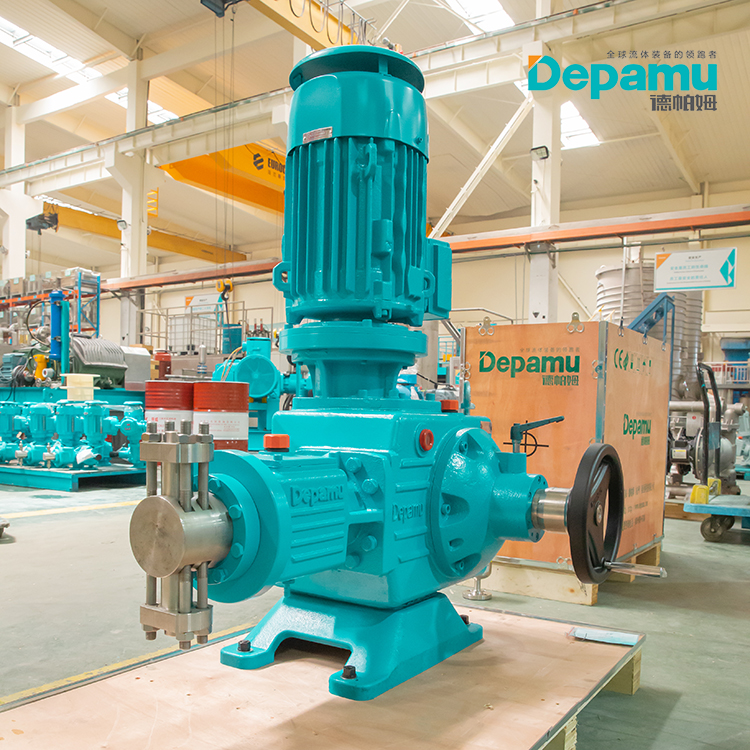
1. Introduction: The Challenge of Heavy Fuel Oil Dosing
Heavy Fuel Oil (IFO 380 or IFO 180) remains a staple energy source for the global shipping industry and power generation sector despite the push for cleaner alternatives . In many maritime and industrial applications, HFO is not merely transferred; it must be dosed. Dosing implies the precise injection of a specific volume of fuel into a system—be it an auxiliary boiler for steam generation, a slow-speed main engine during maneuvering, or an incinerator.
The difficulty lies in the physical properties of the fuel. At ambient temperatures, HFO has the consistency of tar. To become pumpable, it must be heated to approximately 50°C to 70°C for viscosity reduction. However, even at operational temperatures, the viscosity remains high, and the fluid exhibits non-Newtonian behavior.
For low flow and low pressure applications, the challenges multiply:
-
Slip and Slippage: At low flows, positive displacement pumps rely on tight clearances. High viscosity fluid often struggles to enter the pumping chamber (cavitation).
-
Pulsation: Reciprocating Pumps naturally create pulsation. At low flow rates, the "idle" time between strokes can lead to flow discontinuity unless the pump is engineered for smooth operation.
-
Viscosity Compensation: Standard centrifugal pumps fail at high viscosities. Metering pumps must maintain volumetric efficiency even when the fluid is "thick."
Depamu has positioned itself as a specialist in this arena, leveraging German engineering heritage (via technology transfer at the start of the 1990s) to produce metering pumps that adhere to API 674 and API 675 standards . This article argues that for low-flow HFO dosing, the mechanical diaphragm and plunger-type metering pumps offered by Depamu provide a superior solution to rotary pumps due to their linear flow characteristics and independence from pressure variations.
2. The Physics of Low Flow HFO: Viscosity, Pressure, and Cavitation
Before selecting a pump, one must understand the thermodynamic landscape of the application.
2.1 The Viscosity Barrier
HFO typically operates with a kinematic viscosity ranging from 30 cSt to 380 cSt at the pump inlet. Unlike water (1 cSt), HFO exhibits high internal friction. In a metering pump, the suction stroke relies on the inlet pressure (gravity head or charge pump) to push fluid past the check valve and into the cylinder.
For low flow applications, the plunger or diaphragm velocity is intentionally slow. Depamu pumps often operate at speeds as low as 10 to 650 rpm . This slow speed is advantageous for viscosity because it allows time for the heavy oil to flow into the cavity. High-speed pumps would cavitate instantly.
2.2 The "Low Pressure" Paradox
Defining "low pressure" in this context (generally 0 to 1.5 MPa or 0 to 218 PSI) is distinct from high-pressure injection (20 MPa+). Low pressure dosing is typically used for:
-
Boiler Burners: Atomizing HFO needs pressure, but low-pressure systems use rotary cup atomizers requiring only 1-2 bar.
-
Transfer between tanks: Day tank filling.
-
Additive injection (Anti-foam, Demulsifiers): Where the back pressure is minimal.
At these low pressures, the risk is not seal failure, but rather leakage. If the clearances are too large, the fluid will simply slip back to the suction side due to the pressure differential, resulting in zero net flow.
2.3 The Temperature Requirement
To achieve 0-1.5 MPa operation, HFO must be hot. Depamu’s pump heads are designed to accommodate trace heating or jacketed heads. The "insulation and cooling function" highlighted in Depamu’s Rotor Pump literature is critical here; it prevents the HFO from "freezing" (solidifying) inside the pump head when the pump is idle .
3. Depamu’s Core Architectures for Low Flow Service
Depamu does not rely on a single technology for HFO. Depending on the specific gravity and solid content of the fuel, they deploy two distinct architectures: the Plunger (Piston) pump and the Mechanical Diaphragm pump.
3.1 The Reciprocating Plunger Pump (DP(M)ZA and DP(M)WAA Series)
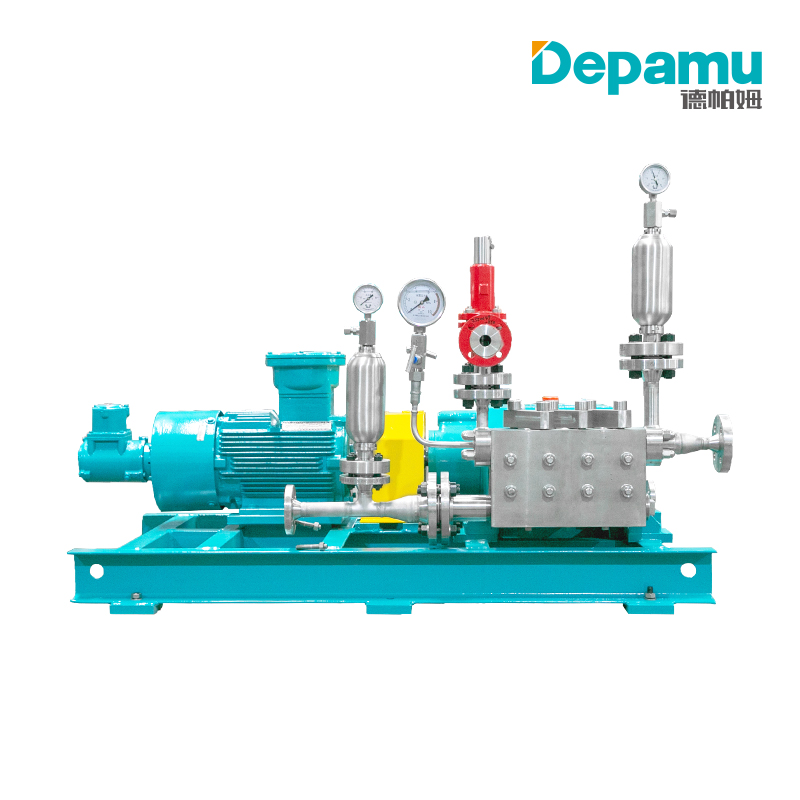
For low flow HFO, the plunger pump is the gold standard. Depamu’s DP(M)ZA series is a reciprocating metering pump where the fluid contacts a high-performance plunger .
Mechanism:
A motor drives a worm gear pair, which converts rotary motion into reciprocating motion via an eccentric mechanism. An integrated sleeve adjustable eccentric allows for 0-100% stepless flow adjustment while the pump is running .
Why it works for HFO Low Flow:
-
High Suction Capability: Plunger pumps generate a strong vacuum on the suction stroke, essential for pulling thick HFO into the chamber without cavitation.
-
Precision: Depamu claims a metering accuracy of ±0.5% in the 10%-100% adjustment range . For boiler fuel efficiency, this accuracy prevents soot formation due to excess fuel.
-
Material Compatibility: The plunger can be manufactured from hardened 316L stainless steel, polished to a mirror finish. This resists the abrasive particles (catalyst fines) found in HFO.
3.2 The Mechanical Diaphragm Pump (DPMFXWA Series)
For applications where zero leakage is paramount (environmental safety), Depamu offers the DPMFXWA series. In this design, the mechanical diaphragm (PTFE) separates the hydraulic oil from the process fluid .
Performance in HFO Service:
-
Maximum Flow: 450 L/h
-
Maximum Pressure: 1.2 MPa (Ideal for this specific low-pressure niche) .
-
Turndown Ratio: 10:1.
-
Temperature Limit: PTFE diaphragms allow up to 80°C, which is the operational sweet spot for HFO.
Advantage: The diaphragm acts as a barrier. If you are dosing HFO in a sensitive environment (e.g., a river barge or food-adjacent facility), a leaking plunger seal would be a disaster. The diaphragm pump offers "hermetic" sealing, ensuring the HFO stays in the pipe.
4. Technical Deep Dive: The Metering Mechanisms
To understand why these pumps succeed where others fail, we must look at the three subsystems: the Drive End, the Hydraulic End, and the Check Valves.
4.1 The Drive End: Worm Gear and Eccentric
Depamu utilizes an integrated worm gear pair. This is not merely a transmission; it is a noise reduction and stability feature. The worm gear drive ensures that the slide rod moves linearly with zero rotational slip.
-
Lubrication: Oil-immersed bath lubrication ensures that the heavy cyclic loads of pumping HFO do not cause premature wear on the gears.
-
Stability: Because HFO is compressible (to a degree), the drive mechanism must have high mechanical stiffness. The double support structure found in Depamu’s rotor pumps is adapted in their metering pumps to support the eccentric mechanism, preventing shaft deflection that would alter the stroke length .
4.2 The Hydraulic End: Managing the "Thick" Fluid
In low-flow metering, the fluid velocity is low. This poses a risk of "stiction" in the check valves.
-
Self-Cleaning Valves: Depamu advertises "check valves in a self-cleaning structure" . For HFO, which leaves a sticky residue, gravity-closing balls often stick to the seat. Depamu’s design likely incorporates spring-assisted or guided ball valves that use the viscous fluid’s own movement to wipe the seat clean on every stroke.
-
Material Selection: For wetted parts, Depamu offers 304, 316, 316L, and PTFE . For aggressive, high-sulfur HFO, Duplex stainless steel is often recommended to prevent chloride stress corrosion cracking, though the base 316L is standard for standard grades.
4.3 Viscosity Correction and NPSHr
A critical specification for low-flow HFO pumps is the Net Positive Suction Head Required (NPSHr) . Depamu claims a suction lift capability of up to 9 meters for their rotor pumps . However, for reciprocating metering pumps, the lift is lower due to the reciprocating inertia.
For HFO, relying on "lift" is dangerous. The industry best practice—and Depamu’s implicit engineering assumption—is that the pump is flooded suction. This means the supply tank is located above the pump, providing positive pressure to push the viscous fluid into the cylinder.
5. Comparative Analysis: Depamu vs. The Market
To contextualize Depamu’s offering, it is useful to compare their low-pressure, low-flow HFO capability against other market leaders and alternative technologies.
5.1 Depamu vs. Competitors (Neptune / ProMinent / NOV)
Analysis:
For low flow and low pressure, the traditional hydraulic diaphragm pumps (Neptune/ProMinent) are over-engineered. They are designed for 3,000 PSI. Running them at 15 PSI can lead to check valve chatter and inaccurate metering due to insufficient back pressure.
Depamu’s mechanical plunger pump is actually superior in this specific window because it relies on mechanical movement rather than hydraulic balancing. It does not require high back pressure to reseat the diaphragm .
5.2 Alternative Tech: Rotor vs. Reciprocating
Depamu also manufactures Rotor pumps (circumferential piston) . Why choose a reciprocating metering pump over a rotor pump for HFO?
-
Rotor Pump: Excellent for high flow, high viscosity (2 million CP), and gentle handling. However, flow rate is a function of speed. Without complex feedback loops, low-flow accuracy is poor because rotor pumps slip (internal recirculation) at low speeds.
-
Reciprocating Metering Pump: Positive displacement with fixed volumetric efficiency per stroke. Even at 1 L/h, it delivers exactly 1 L/h against varying back pressure (within design limits). Conclusion: For dosing, reciprocating is mandatory. For transfer, a rotor pump is better.
6. Operational Best Practices for Depamu HFO Dosing
To achieve the advertised performance of ±0.5% accuracy and long lifespan, operators must adhere to specific procedures when dosing HFO with Depamu pumps.