

Depamu API 675-Compliant Anti-Foam Injection Packages for Oilfield and Refining Service: Engineered for the Russian Operating Environment
Foam is not a peripheral nuisance in oil and gas operations; it is a direct threat to throughput, equipment integrity, and safety. In gathering systems, foam blinds separator level instrumentation and carries liquids into gas lines. In refineries, foam in crude distillation, vacuum towers, and delayed cokers drags heavy fractions into overhead products, fouls downstream units, and forces throughput cuts. In Russia—among the world’s top crude producers and the second-largest natural gas producer—foam control is further complicated by operating temperatures that routinely fall below −40 °C in West Siberia and reach −52 °C in Arctic and Yamal projects. Depamu, a Hangzhou-based manufacturer of Metering Pumps and fluid injection systems, has developed a line of anti-foam injection packages that combines API 675–compliant metering technology with cold-climate engineering specifically aimed at Russian oilfields and refineries. The packages are integrated, skid-mounted, and configured for the precision, reliability, and regulatory realities of the Russian market.
The Foam Problem and the Precision Imperative
Foam stabilization in hydrocarbon service is driven by surface-active species—naphthenic acids, asphaltenes, and added surfactants—adsorbing at the gas–liquid interface. Silicone-based antifoams, particularly polydimethylsiloxane (PDMS) formulations, dominate oilfield and refining applications because of their low surface tension and thermal stability. But the chemistry alone does not solve the problem. Over-dosing wastes expensive antifoam, can contaminate process streams, and in some cases generates secondary foaming or fouling; under-dosing leaves separators and towers exposed to carryover and capacity loss. Effective foam control therefore depends as much on injection precision as on formulation. Depamu’s packages are specified to deliver metering accuracy of ±0.5% or better, tightening the tolerance beyond the ±1% steady-state accuracy floor established by API Standard 675 for controlled-volume positive displacement pumps. In Russian fields where water cuts and gas–oil ratios shift continuously over the production life cycle, that margin of precision translates directly into chemical cost savings and stable separator performance.
Technical Architecture of the Depamu Anti-Foam Injection Package
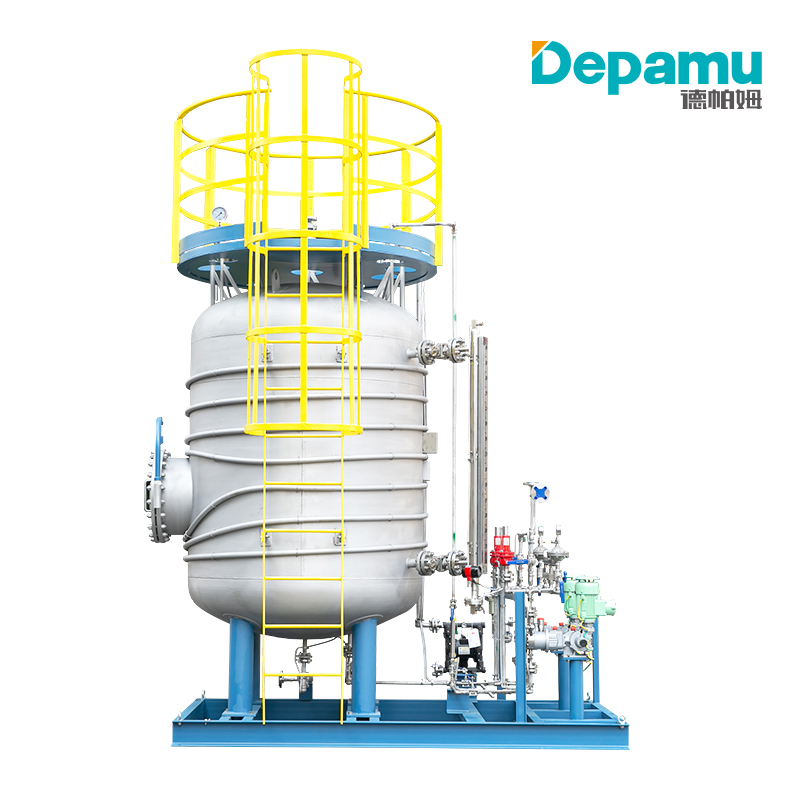
Depamu’s anti-foam packages are factory-assembled skids that integrate the solution tank, metering pump(s), level gauges, safety valves, pulsation dampeners, piping, valves, and electrical control cabinet on a single structural base. Standard configurations include one tank with two pumps (1T+2P), two tanks with three pumps (2T+3P), and two tanks with four pumps (2T+4P). Solution tank volumes span 0.5 m³ to 20 m³. Metering pump capacities range from 10 L/h to 1,500 L/h, with discharge pressures from 0.3 MPa to 4.0 MPa for typical oilfield and refining service; Hydraulic Diaphragm Metering Pumps extend discharge pressure to 32 MPa and beyond for high-pressure wellhead or hydrate-inhibitor duty. The hydraulic diaphragm design is particularly relevant for anti-foam service because it eliminates process-fluid leakage to the environment—a critical advantage when injecting into high-pressure hydrocarbon streams. Wetted parts can be specified in 316 or 304 stainless steel, carbon steel with rubber or plastic lining, FRP, PE, or PVC, and diaphragms in PTFE or other chemically resistant elastomers, allowing the package to be matched to the corrosivity of the specific antifoam formulation and process stream.
At the control level, Depamu’s intelligent packages incorporate online instrument feedback and closed-loop control that adjusts injection rate in proportion to process flow, holding the target ppm concentration as production rates fluctuate. This automated proportionality control is especially valuable in mature Russian fields, where manual adjustment of antifoam injection cannot keep pace with changing water cuts and gas volumes.
API 675 Compliance: What It Means for the Package
API Standard 675 governs controlled-volume positive displacement pumps for petroleum, petrochemical, and gas industry service. Its performance requirements include steady-state accuracy, linearity, and repeatability, with steady-state accuracy typically specified at ±1% and repeatability at ±3%. Depamu’s API 675–compliant metering pumps form the heart of the anti-foam skid, and the company’s DPJY-series Chemical Injection Packages are manufactured to API 675 and have additionally passed DNV and ISO 9001 certification. For Russian operators, API 675 compliance provides an internationally recognized baseline for hydraulic performance and mechanical integrity that is independent of the GOST framework. It signals that the pump’s flow characteristics, pulsation control, and materials of construction have been designed to a petroleum-industry standard rather than a general industrial dosing norm. In a market where the import of Western equipment has been disrupted and operators are reassessing suppliers, the combination of API 675 pump compliance with a fully integrated skid package gives Russian project teams a technically defensible specification anchor.
Engineering for Russian Conditions: Cold Climate and Regulatory Fit
Russia’s oil and gas provinces are not a single operating environment. West Siberian fields dominate national oil output and see routine winter temperatures below −40 °C; Arctic offshore and Yamal Peninsula projects face −52 °C ambient conditions; Volga–Ural and Black Sea refining complexes operate in more moderate but still demanding industrial settings. Depamu’s Russian-market injection packages can be specified with low-temperature steel and heating jackets for solution tanks and piping, ensuring that antifoam agents remain pumpable and injectable through winter conditions. The metering pumps are designed for liquids from −60 °C to +200 °C, and heating jackets on valve and hydraulic block components extend the upper limit to +400 °C for high-temperature refinery streams. This temperature envelope covers the full range from cold-climate wellsite injection to hot refinery process streams.
Depamu’s cold-climate credentials are not theoretical. The company supplied high-pressure process Diaphragm Pumps and hydraulic diaphragm metering pumps for the Arctic LNG 2 project on the Gydan Peninsula, equipment selected to replace pumps previously supplied by American vendors for Arctic LNG 1. That reference demonstrates that Depamu has already met the documentation, testing, and reliability expectations of a flagship Russian Arctic energy project—a relevant qualification for anti-foam packages destined for similarly demanding field locations.
Regulatory compliance is equally important. Russian oilfield facility design is governed by GOST R 58367-2019, which explicitly requires chemical dosing units for introducing reagents—including anti-foam agents—into pipeline systems for oil, gas, and water treatment. Mechanical safety for oilfield equipment falls under TR CU 010/2011, and equipment intended for explosive atmospheres must additionally satisfy TR CU 012/2011. Depamu’s injection packages are designed as integrated, automated dosing units that align with the GOST R 58367-2019 mandate, and the company’s broader Russian market presence—including a Moscow representative office, distribution relationships with Russian industrial partners, and participation in the NEFTEGAZ exhibition—supports localization of technical support and after-sales service.
Application Points Across Oilfield and Refining Service
Anti-foam injection is not a single-point function; it is deployed at multiple locations in the production and refining chain, and each location imposes different pressure, temperature, and control requirements. On the oilfield side, Depamu packages are applied at the wellhead to prevent foam formation in flowlines, at the inlet of three-phase separators to protect separation efficiency, and in gas gathering systems to prevent foam carryover into compression and dehydration units. In refining, anti-foam injection is employed in crude distillation units, vacuum distillation towers, delayed cokers, and fluid catalytic cracking units. The same skid platform can be configured for each service point, with materials of construction, pump specifications, and control algorithms tailored to the specific fluid properties and operating parameters at that location.
The anti-foam package also shares a common engineering platform with Depamu’s demulsifier, corrosion inhibitor, scale inhibitor, methanol, and hydrate inhibitor injection packages. For Russian operators developing a field or refinery complex, this standardization means a single supplier can provide the full chemical injection scope with compatible control systems and consolidated spare parts inventories—a practical advantage where logistics to remote field locations are already complex.
Lifecycle Value and Market Positioning
The Russian antifoam agents market was valued at approximately USD 174.6 million in 2024 and is projected to reach USD 197.1 million by 2030, with oil and gas as the primary demand driver. Equipment suppliers seeking to serve this market must offer more than a pump; they must provide a package that can be commissioned quickly, maintained in remote locations, and supported through a localized service network. Depamu’s skid-mounted, factory-pre-commissioned configuration reduces on-site construction time and assembly-error risk. The metering pumps are engineered for long service intervals, and components are modular for rapid replacement. In a service environment where a failed antifoam pump can quickly translate into separator upsets or refinery throughput loss, that maintainability is as important as the pump’s API 675 performance certificate.
Conclusion
Depamu’s anti-foam injection packages address the Russian oilfield and refining market at the intersection of precision metering, cold-climate engineering, and regulatory alignment. The API 675–compliant metering pump core delivers the ±0.5%-or-better accuracy that antifoam chemistry demands; the integrated skid architecture and closed-loop control provide repeatable injection across changing process conditions; and the low-temperature steel, heating jackets, and Arctic LNG 2 reference demonstrate that the equipment is engineered for the temperatures Russian operators actually face. With GOST R 58367-2019 explicitly requiring chemical dosing infrastructure and TR CU 010/2011 governing mechanical safety, the package is not merely adaptable to the Russian market—it is configured for it. For operators seeking to maintain foam control reliability while reducing dependence on Western supply chains, Depamu offers a technically mature and locally supported alternative.