

Depamu Chemical Dosing Package vs. Woodfield: A Comparative Analysis
Introduction
The selection of a chemical dosing package is rarely a simple procurement decision. In water treatment, oil and gas production, and industrial process control, the dosing skid is the final barrier between a carefully designed chemical treatment programme and the actual condition of the process fluid. A package that drifts from its setpoint, corrodes prematurely, or cannot be integrated into a plant’s distributed control system (DCS) imposes costs that far exceed its purchase price.
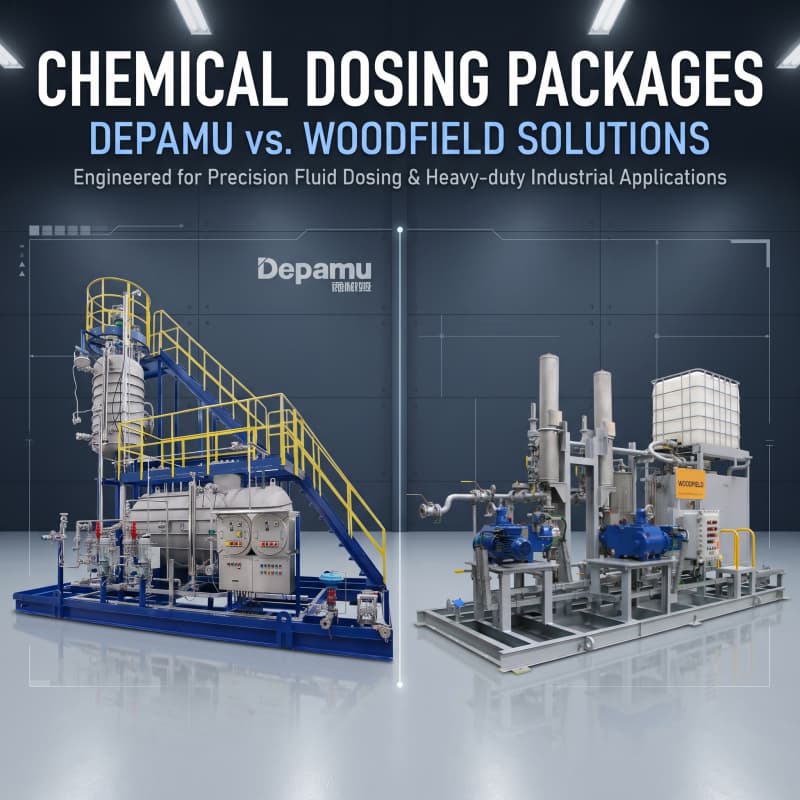
Depamu (Hangzhou) Pumps Technology and Woodfield Systems International represent two distinct approaches to this problem. Depamu is a Chinese “little giant” that has built its reputation on deep metering-pump engineering and highly automated, application-specific Injection Packages. Woodfield is an older, more diversified fluid-handling integrator whose dosing skids sit within a broader portfolio of loading arms, metering skids, and custody-transfer systems. Comparing them is not a matter of declaring one universally superior; it is a question of matching engineering philosophy and supply-chain reality to a specific project’s risk profile.
Company Lineage and Engineering DNA
Depamu was founded in 2003 in Hangzhou’s Qiantang Area, but its technical lineage reaches back to the early 1990s, when it introduced German metering-pump and dosing technologies into the Chinese market. Over two decades it has evolved into a national-level high-tech enterprise recognised as a “Little Giant” for specialised, sophisticated manufacturing, holding more than 100 technical patents. Its product portfolio is pump-centric: plunger, mechanical-diaphragm, and hydraulic-diaphragm Metering Pumps; high-pressure Reciprocating Pumps; screw and Rotor Pumps; and complete dosing packages built around these core components. This vertical focus means Depamu’s dosing skids are designed by engineers who began with the pump, not with the skid frame.
Woodfield Systems International carries a different lineage. Its UK-origin business has accumulated over 95 years of fluid-handling experience, and its Indian and North American operations serve oil and gas, aviation fuel, LPG, LNG, and chemical markets. Woodfield’s dosing skids are one offering within a much broader “skid solutions” portfolio that includes tanker-truck loading and unloading, blending, custody-transfer metering, and LNG truck loading. The company’s engineering culture is therefore shaped by large-scale hydrocarbon transfer and custody metering, where API and OIML compliance, safety instrumented functions, and terminal automation are routine requirements. Its dosing packages inherit that systems-integration mindset.
Package Architecture and Scope
Depamu’s DPJY-series injection packages are factory-assembled, skid-mounted units that integrate chemical dissolution, preparation, metering, and injection into a single compact structure. A typical configuration includes a solution tank, one or more metering pumps, a pulsation damper, safety valve, piping and valve network, level instrumentation, and an electrical control cabinet. Tank volumes for boiler-water applications range from 0.5 to 2.5 m³, while oil-and-gas packages can be specified with tanks from 0.5 to 20 m³. Standard combinations include “1 tank + 2 pumps,” “2 tanks + 3 pumps,” and “2 tanks + 4 pumps,” with footprints from approximately 1,800 × 1,900 × 2,500 mm to 3,000 × 1,900 × 2,500 mm and weights from 1,600 to 4,200 kg.
Woodfield’s chemical dosing and injection skids share the skid-mounted, factory-tested logic but differ in emphasis. They are described as low-flow skids kept close to the injection point, with chemical storage tanks mounted on the skid and a positive-displacement pump conforming to API 675 feeding the process line. Dosing capacities span 2 LPH to 2,000 LPH, and skid sizes range from 1/2″ to 2″ in 150#, 300#, and 600# ratings. The package includes a local control panel, pump protection device with associated interlocks, and optional in-tank mixing with a motorised agitator. Notably, Woodfield positions its dosing skids as “plug and play” units that are pre-wired and flow-tested before shipping, with in-house fabrication, assembly, system integration, and test installation on a single frame.
Pumping Technology and Hydraulic Performance
The most consequential difference lies in the pump envelope. Depamu’s dosing packages are built around a metering-pump range that is unusually wide for a package supplier. Its plunger-type DP(M)ZA and DPWA series can deliver single-pump-head flows up to 12,100 L/h at pressures up to 228 MPa, with pump-head materials including 304, 316, 316L, 904L, Hastelloy C, and high-polymer options. For boiler-water packages, flow capacities of 20–70 L/h are typical, with discharge pressures from 0.5 to 2.5 MPa for ammonia, hydrazine, and acetoxime injection, and 5 to 32 MPa for phosphate injection. This pressure capability is significant: phosphate dosing into high-pressure boiler systems is a duty that many general-purpose dosing skids cannot address without a specialised pump.
Woodfield’s dosing skids rely on API 675 positive-displacement pumps, with capacity varied by manual or automatic stroke adjustment. The published dosing range is 2–2,000 LPH, which covers a broad band of low-to-moderate flow water-treatment and process-chemical duties. Woodfield does not emphasise extreme-pressure dosing in its chemical-dosing literature; its engineering depth is expressed instead in the integration of metering technologies—mass-flow Coriolis, positive-displacement, turbine, ultrasonic, and magnetic—into larger metering and blending skids. For a project requiring 30 MPa phosphate injection, Depamu’s package is the more natural fit; for a 200 LPH corrosion-inhibitor skid tied into a custody-metered hydrocarbon line, Woodfield’s broader flow-handling context may be more relevant.
Control Philosophy and Dosing Accuracy
Depamu’s control architecture is explicitly built for closed-loop chemical dosing. The system can receive real-time process parameters through online instruments, automatically regulate the ratio between chemical injection volume and process-medium flow (the ppm value), and receive feedback on the actual effect after injection. This intelligent online closed-loop control achieves accuracy better than ±1%, and with a high-precision flow recorder or weightless flow-control system, accuracy can reach ±0.5% to 0.2%. In automatic mode, a PLC or the plant DCS processes flow, pH, conductivity, dissolved-oxygen, and turbidity signals, computes the required chemical flow rate, and adjusts pump speed via a variable-frequency drive with a standard 4–20 mA signal. Pump flow adjustment range is 0–100%, and all status and fault signals can be transmitted to the DCS or host computer for remote start/stop. The package supports local manual, semi-automatic, and fully automatic control, and tanks can be specified in 304/316 stainless steel, carbon steel with lining, FRP, PE, or PVC depending on corrosion duty.
Woodfield’s dosing control is competent but framed differently. The skid includes a local control panel for pump operation, and pump calibration can be performed locally or remotely via DCS. Stroke adjustment is available manually or automatically. Pump protection and associated interlocks are standard, reflecting a safety-first hydrocarbon-handling heritage. However, Woodfield’s published dosing literature does not claim a specific closed-loop ppm accuracy figure, nor does it describe sensor-driven, process-feedback modulation of the pump in the same detail as Depamu. The Woodfield dosing skid is designed to deliver a pre-set chemical quantity proportionally to the process line; Depamu’s package is designed to hunt continuously for the chemically optimal injection rate based on live process chemistry.
Application Focus and Industry Fit
Depamu’s dosing packages are organised explicitly around chemical function and process stage. In boiler-water treatment, the line includes dedicated hydrazine packages for oxygen scavenging, ammonia packages for pH adjustment to the 8.5–9.5 range, and phosphate packages for scale control at 5–32 MPa. In oil and gas, the DPJY series covers demulsifier, corrosion-inhibitor, oxygen-scavenger, reverse-demulsifier, biocide, and methanol/ethylene-glycol injection packages, as well as water-injection and polymer-injection systems. In petrochemical refining, it extends to scale inhibitor, desulfuriser, antioxidant, antistatic, anti-wear, polymerisation-inhibitor, and catalyst injection packages. Beyond oil and gas, Depamu lists applications in circulating water, raw-water pre-treatment, wastewater treatment, sewage treatment, nuclear power, pharmacy, and food processing. The company has supplied packages for demanding environments including the Yamal LNG project, and it maintains strategic partnerships with CNPC, Sinopec, and CNOOC while exporting to more than 50 countries.
Woodfield’s dosing skids are applied in water treatment, oil and gas, chemicals, and energy and power, but they are most distinctive when viewed as one module within Woodfield’s larger fluid-handling ecosystem. A customer specifying a Woodfield dosing skid may also be purchasing truck-loading arms, metering skids, blending systems, or custody-transfer packages from the same supplier. Woodfield’s 2024 profile describes its establishment in India in 2000 as a joint venture to produce truck-loading equipment for petrol, diesel, kerosene, Jet A1, LPG, LNG, and hazardous chemicals. Its dosing skids therefore appeal most strongly to EPC contractors and terminal operators who value a single supplier capable of integrating chemical injection with loading, metering, and terminal automation.
Certifications, Market Access, and Supply Chain
Depamu holds API, DNV, ISO 9001, ISO 14001, OHSAS 18001/ISO 45001, and CE certifications, and its products adhere to API 674 and API 675 standards. Its manufacturing base in Hangzhou gives it cost advantages in Asian and Belt-and-Road markets, and its export footprint spans the United States, United Kingdom, France, Russia, Brazil, Germany, Australia, Iran, Turkmenistan, and Syria. For projects with Chinese EPC contractors or financing, Depamu’s commercial and logistical alignment can be decisive.
Woodfield holds ISO 9001, ISO 14001, ISO 45001, ASME B31.3, EN ISO 3834-2, and PED 2014/68/EU certifications, and its fabrication is certified for pressure equipment and steel structures. Its manufacturing and sales footprint includes the United States, United Kingdom, India, and Mexico, with a 95-year heritage in fluid handling. For Western-owner projects requiring PED marking, ASME piping compliance, and a supplier already embedded in the terminal-automation supply chain, Woodfield offers a lower qualification burden.
Comparative Assessment and Selection Guidance
The two suppliers are not mirror images, and the choice between them should be driven by four project variables.
First, dosing pressure and chemical duty. If the package must inject phosphate at 32 MPa, hydrazine at high purity with tight residual control, or a catalyst at extreme pressure, Depamu’s pump range and application-specific package configurations give it a clear technical advantage. If the duty is a low-to-moderate-pressure, 2–2,000 LPH injection into a hydrocarbon or water line, Woodfield’s API 675 pump skid is fully adequate and brings broader skid-integration experience.
Second, automation ambition. Projects that expect the dosing package to perform sensor-driven, closed-loop ppm control with ±0.5% accuracy and full DCS transparency will find Depamu’s control philosophy more closely aligned with that requirement. Projects that need reliable proportional dosing with local control, DCS calibration, and pump protection interlocks will find Woodfield’s offering sufficient and well-proven in hazardous-area terminals.
Third, supplier scope. If the dosing package is a stand-alone chemical-injection island, Depamu’s depth is valuable. If the package must interface mechanically, electrically, and commercially with loading arms, metering skids, and terminal automation, Woodfield’s single-supplier ecosystem can reduce interface risk and commissioning friction.
Fourth, certification and commercial geography. PED/ASME-driven European or American projects may favour Woodfield’s certification profile and Western reference base. Projects aligned with Chinese EPCs, Belt-and-Road financing, or Asian supply chains may find Depamu’s cost structure, delivery times, and technical responsiveness more attractive.
Conclusion
Depamu and Woodfield both manufacture competent, skid-mounted chemical dosing packages, but they optimise for different risks. Depamu optimises for chemical-delivery precision and process-condition responsiveness, with a pump engineering depth that extends to extreme pressures and a control architecture built for closed-loop dosing accuracy. Woodfield optimises for fluid-handling integration and hazardous-area safety, with API 675 pumping, robust pump protection, and a supply-chain position embedded in terminal and custody-transfer projects. A technically sound selection process will not ask which brand is “better” in the abstract, but which supplier’s centre of engineering gravity matches the project’s dominant failure mode: a chemical that is dosed inaccurately, or a package that does not fit safely and commercially into the wider fluid-handling system.