

Depamu High-Pressure Process Diaphragm Pump vs. LEWA ecoflow: A Comparative Analysis
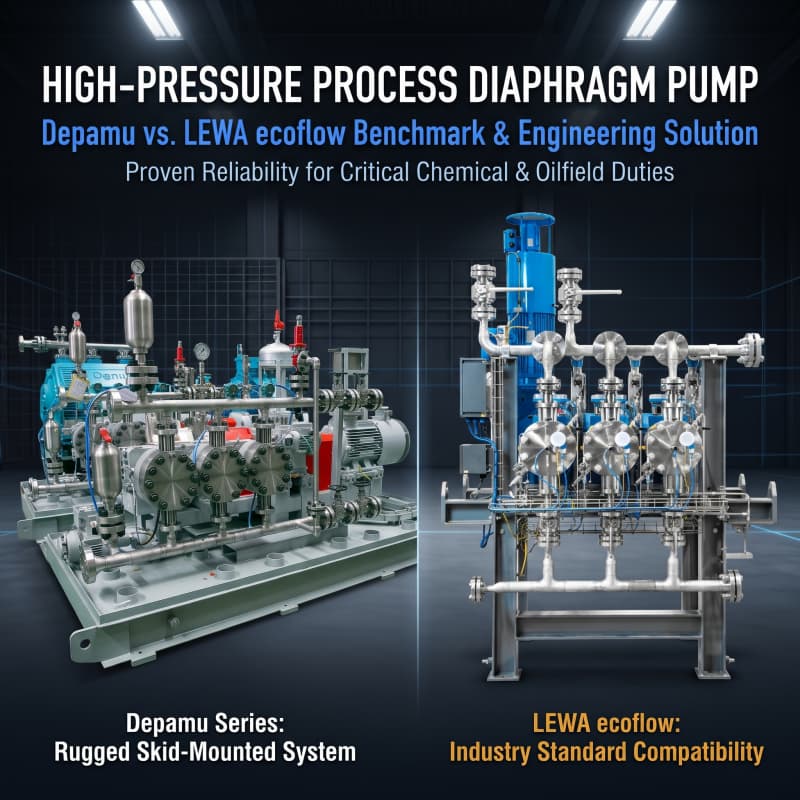
High-pressure process diaphragm pumps occupy a specialized niche in industrial fluid handling. They are called upon when a process demands the containment of aggressive, toxic, or high-purity media at pressures that would destroy conventional sealing arrangements. Within this niche, two names appear with regularity in engineering specifications: Depamu and LEWA. The comparison between Depamu’s high-pressure process diaphragm range and the LEWA ecoflow series is not a contest between a “better” and a “worse” pump. It is a comparison between two distinct engineering philosophies, each optimized for a different center of gravity in the high-pressure landscape.
Technical Architecture: Hydraulic Actuation as the Common Ground
Both pump families are hydraulically actuated diaphragm pumps. A plunger reciprocates in hydraulic oil, and that oil pressure is transmitted across a diaphragm to the process fluid. This architecture is what separates them from mechanically driven diaphragm pumps, where the diaphragm is pushed directly by a mechanical linkage. Hydraulic actuation enables higher pressures and more uniform diaphragm loading.
Depamu’s approach integrates a multi-valve hydraulic compensation system at the hydraulic end. A limit valve, exhaust valve, and internal relief valve work in coordination to maintain stable oil volume, automatically discharging accumulated air and replenishing oil lost during normal operation. The precision of these components is notable: the limit valve achieves an accuracy of ±0.002 mm, with surface hardness of 60–70 HRC. This design philosophy prioritizes robustness and self-correction within the hydraulic circuit, allowing the pump to sustain high pressures over long service intervals in demanding chemical and petrochemical environments.
LEWA’s ecoflow architecture centers on what the company calls the Diaphragm Protection System (DPS). The DPS is not merely a monitoring add-on; it is a hydraulically integrated control scheme that stabilizes diaphragm movement through overpressure in the hydraulic fluid. A spring holds the diaphragm in a neutral position during shutdown, preventing damage from incorrect positioning at startup. The system uses a patented sandwich diaphragm—typically PTFE with a condition monitor—and reports damage before a tear occurs. Where Depamu’s hydraulic end emphasizes self-regulating compensation, LEWA’s emphasizes proactive protection and early warning.
Performance Envelope: Divergent Extremes
The headline specifications reveal where each pump family feels most at home. Depamu’s high-pressure process diaphragm portfolio covers an unusually broad flow range. The HD5P(M) series reaches flow rates of 4.65 to 96.89 m³/h at pressures from 5.3 to 104 MPa. The HD3N(M) spans 2.69 to 85.98 m³/h at 2.8 to 84.9 MPa. Across the broader Depamu range, pressure ratings extend to 160.3 MPa in certain configurations, and per-head flow rates can reach 12,100 L/h. The emphasis is on moving large volumes at very high pressure, a requirement common in oilfield water injection, coal-water slurry transport, and fertilizer process streams.
LEWA ecoflow occupies a different performance space. The process diaphragm variant achieves flow rates up to 19 m³/h per pump head and discharge pressures up to 1200 bar (120 MPa). The flow ceiling is lower than Depamu’s largest offerings, but the pressure ceiling is marginally higher in absolute terms. More significantly, ecoflow is designed as a Metering Pump at heart. Its flow rate is adjustable via a variable eccentric principle with a linear relationship to stroke length, and the broader ecoflow family offers a metering range of 1:100. Depamu’s hydraulic diaphragm models also achieve ±0.5% metering accuracy over a 10–100% adjustment range, but the Depamu range as a whole includes mechanical diaphragm variants with ±2% steady-state accuracy. The distinction is one of default orientation: Depamu builds process pumps that can meter; LEWA builds metering pumps that can handle process pressures.
Suction Capability: A Defining Differentiator
One specification separates LEWA ecoflow sharply from most hydraulically actuated diaphragm pumps: an absolute suction pressure of up to 0.1 bar. In practical terms, this means the pump can draw fluid from a vessel operating near vacuum without cavitation or loss of hydraulic control. For processes involving volatile solvents, degassing media, or low-NPSH installations, this capability can eliminate the need for a charge pump or a elevated feed tank. Depamu’s literature does not emphasize an equivalent suction specification as a headline feature. Its design attention is directed toward discharge-side robustness—high pressure, low pulsation, and hydraulic stability under continuous duty. The suction advantage of ecoflow is not merely a convenience; it reshapes the system architecture around the pump.
Safety and Reliability Philosophies
Both manufacturers treat diaphragm integrity as the central safety concern, but they pursue it through different mechanisms. Depamu’s reliability narrative centers on service life under harsh conditions. The diaphragm assembly is rated for 80 million cycles across a temperature range of −80°C to 160°C. The hydraulic compensation system is designed to prevent the oil depletion and air entrainment that shorten diaphragm life. The company also markets an intelligent PLC and DCS monitoring system with real-time fault warnings, claiming a 40% increase in maintenance efficiency. The orientation is toward operational continuity in severe service.
LEWA ecoflow’s reliability proposition is built around the DPS and the sandwich diaphragm. The DPS stabilizes diaphragm motion and prevents gas bubbles during the suction stroke, which in turn enables higher stroke frequencies—theoretically up to 288 min⁻¹—and a suction lift comparable to plunger pump heads. LEWA states that with regular maintenance, ecoflow pumps can operate for 40 years or more. The M900 pump head, used in ecoflow models for lower flow rates, has been optimized to reduce clearance volume by 37%, improving volumetric efficiency at 400 bar by roughly 17–20 percentage points for small plunger diameters. The emphasis is on precision engineering that extends component life and preserves metering accuracy at the pressure extremes.
Modularity and Customization
LEWA ecoflow is explicitly built as a modular system. The family combines multiple drive sizes with multiple pump head options—eight drive sizes and six pump heads in recent configurations—allowing in-line or boxer arrangements. This modularity extends to sanitary and hygienic variants for food and pharmaceutical applications, with flow rates up to 6 m³/h and pressures up to 500 bar, featuring CIP-capable designs and specialized valve geometries. The pump is configured to the application rather than selected from a fixed catalogue.
Depamu also offers customization—wetted parts can be alloy steel, stainless steel, duplex steel, titanium, or Hastelloy; drive options include electric motor, diesel engine, or solar; and mounting can be horizontal, vertical, stationary, or mobile. However, the customization is framed more as adaptation of a robust base platform to specific media and site conditions, rather than as a combinatorial architecture. Depamu’s product literature presents discrete series (HD5P, HD3E, HD3N, HD3M) with defined performance bands, each engineered for a cluster of related applications.
Application Gravity
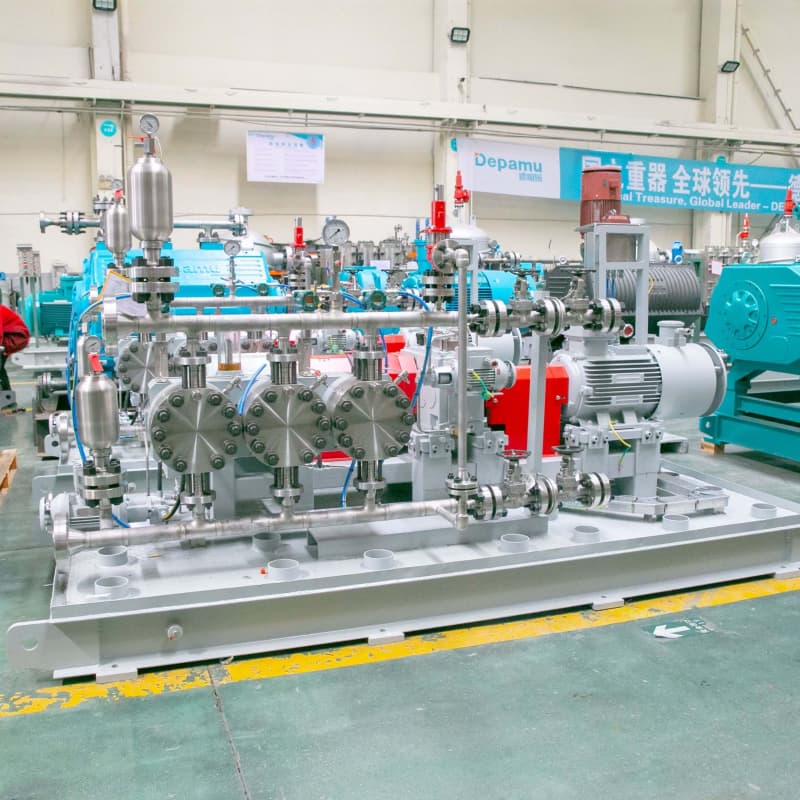
The application lists tell the story of each pump’s center of gravity. Depamu’s high-pressure process diaphragm pumps are presented in the context of oil and gas field water injection, polymer injection, coal-water slurry transport, ammonium carbamate and liquid ammonia service, CO₂ pumps, pipeline cleaning, and metallurgical dephosphorization. The company explicitly designs to API 674, the standard for positive displacement Reciprocating Pumps in petroleum, petrochemical, and chemical service. These are applications where flow capacity and pressure endurance often matter more than sub-percent metering finesse, and where the fluid may be abrasive, viscous, or laden with solids.
LEWA ecoflow’s application language is oriented toward critical, high-value fluids: hazardous, combustible, toxic, abrasive, viscous, environmentally harmful, and sensitive media. The ecoflow family spans metering and process duties, with sanitary variants for pharmaceutical tablet extrusion and skincare manufacturing. The pump is often specified where a leak is not merely a maintenance event but a safety or product-integrity event, and where the ability to adjust flow precisely over a wide turndown is part of the process control strategy.
Economic Considerations
A direct price comparison is neither available nor particularly meaningful, because the two pumps are configured differently for different duty cycles. LEWA positions ecoflow around lowest life-cycle cost: long maintenance intervals, a 40-year design life, and modularity that allows targeted upgrades rather than full replacement. The DPS and sandwich diaphragm are maintenance-cost reduction technologies as much as safety technologies. Depamu’s economic argument rests on compact structure, efficient transmission, and the ability to handle severe service without frequent intervention. The company’s monitoring system is presented as reducing maintenance labor by improving fault visibility. For an operator comparing the two, the relevant calculation is not purchase price but the total cost of ownership over the expected duty cycle: how often the diaphragm must be inspected or replaced, how much production is lost during maintenance, and how sensitive the process is to a momentary loss of metering accuracy.
Conclusion: Selection by Dominant Constraint
The choice between Depamu high-pressure process diaphragm pumps and LEWA ecoflow should be driven by the dominant constraint of the application. If the constraint is large flow at high pressure in a severe-service process—oilfield injection, slurry transport, fertilizer synthesis—Depamu’s broader flow envelope and API 674 orientation make it the natural starting point. If the constraint is precise metering of a critical or hazardous fluid at high pressure, with low suction pressure available, strict containment requirements, and a need for configurable hygienic or process variants, LEWA ecoflow’s DPS architecture, suction capability, and modular depth give it a structural advantage. Both pumps are engineering solutions to the same fundamental problem—how to contain a fluid under pressure while transmitting displacement across a flexible barrier—but they solve it with different priorities. The correct selection is the one whose priorities align with the process, not the one whose headline specification is larger.