

Depamu Long Service Life High Pressure Diaphragm Reciprocating Pump for the Chemical Industry
Abstract
The chemical industry demands pumping equipment that can withstand aggressive media, extreme pressures, and continuous operation without compromising safety or accuracy. Depamu's high pressure diaphragm Reciprocating Pumps have emerged as a compelling solution, engineered in accordance with API 674 standards and incorporating patented hydraulic compensation technologies. This article examines the design principles, technical specifications, and operational advantages that enable these pumps to achieve exceptional service life in chemical processing environments. By analysing the hydraulic end architecture, diaphragm protection mechanisms, and lubrication systems, the discussion demonstrates how Depamu has addressed the fundamental tension between high-pressure capability and long-term reliability—a challenge that has historically limited the adoption of Diaphragm Pumps in demanding chemical applications.
1. Introduction
The chemical industry presents one of the most hostile environments for mechanical equipment. Process fluids range from highly corrosive acids and bases to toxic gases and abrasive slurries containing solid particles. Operating pressures frequently exceed 20 MPa, and temperature extremes can span from cryogenic conditions to above 150°C. In this context, pump failure is not merely an operational inconvenience; it represents a safety hazard, an environmental risk, and a significant financial liability.
Among the various pump technologies available, the diaphragm reciprocating pump occupies a distinctive position. Unlike centrifugal pumps, which rely on kinetic energy transfer, reciprocating pumps deliver fluid through positive displacement, ensuring consistent volumetric output regardless of discharge pressure fluctuations. The diaphragm serves as a hermetic barrier between the process fluid and the pump's mechanical components, eliminating the leakage pathways inherent in packed plunger or mechanical seal designs. This characteristic makes diaphragm pumps particularly suitable for handling toxic, flammable, or highly corrosive media.
Depamu, a manufacturer with substantial expertise in reciprocating pump technology, has developed a range of high-pressure process diaphragm pumps specifically engineered for the chemical industry. These pumps are designed according to American Petroleum Institute standard API 674, which specifies minimum requirements for reciprocating positive displacement pumps used in petroleum, petrochemical, and chemical service. The company's product portfolio spans pressure ratings up to 95 MPa and flow rates reaching 12,100 L/h per pump head, with metering accuracy maintained at ±0.5% across an adjustment range of 10% to 100%.
2. Design Architecture and Long Service Life Mechanisms
2.1 Hydraulic End Design
The hydraulic end of a diaphragm pump is where the most critical design challenges converge. The reciprocating motion of the plunger must be transmitted through hydraulic oil to the diaphragm, which in turn displaces the process fluid. Any instability in the hydraulic system—whether from oil depletion, air entrainment, or pressure fluctuations—directly compromises diaphragm life and metering accuracy.
Depamu addresses this challenge through an integrated compensation valve system. The hydraulic chamber incorporates a limit valve, an exhaust valve, and an internal relief valve operating in coordination to maintain stable oil volume. This mechanical four-valve linkage technology ensures that the hydraulic system remains properly charged, automatically discharging accumulated air and replenishing any oil lost through normal operation. The precision of these components is notable: the limit valve achieves an accuracy of ±0.002 mm, with surface hardness of 60–70 HRC and roughness of 0.4 μm. The diaphragm assembly is rated for 80 million cycles within a temperature range of −80°C to 160°C.
This automatic oil management system is not merely a convenience feature; it is fundamental to service life. In conventional diaphragm pump designs, gradual oil loss or air accumulation leads to incomplete diaphragm stroke, causing stress concentrations that accelerate diaphragm fatigue. By maintaining hydraulic equilibrium, Depamu's system ensures that the diaphragm operates through its full designed stroke on every cycle, distributing mechanical stress evenly across the diaphragm surface.
2.2 Diaphragm Material and Construction
The diaphragm itself is the component most directly exposed to the process fluid and thus the most vulnerable to chemical attack and mechanical wear. Depamu employs a PTFE macromolecule composite diaphragm that undergoes multi-directional rolling and surface quenching treatment. This manufacturing process achieves a surface evenness of 99.92%, reduces cold flow during operation, and enhances compressive strength.
The significance of this material engineering extends beyond simple chemical resistance. PTFE, while chemically inert across a broad spectrum of aggressive media, is susceptible to cold flow—a phenomenon where the material deforms permanently under sustained compressive load. In diaphragm pump applications, cold flow manifests as progressive thinning of the diaphragm at the point of contact with the hydraulic and process plates, ultimately leading to rupture. The multi-directional rolling treatment addresses this by orienting the polymer chains in a manner that resists deformation, effectively extending the diaphragm's functional life.
For hazardous applications involving toxic, flammable, or strongly corrosive fluids, Depamu offers double or multiple diaphragm configurations. A diaphragm rupture alarm device monitors the integrity of the primary diaphragm, preventing process fluid from contacting the hydraulic oil in the event of a breach. This design provides an additional layer of safety while allowing planned maintenance to be scheduled rather than forced by unplanned failure.
2.3 Lubrication and Drive End Durability
Long service life in a reciprocating pump is not solely a function of the hydraulic end; the drive mechanism must also withstand continuous operation without excessive wear. Depamu employs oil-immersion lubrication for the transmission mechanism, ensuring reliable long-term operation of the crank, connecting rod, and bearing assemblies.
A particularly notable design feature is the use of roller bearings in the connecting rod and main shaft connection. Compared with bushing connections that rely on sliding friction, roller bearings offer a lower coefficient of friction and reduced heat generation. More importantly, roller bearings maintain effective lubrication at low pump speeds—a critical consideration for high-pressure applications where pump speed is deliberately reduced to minimise component stress. As Depamu's technical documentation observes, under sliding friction conditions, an oil film cannot form at low speeds even with active lubrication, making normal operation impossible; rolling friction eliminates this limitation.
The drive end can be configured with various transmission options, including external reducers, internal worm gears, internal double helical gears, and belt pulley systems. Each configuration offers distinct advantages depending on the application. Internal worm gear transmissions provide high integration and compact footprint, making them suitable for installations where space is constrained. External pulley drives offer simplicity and overload protection, with belt slip preventing motor burnout under excessive load—an attribute particularly valuable in remote or unmanned chemical plant installations.
3. Technical Specifications and Chemical Industry Applications
3.1 Performance Parameters
Depamu's high-pressure process diaphragm pumps are available in multiple series to accommodate different flow and pressure requirements. The HD3M(M) series, for example, covers a flow range of 2.52–94.61 m³/h and a pressure range of 2.5–160.3 MPa. The HD3E(M) series offers a pressure range of 3.1–50.9 MPa, while the HD3N(M) series extends to 2.8–84.9 MPa. For metering applications requiring higher precision, the DPMWAAB55-5 hydraulic diaphragm Metering Pump achieves a maximum discharge pressure of 95 MPa with a flow rate of up to 12,100 L/h per head.
The wetted parts of these pumps can be manufactured from a range of materials to suit specific chemical compatibility requirements. Options include 304 and 316 stainless steels, 316L, duplex steel, titanium alloys, Hastelloy C, as well as non-metallic materials such as PVC, PVDF, PP, and PTFE. This material flexibility is essential in the chemical industry, where a single pump design must be adaptable to fluids as diverse as concentrated sulfuric acid, liquid ammonia, and organic solvents.
3.2 Chemical Processing Applications
The application scope of Depamu's diaphragm reciprocating pumps in the chemical industry is extensive. They serve as oil-gas field Water Injection Pumps, polymer injection pumps, butanediol charging pumps, ammonium carbamate pumps, liquid ammonia pumps, acetic acid cuprammonia pumps, and liquid carbon dioxide pumps. The pumps are equally suited to fertilizer process service, coal water slurry transport, and high-pressure cleaning applications.
In petrochemical operations, these pumps are deployed for chemical injection and pH control. Depamu has specifically developed ammonia Injection Packages for thermal power plant applications, where precise dosing of ammonia is essential for maintaining optimal pH levels in boiler feed water systems. The ±0.5% metering accuracy ensures that chemical consumption is minimised while process parameters remain within specification.
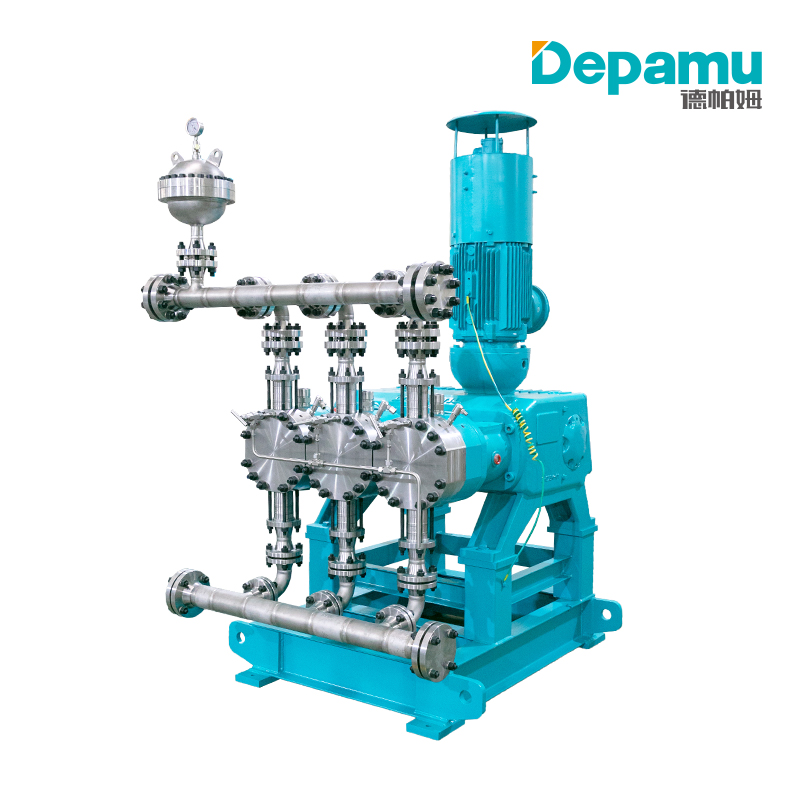
A notable recent application involved the delivery of high-pressure process diaphragm pumps to a chemical new materials project in northern China. Three units were commissioned for service in advanced material manufacturing, employing a triple-plunger configuration that delivers high efficiency, precision, and operational stability. The design incorporated a piston ring structure that replaces traditional packing seals, extending service life while an internal relief valve safeguards flow accuracy.
4. Operational Advantages in Chemical Service
4.1 Leak-Free Operation
The fundamental advantage of diaphragm pump technology in chemical service is the elimination of dynamic seals. Unlike plunger pumps, where the plunger must reciprocate through a packing or mechanical seal that is inherently prone to wear and leakage, the diaphragm creates a static seal between the process fluid and the atmosphere. Depamu's process diaphragm pump design ensures no leakage during the transportation of toxic, flammable, or abrasive media.
This characteristic has both safety and economic implications. In facilities handling hazardous chemicals, the cost of leak detection systems, secondary containment, and vapour recovery equipment can be substantial. A pump that eliminates the leak source simplifies the entire safety architecture of the installation. Furthermore, the absence of seal wear means that maintenance intervals are governed by diaphragm life rather than seal replacement schedules—typically resulting in longer intervals between planned shutdowns.
4.2 Consistent Metering Accuracy
The metering accuracy of ±0.5% across a 10:1 turndown ratio is maintained through the use of high-precision inlet and outlet check valves. These valves ensure that the volumetric displacement of the diaphragm translates directly into fluid delivery, without the slip losses that can affect centrifugal or rotary pump designs. The capacity can be controlled through manual adjustment, electrical signals, pneumatic actuation, or variable frequency drive, allowing integration with distributed control systems in modern chemical plants.
4.3 Suitability for Difficult Fluids
Chemical processes frequently involve fluids that are problematic for conventional pumping equipment. High viscosity fluids resist the shear rates required for centrifugal pumping. Slurries containing solid particles cause abrasive wear in close-clearance components. Depamu's diaphragm pumps are specifically engineered for such conditions. The direct-through pump head cavity, without threaded or recessed areas, prevents particle accumulation and facilitates the passage of highly viscous fluids with entrained solids.
For coal water slurry transport—a particularly demanding application given the abrasive nature of the medium and its tendency to settle—Depamu's pumps have demonstrated stable operation at solid contents up to 80%, pressures of 0.34–0.5 MPa, and temperatures up to 120°C. The hose diaphragm design isolates the abrasive slurry from the pump's mechanical components, with a rupture alarm providing real-time monitoring of diaphragm integrity.
5. Conclusion
The chemical industry's requirement for pumping equipment that combines high pressure capability, chemical resistance, and long service life has traditionally presented a difficult engineering trade-off. High pressures increase mechanical stress on the diaphragm; aggressive fluids attack the materials of construction; and the demand for continuous operation leaves little tolerance for premature failure.
Depamu's high-pressure diaphragm reciprocating pumps address these challenges through a combination of hydraulic system precision, material engineering, and mechanical design. The integrated compensation valve system maintains hydraulic equilibrium, ensuring that the diaphragm operates within its designed stress envelope. The PTFE composite diaphragm, treated to resist cold flow, provides chemical inertness without sacrificing mechanical durability. The oil-immersion lubrication and roller bearing construction of the drive end support reliable operation over extended service intervals.
For chemical processors, the practical consequences are significant: reduced maintenance costs, lower risk of hazardous fluid release, and consistent process control through accurate metering. As the chemical industry continues to demand higher pressures, more aggressive fluid handling, and greater operational reliability, the design principles embodied in Depamu's diaphragm pump range offer a proven pathway to meeting these requirements without compromising on service life or safety