

Depamu High-Quality Hydraulic Double Diaphragm Metering Pumps: Precision, Safety, and Reliability for the Chemical Industry
Introduction
In the chemical industry, the controlled and accurate injection of fluids is not merely a matter of process efficiency—it is a fundamental requirement for product quality, operational safety, and environmental compliance. Whether the medium is a highly corrosive acid, a toxic solvent, a flammable additive, or a viscous polymer, the metering pump stands as the critical interface between the process and the environment. Among the various pump technologies available, the hydraulic double diaphragm metering pump has emerged as a preferred solution for the most demanding chemical applications, offering a combination of zero-leak operation, high metering accuracy, and robust safety features that alternative designs struggle to match. Depamu (Hangzhou) Pumps Technology Co., Ltd., a Chinese high-tech enterprise founded in 2003, has positioned itself at the forefront of this technology, manufacturing a comprehensive range of Hydraulic Diaphragm Metering Pumps that are engineered to meet the rigorous standards of the global chemical, petrochemical, and water treatment industries. This article examines the technical foundations, design features, and practical applications of Depamu’s high-quality hydraulic double diaphragm metering pumps, illustrating why they have become an indispensable tool for chemical processors worldwide.
Company Background and Technological Foundation
Depamu’s entry into the pump industry was marked by a strategic decision to introduce advanced hydraulic diaphragm technology from Germany in the early 1990s, a move that laid the groundwork for decades of innovation. Headquartered in the Qiantang Area of Hangzhou, China, the company has grown into a high-tech enterprise with over 100 technical patents, including 38 invention patents, and has established itself as a drafter of pump industry standards. Its manufacturing operations, supported by subsidiaries specializing in Screw Pumps, Rotor Pumps, and centrifugal pumps, span a 35,000-square-meter facility and employ more than 200 people. The company holds API, CE, ISO 9001, ISO 14001, and ISO 45001 certifications, underscoring its commitment to international quality, environmental, and occupational health and safety standards. Its products have been deployed in oil and gas fields, refineries, nuclear power plants, chemical facilities, pharmaceutical production, and water treatment systems across more than 60 countries, with strategic partnerships involving major enterprises such as CNPC, SINOPEC, CNOOC, and CNNC. This breadth of experience and technical pedigree forms the backdrop against which Depamu’s hydraulic double diaphragm metering pumps must be understood.
The Technical Principle: Why Hydraulic Double Diaphragm?
The superiority of the hydraulic diaphragm metering pump in chemical service begins with its fundamental design philosophy, which is deliberately different from that of a traditional plunger pump. In a conventional plunger pump, a reciprocating plunger must pass through a dynamic seal—a packing or gland—that is inherently vulnerable to wear and, over time, permits the process fluid to escape. This controlled leakage, while sometimes tolerated in benign services, is entirely unacceptable when the medium is toxic, flammable, explosive, or strongly corrosive. The hydraulic Diaphragm Pump eliminates this weakness at its source. Instead of a moving shaft seal, the pump employs a flexible diaphragm that statically seals the hydraulic end from the process fluid. The medium being transported never comes into contact with a sliding seal, meaning that under no operating condition will the fluid leak into the environment. A hydraulic system, driven by an eccentric mechanism, actuates the diaphragm, and the displacement of the hydraulic oil is precisely translated into the displacement of the process fluid.
Depamu’s hydraulic diaphragm metering pumps, particularly the DP(M)ZAA, DP(M)DA, and DP(M)TA series, refine this principle through a sophisticated system of automatic oil supply and internal safety protection based on the mutual interaction of the diaphragm, a limit valve, a compensation valve, and an internal safety valve. The limit valve achieves an accuracy of ±0.002 mm, with a surface hardness of 60–70 HRC and a roughness of 0.4 μm, ensuring that the hydraulic compensation is both precise and durable. The diaphragm itself, a PTFE macro-molecule composite, is manufactured through multi-directional rolling and surface quenching, achieving a uniformity of 99.92 percent. This treatment reduces cold flow during operation and enhances compressive strength, allowing the pump to be reused for 80 million cycles within a temperature range of −80°C to 160°C. The internal safety valve and compensation valve enable automatic air discharge and oil replenishment, delivering outstanding and reliable performance even under fluctuating process conditions.
Metering Accuracy and Control Flexibility
For chemical processors, the value of a metering pump is measured first and foremost by its accuracy. Depamu’s hydraulic diaphragm pumps deliver a metering accuracy of ±0.5 percent across a flow adjustment range of 10 to 100 percent, achieved through a patented integrated sleeve adjustable eccentric transmission mechanism that permits stepless adjustment of the stroke from 0 to 100 percent. The inlet and outlet high-precision check valves further guarantee metering accuracy and fluidity, while the integrated worm gear transmission operates with low noise and high efficiency. Oil-immersion lubrication ensures the long-term reliability of the transmission mechanism, reducing maintenance requirements in continuous chemical operations.
The control architecture of these pumps is equally versatile. Capacity can be adjusted manually, electrically, pneumatically, or through frequency conversion, and the installation of an electric actuator enables automatic remote control. This flexibility is critical in modern chemical plants, where dosing rates often need to be modulated in response to online analytical measurements, production rate changes, or batch recipe adjustments. The pumps can accommodate two or more pump heads—up to 12 in parallel—which can be used to transport the same fluid with reduced pulsation or to transport different fluids as a proportioning pump. For chemical processors dealing with multi-component formulations, this capability simplifies system design and reduces the footprint of the dosing skid.
Safety Architecture for Hazardous Chemical Service
The chemical industry’s most persistent challenge is the safe containment of hazardous materials, and it is here that Depamu’s double diaphragm configuration demonstrates its greatest value. When transporting fluids that are toxic, flammable, explosive, or strongly corrosive, the pump can be equipped with double or multiple diaphragms, creating a layered barrier between the process medium and the hydraulic system. The outer diaphragm, typically made of PTFE, provides excellent corrosion resistance, while the inner diaphragm serves as a backup. More importantly, Depamu integrates a diaphragm rupture alarm device. In the event that one diaphragm fails, the alarm system detects the breach and prevents the process fluid from contacting the hydraulic oil, thereby avoiding a potentially catastrophic accident. The pump can be configured to continue operating until a scheduled diaphragm replacement or to shut down immediately, depending on the operator’s safety philosophy. This layered approach to containment—combining static sealing, material selection, and real-time monitoring—forms the basis of what Depamu describes as a zero-leak guarantee.
The material options available for the wetted parts further extend this safety envelope. Depamu offers pump heads in 304, 316, 316L, 904 stainless steel, Hastelloy C, and polymer materials, allowing the pump to be matched to the specific corrosion profile of the chemical being dosed. For the most aggressive media, the PTFE double diaphragm configuration provides a level of chemical inertness that metal components alone cannot achieve. This combination of material flexibility and diaphragm-based sealing ensures that the pump can be deployed across the full spectrum of chemical processing—from acidic and caustic reagents to solvents and reactive intermediates—without compromising containment integrity.
Performance Envelope and Product Range
Depamu’s hydraulic diaphragm metering pump portfolio spans a wide performance envelope, enabling the selection of an appropriate model for applications ranging from laboratory-scale dosing to full-scale production. The DP(M)ZAA series, for example, covers flow rates from 45 to 90 liters per hour at discharge pressures ranging from 22.8 to 55.0 MPa, depending on the specific model and configuration. Across the broader hydraulic diaphragm range, models are available for handling flow rates from as low as 15 liters per hour to over 2,800 liters per hour, with discharge pressures ranging from 0.4 MPa to 54 MPa. For applications requiring even higher flow, the DP(M)ZAA and related series can be configured with multiple pump heads, while the company’s high-pressure process Reciprocating Pumps extend the capability to 12,100 liters per hour and pressures up to 228 MPa for the most demanding process streams. The DP(M)WA series, another hydraulic diaphragm variant, offers a flow rate adjustment range of 10 to 100 percent with a metering accuracy of ±0.5 percent, and is particularly suited to petrochemical and chemical dosing duties. This breadth of models ensures that chemical engineers can specify a pump that operates at its optimal efficiency point rather than compromising on either accuracy or hydraulic performance.
Applications in the Chemical Industry
The chemical industry encompasses a vast array of processes, and the hydraulic double diaphragm metering pump has proven its value across them. In petrochemical refining, these pumps are used for the precise injection of additives, inhibitors, and other chemicals essential for process control and product quality. They are deployed as oil-gas field Water Injection Pumps, polymer injection pumps, butanediol charging pumps, ammonium carbamate pumps, liquid ammonia pumps, and acetic acid cuprammonia pumps, among other duties. In polyethylene production, the precise injection of catalysts, co-catalysts, and chemical additives represents one of the most demanding applications for fluid-handling equipment, requiring a level of accuracy and reliability that only a hydraulic diaphragm design can consistently deliver. The pumps are equally at home in fine chemical and pharmaceutical manufacturing, where the contamination risk associated with plunger-pump dynamic seals is unacceptable, and in the dosing of corrosive reagents in specialty chemical synthesis.
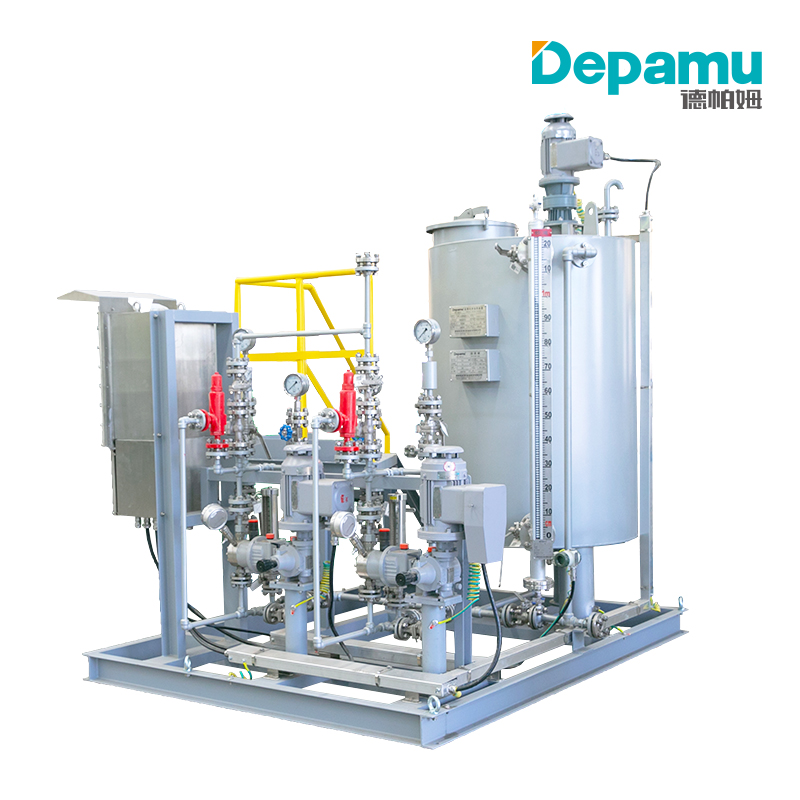
Beyond the process itself, the hydraulic diaphragm metering pump plays a critical role in environmental protection and water treatment within chemical facilities. Depamu’s zero-leak chemical Injection Packages, built around these pumps, are deployed for boiler feedwater treatment—injecting ammonia, hydrazine, acetoxime, and phosphate—as well as for circulating water systems where scale inhibitors, corrosion inhibitors, and germicides must be dosed with high accuracy. In wastewater treatment, the pumps handle flocculants, dispersants, acids, and alkalis, with automated dissolving and injection packages that prepare liquid media from dry powders and granular chemicals before metering them into the process stream under automatic control. The zero-leak design is particularly important in these applications because many of the treatment chemicals are themselves hazardous, and any release would defeat the purpose of the environmental treatment process.
Reliability, Longevity, and Economic Value
A metering pump is a long-term asset, and its economic value is determined not only by its purchase price but by its service life, maintenance requirements, and the cost of downtime. The hydraulic diaphragm design offers significant advantages in all three dimensions. The elimination of the dynamic plunger seal removes the single most wear-prone component of a conventional metering pump, reducing the frequency of maintenance interventions and the associated labor costs. The PTFE composite diaphragm, treated to resist cold flow and enhance compressive strength, has demonstrated a cycle life of 80 million operations, and the oil-immersion lubrication of the transmission mechanism ensures reliable long-term operation without excessive wear. The internal safety and compensation valves protect the hydraulic system from overpressure and air ingress, further extending the pump’s service life and reducing the risk of unexpected failure. For chemical plants operating continuously, the ability to run a dosing pump for extended periods without shutdown for seal replacement translates directly into higher overall equipment effectiveness and lower total cost of ownership. As environmental regulations become more stringent and the tolerance for chemical leakage approaches zero, the hydraulic diaphragm metering pump’s combination of zero-leak operation, high accuracy, and low maintenance is increasingly recognized not as a premium option but as a baseline requirement for responsible chemical manufacturing.
Conclusion
Depamu’s high-quality hydraulic double diaphragm metering pumps represent a mature and highly engineered response to the chemical industry’s most demanding fluid-handling challenges. By replacing the vulnerable dynamic seal of the plunger pump with a statically sealed diaphragm, and by layering that diaphragm with advanced PTFE materials, rupture detection, and a suite of internal hydraulic safety features, Depamu has created a pump architecture that delivers zero-leak containment without sacrificing metering accuracy or hydraulic performance. The company’s ±0.5 percent accuracy, 80-million-cycle diaphragm life, flexible control options, and broad performance envelope make these pumps suitable for applications ranging from corrosive reagent dosing in specialty chemical production to catalyst injection in polyethylene plants and chemical metering in water treatment facilities. Backed by more than two decades of manufacturing experience, over 100 technical patents, and internationally recognized certifications, Depamu has established itself as a credible and capable partner for chemical processors seeking to reconcile the competing imperatives of precision, safety, and operational economy. In an industry where the consequences of a leak or a dosing error can be measured in environmental damage, human health, and production loss, the hydraulic double diaphragm metering pump is not merely a component of the process—it is a cornerstone of responsible chemical engineering.