

Depamu Three-Screw Pumps for Viscous Fluids and Transfer: Engineering Precision for Demanding Duties
Introduction
Industrial fluid transfer rarely rewards simplicity. The fluids that matter most in oil and gas, petrochemicals, food processing, and environmental engineering are often viscous, shear-sensitive, abrasive, or all three at once. Centrifugal pumps, the default choice for clean, low-viscosity liquids, lose efficiency sharply as viscosity climbs and can physically degrade the products they move. Positive displacement pumps fill this gap, and among them, the three-screw pump occupies a distinctive position: it delivers gentle, pulsation-free handling in a configuration optimized for clean lubricating service at high pressure and high flow. Depamu (Hangzhou) Pumps Technology Co., Ltd., founded in 2003 and holder of more than 100 technical patents along with API, CE, ISO 9001, ISO 14001, and ISO 45001 certifications, has built its three-screw pump portfolio around precisely this spectrum of demanding tasks. This article examines how Depamu’s three-screw technology translates advanced German engineering into operational efficiency for viscous fluids and transfer duties, covering the working principle, design architecture, performance envelope, viscosity handling, application landscape, and maintenance considerations.
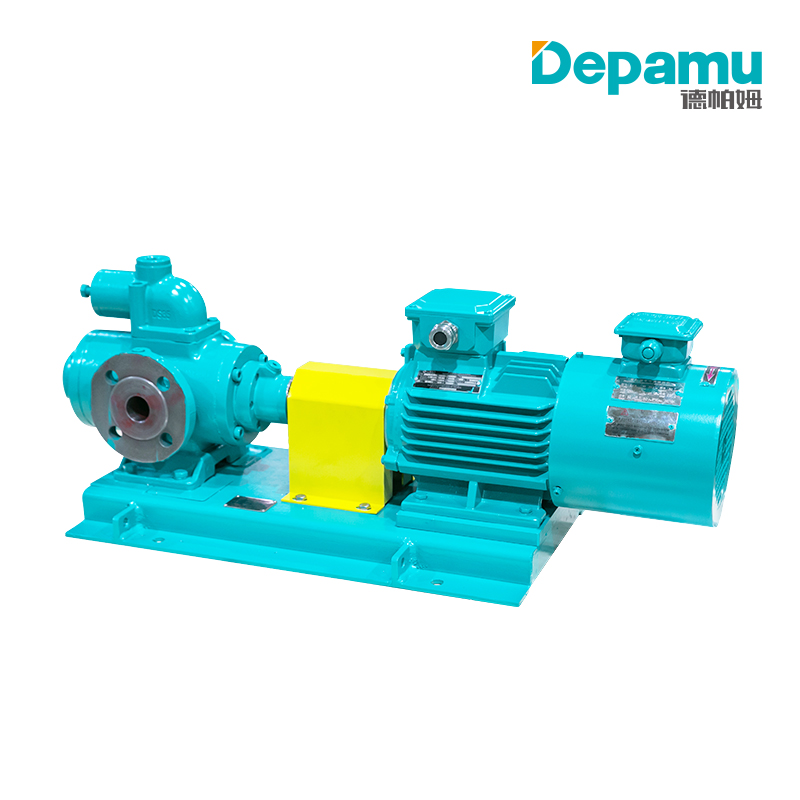
The Working Principle: Advancing Cavities and Hydrodynamic Lubrication
The three-screw pump is a rotary, self-priming positive displacement pump. Its pumping element consists of three intermeshing screw shafts—one power-driven main screw and two driven idler screws—rotating within a precision-machined casing. As the screws rotate, they form continuous sealed cavities that progress axially from the suction port to the discharge port. The sealing lines between the screws and the liner separate the suction cavity from the discharge cavity, and as rotation continues, these sealing lines move periodically along the axial direction, continuously pushing the medium from inlet to outlet without pulsation.
What distinguishes the Depamu three-screw design is its reliance on hydrodynamic lubrication. Under normal operating conditions, the screws do not maintain physical contact with one another. Instead, a thin oil film forms between the drive screw and the driven screws, as well as between the screws and the liner, protecting the screw surfaces from wear and ensuring a remarkably long service life. The drive screw is hydraulically balanced, and the driven screws are hydraulically powered, meaning the pumping action itself generates the forces that keep the rotors in their correct positions without mechanical contact. This principle gives Depamu’s DPSN and DP3G series their “semi-permanent” service-life claim in clean lubricating service. The trade-off is equally clear: the three-screw pump depends on the pumped fluid itself for lubrication, which is why it excels on lubricating liquids such as lube oil, diesel, bitumen, and fuel oil, but is not the reference technology for abrasive slurries or highly non-lubricating media—those duties fall to Depamu’s single-screw (progressive cavity) and twin-screw configurations.
Design Features: Uniform Flow, Self-Priming, and Mechanical Simplicity
The operational consequences of this design are substantial. Depamu’s three-screw pumps deliver uniform and continuous flow with no pulsation, high volumetric efficiency, and low noise. Their service life is remarkably longer than that of a gear pump or Rotor Pump in comparable clean-lubricating duties. The pumps exhibit strong self-priming capacity, eliminating the need for a bottom valve or auxiliary evacuating equipment, and they operate reliably even when not perfectly primed. Because the pumped fluid is transported without foam or turbulence, highly viscous and high-temperature fluids can be handled without degradation of their original properties—there is no shearing or mixing during transfer, so the fluid characteristics formed during processing are well preserved.
The mechanical architecture is deliberately compact. The pumps are small in size and light in weight, allow high speeds, and are not overly sensitive to gases or pollutants. Direct driving by a motor or other prime mover is feasible, simplifying installation and reducing the footprint of the pump skid. Depamu’s connecting rod and main shaft are joined via a roller bearing, a detail that reduces friction and heat emission compared with bushing connections. The structure is durable, and mounting and maintenance are straightforward, which matters in refineries, power plants, and marine engine rooms where access is limited and downtime is expensive.
Performance Envelope: DPSN and DP3G Series
Depamu’s three-screw portfolio is anchored by two principal series, the DPSN and the DP3G, both representing a sophisticated integration of German engineering principles adapted to global industrial standards. Their performance parameters position them as high-pressure, high-flow specialists. Maximum flow rate reaches 575 m³/h (9,583 L/min), maximum differential pressure reaches 25 bar, and maximum speed is 2,900 r/min. The DPSN series, in particular, is documented with a capacity of up to 456 m³/h (7,600 L/min), differential pressure up to 40 bar in certain configurations, and a maximum fluid temperature of 300 °C. The medium viscosity range for both the DPSN and DP3G series is stated as 3–760 cSt.
These figures should be read in the context of the three-screw pump’s inherent strengths. The pump’s flow is directly proportional to rotational speed and essentially independent of discharge pressure, which gives operators a predictable, linear control relationship. The absence of valves and reciprocating mechanisms removes the pulsation and fatigue failure modes associated with Reciprocating Pumps, while the hydrodynamic film reduces wear to the point where maintenance intervals in clean service can be extended significantly. For transfer duties involving lube oil, diesel, bitumen, and fuel oil, the DPSN and DP3G series provide a combination of pressure, flow, and reliability that is difficult to match with centrifugal or gear-pump alternatives.
Viscosity Handling: From Light Oils to Heavy Bitumen
Viscosity is the variable that most directly separates pump technologies. Depamu’s broader screw pump range is engineered for media with viscosities spanning from 1 mPa·s to 1,000,000 mPa·s, encompassing thixotropic and expansible fluids, shear-sensitive media, and liquids with or without self-lubricity. Within this spectrum, the three-screw pump occupies the clean-lubricating, higher-pressure segment. The stated viscosity range of 3–760 cSt for the DPSN and DP3G series covers the majority of fuel oils, lubricating oils, hydraulic oils, and diesel grades encountered in transfer and loading applications. For heavier bitumen and residual fuel oils, viscosity can be managed through heating, and the pump’s ability to handle high temperatures—up to 300 °C in the DPSN series—makes it compatible with hot-transfer duties where viscosity must be reduced to a pumpable range.
The critical distinction is that the three-screw pump’s hydrodynamic lubrication mechanism requires the fluid to possess some lubricity. This is not a limitation for the applications it targets—lube oil, diesel, bitumen, and fuel oil are all naturally lubricating—but it does mean that the three-screw pump should not be selected for water-based, abrasive, or highly non-lubricating media without careful evaluation. Depamu addresses those duties with its single-screw and twin-screw lines: the single-screw progressive cavity pump handles solids concentrations up to 60% and particle sizes of 10 mm or more, while the Twin-Screw Pump handles low-lubricity fluids and gas-liquid-solid mixtures without losing prime. The three-screw pump, by contrast, is the specialist for clean, lubricating, high-pressure transfer where its precision geometry and hydrodynamic film deliver their longest service life and highest efficiency.
Applications: From Refinery Transfer to Marine Fuel Systems
The application scope of Depamu three-screw pumps is broad and well-defined. They are used for the delivery of fuel oil, lubricating oil, hydraulic oil, and other lubricating liquids across petroleum, architecture, chemical fiber, metallurgy, lithium-ion battery, machinery, electricity, machine tool, shipping, glass, food, environmental protection, water treatment, and highway sectors. In industrial plants, three-screw pumps serve as lubricating pumps; in hydraulic systems, they function as Hydraulic Pumps; in fuel oil systems, they act as transfer and boost pumps; and in transfer systems, they serve as transfer and oil-filling pumps.
More specifically, the pumps find application in petroleum refining, metallurgy, machine tools, power generation, marine propulsion systems, and glass manufacturing. In marine engineering, three-screw pumps are valued for their compact footprint and reliable self-priming in fuel-oil transfer and booster service. In power generation, they circulate lube oil through turbine bearing systems and handle fuel-oil forwarding. In bitumen and asphalt handling, heated three-screw pumps move heavy residual streams from storage to processing or loading. The common thread across these duties is the need for smooth, non-shearing, pulsation-free transfer of a lubricating fluid at pressures and flow rates that centrifugal pumps cannot sustain efficiently. The three-screw pump’s ability to preserve fluid properties—no foaming, no turbulence, no shearing—is particularly important in lube-oil circulation, where entrained air or degraded additive packages can compromise downstream equipment.
Advantages in Viscous-Fluid Transfer
Several advantages converge to make the three-screw pump a preferred choice for viscous-fluid transfer. First, the uniform, pulsation-free flow protects piping, instrumentation, and downstream processes from the pressure spikes that reciprocating pumps generate. Second, the high volumetric efficiency and low noise profile improve the working environment and reduce energy losses in continuous-duty service. Third, the strong self-priming capability simplifies system design by eliminating bottom valves and vacuum-assist equipment, which reduces capital cost and potential failure points. Fourth, the compact, lightweight construction and direct-drive capability allow flexible installation in skid-mounted or space-constrained environments. Fifth, the absence of foaming and turbulence preserves the fluid’s original characteristics, which is essential in lube-oil and hydraulic-oil circuits where air entrainment can cause cavitation, oxidation, and premature oil degradation. Sixth, the durable structure and easy maintenance translate into lower total cost of ownership, particularly in clean-lubricating service where the hydrodynamic film minimizes wear and extends the interval between overhauls.
Operation, Maintenance, and Service Support
Three-screw pumps are mechanically robust, but they are not maintenance-free. The reliance on the pumped fluid for lubrication means that dry running must be avoided; even brief operation without adequate fluid film can damage the screw surfaces and liner. Suction conditions must be monitored to prevent cavitation, and the fluid should be free of abrasive particles that could disrupt the hydrodynamic film. Depamu’s after-sales service system provides a 7-day, 24-hour hotline and service stations, with a response mechanism that promises solutions within 24 hours of a request and, when necessary, on-site assistance from the after-sales team.
In practical maintenance terms, the three-screw pump’s simplicity is an asset. There are no valves, no timing gears in the pumping chamber, and no reciprocating components. The screw set and liner are the primary wear interfaces, and in clean lubricating service their life can be very long. Routine checks focus on suction pressure, discharge pressure, flow rate, vibration, noise, and temperature—parameters that can be monitored with standard instrumentation and trended to detect early signs of wear or misalignment. When overhaul is required, the compact construction and modular design facilitate disassembly and parts replacement, reducing downtime compared with more complex pump architectures.
Conclusion
Depamu’s three-screw pumps occupy a well-defined and highly valuable niche in industrial fluid transfer: the smooth, efficient, high-pressure handling of clean, lubricating, viscous fluids. Their hydrodynamic lubrication principle, with a hydraulic-balanced drive screw and hydraulically powered idler screws, eliminates metal-to-metal contact in normal operation and underpins a service life that is remarkably long by the standards of gear and rotor pumps. The DPSN and DP3G series translate this principle into a performance envelope of up to 575 m³/h, 25 bar differential pressure, and 2,900 r/min, with viscosity capability spanning 3–760 cSt and temperature capability reaching 300 °C in the DPSN series. For lube oil, diesel, bitumen, fuel oil, and hydraulic oil transfer, these characteristics deliver uniform, pulsation-free flow, strong self-priming, compact installation, and preservation of fluid properties—advantages that matter in refineries, power plants, marine engine rooms, and bitumen-handling facilities alike. Where the duty involves clean lubricating fluids at pressure and flow rates beyond the economical range of centrifugal pumps, the Depamu three-screw pump represents a mature, precise, and reliable engineering answer. Its limitations—the need for lubricity and the avoidance of dry running and abrasives—are well understood and easily managed through proper system design and operating discipline, leaving the pump to do what it does best: move viscous fluids gently, continuously, and efficiently, year after year.