

Depamu Screw Pump – Efficient Solution for Demanding Pumping Tasks
Introduction
Industrial fluid transfer rarely rewards simplicity. The fluids that matter most in oil and gas, petrochemicals, food processing, and environmental engineering are often viscous, abrasive, shear-sensitive, or all three at once. Centrifugal pumps, the default choice for clean, low-viscosity liquids, lose efficiency sharply as viscosity climbs and can physically degrade the products they move. Positive displacement pumps fill this gap, and among them, the screw pump family occupies a distinctive position: it delivers the gentle, pulsation-free handling of a progressive cavity design in configurations optimized for duties ranging from abrasive slurries to high-pressure lube oil circulation.
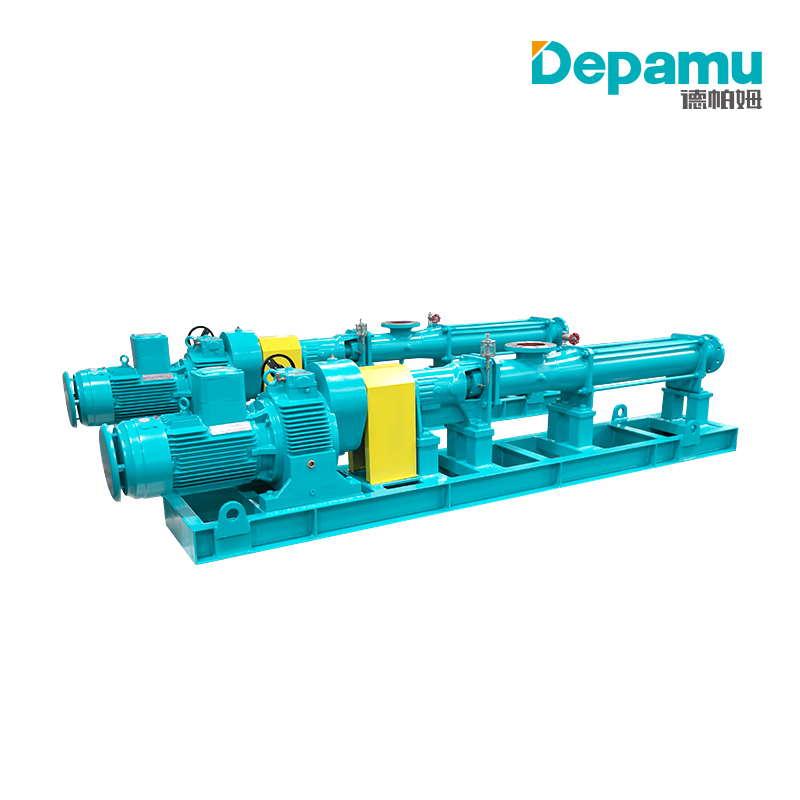
Depamu (Hangzhou) Pumps Technology Co., Ltd. has built its screw pump portfolio around precisely this spectrum of demanding tasks. Founded in 2003 in Hangzhou’s Qiantang District, the company has accumulated more than 100 technical patents, participates in the drafting of pump industry standards, and holds API, CE, ISO 9001, ISO 14001, and ISO 45001 certifications. Its screw pump line—single, twin, and triple configurations—is explicitly rooted in advanced German engineering, and the company’s own literature frames these pumps as solutions for “special working conditions” involving high viscosity, suspended solids, and shear-sensitive media. This article examines how Depamu’s screw pump technology translates that design philosophy into operational efficiency across some of industry’s most unforgiving pumping duties.
One Technology Platform, Three Answers to Different Problems
The term “screw pump” conceals an important engineering distinction. Depamu manufactures three distinct positive-displacement architectures, and the differences between them are not cosmetic—they determine which fluids a given pump can handle efficiently and which it cannot.
The single screw pump, also known as the progressive cavity pump (PCP), is the most widely recognized of the family. Its pumping element is a single helical metallic rotor rotating eccentrically within a double-helical elastomer stator. As the rotor turns, sealed cavities progress axially from suction to discharge, each carrying a fixed volume of fluid. This geometry produces a flow that is directly proportional to rotational speed and essentially independent of discharge pressure, with no valves, no reciprocating mechanisms, and no pulsation. The elastic stator also allows the pump to pass solid particles without clogging—Depamu’s PCPs accommodate solids concentrations up to 60% and particle diameters of 10 mm or more in standard configurations, with specialized designs handling up to 30 mm. The trade-off is pressure and temperature limitation relative to all-metal designs, but for slurries, sludge, and shear-sensitive pastes, the single screw pump remains the reference technology.
The twin screw pump takes a different approach. Two synchronized metal rotors, typically one right-handed and one left-handed, rotate within a precision liner without metal-to-metal contact inside the pumping chamber. Timing gears in a separate housing maintain synchronization. This design removes the elastomer stator from the pressure boundary, enabling higher pressure capability and reliable operation on low-lubricity fluids such as water, solvents, and light hydrocarbons that would cause an elastomer-stator PCP to slip or overheat. Depamu’s twin screw pumps operate at low rotational speeds—typically 500 to 1,500 rpm—generating laminar flow that avoids emulsification of oil-water mixtures and preserves the integrity of long-chain polymers in water treatment applications. They also handle “gas-liquid-solid” mixtures without losing prime, eliminating upstream separation equipment in crude oil transfer.
The triple screw pump is the high-pressure, high-flow specialist. Three intermeshing screws—one driven main screw and two idler screws—create advancing cavities that move fluid axially. The defining feature is hydrodynamic lubrication: under normal operation, the screws do not touch each other or the liner; a thin film of the pumped fluid itself separates the surfaces. This principle gives Depamu’s DPSN and DP3G series their “semi-permanent” service-life claim in clean lubricating service, with maximum flow rates of 575 m³/h, differential pressures to 25 bar, speeds to 2,900 rpm, and viscosity handling from 3 to 760 cSt at temperatures up to 300°C. Triple Screw Pumps are not intended for abrasive slurries—the precision clearances and hydrodynamic film demand clean, lubricating media—but in lube oil, diesel, bitumen, and fuel oil service, they combine high flow density with exceptionally quiet, pulsation-free operation.
Efficiency That Shows Up Beyond the Nameplate
Pump efficiency is often reported as a single number at a single operating point. In real processes, the efficiency that matters is the efficiency across the range of conditions a pump actually encounters—varying viscosity, fluctuating back-pressure, changing solids load, and the need to control flow without wasting energy.
Progressive cavity and screw pumps offer a structural advantage here: flow is proportional to speed, not pressure. A PCP or triple screw pump can be turned down or sped up with a variable frequency drive to match demand, rather than throttled against a control valve. Depamu’s own application literature makes this point explicitly: unlike centrifugal pumps that require throttling valves for flow control, progressive cavity pumps vary flow by changing speed, leading to significant electrical savings in variable-demand applications. The same principle applies to twin screw pumps, where direct drive or reduced-speed gearing minimizes mechanical losses and allows precise output matching through VFD control.
The efficiency gain is not merely theoretical. In downhole crude oil artificial lift, field applications of all-metal progressive cavity pumps have been reported to reduce average daily power consumption by up to 66.6% compared with conventional pumping units, with volumetric efficiencies typically in the 75–95% range. That figure reflects the elimination of the reciprocating inertia losses and valve losses inherent in beam pumping, but the underlying mechanism—positive displacement delivering flow independent of back-pressure—translates to surface transfer duties as well.
Viscosity behavior further favors screw technology in the media where centrifugal pumps falter. Above roughly 300 cSt, centrifugal pump efficiency declines sharply, with documented head losses and efficiency reductions of 20% or more at viscosities approaching 800–1000 cP. A twin screw pump, by contrast, increases in volumetric efficiency as viscosity rises, because the more viscous fluid acts as a more effective seal against internal slip. A triple screw pump maintains consistent volumetric efficiency across its 3–760 cSt range, so a single pump can serve a process where viscosity fluctuates with temperature or batch composition without recalibration or loss of throughput. And a single screw pump’s performance envelope extends from 1 cP to over 1,000,000 cP, covering duties from thin bilge water to toothpaste and molten polymer within the same technology family.
Designed for the Fluids That Break Other Pumps
The efficiency case for screw pumps is strongest where the fluid itself would degrade or disable a centrifugal machine. Depamu’s application engineering has focused on several such environments, and the common thread is that the pump’s low-shear, positive-displacement action is not an accessory feature but the enabling condition for the process to work at all.
In petrochemical slurry and residue service, heavy hydrocarbons may exceed 100,000 cP at ambient temperature, catalyst fines introduce abrasive wear, and shear-sensitive polymer solutions can lose molecular integrity under turbulent pumping. Depamu’s stainless steel sanitary single screw pumps address this combination with 316L wetted components, elastomer stators selected for chemical compatibility, and a low-shear cavity progression that preserves emulsion and polymer structure. The pumps are self-priming to 8 meters of water column and can generate discharge pressures to approximately 48 bar, making a single device serve as both transfer pump and Metering Pump without separate flow-control valves. The “sanitary” designation extends beyond food and pharmaceutical service: polished product-contact surfaces, absence of dead spaces, and compliance with FDA and EU 1935/2004 material regulations reduce cross-contamination risk and cleaning downtime in chemical batch operations.
In food and bioprocessing, the fluid is the product. Toothpaste at 30,000–150,000 cP, fruit jams with suspended pieces, fermentation broths containing shear-sensitive mycelia, and syrups whose viscosity changes by orders of magnitude with temperature all punish pumps that agitate or aerate. Depamu’s single screw pumps handle this range with a low-shear action that preserves yield stress and thickener structure in toothpaste, avoiding the “slumping” that occurs when shear degrades the product’s rheology. In syrup and jam transfer, the pump’s suction lift of up to 8 meters draws viscous product from vessels without priming equipment, and its temperature range of −12°C to +150°C accommodates hot-fill and cold-start conditions. The flow–speed linearity also supports accurate in-line metering, a property that matters when a jam or syrup is an ingredient rather than a finished good.
In environmental and marine applications, the challenge is heterogeneity. Bilge water is an oil-water emulsion with rust, debris, and variable oil content; wastewater sludge is abrasive and high-solids; polymer flocculants are shear-sensitive and must be dosed without degradation. Depamu Screw Pumps handle oily bilge water with solid particles up to 30 mm and viscosity ranges spanning six orders of magnitude, while their self-priming capability reaches the bottom of bilge wells without auxiliary equipment. In sludge and polymer dosing, the PCP’s low-shear cavities convey abrasive sludge at solids concentrations up to 60% and meter polymer solutions without breaking the long-chain molecules that make flocculation work. These are not duties where a centrifugal pump can be “adapted” with a larger impeller or a different material; the pumping principle itself must change, and the screw pump is the principle that fits.
Pulp and paper adds a fibrous dimension. Pulp slurries at 3–18% consistency combine high viscosity, abrasive silica and lignin particles, and long cellulose fibers that centrifugal pumps both clog and mechanically degrade. Depamu’s single screw pumps move pulp through sealed cavities with no shearing or mixing during transfer, preserving fiber length and therefore the tensile strength of the finished paper. The pumps handle solids up to 30 mm, accommodating wood chips and uncooked fiber bundles without blockage, and the absence of high-velocity impeller action eliminates the cavitation that plagues centrifugal pulp transfer at high consistency.
The Operational Case: Pulsation, Wear, and Maintenance
Efficiency in a demanding pumping task is not only kilowatt-hours per cubic meter. It is also the cost of downtime, the frequency of stator replacement, the need for pulsation dampeners, and the engineering effort required to make a pump fit a process.
Pulsation-free flow is a recurring theme across Depamu’s screw pump documentation. The triple screw pump delivers “uniform, continuous, and free of pulsation” flow through axial movement of fluid, with minimal pressure fluctuation even at high rotational speeds. The twin screw pump avoids the turbulence and agitation of centrifugal impellers, preventing emulsification and preserving natural fluid states. The single screw pump’s sealed cavities move fluid linearly without turbulence, pulsation, or significant shear stress. In practical terms, this eliminates the need for pulsation dampeners, reduces pipe vibration and fatigue, and makes inline metering feasible without separate flow-smoothing equipment. For adhesive and sealant manufacturing, where pulsation can introduce air bubbles and inconsistent application weights, this is a direct quality-control advantage.
Wear management is the other half of the maintenance equation. In abrasive service, Depamu addresses rotor life through material selection and coating: hard chrome plating or tungsten carbide spray coatings extend rotor life by factors of three to five compared with uncoated 316L stainless steel in abrasive duty, while stator interference fit is reduced for abrasive applications to balance sealing against frictional wear. In clean lubricating service, the triple screw pump’s hydrodynamic film does the opposite—it minimizes mechanical contact and friction, producing the “semi-permanent” longevity that makes these pumps attractive for continuous-duty lube oil circulation in refineries, power generation, and marine main engines. The design logic is application-specific: elastomer stators and hardened rotors for slurry, hydrodynamic metal-on-metal separation for clean lubricant, and timing-gear-driven non-contacting rotors for low-lubricity fluids. The pump is configured around the wear mechanism, not the other way around.
Modularity further reduces the engineering burden of matching a pump to a process. Depamu’s single screw platform offers multiple bearing housing configurations, seal options (single mechanical, double mechanical with barrier fluid, flushed gland packing), drive arrangements (direct-coupled, belt-driven, inverter-ready), mounting styles (foot-mounted, vertical, hopper-feed), and connection standards (DIN, ANSI, Tri-clamp, SMS). A toothpaste line and a petrochemical slurry transfer station may use the same pumping principle, but they do not need the same shaft seal, bearing lubrication, or surface finish. The ability to configure these variables without redesigning the pumping element is itself an efficiency: it shortens the path from process requirement to installed equipment.
Scope and Limitations
A balanced assessment of any pump technology must acknowledge what it does not do well. Depamu’s triple screw pumps are not intended for abrasive slurries; the precision clearances and hydrodynamic film that give them their longevity in lube oil service are vulnerable to solid particles. Single screw pumps with elastomer stators have temperature limitations relative to all-metal PCPs, and their pressure capability per stage is lower than that of reciprocating or multi-stage centrifugal machines. Twin screw pumps require timing gears and tighter manufacturing tolerances than single screw designs, which carries a cost premium. These are not defects; they are the boundaries of the design envelope. The efficiency claim for Depamu screw pumps is not that one configuration outperforms every alternative on every metric, but that within the viscosity, solids, shear-sensitivity, and flow ranges where positive displacement is the correct principle, the screw pump family offers a closer fit to the fluid than centrifugal or reciprocating alternatives—and Depamu’s range of single, twin, and triple configurations allows that fit to be optimized rather than compromised.
Conclusion
The demanding pumping tasks of modern industry are rarely demanding because the flow rate is high or the pressure is extreme. They are demanding because the fluid refuses to behave: it is too viscous for a centrifugal impeller, too abrasive for a gear pump, too shear-sensitive for a lobe pump, or too variable for a single fixed-clearance design. Depamu’s screw pump portfolio responds to this reality not with a single universal pump but with a technology platform differentiated by pumping principle. The single screw pump handles slurries, sludge, pulp, and shear-sensitive pastes with a low-shear cavity action and solids tolerance that centrifugal machines cannot match. The twin screw pump extends positive displacement into water, solvents, and multiphase oil service with timing-gear synchronization and laminar flow. The triple screw pump delivers high-flow, high-pressure, pulsation-free performance in clean lubricating media through hydrodynamic screw separation.
The efficiency that results is measured in more than kilowatts. It appears as preserved product quality in toothpaste and jam, intact polymer chains in water treatment, reduced power consumption in artificial lift, eliminated pulsation dampeners and flow-control valves, and maintenance intervals extended by application-specific material and coating choices. For industries where the fluid defines the process, that is the form of efficiency that matters—and it is the standard against which Depamu’s screw pump range makes its case.