

Depamu Horizontal Marine Bilge Screw Pump: A Robust Solution for Vessel Cleaning and Waste Management
The operational integrity of a modern vessel hinges on the reliable management of fluids that are rarely clean and never uniform. Among the most challenging of these is bilge water—a noxious accumulation of seawater, lubricating oil, fuel residue, detergent, and solid particulates that collects in the lowest compartments of the hull. The task of extracting this mixture is not merely a matter of routine housekeeping; it is a critical operation for vessel safety, environmental compliance, and operational continuity. In this demanding context, the Depamu horizontal marine bilge screw pump emerges as a purpose-engineered asset, combining progressive cavity technology with a configuration specifically adapted to the spatial and operational constraints of marine engineering.
The Technical Foundation: Progressive Cavity Principle
The Depamu Screw Pump operates on the progressive cavity principle, a positive displacement mechanism that distinguishes it fundamentally from centrifugal pumps. At its core lies a precisely engineered metallic rotor—a single external helix—that turns eccentrically within an elastomer stator featuring a double internal helix. As the rotor rotates, a series of sealed cavities are formed and progress axially from the suction port to the discharge port, carrying the fluid in a smooth, continuous, and nearly pulsation-free flow. This design is inherently advantageous for bilge cleaning because it creates a positive displacement action that remains consistent regardless of discharge pressure. Unlike centrifugal pumps, whose flow rates diminish as viscosity or pressure increases, progressive cavity pumps maintain a metered flow proportional to their rotational speed, ensuring predictable performance even when the pumped medium is unpredictable.
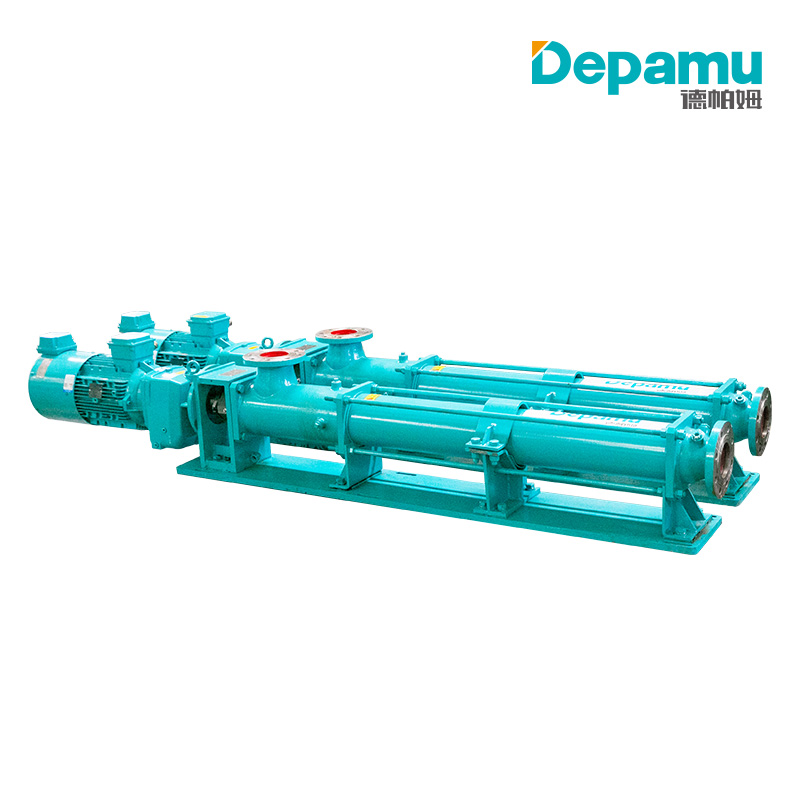
The horizontal configuration of these pumps is of particular significance for marine installations. Machinery spaces and bilge wells are notoriously confined, with limited headroom and restricted access. A horizontally oriented pump allows for flexible integration into engine room layouts, whether mounted on a baseplate or directly coupled to the drive motor. Depamu offers these pumps in multiple mounting arrangements, including horizontal and vertical orientations, precisely to accommodate the spatial constraints of different vessel designs. This adaptability ensures that the pump can be positioned for optimal suction performance without requiring extensive structural modification to the vessel.
Performance Envelope: Handling the Unhandleable
The defining characteristic of the Depamu screw pump is its exceptionally broad performance envelope, which directly addresses the heterogeneous nature of bilge water and vessel cleaning fluids. The pump can manage media with viscosities ranging from 1 mPa·s to 1,000,000 mPa·s, accommodating everything from relatively thin, water-like bilge accumulations to thick, viscous sludge that resists conventional pumping methods. This viscosity range is critical because bilge water composition fluctuates dramatically depending on the vessel’s operation, the age of the fluids, and the temperature conditions. A pump that performs well with light oily water may falter when confronted with heavy fuel oil residues; the Depamu design eliminates this vulnerability by maintaining consistent performance across the entire spectrum.
Equally important is the pump’s ability to handle solid particles up to 30 mm in size. Bilge water is rarely free of debris; rust flakes, gasket fragments, sand, and fibrous materials are common contaminants that can clog or damage less robust pumping equipment. The progressive cavity design is inherently tolerant of such inclusions, with the sealed cavities accommodating particles without impingement or blockage. This capability extends to abrasive media, cohesive substances, and fluids containing entrained gas or fiber—all conditions routinely encountered in marine waste streams. The pump’s self-priming capability, achieving suction lifts of up to 8 meters of water column, is another essential feature. Bilge wells are located at the very bottom of the hull, often at a significant vertical distance from the pump installation. The ability to draw fluid from these depths without auxiliary priming equipment ensures reliable operation even when bilge levels are low, preventing loss of prime and maintaining the integrity of the separation and treatment process.
Temperature resilience further extends the pump’s utility. With an operating range of −12°C to +150°C, the Depamu screw pump can handle cold bilge water in unheated spaces as well as hot sludge transferred directly from settling tanks and separators. This thermal versatility is indispensable in marine environments where fluids may originate from machinery operating at elevated temperatures or from bunker tanks exposed to low ambient conditions.
Bilge Cleaning: The Primary Application
The primary mission of the marine bilge pump is to remove the accumulated water-oil-solid mixture from the lowest compartments of the vessel and transfer it to the oily water separator for treatment. Regulatory frameworks such as MARPOL Annex I impose strict limits on the oil content of water discharged overboard—typically requiring treatment to below 15 parts per million—making the reliable delivery of bilge water to the separation train a compliance imperative, not merely an operational convenience. The Depamu screw pump is specifically engineered for this duty. Its positive displacement action ensures that the pump can handle fluids with varying oil-to-water ratios without performance degradation, a critical attribute given that bilge composition can change from a thin sheen to a heavy emulsion within a single pumping cycle.
The low-shear nature of the progressive cavity mechanism offers an additional, often overlooked advantage. Centrifugal pumps impart high shear forces that can emulsify oil droplets, making subsequent separation more difficult and potentially increasing the load on the oily water separator. The Depamu screw pump’s gentle, non-shearing transfer protects the molecular chain structure and specific fluid properties of the medium, preserving the integrity of the oil-water mixture so that gravity-based separation can proceed efficiently. This characteristic is particularly valuable when handling emulsions and sludge that must maintain their physical characteristics for effective downstream processing.
The horizontal configuration further enhances operational practicality. In a typical engine room, the bilge pump must be accessible for inspection and maintenance while occupying minimal floor space. The horizontal orientation allows for straightforward coupling to the drive motor, simplified piping connections, and ease of service access—advantages that translate directly into reduced downtime and lower maintenance costs. Depamu’s modular construction philosophy extends this benefit by permitting targeted replacement of worn components—such as the stator or rotor—rather than requiring a complete pump overhaul. In vessels on extended voyages where access to shoreside repair facilities is limited, this modularity is a decisive operational advantage.
Beyond Bilge: Integrated Vessel Cleaning and Waste Management
While bilge cleaning is the principal application, the Depamu horizontal screw pump’s capabilities extend into the broader ecosystem of vessel cleaning and waste handling. The same technology that transfers bilge water to the separator is equally suited to moving the concentrated oil sludge produced by that separator to the marine incinerator for disposal. Incinerator feed systems demand a steady, controlled delivery of sludge to maintain combustion stability; pulsation or flow variation can cause flame instability, incomplete combustion, and potentially dangerous flashback conditions. The screw pump’s continuous, nearly pulsation-free discharge—a direct consequence of its positive displacement design—ensures that the delivered volume remains consistent regardless of variations in sludge viscosity or solid content. The pump’s ability to handle fluid temperatures up to 150°C allows it to accept hot sludge directly from settling tanks and separators, eliminating the need for intermediate cooling or transfer stages.
The versatility of the horizontal screw pump also lends itself to tank cleaning and general vessel housekeeping operations. Cargo tanks, fuel oil tanks, and lubricating oil sumps require periodic cleaning to remove accumulated residues, and the pump’s ability to handle high-viscosity media, solids, and fibrous contaminants makes it a natural choice for these duties. In dual-function installations, the same pump can serve both bilge cleaning and sludge transfer duties with appropriate valving and system design, reducing the number of pumps required on board and saving valuable space in already congested machinery spaces. The pump’s ability to rotate and transport fluids in both directions further enhances system design flexibility, enabling back-flushing of suction lines and clearing of blockages without disassembly.
Operational Reliability and System Integration
In the maritime industry, equipment reliability is not an abstract quality but a matter of survival. A bilge pump that fails during an emergency flooding event can transform a manageable situation into a catastrophic one. The Depamu screw pump’s robust construction—grounded in German engineering principles and backed by CE, ISO 9001, ISO 14001, and ISO 45001 certifications—reflects a design philosophy oriented toward operational continuity. The positive displacement mechanism is inherently less vulnerable to cavitation than centrifugal alternatives, and its ability to handle gas-laden fluids without losing prime provides a safety margin that is absent in many conventional pump designs.
Modern vessel automation trends further amplify the value of the Depamu screw pump. The pumps can be configured with variable frequency drives and remote monitoring capabilities, enabling real-time performance data collection and remote adjustments from the engine control room or bridge. This integration supports the industry’s gradual transition toward minimally manned and automated machinery spaces, where equipment must operate reliably with limited human intervention. The ability to monitor flow rates, detect anomalies, and adjust pump speed remotely enhances both operational efficiency and safety, particularly during unmanned night watches or in compartments that are difficult to access.
Conclusion
The Depamu horizontal marine bilge screw pump represents a convergence of thoughtful engineering and practical maritime necessity. By applying progressive cavity technology in a configuration adapted to the spatial realities of vessel machinery spaces, Depamu has created a pumping solution that addresses the fundamental challenges of bilge cleaning: variable viscosity, solid contamination, limited suction access, and the imperative for uninterrupted operation. Its capacity to handle fluids ranging from thin oily water to thick sludge, its self-priming capability up to 8 meters of water column, and its gentle, non-shearing transfer mechanism make it uniquely suited to the complex mixtures found in ship bilges.
Beyond the bilge, the same pump technology supports incinerator sludge delivery, tank cleaning, and integrated waste management systems, offering vessel operators a single, proven platform for multiple fluid-handling duties. In an industry where environmental regulations continue to tighten and operational margins continue to narrow, the Depamu horizontal screw pump provides a reliable, adaptable, and maintainable solution—one that contributes not only to the vessel’s operational efficiency but also to its compliance with the increasingly stringent standards governing the discharge and disposal of maritime waste. For naval architects, marine engineers, and vessel operators alike, it stands as a compelling example of how focused engineering can transform one of the ship’s most unpleasant chores into a controlled, dependable, and environmentally responsible process.