

Depamu 3-Screw Type Diesel Loading and Supply Pumps: Engineering Precision for Fuel Oil, Lubricating Oil, and Hydraulic Oil
Abstract
In the complex industrial ecosystems of oil refineries, marine engine rooms, and hydraulic power units, the reliable transfer of lubricating fluids is not merely a matter of logistics—it is the lifeline of operational continuity. Among the various pumping technologies available, the three-Screw Pump stands out for its unique ability to combine high pressure with quiet, pulse-free flow. Depamu (Hangzhou) Pumps Technology Co., Ltd., a high-tech enterprise with over two decades of engineering pedigree, has refined this technology to meet the rigorous demands of modern fluid handling . This article provides a comprehensive technical analysis of Depamu’s 3-screw pumps, specifically focusing on their application as diesel loading and supply pumps for fuel oil, lubricating oil, and hydraulic oil. We will explore their mechanical architecture, operational physics, performance specifications, and the intrinsic advantages that make them superior to alternative positive displacement pumps in the petrochemical and marine sectors.
1. The Fundamental Architecture of the Depamu 3-Screw Pump
The Depamu 3-screw pump series, particularly the DPSN and DP3G models, represents a sophisticated integration of German engineering principles adapted for global industrial standards . Unlike centrifugal pumps that rely on high-speed impellers or gear pumps that use meshing teeth, the three-screw pump operates on a different hydrodynamic principle.
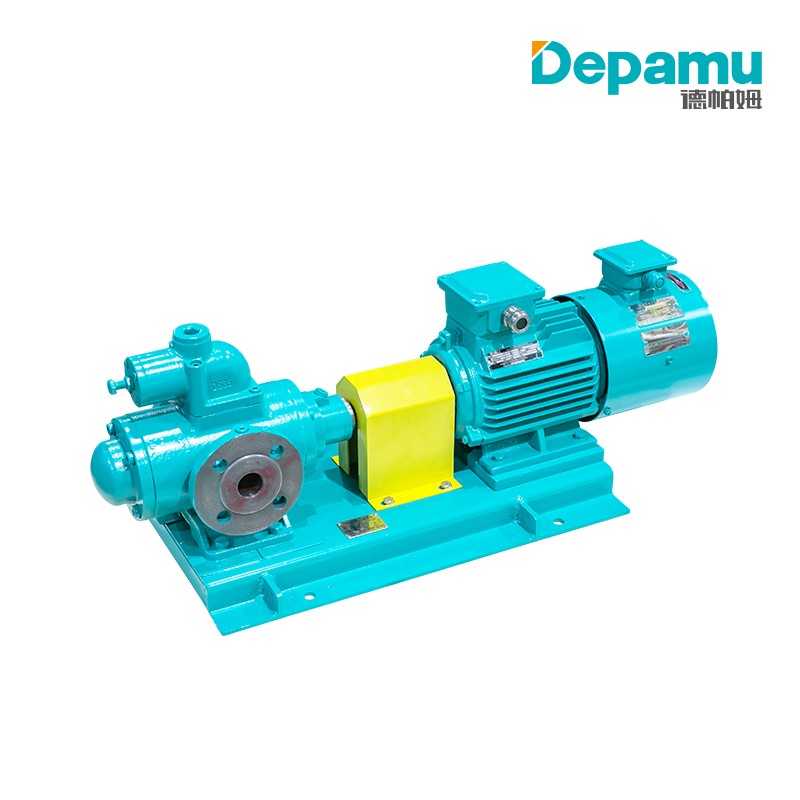
1.1. Component Layout
The pump’s core consists of three rotors: one central power rotor (drive screw) and two idler rotors (sealing screws). These three screws intermesh within a precision-machined liner or housing. As the drive screw rotates (driven directly by an electric motor), the two flanking idler screws rotate in the opposite direction. Critically, there is no metal-to-metal contact between the driving and driven screws.
1.2. The "Fluid Seal" Concept
The magic of the Depamu 3-screw pump lies in the fluid film. The clearances between the screws and the housing are meticulously calculated. The pumped liquid itself—whether heavy fuel oil (HFO), diesel, or hydraulic fluid—fills these gaps, creating a dynamic hydraulic seal. This means the pump is self-lubricating, provided the viscosity is within the operational range. As noted in Depamu’s technical literature, the main and slave screws do not make mechanical contact; rather, they are driven by the pressurized liquid, which forces the slave screws to rotate around their axes . This results in almost negligible mechanical friction, drastically extending the pump’s lifespan.
2. Operational Physics: Why Screw Pumps Excel in Oil Transfer
To understand why the Depamu 3-screw pump is specified for critical applications like diesel loading or hydraulic supply, one must analyze the physical behavior of the fluid as it passes through the pump.
2.1. Axial Laminar Flow
The geometry of the screws creates a series of distinct, sealed cavities. As the screws rotate, these cavities move axially from the suction port to the discharge port. Crucially, the fluid does not rotate or churn inside the pump; it moves in a straight line. This axial laminar flow eliminates turbulence, foam, and emulsification . For hydraulic oil systems, where air entrainment leads to spongy control responses and component cavitation, this is a decisive advantage over gear pumps.
2.2. Pulse-Free Pressure Generation
Positive displacement pumps generally fall into two categories: pulsating (like piston pumps) and continuous (like screw pumps). Depamu’s 3-screw pump produces a continuous, uniform flow rate. As the screw threads progressively mesh, they displace fluid smoothly without the trapping and releasing action that causes pressure spikes. This quasi-pulse-free flow reduces stress on downstream piping, valves, and instrumentation, making these pumps ideal for precise burner supply in boilers or servo-valve feed in hydraulic systems.
2.3. High Suction Performance (NPSH)
Depamu designs their 3-screw pumps with a high suction lift capability, often reaching up to 8 meters . For diesel loading applications—where pumps often sit on a wharf or tank farm and must pull fuel from underground storage tanks—this self-priming characteristic is vital. The design eliminates the need for expensive vacuum priming systems or bottom foot valves, simplifying the piping arrangement and reducing installation costs.
3. Detailed Application Analysis: Fuels, Lubricants, and Hydraulics
The Depamu 3-screw pump is not a "one-size-fits-all" device; rather, it is a versatile platform optimized for specific Newtonian and non-Newtonian fluids within the viscosity range of 3 to 760 cSt and temperatures up to 300°C .
3.1. Fuel Oil and Diesel Loading (The Supply Role)
In power plants and marine bunkering stations, the transfer of Heavy Fuel Oil (HFO) and Marine Diesel Oil (MDO) presents challenges such as high viscosity (requiring heating) and the risk of solid particulate contamination.
Depamu 3-screw pumps handle this by exhibiting a high tolerance for entrained gases and solid particles. In diesel loading scenarios, the pump’s ability to handle air-vapor mixtures prevents "vapor lock"—a condition common in centrifugal pumps where vapor pockets stop fluid flow entirely. Furthermore, the robust construction allows for the installation of safety valves. For medium to large flow applications, Depamu integrates a safety valve directly into the pump body. If the discharge line is blocked or the pressure exceeds the pre-set limit (max 25 bar differential pressure), the valve re-circulates fluid back to the inlet side, protecting the motor and pipes from overpressure damage .
3.2. Lubricating Oil Transfer
Lube oil systems demand absolute cleanliness and minimal shear. High-shear pumps can break down the long-chain polymers in multi-grade lubricating oils, reducing their viscosity index and protective capabilities. Because the Depamu 3-screw pump moves fluid via laminar flow rather than high-shear agitation, it transfers lube oil without degrading the fluid’s properties. This makes it a preferred choice for circulating oil in turbine generators, large compressors, and gearboxes.
3.3. Hydraulic Oil Service (The Power Role)
Hydraulic systems require instantaneous response and high volumetric efficiency. Depamu’s 3-screw pumps offer volumetric efficiencies that significantly outperform gear pumps. The constant clearance between the screws ensures that even at high rotational speeds (up to 2900 r/min), slip loss (the backflow of fluid from the discharge to the suction side) is minimized. This results in consistent actuator speeds and predictable pressure rise, which is critical for machine tools, plastic injection molding machines, and marine steering gear .
4. The Depamu Advantage: Comparing 3-Screw to Alternative Technologies
To justify the selection of a Depamu 3-screw pump, engineers must evaluate it against the incumbent technologies: gear pumps (external/internal) and vane pumps.
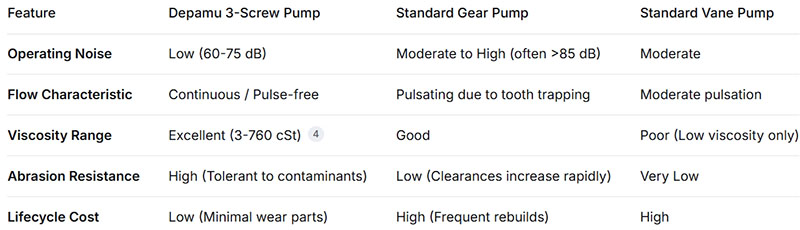
As the table indicates, while gear pumps are cheaper upfront, they suffer from mechanical contact between teeth, leading to wear and performance degradation over time. Depamu’s 3-screw pump, conversely, offers a "semi-permanent" life regarding the screw assembly due to the non-contact, oil-film-protected operation .
5. Technical Specifications and Model Variants (DPSN vs. DP3G)
Depamu primarily offers two distinct series to cater to varying industrial loads: the DPSN series and the DP3G series. While they share core pumping principles, their hydraulic layouts differ.
5.1. DPSN Series (General Industrial)
This series is characterized by a robust design suitable for land-based industrial applications. It supports a maximum flow rate of 575 m³/h (9,583 L/min) and a maximum differential pressure of 25 bar. The DPSN series is designed for high rotational speeds, allowing for direct coupling to standard 2-pole or 4-pole electric motors without a gear reducer in many cases .
5.2. DP3G Series (Marine & High-Pressure)
The DP3G series offers structural simplicity for maintenance. In smaller flow models (0.2–6.5 m³/h), the pump body and liner are integrated. For medium to large flows, the liner is a separate part fixed inside the pump body. This series is particularly prevalent in marine applications, offered in both horizontal and vertical mounting configurations to suit the tight spatial constraints of engine rooms. The DP3G series often utilizes AC/DC marine-specific electric motors .
5.3. Material and Seal Strategy
Depamu’s engineering allows for customization of shaft seals based on the medium:
-
Mechanical Seals: Standard for diesel and light hydraulic oils, providing a leak-proof dynamic seal.
-
Gland Packing: Used for high-temperature fuel oils (up to 300°C) where mechanical seals might fail due to coking or thermal expansion .
6. Operational Best Practices and Maintenance
While Depamu 3-screw pumps are renowned for their durability, adherence to operational best practices ensures maximum Mean Time Between Repairs (MTBR).
6.1. Viscosity Sensitivity
The pump is designed for lubricious fluids. Starting a 3-screw pump with highly viscous oil at low temperatures can lead to cavitation or torsional overload. Operators should ensure that the oil viscosity does not exceed the pump’s maximum rating (760 cSt) during startup. For cold environments, trace heating on the pump casing or suction line is recommended.
6.2. Running Dry
Although the pump can handle entrained air, running completely dry for extended periods is detrimental. The fluid film is essential for cooling and lubricating the screw set. Depamu has addressed this in control systems by recommending flow switches or low-level cut-offs to shut down the pump in the event of suction starvation.
6.3. Direction of Rotation
Depamu 3-screw pumps are reversible? (Note: Generally, they are optimized for a single direction). However, specific models allow for reversed flow, which is valuable in hydraulic circuits requiring regeneration. Standard units should be wired according to the directional arrow cast on the housing to ensure that the fluid flow pushes the idler screws correctly.
7. The Manufacturing and Quality Backing
Depamu is not merely an assembler of parts; the company holds over 100 technical patents and has participated in drafting Chinese pump industry standards. Their facility in Hangzhou Qiantang Area is certified under API (American Petroleum Institute), CE (Europe), ISO 9001, ISO 14001, and ISO 45001 . This certification matrix is crucial for international buyers, particularly those in the oil and gas sector (CNPC, SINOPEC, CNOOC) where API conformance is mandatory.
The company’s ability to export to the USA, UK, and France indicates compliance with stringent environmental and efficiency regulations, such as the EU Eco-design directives (ErP) for motor efficiency .
8. Conclusion
The Depamu 3-screw type diesel loading and supply pump represents a mature, highly engineered solution for the transfer of fuel oil, lubricating oil, and hydraulic oil. By harnessing the physics of axial laminar flow and non-contacting screw rotation, Depamu has eliminated the traditional trade-off between high pressure and long service life.
For the plant engineer, the value proposition is clear:
-
Reliability: No metal-to-metal contact means minimal wear.
-
Performance: Pulse-free flow protects sensitive downstream equipment.
-
Efficiency: High volumetric efficiency reduces energy consumption compared to worn gear pumps.
-
Versatility: The ability to handle viscosities from 3 to 760 cSt and temperatures up to 300°C makes it a universal tool for the engine room or refinery .
As global demand for energy efficiency and industrial automation rises, the role of quiet, efficient, and durable pumps becomes paramount. Whether refueling a Panamax vessel, lubricating a steam turbine, or actuating a hydraulic press, Depamu’s 3-screw pumps deliver the steady hand required for modern fluid power and transfer.