

Depamu High-Pressure Plunger Reciprocating Pumps: Precision, Power, and Reliability for Demanding Industrial Applications
Introduction
In the modern industrial landscape, the movement of fluids under extreme pressure is not a peripheral concern but a core operational requirement. From the injection of water and polymers into aging oil reservoirs to the precise dosing of corrosive chemicals in refinery processes, high-pressure pumping equipment sits at the heart of production, safety, and efficiency. Among the technologies that dominate these demanding duties, the reciprocating plunger pump stands out for its ability to generate very high pressures at controlled flow rates with remarkable mechanical efficiency. Depamu (Hangzhou) Pumps Technology Co., Ltd., a Chinese high-technology enterprise founded in 2003, has emerged as a significant force in this field, offering a comprehensive portfolio of high-pressure plunger reciprocating pumps engineered to meet the severe service conditions of oil and gas, petrochemical, chemical, and heavy industrial operations. This article examines the technical foundations, design characteristics, and industrial applications of Depamu's high-pressure plunger reciprocating pumps, explaining why they have become a trusted solution in critical processes around the world.
A Foundation of Engineering Credentials
Depamu's credibility in the high-pressure pump market is built on two decades of sustained investment in research and development. The company, headquartered in the Qiantang Area of Hangzhou, China, has accumulated more than 100 technical patents, including 38 invention patents, and has participated as a drafter of pump industry standards. Its manufacturing and quality systems hold API, CE, ISO 9001, ISO 14001, and ISO 45001 certifications, reflecting conformity with international requirements for quality management, environmental performance, and occupational health and safety. The company's products have been deployed in more than 60 countries and regions, including the United States, the United Kingdom, and France, and it maintains long-term strategic partnerships with major Chinese energy and engineering enterprises such as CNPC, SINOPEC, CNOOC, and CNNC. This combination of patented technology, international certification, and large-scale project experience provides the institutional and technical foundation upon which Depamu's plunger reciprocating pumps are designed and manufactured.
The Working Principle and Technical Identity of the Plunger Reciprocating Pump
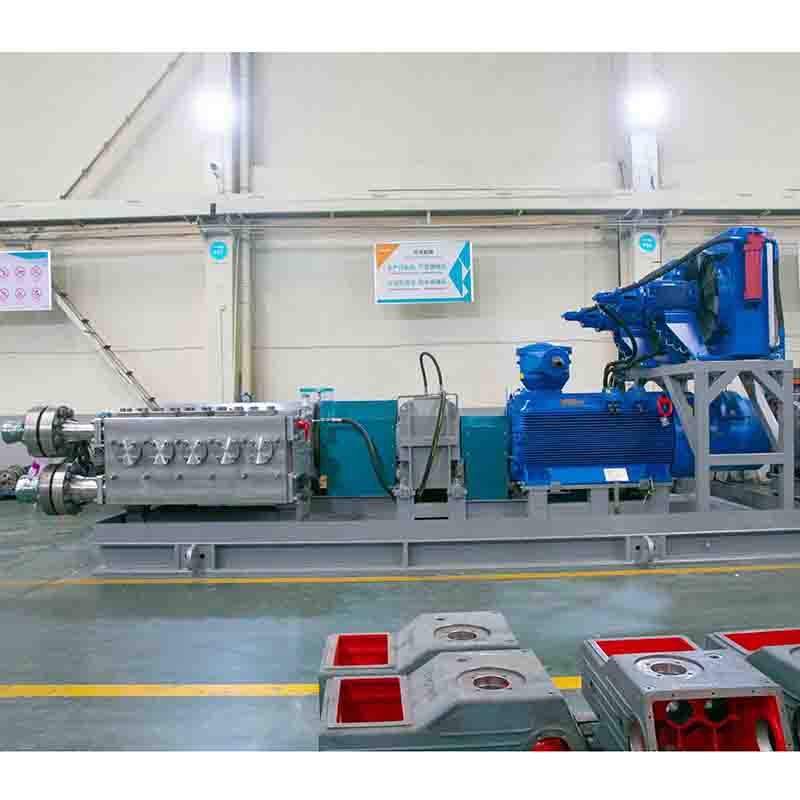
A high-pressure plunger reciprocating pump is a positive-displacement machine. In Depamu's design, the plunger is in direct contact with the fluid being handled, and the volume of the working chamber is changed cyclically by the reciprocating motion of the plunger, thereby drawing fluid in through the suction valve and discharging it through the outlet valve. Because the displacement of fluid is governed by the physical stroke of the plunger rather than by centrifugal action, the pump delivers a nearly constant flow rate that is largely independent of discharge pressure fluctuations in the outlet line. This characteristic is particularly valuable in processes where the back-pressure of the system may vary—such as injection into a reservoir or dosing into a reactor operating at elevated pressure—because the delivered volume remains stable even as the pressure environment changes.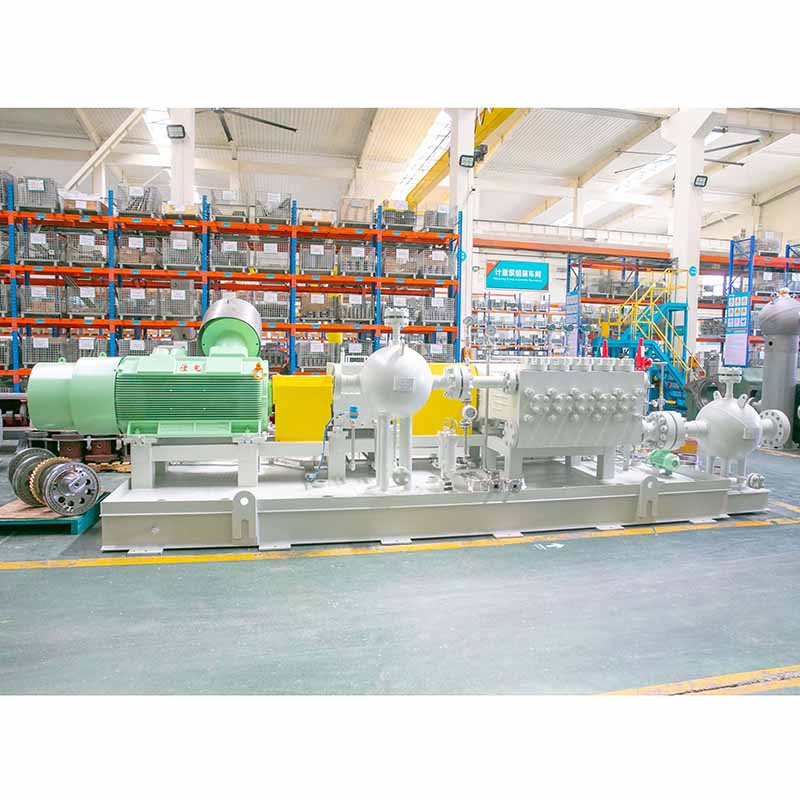
Depamu's high-pressure process reciprocating pumps, including its plunger-type models, are designed in accordance with the American Petroleum Institute standard API 674, which specifies requirements for positive displacement pumps used in petroleum, petrochemical, and natural gas industries. The HD series, encompassing models such as the HD3E(M), HD3M(M), HD3N(M), and HD5J(M), covers a broad operating envelope: flow ranges from 0.76 to 94.61 m³/h and pressure ranges from 2.5 to 160.3 MPa. Other configurations within the plunger metering line extend the pressure capability further, with single pump head flow rates up to 12,100 L/h and discharge pressures reaching 228 MPa in certain specialized models. This range allows operators to select a pump precisely matched to the pressure and capacity requirements of a given process, rather than compromising on either dimension.
Design Features That Support Severe-Service Performance
The engineering details of Depamu's plunger pumps are oriented toward durability, precision, and operational continuity. The plunger itself is typically manufactured with a hard-material spray coating that provides high surface hardness and an excellent finish. This reduces running resistance and wear, extending the service life of the plunger and the packing assembly. High-performance plunger materials are paired with special packing and sealing components designed to maintain superior sealing performance over long operating periods, a critical requirement when handling fluids that are toxic, corrosive, or volatile.
The transmission end of the pump is equally considered. Depamu employs an integral sleeve adjustable eccentric transmission mechanism that allows the stroke to be adjusted steplessly from 0 to 100%, with a metering accuracy of ±0.5%. Oil-immersed lubrication ensures long-term reliable operation of the transmission mechanism, while the integrated worm-gear auxiliary transmission contributes to low noise and high efficiency. Flow adjustment can be achieved manually, electrically, pneumatically, or through frequency conversion, and an electric stroke adjustment mechanism enables remote automatic control. For processes requiring reduced pulsation or the proportioning of multiple media, the pumps can be configured with double or multiple heads in parallel—up to twelve heads—so that several plungers can deliver the same fluid with smoothed flow or different fluids in a coordinated ratio. The wetted parts are available in a wide range of materials, including 304 and 316 stainless steels, 316L, 904, Hastelloy C, and polymer materials, allowing the pump head to be matched to the corrosivity and temperature of the process fluid. Installation options include horizontal, vertical, fixed, and mobile configurations, and the pumps can be driven by electric motor, diesel engine, or solar energy, with internal double-helical gear, external reducer, pulley, or variable-frequency speed regulation.
Industrial Applications: Where High-Pressure Plunger Pumps Prove Their Value
Oil and Gas Field Operations
The oil and gas sector is perhaps the most demanding environment for High-Pressure Reciprocating Pumps. Depamu's plunger pumps are used extensively for water injection, polymer injection, and alcohol injection in oil and gas fields, as well as for oil hydrogenation refining, liquid carbon dioxide transfer, and liquid ammonia handling. In secondary and tertiary oil recovery, Water Injection Pumps must deliver large volumes of water at pressures sufficient to penetrate reservoir formations and maintain production. Depamu's HD5P(M) model, for example, operates across a flow range of 4.65 to 96.89 m³/h and a pressure range of 5.3 to 104 MPa, making it suitable for both standard waterflooding and enhanced oil recovery applications. For polymer injection, where the viscosity of the injected fluid is significantly higher than that of water, the positive-displacement character of the plunger pump ensures that the delivered volume remains predictable despite changes in system resistance. A notable offshore reference is Depamu's delivery of a super-large-flow high-pressure water injection pump system for CNOOC's floating production, storage, and offloading project in the South China Sea, equipped with an 800 kW motor drive and achieving a maximum working pressure of 30 MPa with a single-unit daily water injection volume of 2,000 m³. The system incorporates a PLC-based control architecture for real-time closed-loop regulation of pressure, flow, and temperature, and has passed API 674 and DNV-GL certifications. Depamu has also supplied offshore chemical agent injection skid equipment and high-pressure reciprocating pumps for CNOOC operations in the South China Sea and Bohai Sea, with skid-mounted designs that reduce footprint and corrosion-resistant materials suited to the marine environment.
Petrochemical and Chemical Processing
In petrochemical operations, the pump must often function as a barrier as much as a mover of fluid. The consequences of leakage when handling flammable, toxic, or corrosive media are severe, and the requirement for zero leakage is frequently non-negotiable. Depamu addresses this through both plunger and diaphragm-based reciprocating technologies, with the plunger pump offering direct fluid contact and robust construction for high-pressure duties. The DP(M)XAA and DP(M)DA plunger Metering Pumps are widely used in petrochemical, natural gas, and oil and gas field applications, particularly where high viscosity, high pressure, and high temperature media are involved. In refinery and chemical plant operations, these pumps serve in chemical dosing and injection systems for corrosion inhibitors, scale inhibitors, demulsifiers, and other process chemicals, where precise and repeatable delivery is essential for process control and product quality. The ±0.5% metering accuracy of the adjustable eccentric transmission, combined with high-precision inlet and outlet check valves, ensures that the quantity of chemical introduced into the process is both known and controllable.
A landmark project in this sector is Depamu's development of two super-large high-pressure Diaphragm Pumps for Sinopec's Zhenhai Refining & Chemical Company isononanol project. Each pump weighs nearly 26 tons, and the development effort took more than 400 days, with the central technical challenge being the simultaneous achievement of ultra-high pressure and large flow—a combination that traditional pump designs often struggle to deliver. While this particular application used diaphragm pump technology, it illustrates the depth of Depamu's engineering capability in the high-pressure reciprocating domain and the broader context within which its plunger pumps are specified for equally demanding duties.
Fertilizer Production and Chemical Synthesis
The fertilizer industry relies on high-pressure pumps for the precise introduction of reactive and corrosive intermediates into synthesis processes. Depamu's Plunger Metering Pumps are employed in the production of ammonium nitrate and other nitrate fertilizers, where they dose nitric acid into neutralization reactors. The capability for high flow rates—up to 12,100 L/h per head in certain models—makes these pumps suitable for the large-scale continuous processes characteristic of modern fertilizer plants. The availability of corrosion-resistant pump head materials, including Hastelloy C and 904 stainless steel, is essential in nitric acid service, where ordinary stainless steels may suffer accelerated attack. Beyond fertilizers, the pumps are used for butanediol charging, ammonium carbamate transfer, and acetic acid cuprammonia service, demonstrating their adaptability across a range of aggressive chemical duties.
Heavy Industry, Metallurgy, and Mining
In metallurgy and steel production, high-pressure water is used for descaling and rust removal on billets, blooms, slabs, and finished products. Depamu's plunger pumps deliver the high-pressure water required for these surface-treatment processes, with the stable flow characteristic of positive-displacement operation ensuring consistent descaling performance even as the demands of the process vary. In mining, the pumps serve for salt mine water injection and coal seam water injection, applications in which continuous operation and resistance to abrasive or chemically aggressive water are essential. The compact modular structure of the HD series, with its small size and light weight, is advantageous in space-constrained industrial installations, while the low noise and high transmission efficiency of the drive end contribute to a better working environment.
Water Treatment and High-Pressure Membrane Processes
High-pressure plunger pumps are also employed in water treatment applications where membrane processes require feed pressures beyond the range of conventional centrifugal equipment. In reverse osmosis desalination and high-pressure membrane filtration, plunger pumps can inject antiscalants and other conditioning chemicals into the high-pressure feed stream, a duty for which reciprocating positive-displacement pumps are particularly well suited because they can generate the necessary pressure without the efficiency penalties associated with centrifugal pumps operating far from their best-efficiency point. Depamu's broader product portfolio includes water-treatment equipment and chemical dosing packages, and the plunger reciprocating pump serves as a key component within these systems.
Operational Advantages and Lifecycle Value
The operational case for Depamu's high-pressure plunger reciprocating pumps rests on several interrelated characteristics. First, the positive-displacement principle delivers high mechanical efficiency, often exceeding 90% in well-designed reciprocating pumps, which translates into lower power consumption for a given hydraulic duty compared with centrifugal alternatives in high-head, low-to-moderate-flow applications. Second, the flow rate is stable and largely unaffected by pressure fluctuations in the discharge line, giving process operators a predictable and controllable variable even when downstream conditions change. Third, the use of hard-coated plungers, high-performance packings, and precision check valves supports long service life, while the modular construction and replaceable components simplify maintenance and reduce lifecycle cost. Fourth, the availability of multiple flow-adjustment modes—manual, electric, pneumatic, and variable-frequency—allows the pump to be integrated into modern process control architectures, including remote and automated operation. Finally, Depamu supports its installed base with a 7-day × 24-hour service hotline and a response mechanism that commits to providing solutions within 24 hours of a customer request, with field service available when necessary.
Conclusion
The high-pressure plunger reciprocating pump occupies a distinctive position in industrial fluid handling: it is the technology of choice when pressures are high, flow rates are moderate to large, and the process cannot tolerate the instability or inefficiency of a centrifugal machine operating outside its comfortable range. Depamu's plunger reciprocating pumps, designed to API 674 and supported by more than a hundred patents and a broad international certification portfolio, bring together hard-coated plunger technology, precise adjustable-stroke transmission, flexible materials of construction, and multiple configuration options to meet the specific requirements of oil and gas production, petrochemical processing, fertilizer synthesis, metallurgical descaling, mining, and water treatment. As industry continues to push into higher pressures, more corrosive media, and more tightly controlled processes, the combination of positive-displacement precision and mechanical robustness that defines the Depamu plunger reciprocating pump is likely to remain a foundational element of reliable industrial fluid transfer.