

Abstract
The transfer of bitumen and asphalt ranks among the most demanding duties in petroleum, petrochemical, and heavy process industries. With viscosities that routinely exceed 100,000 centipoise (cP) and a strong tendency to solidify when temperatures drop, these materials defeat the operating logic of conventional centrifugal pumps. The Depamu positive displacement twin Screw Pump has emerged as an engineered response to this challenge, combining a true volumetric pumping principle with design features—synchronized timing gears, externally mounted bearings, and casing heating jackets—that directly address the failure modes of alternative technologies. This article examines the technical foundations of the Depamu Twin Screw Pump, its specific design adaptations for bitumen and asphalt service, and the operational and economic advantages that make it a reference solution for high-viscosity hydrocarbon transfer.
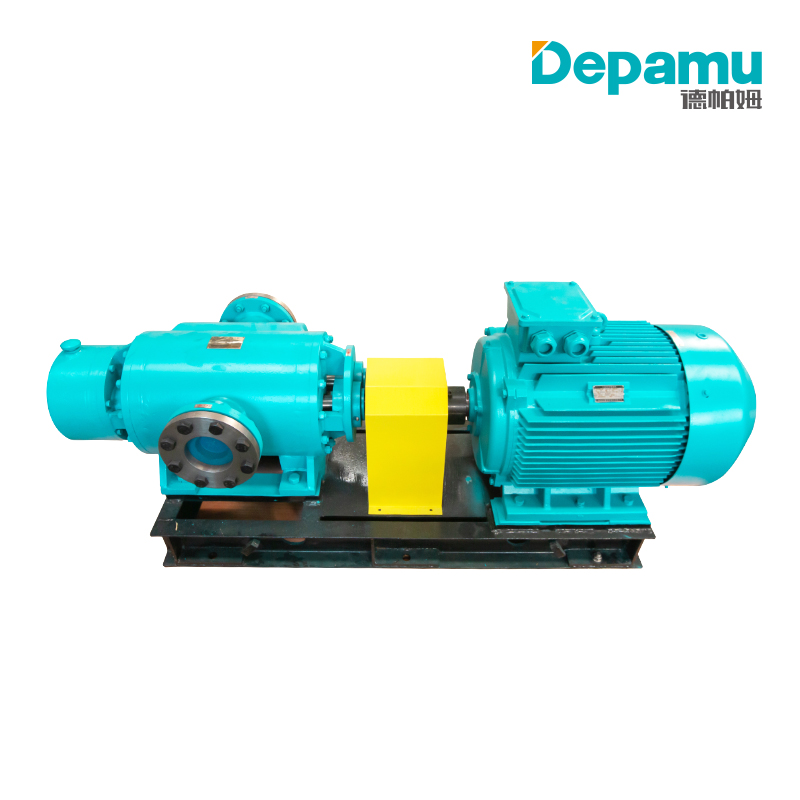
1. Introduction: The Physical Challenge of Bitumen and Asphalt
Bitumen and asphalt are not simply “thick” liquids. At ambient temperatures, they behave as viscoelastic semi-solids; even when heated to a pumpable state, their viscosities can exceed 100,000 cP, often accompanied by abrasive solids and dissolved or entrained gases. The consequences for pumping equipment are severe. Centrifugal pumps, which depend on a high-speed impeller to impart kinetic energy, lose volumetric efficiency dramatically as viscosity rises and are prone to cavitation when the net positive suction head available (NPSHa) is limited. Gear pumps, historically common in asphalt terminals, require the product to be heated well above 270°F to avoid cavitation and can suffer catastrophic damage if a solidified asphalt slug enters the discharge line.
In this operational envelope, the positive displacement twin screw pump occupies a distinct technical position. Its flow is fundamentally volumetric rather than kinetic, and its internal geometry is adapted to gentle, low-shear axial transport. Depamu (Hangzhou) Pumps Technology Co., Ltd., founded in 2003 and holding more than 100 technical patents, has developed a twin screw pump platform that translates this principle into a practical, API 676–compliant solution for heavy oil and high-viscosity service.
2. The Volumetric Principle: Why Positive Displacement Matters for Bitumen
The defining characteristic of the Depamu twin screw pump is that it is a true positive displacement machine. Inside the pump casing, two precision-machined, counter-rotating screw rotors—one right-handed and one left-handed—are housed within a close-clearance liner. As the rotors turn, the helical grooves and the casing wall form a series of interconnected, sealed cavities. These cavities fill at the suction port and then move axially along the rotor length toward the discharge port, delivering a virtually constant volume of fluid for each revolution of the shafts, regardless of the back pressure exerted by the system within its designed operating range.
This behavior has direct consequences for bitumen service. A centrifugal pump’s flow rate is intrinsically sensitive to system pressure and viscosity; even modest fluctuations in back pressure can cause significant deviations from the required flow rate. In terminal unloading, pipeline transfer, or process feed duties, this sensitivity translates into instability. The twin screw pump, by contrast, maintains its delivered volume independent of viscosity-driven pressure changes, providing the predictable, controllable transfer that high-viscosity operations require.
Equally important is the quality of the transport. The fluid moves axially at low velocity, without the turbulence, agitation, or pulsation characteristic of many other pump types. Bitumen and modified asphalts can be shear-sensitive; the gentle conveying action of the twin screw design preserves the molecular and colloidal structure of the product, ensuring that its performance specifications remain intact through the transfer process.
3. Design Features That Make the Difference in Asphalt Service
The twin screw principle provides the foundation, but Depamu’s engineering adaptations are what allow the pump to operate reliably in the punishing conditions of bitumen and asphalt handling.
3.1 Synchronized timing gears and non-contact rotors. The two screw rotors are driven by external timing gears that maintain precise synchronization without metal-to-metal contact between the rotors themselves. This eliminates a primary source of wear and seizure risk, particularly important when handling fluids with poor lubricity or when the pump experiences transient dry-running conditions. In practical terms, the non-contact design means that a momentary loss of suction—a common occurrence during tank stripping or railcar unloading—does not automatically result in rotor galling or pump seizure. Depamu twin screw pumps are designed to tolerate short-term dry running safely, a capability that reduces unplanned downtime and maintenance costs.
3.2 Externally mounted, independently lubricated bearings. The bearings supporting the rotor shafts are mounted outside the process fluid and lubricated independently. Bitumen is not a lubricating medium in the conventional sense, and at elevated temperatures its low lubricity can accelerate bearing wear in internally bearing-supported designs. The external arrangement isolates the bearings from the hot, viscous product, extending service life and allowing the pump to handle non-lubricating media without compromise. It also simplifies maintenance: critical bearing and gear components can be inspected and serviced without dismantling the entire pump wet-end.
3.3 Casing heating jackets. For bitumen and asphalt service, the heating jacket is not an accessory—it is often a prerequisite for reliable operation. A thermal transfer fluid circulates around the pump casing, maintaining the metal at an elevated temperature and preventing the process fluid from solidifying, gelling, or depositing on internal surfaces. This is particularly critical during start-up, shutdown, and low-flow periods, when a cold casing can chill the product below its pour point and create a solid plug within the pump. Depamu offers heating jackets integrated into the pump casing, with configurations suitable for high-temperature bitumen circulation. By keeping the wetted surfaces hot, the jacket ensures that the pump remains ready for service even in cold climates or marine environments where ambient temperatures would otherwise render the product unpumpable.
3.4 Exceptional self-priming and low NPSH requirement. Because the pumped fluid itself acts as a sealing liquid within the working components, the Depamu twin screw pump can draw liquid from suction depths of up to 8 meters of water column without auxiliary priming systems or foot valves. Its net positive suction head requirement (NPSHr) is only 1.5 meters. This is a decisive advantage in asphalt service, where NPSHa is frequently marginal. Railcar and barge unloading, tank stripping, and suction-lift installations from storage pits all present conditions in which a centrifugal pump would cavitate and lose performance. The twin screw pump operates reliably in these low-NPSH regimes, extracting product from vessels and sumps that would otherwise require external priming or elevated tank levels.
3.5 Multiphase and solids tolerance. Bitumen and heavy residual streams are rarely clean, single-phase fluids. They may contain sand, formation fines, and entrained or dissolved gases that evolve during pumping. Depamu twin screw pumps can tolerate gas content of up to 98% and solid content of up to 60%, enabling them to handle heavy oils containing particulate matter that would rapidly destroy a close-clearance centrifugal impeller. This multiphase capability prevents vapor locking in suction lines and allows the pump to continue delivering product even when the incoming stream is not fully liquid.
4. Performance Envelope and Standards Compliance
The Depamu twin screw pump line is engineered to comply with API 676, the internationally recognized standard for positive displacement rotary pumps in petroleum, petrochemical, and natural gas industries. This compliance provides operators with assurance regarding dimensions, materials, performance testing, and documentation practices.
The performance envelope covers the full spectrum of heavy and viscous duties. Flow rates range from 0.1 to 3,000 m³/h, accommodating duties from small-scale additive injection to high-volume pipeline and tanker transfer. Discharge pressures can reach approximately 48 bar or higher depending on configuration, providing sufficient head for long-distance transfer, loading operations, and process feed requirements. The pumps handle fluid viscosities up to 100,000 cP as a standard capability, with certain configurations extending this limit further. Fluid temperature capabilities typically span from −12°C to +150°C, accommodating both ambient-temperature light oils and heated heavy residues. The combination of high viscosity tolerance, elevated temperature operation, and solids handling capability makes the platform directly applicable to the most challenging bitumen and asphalt streams.
5. Operational and Economic Advantages in Bitumen Service
The technical features of the Depamu twin screw pump translate into tangible operational benefits for terminal operators, refiners, and asphalt producers.
Reduced heating requirements and faster unloading. Because the twin screw pump can operate at low speeds with a very low NPSHr, it can begin pumping asphalt at lower temperatures than a gear pump can manage. Industry experience with non-timed Twin-Screw Pumps has shown that asphalt transfer can commence at approximately 220°F, compared with the 270°F-plus heating required for gear pump operation. This reduces the energy, time, and cost associated with heating railcars, barges, and storage tanks before transfer can begin. In one reported case, a twin-screw asphalt pump reduced railcar unloading time by more than 70%.
Handling solidified slugs without damage. Asphalt solidification in discharge piping is an operational reality in terminals. Gear pumps subjected to a solid slug can suffer broken gear teeth or shaft damage. A twin screw pump with an integral relief valve and handwheel can be used to push solidified asphalt out of the discharge line by internally bypassing fluid, providing a safer and more efficient method than torch-heating the pipe. The non-contact rotor design further reduces the risk of catastrophic damage if the pump encounters an unexpected solid burden.
Low shear, product-quality preservation. Modified bitumen and polymer-modified asphalts are engineered products whose performance depends on their molecular architecture. The gentle, pulsation-free axial transport of the twin screw pump avoids the high shear that can degrade polymer chains or alter the colloidal structure of the asphalt. This preserves the product’s specification and ensures that the pumped material performs as intended in its final application.
Simplified maintenance and reduced downtime. The external bearing and timing gear arrangement, combined with the small number of rotating elements, simplifies maintenance interventions. Bearing and gear components can be inspected without dismantling the hydraulic end, and the absence of metal-to-metal contact between rotors reduces wear-related failures. In high-viscosity service, where every hour of unplanned downtime carries significant cost, this maintainability translates directly into improved availability and lower lifecycle cost.
6. Application Contexts: Where the Depamu Twin Screw Pump Fits
The operational profile of the Depamu twin screw pump aligns with several critical nodes in the bitumen and asphalt supply chain.
In refinery and terminal service, these pumps serve as prime movers for heavy fuel oils, residual fuels, and bitumen, handling loading, unloading, and transfer duties between storage tanks, day tanks, and process units. The heating jacket and low-NPSH capability are particularly valuable in railcar and barge unloading, where suction conditions are constrained and product temperatures may be below the optimum for centrifugal or gear pump operation.
In asphalt production and blending, the pump’s low-shear transport preserves the integrity of polymer-modified and crumb-rubber-modified binders, ensuring that the modification remains effective after transfer. The ability to handle elevated temperatures and viscous, solids-laden streams makes the twin screw platform suitable for tank farm circulation, blending, and feed to mixing plants.
In marine and heavy fuel oil handling, the combination of high viscosity tolerance, gas handling capability, and reliable self-priming supports bunker transfer, settling tank circulation, and day tank supply—duties in which product temperatures and viscosities vary widely and where vapor locking or cavitation would disrupt operations.
7. Conclusion
The Depamu double screw pump represents a deliberate engineering response to the specific failure modes that bitumen and asphalt impose on pumping equipment. Its volumetric operating principle delivers stable, predictable flow independent of viscosity-driven pressure fluctuations. Its synchronized, non-contacting rotors, externally lubricated bearings, and integrated heating jackets address the wear, solidification, and maintenance challenges that define high-viscosity hydrocarbon service. Its low NPSH requirement and self-priming capability extend operational range into suction conditions that defeat centrifugal and gear pumps. And its compliance with API 676 provides a framework of quality and interchangeability that global operators require.
For industries in which bitumen and asphalt are not merely pumped but handled with care to preserve quality, reduce energy consumption, and maintain continuous availability, the Depamu twin screw pump offers a technically coherent and field-proven solution. As heavy hydrocarbon streams continue to demand equipment that can operate reliably at the edges of conventional pump performance, the positive displacement twin screw platform is positioned not as a niche alternative but as a foundational technology for high-viscosity transfer.